

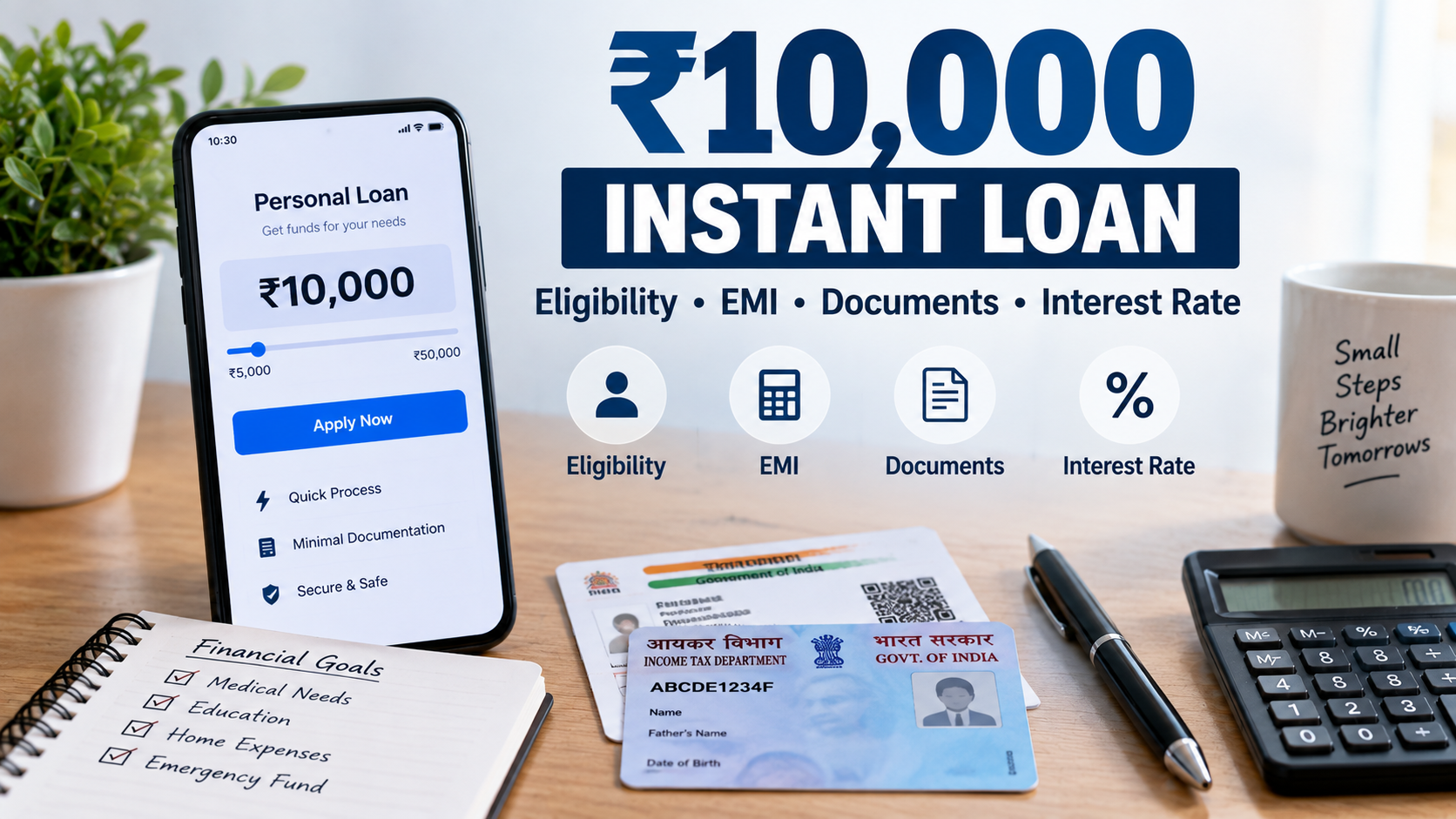
Need a small amount urgently for a medical bill, utility payment, education expense or another short-term need? A ₹10,000 instant loan can be one option, provided you understand the interest, fees and repayment terms before borrowing.
Small-ticket loans are often offered digitally by banks and NBFCs, sometimes through lending service providers or digital lending apps. However, “instant” does not mean guaranteed approval. The lender still assesses the borrower's creditworthiness, income and other factors. RBI's digital-lending framework requires regulated lenders to assess the borrower's economic profile and disclose the loan's Annual Percentage Rate (APR) and Key Fact Statement (KFS).
This guide explains ₹10,000 instant loan eligibility, EMI calculations, documents, interest rates, charges and important safety checks before applying.
What Is a ₹10,000 Instant Loan?
A ₹10,000 instant loan is generally a small-ticket unsecured personal loan. Since it is unsecured, you normally do not pledge property, gold or another asset as collateral.
Depending on the lender, the application may be completed digitally through a website or app.
Common characteristics include:
- Loan amount: ₹10,000
- Usually unsecured
- Online application
- KYC verification
- Creditworthiness assessment
- Short repayment tenure
- EMI or scheduled repayment
- Direct bank-account disbursal after approval
The exact loan amount, tenure, interest rate and charges depend on the lender and the borrower's profile.
₹10,000 Instant Loan Eligibility
There is no single eligibility rule applicable to every lender. Banks and NBFCs can have their own underwriting policies.
However, applicants may commonly be assessed on the following factors:
1. Age
The lender may specify a minimum and maximum age for applicants.
2. Income
Regular income can help demonstrate repayment capacity. Depending on the lender, this may come from:
- Salary
- Business income
- Professional income
- Other acceptable sources
3. Employment or Income Stability
Some lenders may consider employment history or the stability of business/professional income.
4. Credit History
Your credit report and repayment history can form part of the lender's assessment.
A lower credit score does not automatically mean that every lender will reject an application, but loan terms and approval criteria can vary.
5. Bank Account
The lender generally needs a verified bank account for loan disbursal and repayment.
6. KYC Verification
The lender needs to verify your identity and other required details before approving the loan.
What Documents Are Needed for a ₹10,000 Loan?
Small digital loans may require fewer documents than larger traditional loans, but requirements vary.
Commonly requested information/documents can include:
- PAN
- Aadhaar or another accepted KYC document
- Mobile number
- Bank-account details
- Address details
- Income information
- Bank statement, where required
- Salary slip or other income proof, where required
RBI's digital-lending framework requires regulated entities to capture relevant economic information, including factors such as age, occupation and income, to assess creditworthiness.
Be Careful With Document Requests
A legitimate lender should clearly explain why information is being collected and how it will be used.
RBI's framework also requires appropriate privacy and data-handling practices for digital lending.
₹10,000 Instant Loan Interest Rate
There is no universal interest rate for a ₹10,000 instant loan.
The rate can vary based on:
- Lender
- Borrower's credit profile
- Income
- Existing debt
- Loan tenure
- Risk assessment
- Product terms
Instead of comparing only the advertised interest rate, borrowers should check the APR, because it reflects the all-inclusive annualised cost of the digital loan.
RBI requires the APR to be disclosed upfront for digital loans and included in the Key Fact Statement.
How Is ₹10,000 Loan EMI Calculated?
The standard reducing-balance EMI formula is:
EMI = [P × R × (1+R)ⁿ] / [(1+R)ⁿ – 1]
Where:
- P = Principal loan amount
- R = Monthly interest rate
- N = Number of monthly instalments
For example, if ₹10,000 is borrowed at an illustrative 24% annual rate for 12 months, the monthly EMI is approximately ₹946.
The total repayment would be approximately ₹11,347, excluding any additional fees.
What Is the Total Cost of a ₹10,000 Instant Loan?
This is where borrowers need to look beyond the EMI.
The total cost can include:
Principal + Interest + Applicable Fees/Charges
Possible charges may include:
- Processing fee
- GST on applicable fees
- Late/penal charges
- Other disclosed charges
- Certain prepayment-related charges, where applicable
For digital loans covered by RBI's framework, fees and charges payable by the borrower should be disclosed through the Key Fact Statement, and charges not mentioned in the KFS cannot subsequently be charged by the regulated entity.
What Is a Key Fact Statement (KFS)?
A Key Fact Statement is an important document that helps borrowers understand the main terms and cost of a loan before entering into the agreement.
For digital lending, the KFS includes important information such as:
- Loan amount
- APR
- Repayment schedule
- Applicable charges
- Recovery mechanism
- Grievance-redressal information
- Cooling-off/look-up period
RBI requires regulated entities to provide the KFS before execution of the loan contract.
Simple Rule
Don't accept a ₹10,000 loan simply because the app says “instant approval.” Read the KFS first.
How to Apply for a ₹10,000 Instant Loan
The exact process varies by lender, but a typical digital application may involve:
Step 1: Choose the Lender
Check whether the lender is a regulated bank/NBFC and understand the role of any lending service provider.
Step 2: Enter Basic Details
You may be asked for:
- Name
- Mobile number
- PAN
- Employment/income details
- Address
Step 3: Complete KYC
Complete the lender's required identity verification.
Step 4: Submit Required Information
Provide income or bank information if requested.
Step 5: Review the Loan Offer
Before accepting, check:
- Interest rate
- APR
- EMI
- Tenure
- Processing fee
- Total repayment
- Late-payment charges
- Other applicable charges
Step 6: Read the KFS and Agreement
Don't skip this step.
Step 7: Accept and Complete the Required E-Sign/Authentication
Once the loan is accepted and approved, disbursal takes place according to the lender's process.
RBI's digital-lending guidelines require loan disbursal to go directly to the borrower's bank account, subject to specified regulatory exceptions.
Before applying, check:
- Who is the actual lender?
- Is the lender a regulated bank/NBFC?
- Is the APR clearly disclosed?
- Is there a KFS?
- Are all charges clearly mentioned?
- Is the privacy policy available?
- Is the grievance officer/contact information provided?
- Is repayment made to the lender's designated account rather than an unrelated personal account?
Warning Signs of a Risky Loan App
Be cautious if an app or person:
❌ Promises guaranteed approval without assessment
❌ Doesn't clearly identify the actual lender
❌ Hides the interest rate or APR
❌ Doesn't provide a KFS
❌ Demands unexplained upfront payments
❌ Requests unnecessary access to personal data
❌ Uses aggressive or threatening recovery messages
❌ Provides unclear repayment instructions
RBI's digital-lending framework includes requirements around disclosures, data privacy and grievance redressal.
When Should You Consider a ₹10,000 Loan?
A small personal loan may make sense when:
- The expense is genuinely necessary.
- You have a predictable source of repayment.
- The EMI fits comfortably into your budget.
- You have compared the total cost.
- You understand the repayment date.
Avoid borrowing simply because it is easy to access.
An instant loan should not become a way to repeatedly cover regular expenses or existing EMIs.
₹10,000 Loan vs Credit Card: What Should You Check?
| Factor | ₹10,000 Personal Loan | Credit Card |
|---|---|---|
| Purpose | General borrowing | Purchases/credit |
| Repayment | Usually fixed EMI | Depends on repayment |
| Interest | Depends on lender | Depends on card/transaction |
| Processing fee | May apply | Depends on transaction |
| Credit impact | Repayment behaviour matters | Repayment/utilisation matter |
| Best comparison | APR + total repayment | Interest + applicable fees |
The right option depends on the specific cost and your repayment capacity.
How to Keep Your EMI Manageable
Before taking a ₹10,000 loan, ask yourself:
Can I repay the loan on time?
If your monthly income is uncertain, even a small EMI can become difficult.
What happens if I miss an EMI?
Late payments can create additional charges and may affect your credit profile.
Do I really need the loan?
If the expense can wait until your next salary or regular income, borrowing may not be necessary.
Have I checked the total repayment?
Never compare loans using EMI alone.
A lower EMI can simply mean a longer tenure and potentially greater total interest.
Frequently Asked Questions
1. Can I get an instant loan of ₹10,000?
Some banks, NBFCs and digital lending platforms offer small personal loans, but approval depends on their eligibility and credit assessment.
2. What documents are needed for a ₹10,000 loan?
Depending on the lender, you may need PAN, KYC documents, bank details and income-related information.
3. What is the interest rate on a ₹10,000 instant loan?
There is no fixed rate applicable to all lenders. The rate depends on the lender, borrower profile, tenure and loan product.
4. What is the EMI for a ₹10,000 loan?
It depends on the interest rate and tenure. For example, at an illustrative 24% annual rate, a 12-month ₹10,000 loan has an EMI of approximately ₹946 before additional charges.
5. Can I get a ₹10,000 loan without collateral?
Many small personal loans are unsecured, meaning collateral is not required. However, lender-specific conditions apply.
6. Does CIBIL Score matter for a ₹10,000 loan?
It can. Lenders may consider credit history and other information while assessing creditworthiness.
7. Can I apply for a ₹10,000 loan online?
Some lenders offer completely digital application processes.
8. Is an instant loan really disbursed instantly?
Not necessarily. “Instant” generally refers to a fast digital application or decision process. Actual approval and disbursal depend on verification and lender processes.
9. What is APR in a personal loan?
APR is the effective annualised cost of a digital loan and is intended to provide a broader picture of borrowing costs than the nominal interest rate alone.
10. What is a Key Fact Statement?
A KFS is a standardised document containing important loan information, including the APR and other key terms and charges.
11. Can an instant loan affect my credit score?
Yes. Credit activity and repayment behaviour can affect your credit history, depending on how the loan is reported and managed.
12. What should I do if I cannot repay my EMI?
Contact the lender as early as possible and understand the available options. Avoid taking another expensive loan simply to repay an existing one without assessing the overall debt burden.
13. Are loan apps regulated by RBI?
Not every app is itself a bank or NBFC. A digital lending app may operate as a platform/LSP for a regulated lender. Therefore, borrowers should identify the actual regulated lender behind the loan.
14. Can a lender charge fees that are not shown in the KFS?
For digital loans covered by RBI's framework, charges that are not disclosed in the KFS cannot subsequently be charged by the regulated entity.
Published on : 22nd September
Published by : SMITA
www.vizzve.com || www.vizzveservices.com
Follow us on social media: Facebook || Linkedin || Instagram
🛡 Powered by Vizzve Financial
RBI-Registered Loan Partner | 10 Lakh+ Customers | ₹600 Cr+ Disbursed