

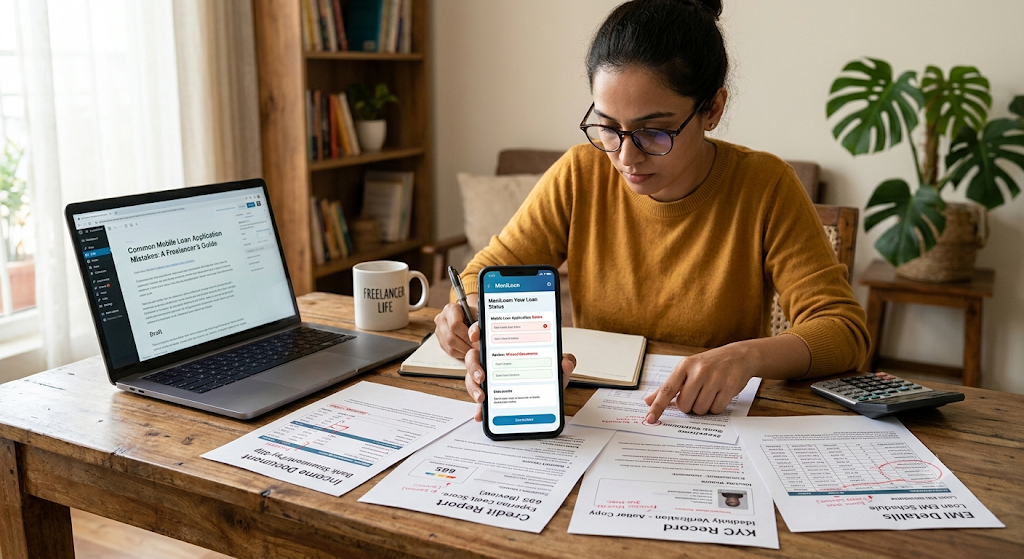
Mobile-first borrowing has made it easier for freelancers to explore personal loans, submit applications and complete verification using a smartphone. However, convenience does not guarantee loan approval. Small mistakes in income details, document submission, KYC or loan selection can create problems during the application process.
Freelancers often have different income patterns from salaried employees. They may receive payments from multiple clients, work on short-term projects or experience fluctuations in monthly earnings. Lenders may therefore assess freelance income, credit history, ITR, bank statements, existing EMIs and repayment capacity before approving a loan.
Understanding common mistakes can help freelancers prepare better, protect their financial information and make more informed borrowing decisions.
10 Common Mistakes Freelancers Should Avoid When Applying for Mobile Loans
1. Reporting Incorrect or Inconsistent Freelance Income
One common mistake is entering an income figure that does not match the applicant's actual financial records.
Freelancers may earn different amounts every month. Some months may include several client payments, while others may have fewer assignments.
For example, a freelancer might receive:
| Month | Illustrative income |
|---|---|
| January | ₹32,000 |
| February | ₹40,000 |
| March | ₹28,000 |
| April | ₹45,000 |
The average monthly income across these four months is ₹36,250.
This example illustrates why freelancers should review their income pattern instead of presenting their highest-earning month as regular income.
How to avoid this mistake:
-
Maintain accurate income records.
-
Keep client invoices and payment receipts.
-
Review bank statements.
-
Provide information that matches supporting documents.
-
Avoid exaggerating monthly earnings.
2. Applying Without Checking Your Credit Report
Credit history can influence how a lender evaluates an application.
Some freelancers apply for loans without checking their credit reports first. This may mean they overlook incorrect account information, overdue entries or other issues that need attention.
Lenders may consider:
-
Previous loan repayment history
-
Credit-card payment behaviour
-
Outstanding balances
-
Existing credit accounts
-
Recent credit enquiries
-
Reported overdue payments
How to avoid this mistake:
Review your credit report before applying. If you identify an error, raise a dispute with the relevant credit bureau. A good credit history can support an application, but it does not guarantee approval.
3. Not Keeping ITR and Income Documents Ready
Freelancers may not receive traditional salary slips. Lenders may therefore request alternative documents to understand their earnings.
Submitting an application without checking the document requirements can lead to additional verification or delays.
Documents that may be requested include:
-
Income Tax Returns (ITR)
-
Bank statements
-
Client invoices
-
Work contracts
-
Payment receipts
-
Freelance platform earnings statements
-
GST records, where applicable
How to avoid this mistake:
Organize your financial documents before applying. Confirm which records the lender accepts rather than assuming that every lender follows the same documentation process.
4. Ignoring Existing EMIs and Financial Obligations
Another common mistake is focusing only on the new loan amount without calculating existing debt.
Lenders may consider current financial commitments when assessing repayment capacity.
For example:
| Financial detail | Illustrative amount |
|---|---|
| Dependable monthly income | ₹45,000 |
| Existing monthly EMIs | ₹10,000 |
| Remaining before other expenses | ₹35,000 |
The remaining ₹35,000 is not entirely available for a new EMI. Freelancers must also consider household expenses, business costs and possible income fluctuations.
How to avoid this mistake:
-
Calculate all existing EMIs.
-
Include credit-card repayment obligations.
-
Review regular household and business expenses.
-
Estimate how much repayment you can manage comfortably.
-
Avoid borrowing more than necessary.
5. Choosing a Loan Amount That Is Too High
Some applicants select the maximum loan amount offered instead of calculating how much they actually need.
A larger loan can result in a higher EMI and greater total repayment obligations.
Freelancers should be particularly careful because their income may change from month to month.
How to avoid this mistake:
-
Calculate your actual financial requirement.
-
Estimate the EMI before applying.
-
Consider lower-income months.
-
Compare different loan tenures.
-
Choose an amount that fits your repayment capacity.
Remember, a longer tenure may reduce the monthly EMI but can increase the total interest paid.
6. Entering Incorrect KYC or Personal Details
Incorrect information can create verification problems.
For example, a name mismatch between PAN and other identity documents, an incorrect date of birth or outdated address information may require additional checks.
How to avoid this mistake:
-
Check your name and date of birth.
-
Enter accurate address details.
-
Use valid identity documents.
-
Verify bank-account information.
-
Review all application details before submission.
Complete KYC only through the genuine lender's website or authorized application.
7. Using Unverified Loan Apps
The convenience of mobile borrowing can also expose applicants to fraudulent apps or misleading loan offers.
A suspicious app may request unnecessary permissions, make unclear fee claims or pressure applicants to share confidential information.
How to avoid this mistake:
Before applying:
-
Identify the actual lender.
-
Verify the lender's regulated status.
-
Confirm that the app or service provider is authorized to act on the lender's behalf.
-
Review privacy terms and requested permissions.
-
Check the interest rate and applicable charges.
-
Use official customer-support channels.
Never share OTPs, UPI PINs, ATM PINs, card PINs or internet-banking passwords with an agent or suspicious application.
8. Applying to Multiple Lenders Without Comparing Requirements
Submitting applications to several lenders at the same time may create unnecessary credit enquiries and make it harder to track application status.
It can also lead to confusion when comparing loan offers.
How to avoid this mistake:
-
Compare eligibility conditions first.
-
Review interest rates and APR.
-
Check processing fees and other charges.
-
Understand the repayment terms.
-
Apply selectively to suitable lenders.
A careful comparison is generally more useful than sending applications everywhere.
9. Ignoring APR, Processing Fees and Other Charges
A low advertised interest rate does not always mean a loan has a low overall cost.
Freelancers should review all applicable charges before accepting a loan.
| Loan cost | What to check |
|---|---|
| Interest rate | Applicable rate and calculation method |
| APR | Overall annualized borrowing cost |
| Processing fee | Amount and applicable taxes |
| EMI | Monthly repayment obligation |
| Late-payment charges | Charges for delayed payments |
| Prepayment terms | Conditions for early repayment |
| Total repayment | Overall amount payable |
How to avoid this mistake:
Read the Key Facts Statement (KFS) and loan agreement carefully. For applicable digital loans, the KFS provides important information about the loan's costs and terms.
10. Treating Preliminary Approval as Final Approval
Some digital platforms may display an eligibility estimate or preliminary offer before completing all verification.
Applicants sometimes assume that this means the loan is fully approved.
However, final sanction may depend on document verification, credit assessment and the lender's policies.
How to avoid this mistake:
-
Wait for formal confirmation from the lender.
-
Review the final sanctioned amount.
-
Check the applicable loan terms.
-
Verify the disbursal details.
-
Do not pay an unknown person to secure approval.
Common Mistakes vs Better Practices
| Common mistake | Better practice |
|---|---|
| Reporting the highest monthly income | Use accurate, supportable income figures |
| Ignoring credit history | Review your credit report |
| Missing ITR or bank records | Organize income documents |
| Overlooking existing EMIs | Calculate total debt obligations |
| Choosing the maximum loan | Borrow according to actual need |
| Entering incorrect KYC details | Verify information before submission |
| Using unknown loan apps | Verify the actual lender |
| Applying everywhere | Compare lenders and apply selectively |
| Ignoring APR and fees | Review the complete borrowing cost |
| Assuming instant approval is final | Wait for final sanction and verification |
How Freelancers Can Prepare for Mobile-First Borrowing
A few practical steps can make the application process more organized.
Maintain Separate Financial Records
Where practical, keep freelance income and business expenses organized. This can help you understand your cash flow and prepare supporting documents.
Review Your Income Pattern
Look at your earnings over several months. Avoid relying on a single high-income month when estimating your regular repayment capacity.
Keep Documents Updated
Maintain accessible copies of ITR, bank statements, invoices and other documents that may be required by the lender.
Estimate Your EMI in Advance
Consider your existing EMIs, household expenses and business costs before choosing a loan amount.
Read the Loan Documents
Review the KFS, APR, fees, repayment schedule and loan agreement before accepting a digital loan.
Freelancer Mobile Loan Safety Checklist
Before submitting your application, check:
-
I have verified the actual lender.
-
I am using an official or authorized application.
-
I have reviewed the app's privacy terms and permissions.
-
I have provided accurate income information.
-
My supporting documents are genuine and readable.
-
My KYC details are correct.
-
I have reviewed my credit report.
-
I have calculated existing EMIs.
-
I can afford the proposed repayment.
-
I have checked APR, fees and total repayment.
-
I have read the KFS and loan agreement.
-
I have not shared confidential PINs or passwords.
Key Takeaways
-
Incorrect income details can create problems during freelancer loan verification.
-
ITR, bank statements and invoices may help demonstrate freelance earnings.
-
Credit history and existing EMIs can influence loan eligibility.
-
Applying for more than you can afford can increase repayment pressure.
-
Verify the actual lender before using a mobile loan application.
-
Compare APR, processing fees, EMI and total repayment.
-
A preliminary eligibility result does not guarantee final loan approval.
-
Read the KFS and loan agreement before accepting a loan.
FAQs
1. What are the most common mistakes freelancers make when applying for loans?
Common mistakes include reporting inconsistent income, ignoring credit history, submitting incomplete documents, overlooking existing EMIs and choosing an unaffordable loan amount.
2. Can incorrect income details affect freelancer loan eligibility?
Yes. Inconsistent or unsupported income information may lead to additional verification or affect the lender's assessment.
3. Do freelancers need salary slips for mobile loans?
Not necessarily. Depending on the lender, freelancers may provide ITR, bank statements, invoices, contracts or other accepted income records.
4. Does irregular freelance income affect loan approval?
It may affect the lender's assessment of repayment capacity. Lenders may review income patterns and supporting documents to understand earnings.
5. Can existing EMIs reduce freelancer loan eligibility?
Yes. Existing loan repayments and other financial obligations may affect how much additional borrowing a lender considers affordable.
6. Should freelancers check their credit report before applying?
Yes. Reviewing a credit report can help applicants identify incorrect information, overdue entries and other issues before submitting an application.
7. Is it safe to apply through any instant loan app?
No. Applicants should identify the actual lender, verify the app's authorized lending arrangement and review its privacy terms before sharing information.
8. Can applying to multiple loan apps affect a credit profile?
Multiple applications may result in multiple credit enquiries, depending on how lenders process them. Compare options first and apply selectively.
9. What is the KFS in a digital loan?
KFS stands for Key Facts Statement. It provides important information about applicable loan costs and terms before the loan contract is executed.
10. Does instant eligibility mean final loan approval?
No. A preliminary eligibility indication is not the same as final sanction. The lender may still need to complete verification and its full assessment.
11. How can freelancers avoid taking an unaffordable loan?
Calculate existing EMIs, household expenses and business costs. Estimate the new EMI and consider whether repayments remain manageable during lower-income months.
12. What should freelancers do if their loan application is rejected?
Review the reason provided, check your credit report, correct document errors and reassess repayment capacity. Avoid immediately applying to multiple lenders without understanding the issue.
Published on : 5th November 2026
Published by : Shibam nath
www.vizzve.com || www.vizzveservices.com
Follow us on social media: Facebook || Linkedin || Instagram
🛡 Powered by Vizzve Financial
RBI-Registered Loan Partner | 10 Lakh+ Customers | ₹600 Cr+ Disbursed