

Introduction
Starting to invest is one of the most important steps toward building long-term financial security.
But investing is not simply about finding an asset that has delivered high returns in the past.
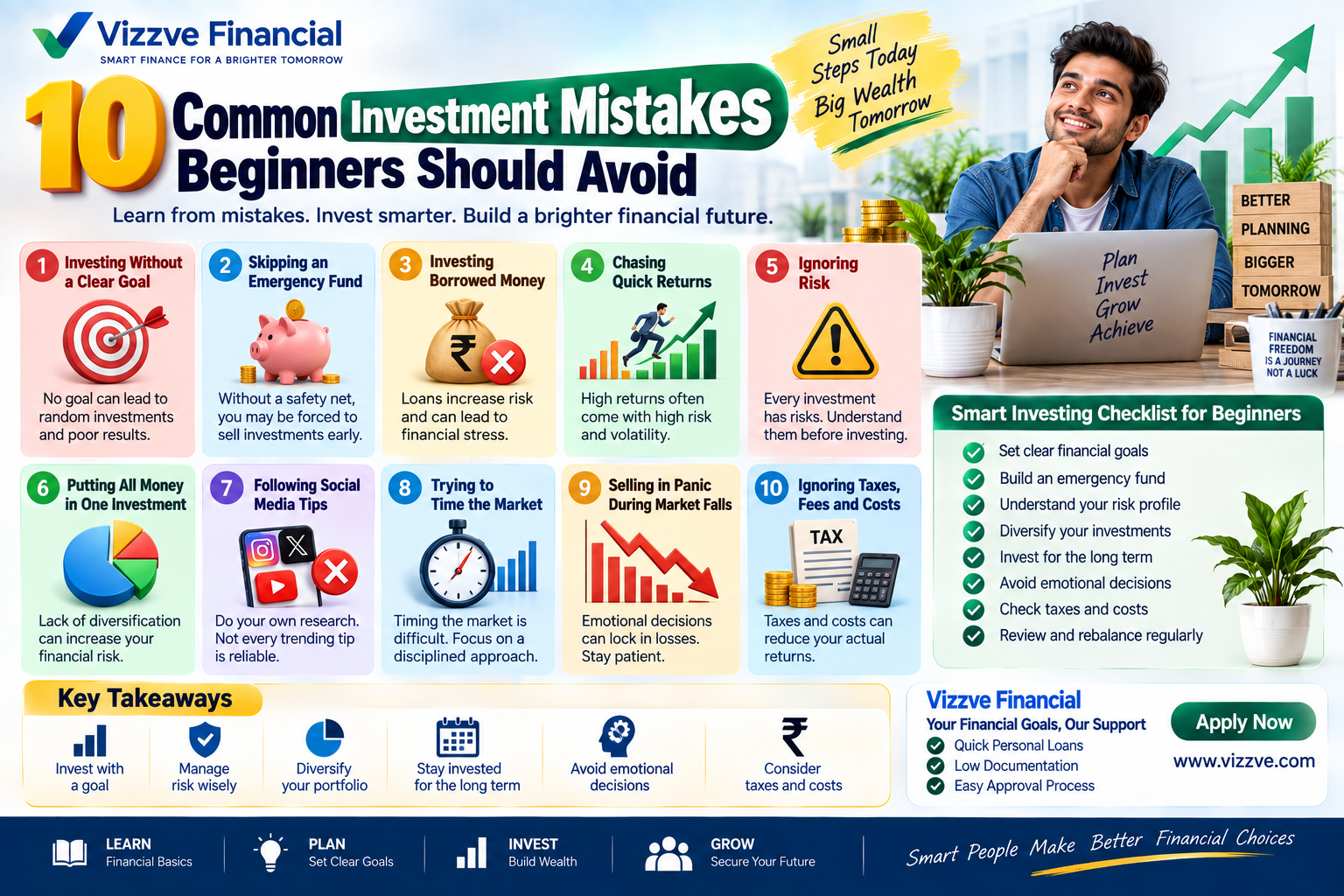
Many beginners make avoidable mistakes such as investing without an emergency fund, following social-media tips, chasing quick returns, ignoring risk, putting too much money into one investment or selling during a temporary market fall.
The good news is that most of these mistakes can be avoided with a simple process.
You do not need to become a market expert before making your first investment. You need to understand your goals, time horizon, risk capacity, asset allocation and investment costs.
This guide explains 10 common investment mistakes beginners should avoid and provides practical steps to build a more disciplined approach.
AI Answer Box: What Are the Biggest Investment Mistakes Beginners Make?
Quick Answer
The most common mistakes include:
- Investing without clear financial goals
- Skipping an emergency fund
- Investing borrowed money
- Chasing quick returns
- Ignoring risk
- Putting too much money into one asset
- Following tips without research
- Trying to time the market
- Selling emotionally during market falls
- Ignoring taxes, fees and investment costs
Simple Rule for Beginners
Set goals → Build financial safety → Understand risk → Diversify → Invest consistently → Review periodically → Avoid emotional decisions.
Why Do Beginners Make Investment Mistakes?
Investing involves money, emotions and uncertainty.
A beginner may see an investment rising rapidly and assume that the same return will continue.
Another investor may experience a market correction and immediately sell because of fear.
These reactions are understandable, but they can interfere with a long-term investment strategy.
AMFI notes that mutual fund values can rise or fall with market movements and that past performance does not guarantee future performance.
That principle applies broadly to investing: historical returns are information, not promises.
1. Investing Without a Clear Financial Goal
One of the first mistakes beginners make is investing without knowing why they are investing.
“I want to make money” is not a specific financial goal.
A useful goal has:
- A purpose
- A target amount
- A deadline
- A reasonable investment strategy
Examples
| Goal | Time Horizon | Planning Approach |
|---|---|---|
| Emergency reserve | Immediate | Highly liquid savings |
| Buying a vehicle | 1–3 years | Lower-volatility options may be considered |
| Home down payment | 3–7 years | Goal-based asset allocation |
| Child's education | 10+ years | Long-term diversified strategy |
| Retirement | 15–30 years | Long-term diversified portfolio |
The investment chosen for a goal should match the time available.
Beginner Tip
Before investing, write down:
Goal → Amount Needed → Target Date → Monthly Investment → Risk Capacity
2. Investing Before Building an Emergency Fund
Investing every rupee while keeping no accessible cash reserve can create problems.
Imagine that you invest your savings in market-linked assets and then suddenly face:
- Job loss
- Medical expenses
- Family emergency
- Urgent home repairs
- Unexpected debt
You may be forced to sell investments at an inconvenient time.
What Should an Emergency Fund Do?
An emergency fund should prioritize:
- Accessibility
- Capital preservation
- Liquidity
- Stability
It is not primarily designed to maximize investment returns.
A Practical Framework
Many financial planners use several months of essential expenses as a starting point, but the appropriate amount depends on income stability, dependents, insurance coverage and other circumstances.
For example:
Monthly essential expenses: ₹30,000
Six-month reserve: ₹1,80,000
This is only an illustration, not a universal rule.
3. Investing Borrowed Money
Using loans or credit to invest can dramatically increase financial pressure.
If an investment falls while loan repayments continue, you have two separate problems:
Investment loss + repayment obligation
For beginners, using borrowed money to speculate in volatile investments can be particularly risky.
Why This Mistake Is Dangerous
Suppose someone borrows ₹2 lakh to invest.
If the investment falls 20%, the investment value becomes approximately ₹1.60 lakh.
But the loan does not automatically fall by 20%.
Interest and repayment obligations continue.
Better Approach
Build investments primarily from surplus money that is available after meeting essential expenses and financial obligations.
4. Chasing Quick Returns
One of the biggest beginner traps is the belief that investing should make money quickly.
You may see headlines about:
- Multibagger stocks
- High-return funds
- Cryptocurrency gains
- IPO listing gains
- Intraday profits
- Options trading
- “Guaranteed” opportunities
But a high potential return generally comes with higher uncertainty or risk.
The Better Question
Instead of asking:
“Which investment will give the highest return?”
Ask:
“What level of risk am I taking to pursue this return?”
That change in thinking can significantly improve investment discipline.
5. Ignoring Risk
Every investment has risks.
The type and degree of risk vary.
Examples
| Investment | Important Risks |
|---|---|
| Equity shares | Market and company-specific risk |
| Equity mutual funds | Market volatility and scheme-specific risk |
| Debt funds | Interest-rate and credit risks |
| Fixed deposits | Inflation and reinvestment risks |
| Gold | Price volatility |
| Real estate | Liquidity and concentration risk |
| Government securities | Interest-rate and market risks |
AMFI explicitly states that mutual funds are not guaranteed-return products and that investors can face loss of principal depending on the scheme and market conditions.
Risk Capacity vs Risk Appetite
These are not always the same.
Risk appetite: How much volatility you are psychologically comfortable with.
Risk capacity: How much financial loss your circumstances can actually withstand.
A person may have a high risk appetite but low risk capacity because they need the money soon.
6. Putting All Your Money Into One Investment
Concentration can make a portfolio vulnerable.
For example, imagine a beginner invests almost all savings in:
- One stock
- One sector
- One asset class
- One property
- One thematic investment
If that investment performs poorly, the overall financial impact can be substantial.
Diversification
Diversification means spreading investments across appropriate assets rather than depending entirely on one investment.
AMFI highlights diversification as one of the benefits of mutual funds because a scheme can invest across multiple securities and asset categories.
However, diversification does not eliminate investment risk.
7. Following Social Media Tips Without Research
Investment content is everywhere.
You may see:
“Buy this stock today!”
“This stock will double!”
“Guaranteed 30% return!”
“Everyone is buying this IPO!”
The problem is that social-media content rarely provides the complete context required for an investment decision.
Before Investing, Check
- What does the company do?
- How does it make money?
- Is revenue growing?
- Is it profitable?
- What is its debt?
- What is its valuation?
- What are the major risks?
- Who are its competitors?
- What is your investment horizon?
Remember
A popular investment is not automatically a suitable investment for you.
8. Trying to Time the Market
Beginners often wait for the “perfect” time to invest.
They may think:
“I will invest when the market falls.”
Then the market rises.
Later they think:
“I will wait for another correction.”
The process can continue indefinitely.
Why Timing Is Difficult
Markets respond to:
- Economic data
- Interest rates
- Corporate earnings
- Global events
- Inflation
- Investor sentiment
- Geopolitical developments
Predicting the exact top or bottom consistently is extremely difficult.
For investors using mutual funds, systematic investing can help create investment discipline rather than relying entirely on attempts to predict short-term market movements.
AMFI reported ₹32,297 crore of SIP contributions in August 2026, illustrating the continued scale of systematic investing in India.
9. Selling in Panic During Market Falls
Market declines can be uncomfortable.
A portfolio worth ₹5 lakh becoming ₹4 lakh can feel like a permanent loss.
But whether a decline is temporary or permanent depends on the underlying investment and the reason for the decline.
Before Selling, Ask:
- Has my financial goal changed?
- Has the investment fundamentally changed?
- Has my risk capacity changed?
- Is the asset allocation still appropriate?
- Am I selling because of analysis or fear?
Important Distinction
A market correction and a permanently damaged investment are not necessarily the same thing.
Investors should evaluate their specific holdings rather than reacting automatically to every market movement.
10. Ignoring Taxes, Fees and Costs
A return shown on an investment statement is not always the same as the amount you ultimately keep.
Depending on the investment, you may encounter:
- Capital gains tax
- Tax on interest
- Dividend taxation
- Brokerage
- Expense ratios
- Exit loads
- Transaction costs
- Platform charges
Why Taxes Matter
Suppose an investment generates a profit.
The relevant question is not simply:
“How much did I earn?”
It is:
“How much did I earn after taxes and costs?”
Tax rules can change, so investors should verify the applicable rules for the relevant financial year.
For example, the Income Tax Department's current AY 2026–27 materials distinguish different categories of capital gains and provide specific rules for equity-linked gains and other income.
Investment Mistakes: Quick Comparison Table
| Mistake | What Happens | Better Approach |
|---|---|---|
| No goal | Random investing | Invest for specific goals |
| No emergency fund | Forced selling | Build financial reserve |
| Borrowed money | Debt + investment risk | Use surplus funds |
| Chasing returns | Excessive risk | Evaluate risk-adjusted expectations |
| Ignoring risk | Unexpected losses | Understand risk first |
| No diversification | Concentration risk | Diversify appropriately |
| Social-media tips | Poor decisions | Research independently |
| Market timing | Missed opportunities | Follow a disciplined strategy |
| Panic selling | Locks in losses | Review fundamentals and goals |
| Ignoring taxes/costs | Lower net returns | Calculate after-tax outcomes |
Investment Mistakes Beginners Should Avoid: Pros and Cons of Different Approaches
Aggressive Approach
Potential advantages
- Greater exposure to growth assets
- Higher potential long-term returns
Potential disadvantages
- Greater volatility
- Larger short-term losses possible
- Requires stronger risk capacity
Conservative Approach
Potential advantages
- Lower volatility
- Greater emphasis on capital stability
Potential disadvantages
- Inflation can reduce purchasing power
- Long-term wealth accumulation may be slower depending on returns
Balanced Approach
Potential advantages
- Combines different asset classes
- Can align growth and stability objectives
Potential disadvantages
- Still exposed to market risk
- Requires periodic review
No approach is universally appropriate. The right mix depends on the investor's financial circumstances and goals.
How Beginners Can Start Investing More Carefully
Step 1: Calculate Your Monthly Cash Flow
Write down:
Income – Essential Expenses – Existing Obligations = Potential Investment Surplus
Do not treat your entire salary as investable money.
Step 2: Create an Emergency Reserve
Build an accessible financial cushion before taking substantial market risk.
The appropriate amount depends on your circumstances.
Step 3: Clear Expensive Debt
High-cost debt can work against wealth creation.
Before aggressively investing, review:
- Credit-card balances
- Personal loans
- Other high-cost borrowing
Step 4: Define Your Goals
Create separate targets for:
- Short-term goals
- Medium-term goals
- Long-term goals
- Retirement
Step 5: Understand Your Risk Profile
Consider:
- Age
- Income stability
- Dependents
- Existing savings
- Debt
- Investment horizon
- Ability to tolerate losses
Step 6: Choose Appropriate Investments
Different goals can require different investment strategies.
Do not select an investment simply because it recently produced a strong return.
Step 7: Diversify
Avoid putting your entire financial future behind a single investment idea.
Diversification should be meaningful rather than simply owning dozens of similar investments.
Step 8: Automate Where Appropriate
Systematic investment methods can help create discipline.
For eligible mutual-fund investments, SIPs allow investors to invest a fixed amount periodically rather than attempting to invest everything at once.
Step 9: Review Periodically
You do not need to check your portfolio every hour.
Review when:
- Your income changes
- Your financial goals change
- Your risk capacity changes
- Your asset allocation moves significantly
- Your investment thesis changes
A Simple Beginner Portfolio Framework
There is no single portfolio that works for everyone.
Instead, consider dividing your financial plan into three broad buckets:
Bucket 1: Safety Money
Purpose:
- Emergency expenses
- Near-term needs
- Financial stability
Priority:
Liquidity and stability
Bucket 2: Goal Money
Purpose:
- Home
- Education
- Vehicle
- Other planned expenses
Priority:
Matching risk with time horizon
Bucket 3: Long-Term Wealth
Purpose:
- Retirement
- Long-term wealth creation
- Financial independence
Priority:
Long-term growth and diversification
The exact asset allocation should depend on the investor's circumstances.
Real-World Example: How One Mistake Can Affect a Beginner
Consider a hypothetical investor named Rahul.
Rahul has ₹3 lakh in savings.
He puts ₹2.5 lakh into one stock because someone on social media says it could double.
The stock falls 30%.
His ₹2.5 lakh investment becomes approximately ₹1.75 lakh.
Rahul now needs money for an emergency.
Because he does not have sufficient cash reserves, he may be forced to sell at a loss.
The original problem was not simply the stock falling.
The bigger issue was poor financial planning before investing.
A better process would have considered:
- Emergency savings
- Investment horizon
- Risk capacity
- Diversification
- Goal requirements
Expert Commentary: The Most Important Beginner Lesson
The strongest investment habit is not finding a perfect investment.
It is developing a process that prevents major mistakes.
A disciplined investor understands that:
Good investing is often about avoiding unnecessary mistakes rather than constantly finding the next big opportunity.
That means resisting FOMO, avoiding unrealistic return expectations, understanding risk and keeping investment decisions connected to financial goals.
Current Investment Landscape in India
India's retail investment ecosystem has expanded significantly.
AMFI's August 2026 data shows monthly SIP contributions of ₹32,297 crore, with more than 10 crore contributing SIP accounts reported for the month.
This growth shows the increasing adoption of systematic investing, but a growing investor base does not remove investment risk.
Mutual fund schemes can vary substantially in portfolio composition and risk.
Equity-oriented schemes, for example, are generally designed for long-term growth but can be volatile over shorter periods.
Therefore, beginners should focus on understanding the investment product rather than investing simply because a particular category is popular.
Investment Checklist for Beginners
Before investing, ask:
Goal
- Why am I investing?
- When will I need the money?
Safety
- Do I have emergency savings?
- Do I have appropriate insurance?
Debt
- Do I have expensive outstanding debt?
- Can I invest without increasing financial pressure?
Risk
- How much loss can I financially tolerate?
- How much volatility can I emotionally tolerate?
Diversification
- Is too much money going into one investment?
- Are my investments exposed to the same underlying risk?
Research
- Do I understand what I am buying?
- Have I read reliable information?
Tax and Cost
- What taxes apply?
- What fees or charges apply?
- What will my approximate net return be?
Review
- When will I review the investment?
- What conditions would make me change my strategy?
Key Takeaways
- Do not invest without a financial goal.
- Build financial safety before taking significant investment risk.
- Avoid borrowing money to speculate.
- Do not chase unusually high returns without understanding the risk.
- Diversification can reduce concentration risk but cannot eliminate losses.
- Never rely entirely on social-media investment tips.
- Avoid making investment decisions based on fear or excitement.
- Trying to predict every market movement can lead to poor timing decisions.
- Understand taxes, charges and expenses.
- Review investments based on goals and changing circumstances rather than daily market noise.
- Long-term investing requires patience and discipline.
- There is no universal investment product that is suitable for every investor.
12 Frequently Asked Questions
1. What are the most common investment mistakes beginners make?
The most common mistakes include investing without goals, ignoring risk, chasing returns, lack of diversification, emotional decision-making and failing to consider taxes and costs.
2. Should beginners invest before creating an emergency fund?
Generally, financial safety should be considered before taking substantial investment risk. An emergency reserve can reduce the chance of having to sell investments during an unfavorable market period.
3. Is investing borrowed money a good idea?
Borrowing to invest can increase financial risk because investment losses occur while loan repayments and interest obligations continue.
4. How much should a beginner invest?
There is no universal amount. The appropriate amount depends on income, expenses, debt, emergency savings, financial goals and risk capacity.
5. Should beginners invest in stocks?
Stocks can be part of a long-term investment strategy, but beginners should understand market volatility and company-specific risk before investing.
6. Is SIP suitable for beginners?
A SIP is a method of investing a fixed amount periodically in a mutual fund. It can encourage investment discipline, but the underlying mutual fund still carries market risk.
7. Is diversification important for beginners?
Diversification can reduce dependence on a single investment or asset. However, diversification does not guarantee profits or eliminate losses.
8. Should beginners invest based on past returns?
Past performance can provide historical information, but it does not guarantee future performance.
9. How can beginners avoid emotional investing?
Create a written investment plan, define goals, understand risk beforehand and avoid making decisions solely because markets rise or fall sharply.
10. How often should beginners check their investments?
The appropriate frequency depends on the investment and strategy. Long-term investors generally do not need to react to every daily price movement.
11. What is the biggest mistake in wealth creation?
One major mistake is allowing short-term emotions to repeatedly override a long-term financial plan.
12. What should I check before investing?
Understand the product, risk, expected role in your portfolio, fees, taxation, liquidity, time horizon and whether it matches your financial goal.
13. Can diversification guarantee investment safety?
No. Diversification can spread risk, but market declines can affect multiple assets at the same time.
14. Are high-return investments always better?
No. Higher expected returns generally involve greater uncertainty or risk. The appropriate investment depends on the investor's objectives and ability to tolerate losses.
15. Can beginners become successful investors without being experts?
Yes, beginners can develop disciplined investing habits without becoming professional analysts. Understanding basic financial concepts, using reliable information and following a suitable plan are important starting points.
Published on : 23RD September
Published by : G REDDY KUMAR
www.vizzve.com || www.vizzveservices.com
Follow us on social media: Facebook || Linkedin || Instagram
🛡 Powered by Vizzve Financial
RBI-Registered Loan Partner | 10 Lakh+ Customers | ₹600 Cr+ Disbursed