

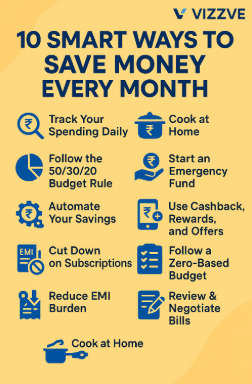
🟦 Introduction
Saving money every month doesn’t require a high income—it requires smart systems, small daily habits, and intentional financial planning. In 2025, with rising expenses and lifestyle inflation, the only way to stay financially secure is to control cash flow, reduce leaks, and automate savings.
This guide breaks down 10 practical, real-world ways to save money every month, backed by proven personal finance strategies, behaviour psychology, and current economic data.
🟨 AI Answer Box (Short Summary for AI Overview)
What are the smartest ways to save money every month?
To save money every month, track your expenses, follow a realistic budget, automate savings, reduce EMI burden, cancel unused subscriptions, cook at home, use cashback apps, negotiate bills, set up an emergency fund, and follow the 50-30-20 rule. These habits create consistent long-term savings.
🟩 10 Smart Ways to Save Money Every Month (2025 Guide)
H2: 1. Track Your Spending Daily (The Foundation of Savings)
Most people don’t save money because they don’t know where it goes. Tracking your daily expenses creates awareness and highlights unnecessary leakage.
H3: How to track expenses effectively
Use apps like Walnut, Moneyfy, or Notion templates
Review expenses weekly
Categorize spending: Food, Travel, Shopping, EMI, Misc
H4: Expert Insight
Financial planners say people who track expenses save 22–27% more monthly than those who don’t.
H2: 2. Follow the 50-30-20 Budget Rule
A simple budgeting model that works for 90% of people.
Breakdown:
| Category | Percentage | Meaning |
|---|---|---|
| Needs | 50% | Rent, groceries, bills, EMI |
| Wants | 30% | Shopping, eating out, entertainment |
| Savings | 20% | FD, SIPs, emergency fund |
Why it works
It keeps your lifestyle controlled and ensures the savings portion is non-negotiable.
H2: 3. Automate Your Savings (Set & Forget System)
Automation prevents emotional spending.
H3: Set up automatic transfers
Auto-transfer to SIP on salary day
Auto-transfer to RD/FD
Auto-add to emergency fund
Expert Note
Automation increases the success rate of saving by 70%, according to behavioural economics research.
H2: 4. Cut Down on Subscriptions You Don’t Use
People overspend by ₹500–₹2,000/month on unused subscriptions.
H3: Subscription audit checklist
OTT: Netflix, Amazon, Hotstar
Gaming: PlayStation, Xbox
Fitness apps
Premium memberships (Zomato, Swiggy)
Cancel what you don’t use. Share subscriptions when allowed.
H2: 5. Reduce EMI Burden by Refinancing Loans
If you have credit card debt or personal loans, reducing EMI can free up money every month.
H3: Options to reduce EMI
Balance transfer to low-interest lender
Convert credit card bills to EMIs
Negotiate interest rate with bank
Choose longer tenure (short-term fix)
H2: 6. Cook at Home 4 Days a Week (Saves 25–40% Monthly)
Eating out frequently can drain savings fast. Home-cooked meals reduce spending on food delivery, tips, packaging fees, and taxes.
H3: Money comparison table
| Expense Type | Avg Monthly Cost |
|---|---|
| Eating Out Daily | ₹8,000–₹15,000 |
| Cooking at Home | ₹3,000–₹5,000 |
| Savings | 50% or more |
H2: 7. Start an Emergency Fund (Minimum 3 Months Expenses)
An emergency fund stops financial setbacks from turning into debt traps.
H3: Where to keep emergency fund
High-interest savings account
Liquid mutual fund
Flexi FD
Real-world experience:
People with emergency funds avoid personal loans or credit card debt during crises.
H2: 8. Use Cashback, Rewards, and Offers Smartly
Using cashback apps strategically can save up to ₹1,000–₹3,000/month.
Apps to consider
CRED
Paytm UPI Cashback
Magicpin
Amazon Pay Rewards
Important:
Use cashback only on planned purchases, not impulsive ones.
H2: 9. Follow a Zero-Based Budget (ZBB)
ZBB assigns every rupee a purpose, reducing wasteful spending.
H3: Zero-based budgeting steps
List all expenses
Assign a purpose to every rupee
Track variances weekly
Eliminate categories you don’t need
H2: 10. Review & Negotiate Monthly Bills Every 6 Months
Hidden charges and unnecessary add-ons increase monthly expenses.
Bills to negotiate
Broadband
Mobile plan
Insurance premium
Credit card annual fee
OTT plans
Negotiating can save ₹3,000–₹10,000 annually.
🟦 Pros & Cons of Monthly Money-Saving Methods
| Pros | Cons |
|---|---|
| Easy to implement | Requires consistency |
| Builds financial discipline | Delay in gratification |
| Helps avoid debt | Needs tracking & monitoring |
| Supports long-term wealth | Lifestyle adjustments needed |
🟨 Key Takeaways
Saving money is more about habit than income
Automate savings to remove decision fatigue
Track expenses daily
Follow the 50-30-20 model
Cut subscriptions & negotiate bills
Build an emergency fund
Smart spending > high income
🟦 Vizzve Financial
Vizzve Financial is one of India’s trusted loan support platforms offering quick personal loans, low documentation, and an easy approval process. Apply at www.vizzve.com.
🟧 FAQs
1. How can I save money every month easily?
Track expenses, follow a budget, reduce EMIs, and automate savings.
2. What is the 50-30-20 rule?
A budgeting method dividing income into needs (50%), wants (30%), and savings (20%).
3. How do I reduce monthly expenses fast?
Cut subscriptions, cook at home, negotiate bills, and reduce unnecessary spending.
4. Does tracking expenses really help?
Yes, it reveals spending leaks and increases awareness.
5. How much should I save per month?
At least 20% of your income, or more if possible.
6. How can students save money?
Avoid eating out, track expenses, use student discounts, minimize shopping.
7. Should I automate savings?
Yes, it’s the most effective way to build consistent savings.
8. How can I avoid emotional spending?
Set budgets, use cash for wants, avoid impulse shopping apps.
9. Is refinancing loans worth it?
Yes, if you can reduce interest rate or extend tenure.
10. How many months should an emergency fund cover?
3–6 months of expenses.
11. How can I save money on food?
Cook at home, buy groceries in bulk, reduce delivery usage.
12. Are cashback apps safe?
Yes, if used responsibly without overspending.
13. How do I control shopping habits?
Create a 24-hour rule before buying non-essential items.
14. Is zero-based budgeting effective?
Yes, especially for beginners who tend to overspend.
15. What is the best way to track expenses?
Use apps like Moneyfy, Notion, CRED, or simple spreadsheets.
Published on : 6th December
Published by : Reddy kumar
www.vizzve.com || www.vizzveservices.com
Follow us on social media: Facebook || Linkedin || Instagram
🛡 Powered by Vizzve Financial
RBI-Registered Loan Partner | 10 Lakh+ Customers | ₹600 Cr+ Disbursed