

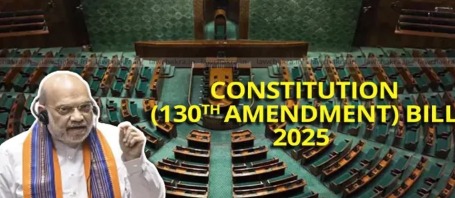
The Constitution (One Hundred and Thirtieth Amendment) Bill, 2025 has sparked widespread debate across India’s political and legal circles. Introduced in the Lok Sabha by Union Home Minister Amit Shah in August 2025, the bill proposes a significant constitutional change — removal of ministers who remain in detention for over 30 days on serious criminal charges.
While the government argues that no one should hold public office from behind bars, critics fear it could open the door for political misuse and constitutional overreach. Let’s explore the key provisions, implications, and reactions surrounding this controversial bill.
Key Provisions of the 130th Amendment Bill
The amendment seeks to modify Articles 75, 164, and 239AA of the Constitution, covering the Prime Minister, Chief Ministers, and Council of Ministers at both central and state levels — including the National Capital Territory of Delhi.
Here’s what it proposes:
If a minister is arrested or detained for 30 consecutive days on charges carrying imprisonment of 5 years or more, they cease to hold office automatically on the 31st day.
For Union Ministers, the Prime Minister must recommend their removal to the President.
For State Ministers, the Chief Minister advises the Governor.
For Delhi, the President acts on the advice of the Chief Minister.
Once the individual is released — either through bail or acquittal — they may be reappointed to their post.
The bill also extends these provisions to Union Territories and Jammu & Kashmir, ensuring uniformity across all jurisdictions.
Objective Behind the Bill
According to the government, the amendment is a step toward “ethical governance” and aims to curb the criminalisation of politics.
The argument is simple — public trust in governance suffers when ministers continue to hold office while being in judicial custody.
Home Minister Amit Shah stated that the bill is designed to “protect the sanctity of democratic institutions” and prevent misuse of office by those facing serious criminal allegations.
Criticism and Controversy
Despite its stated intent, the bill has triggered intense opposition. Critics argue that:
Presumption of Innocence is Undermined
The bill allows removal without conviction — a direct challenge to the principle that one is innocent until proven guilty.
Scope for Political Misuse
Detractors fear that governments could weaponize arrests to disqualify political opponents through fabricated cases.
Federal Imbalance
By empowering Governors and the President (on the Centre’s advice) to remove state ministers, the bill allegedly erodes state autonomy.
Constitutional Challenge Likely
Legal experts believe the bill may face scrutiny under Articles 14 (Equality before Law) and 21 (Right to Liberty) for violating fundamental rights.
Public Perception Concerns
Opponents argue that removal based on mere detention could stigmatize individuals before due legal process concludes.
Government’s Defense
In response to the backlash, the Centre insists the bill targets only serious offences (punishable by five years or more) and not minor or politically motivated cases.
The government maintains that:
The measure promotes transparency and accountability.
A minister in detention cannot perform constitutional duties.
The provision for reappointment upon release ensures fairness.
Home Minister Amit Shah emphasized that “no democracy can function with leaders governing from prison,” reiterating that the amendment strengthens constitutional morality.
Implications for Indian Democracy
If enacted, the 130th Amendment could set a new precedent for accountability among public representatives. However, it also raises deeper questions about the balance between executive power and individual rights.
Potential impacts include:
Greater pressure on political parties to field clean candidates.
Heightened legal scrutiny over arrests involving political leaders.
Possible increase in judicial interventions to ensure fairness.
A redefinition of ethical standards in governance.
The amendment’s success or misuse will depend largely on how it’s implemented — and whether checks and balances are upheld.
Political Reactions
The proposal has polarized Parliament:
The ruling party hailed it as a “bold and necessary reform.”
The Opposition called it a “tool of political control,” warning it could be used to topple elected governments.
West Bengal Chief Minister Mamata Banerjee described it as “a direct threat to democracy.”
Constitutional experts have urged the formation of a Parliamentary Review Committee to assess its legal and ethical implications before passage.
FAQ Section
Q1: What is the Constitution (130th Amendment) Bill, 2025?
A: It’s a proposed amendment to remove ministers (at Centre, State, and UT levels) who are detained for 30 or more consecutive days on serious criminal charges.
Q2: Does the bill require conviction for removal?
A: No. Removal is triggered automatically after 30 days of detention, even without conviction.
Q3: Can a removed minister return to office?
A: Yes. Once released, the individual can be reappointed to their previous position.
Q4: Why is the bill controversial?
A: Critics say it undermines the presumption of innocence and could be politically misused to target opposition leaders.
Q5: What happens next?
A: The bill has been referred to a Joint Parliamentary Committee (JPC) for review before final voting in Parliament.
Conclusion
The Constitution (130th Amendment) Bill, 2025 represents one of the most debated legislative proposals in recent years — aiming to promote clean governance while raising concerns about constitutional fairness.
Whether it becomes a milestone in political reform or a flashpoint for legal challenges, the bill undeniably signals India’s evolving struggle to balance integrity in public office with individual rights and due process.
As the debate unfolds, it will test not just the government’s intentions, but also the resilience of India’s democratic and constitutional framework.
Published on : 8th October
Published by : SMITA
www.vizzve.com || www.vizzveservices.com
Follow us on social media: Facebook || Linkedin || Instagram
🛡 Powered by Vizzve Financial
RBI-Registered Loan Partner | 10 Lakh+ Customers | ₹600 Cr+ Disbursed
https://play.google.com/store/apps/details?id=com.vizzve_micro_seva&pcampaignid=web_share