

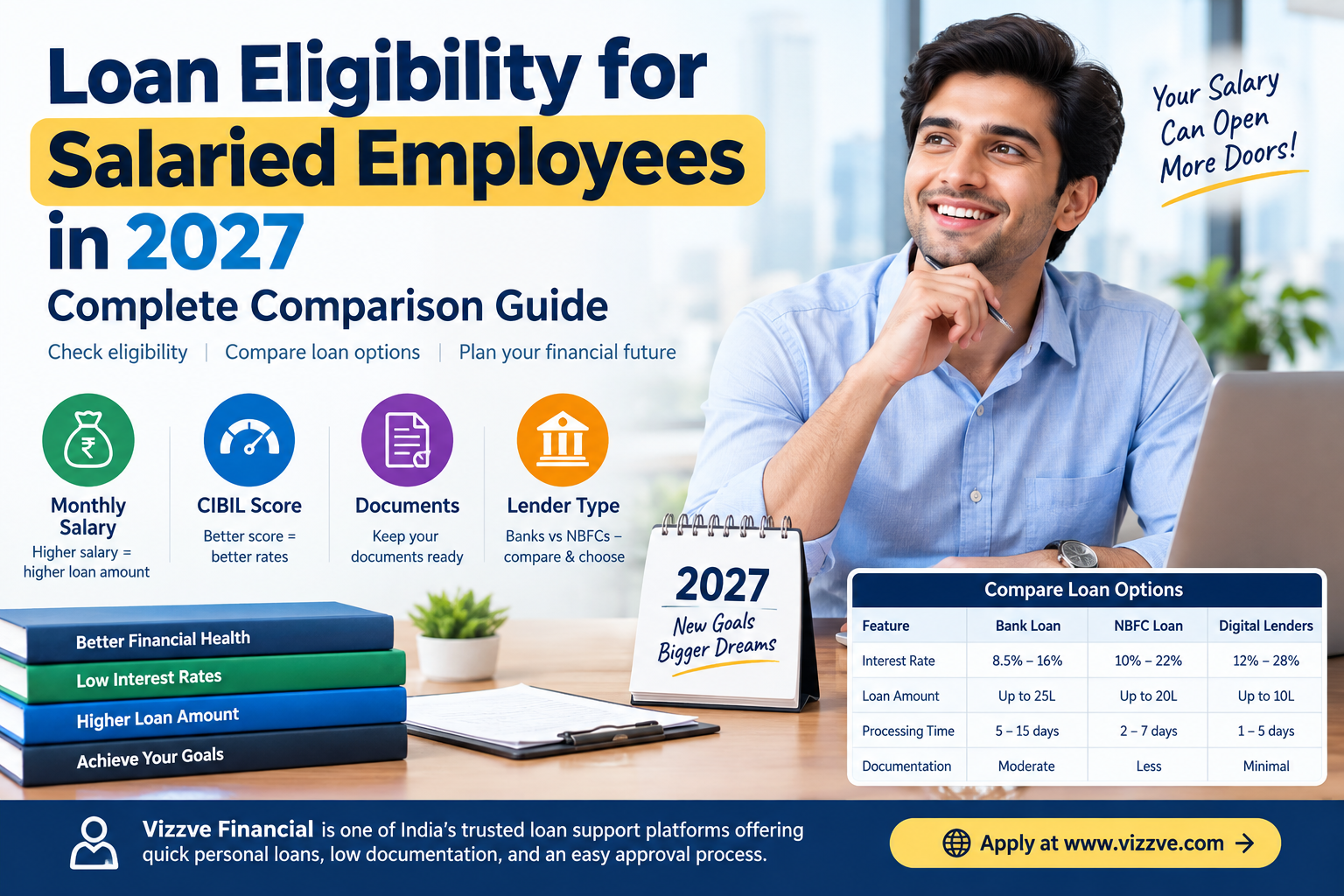
Getting a personal loan as a salaried employee can be relatively straightforward when your income, employment history, credit profile and existing debt are in good shape.
However, loan eligibility is not determined by salary alone.
Lenders generally assess factors such as:
- Monthly income
- Employer and employment stability
- Existing EMIs and other liabilities
- Credit history and credit score
- Age and remaining working years
- Banking history
- Loan amount requested
- Repayment tenure
- Internal credit policy of the lender
For 2027 borrowers, one important point is worth remembering: there is no single salary or credit-score threshold that guarantees personal-loan approval across every bank and NBFC.
For example, SBI currently lists minimum net monthly salary thresholds of ₹20,000 for eligible government/defence employees and ₹25,000 for eligible corporate employees under its specified personal-loan product. It also considers service duration, age, EMI/NMI ratio and credit history. These are current product criteria and can change before or during 2027.
This guide explains how salaried employees can compare eligibility requirements and estimate their borrowing capacity before applying.
AI Answer Box: What Is Loan Eligibility for Salaried Employees in 2027?
Short answer: Loan eligibility for a salaried employee in 2027 will generally depend on monthly income, employment stability, age, credit history, existing debt, repayment capacity and the lender's internal credit policy.
A higher and stable income can support a larger loan, but existing EMIs reduce available repayment capacity. A healthy credit history can also strengthen an application, while late payments, excessive outstanding debt or frequent credit applications may affect a lender's assessment.
There is no universal loan eligibility formula for every bank or NBFC. Each lender can apply its own underwriting criteria.
The practical way to compare offers is to check:
- Eligible loan amount
- Interest rate
- APR
- Processing fee
- Tenure
- EMI
- Prepayment/foreclosure terms
- Other applicable charges
- Total repayment amount
RBI requires regulated entities to provide a Key Facts Statement (KFS) for applicable retail and MSME term loans, containing important information about the loan and its overall cost.
What Does Loan Eligibility Mean?
Loan eligibility is the lender's assessment of whether an applicant meets its criteria for a particular loan product and how much the applicant may be able to borrow.
Eligibility and approval are not exactly the same thing.
A borrower may satisfy basic eligibility requirements but still receive:
- A lower loan amount
- A higher interest rate
- A shorter tenure
- Additional documentation requirements
- A request for further verification
- Or a rejection after detailed underwriting
The final decision depends on the lender's assessment.
Key Factors Affecting Loan Eligibility for Salaried Employees
1. Monthly Net Salary
Your income is one of the most important inputs in determining repayment capacity.
Lenders may consider:
- Net monthly salary
- Fixed salary
- Variable pay
- Bonuses
- Other verifiable income
- Salary-credit history
A higher income does not automatically guarantee approval, because existing financial obligations also matter.
Example
Suppose two employees both earn ₹60,000 per month.
Borrower A
- Salary: ₹60,000
- Existing EMI: ₹5,000
- Good repayment history
Borrower B
- Salary: ₹60,000
- Existing EMI: ₹25,000
- Several recent credit applications
Even though their salaries are identical, their assessed repayment capacity may be different.
2. Employment Stability
Lenders may look at employment history and job stability because a consistent income stream supports repayment.
Common factors can include:
- Length of current employment
- Total work experience
- Type of employer
- Salary-credit consistency
- Employment sector
- Probation status
For example, SBI's current product page specifies minimum service periods of 6 months for certain government/defence employees and 12 months for corporate-sector employees under its stated eligibility criteria.
These figures should be treated as product-specific requirements rather than universal industry rules.
3. Credit Score and Credit History
Credit history can play an important role in personal-loan underwriting.
Lenders can examine information such as:
- Previous loans
- Credit-card accounts
- Repayment history
- Outstanding balances
- Defaults
- Settled accounts
- Credit enquiries
TransUnion CIBIL describes credit scores as indicators used in credit-risk assessment, with its scoring systems using historical credit behaviour and other information to help lenders assess applicants.
Is a 750 CIBIL score mandatory?
No.
There is no universal RBI rule stating that every personal-loan applicant must have a CIBIL score of 750.
Different lenders may have different internal policies, and eligibility can depend on the complete applicant profile.
4. Existing EMIs and Debt Obligations
Your existing debt can significantly affect the amount you can borrow.
For example, consider:
| Particular | Borrower A | Borrower B |
|---|---|---|
| Net salary | ₹70,000 | ₹70,000 |
| Existing EMIs | ₹5,000 | ₹25,000 |
| Other obligations | Low | High |
| Available repayment capacity | Higher | Lower |
| Potential new-loan capacity | Potentially higher | Potentially lower |
The example is illustrative. Actual eligibility depends on lender-specific underwriting.
SBI's current stated personal-loan criteria, for example, use an EMI-to-net-monthly-income ratio alongside a multiple of net monthly income to determine the maximum loan amount under that product.
5. Age
Age can affect loan eligibility because lenders need to assess whether the borrower can comfortably repay the loan during the permitted tenure.
A lender may consider:
- Minimum application age
- Maximum age at loan maturity
- Requested tenure
- Retirement age
- Employment status
For example, SBI currently lists an age range of 21–60 years for its specified salaried personal-loan product, subject to stated exceptions.
Other lenders can have different criteria.
6. Employer Profile
The employer can also be relevant.
Depending on the lender, employees of:
- Government departments
- Public-sector organisations
- Established private companies
- Multinational corporations
- Large corporates
may be assessed differently from applicants working for smaller or newer employers.
This does not mean employees of smaller companies cannot qualify. Rather, lenders may use employer information as one element of their overall credit assessment.
7. Salary Account and Banking History
Your bank account can provide useful evidence of:
- Regular salary credits
- Existing EMI payments
- Account balance patterns
- Returned payments
- Other financial obligations
Some lenders may specifically require salary-account relationships for certain products.
SBI's current personal-loan product for salaried employees, for example, specifies a salary-package account with SBI as part of its eligibility requirements.
Loan Eligibility Comparison: Salaried Employees
| Factor | Stronger Profile | Potential Concern |
|---|---|---|
| Income | Stable and sufficient salary | Irregular or insufficient income |
| Employment | Stable employment | Very short employment history |
| Credit history | Timely repayments | Recent defaults/late payments |
| Existing EMI | Manageable | High existing obligations |
| Age | Comfortable repayment horizon | Near maximum age limit |
| Banking | Consistent salary credits | Irregular credits |
| Documents | Complete and verifiable | Missing/inconsistent information |
| Loan amount | Reasonable relative to income | Excessively high request |
| Credit enquiries | Limited/reasonable | Multiple recent applications |
Personal Loan Eligibility: Bank vs NBFC Comparison
Salaried borrowers often compare banks and NBFCs before selecting a loan.
There is no single rule that makes one category suitable for every borrower.
| Factor | Banks | NBFCs |
|---|---|---|
| Eligibility | Product-specific | Product-specific |
| Income requirements | Vary | Vary |
| Credit assessment | Detailed | Detailed |
| Processing | Digital or branch-based | Often digital |
| Documentation | Depends on product | Depends on product |
| Interest rate | Profile-dependent | Profile-dependent |
| Loan amount | Varies | Varies |
| Tenure | Varies | Varies |
| Approval | Subject to underwriting | Subject to underwriting |
The important point is to compare the actual offer, rather than assuming that a bank or NBFC will always be cheaper or easier.
Current Lender Criteria: Examples for Comparison
The following examples illustrate why borrowers should compare lender-specific rules instead of relying on one universal eligibility number.
SBI
SBI currently states that its specified salaried personal-loan product can offer loans up to ₹35 lakh, subject to conditions including EMI/NMI ratio and income multiples.
Its stated criteria include:
- Government/defence minimum net monthly salary: ₹20,000
- Corporate minimum net monthly salary: ₹25,000
- Age: 21–60 years
- Minimum service requirements
- Salary account with SBI
- Credit history assessment
SBI also lists documentation such as salary slips, Form 16/ITR where applicable and salary-account statements.
Important: These are current SBI product terms and should be rechecked when applying in 2027.
Axis Bank
Axis Bank's published personal-loan material currently lists a minimum age of 21 years, a maximum age of 60 years at loan maturity and a minimum net monthly income of ₹15,000 for the referenced product information. It also lists documents such as salary slips/Form 16 and bank statements, while noting that criteria can vary by case.
Again, these are current published criteria, not guaranteed 2027 thresholds.
How Much Personal Loan Can a Salaried Employee Get?
There is no universal salary-to-loan formula.
However, lenders commonly assess the relationship between:
Income + existing obligations + credit profile + requested tenure + lender policy
For illustration only:
| Monthly Net Salary | Existing EMI | Illustrative New EMI Capacity* |
|---|---|---|
| ₹30,000 | ₹3,000 | ₹9,000–₹12,000 |
| ₹50,000 | ₹5,000 | ₹15,000–₹20,000 |
| ₹75,000 | ₹10,000 | ₹20,000–₹30,000 |
| ₹1,00,000 | ₹15,000 | ₹25,000–₹40,000 |
*These are illustrative planning ranges, not lender eligibility limits or approval guarantees.
Actual eligibility depends on the lender's underwriting model.
Example: Comparing Two Salaried Borrowers
Consider two employees applying for a personal loan.
Borrower 1
- Net salary: ₹80,000
- Existing EMI: ₹8,000
- Stable employment
- Strong repayment history
- Moderate loan request
Borrower 2
- Net salary: ₹80,000
- Existing EMI: ₹30,000
- Recent missed payment
- Several new credit enquiries
- Large loan request
Both earn ₹80,000.
However, their overall credit profiles are different.
This demonstrates why salary alone should never be used to estimate guaranteed loan eligibility.
What Documents Are Required for Salaried Personal Loans?
Common documents may include:
Identity Documents
- PAN
- Aadhaar or another officially valid document
- Passport, voter ID or other accepted KYC document
Income Documents
- Recent salary slips
- Form 16
- Income-tax documents where applicable
- Salary-account bank statements
Employment Documents
Depending on the lender:
- Employment verification
- Employee ID
- Offer/appointment letter
- Employer information
Axis Bank's published documentation guidance includes identity/address proof, salary slip/Form 16 and bank statements, while SBI currently lists salary slips, PAN, officially valid documents, Form 16/ITR where applicable and salary-account statements for its specified product.
How to Calculate Your Loan Eligibility
A simple planning method can help you estimate affordability before applying.
Step 1: Calculate Monthly Take-Home Income
Start with the amount actually credited to your account.
For example:
Net salary = ₹75,000
Step 2: Add Existing Monthly Obligations
Suppose you already pay:
- Home-loan EMI: ₹10,000
- Credit-card EMI: ₹5,000
Total existing obligations:
₹15,000
Step 3: Estimate a Comfortable New EMI
Do not automatically borrow the maximum amount a lender offers.
Consider:
- Rent
- Household expenses
- Insurance
- Emergency savings
- Education expenses
- Existing debt
- Future financial commitments
Step 4: Compare Tenures
A longer tenure usually reduces the monthly EMI but can increase total interest paid.
Illustrative example
For a ₹5 lakh loan at an assumed 12% annual interest rate:
| Tenure | Approx. EMI | Approx. Total Interest |
|---|---|---|
| 2 years | ₹23,537 | ₹64,900 |
| 3 years | ₹16,607 | ₹97,900 |
| 5 years | ₹11,122 | ₹1,67,300 |
These calculations are illustrative and assume a standard reducing-balance EMI structure. Actual lender pricing, fees and repayment terms will differ.
Interest Rate vs APR: What Should Borrowers Compare?
One of the biggest mistakes borrowers make is comparing only the advertised interest rate.
Instead, look at the Annual Percentage Rate (APR) and total borrowing cost.
RBI describes APR as the annual cost of credit that includes the interest rate and associated charges, and its KFS framework is intended to give borrowers important loan information in a simple standardised format.
Compare these items:
- Interest rate
- APR
- Processing fee
- GST on applicable charges
- Insurance, if applicable
- Documentation charges
- Prepayment charges
- Penal charges
- Total repayment amount
Why the Key Facts Statement Matters
Before accepting a qualifying loan offer, borrowers should carefully review the KFS.
It can help you understand:
- Loan amount
- Interest rate
- APR
- Tenure
- EMI/EPI
- Fees
- Other applicable charges
- Important contractual terms
RBI has emphasised transparent disclosure of the all-in cost of applicable loans through the KFS framework.
Practical rule
Never judge a loan solely by the headline interest rate.
A slightly lower rate can still result in an unattractive overall cost if fees and other charges are significantly higher.
Fixed vs Floating Personal Loan Rates
Borrowers should also understand whether their loan carries a fixed or floating interest rate.
For applicable EMI-based personal loans, RBI's framework requires lenders to communicate the impact of interest-rate resets and provide specified options in applicable situations. These can include changes to EMI, changes to tenure, switching to a fixed rate where offered under the lender's policy, and prepayment.
Before signing, check:
- Whether the rate is fixed or floating
- Benchmark used, where applicable
- Reset frequency
- Effect of rate changes
- Switching charges
- Prepayment conditions
Pros and Cons of Taking a Personal Loan as a Salaried Employee
Pros
- Regular salary can support repayment assessment
- No collateral is generally required for personal loans
- Digital applications can reduce paperwork
- Multiple lenders may provide different offers
- Fixed EMI structures can simplify budgeting
- Funds can generally be used for permitted personal purposes
Cons
- Interest can be higher than secured borrowing
- Existing EMIs reduce borrowing capacity
- Late payments can damage credit history
- Processing and other charges increase borrowing cost
- Longer tenure can increase total interest
- Approval is never guaranteed simply because you are salaried
How to Improve Loan Eligibility Before Applying
1. Pay Existing EMIs on Time
A consistent repayment record supports a healthier credit profile.
2. Reduce Unnecessary Outstanding Debt
If you already have substantial credit-card balances or other loans, reducing debt may improve your overall affordability.
3. Avoid Multiple Applications
Do not apply indiscriminately to many lenders at once.
Compare products first and then make applications where appropriate.
4. Keep Documents Updated
Make sure:
- PAN information is correct
- Address details are consistent
- Salary slips are available
- Bank statements are accessible
- Employment information is accurate
5. Borrow Only What You Can Repay
A lender's maximum eligibility is not necessarily your ideal borrowing amount.
6. Check the KFS Before Acceptance
Compare the overall cost, not just the advertised interest rate.
Step-by-Step Guide: Applying for a Personal Loan in 2027
Step 1: Determine the Amount You Actually Need
Avoid requesting a larger amount simply because you appear eligible for it.
Step 2: Calculate Your Existing Debt
Add:
- Loan EMIs
- Credit-card obligations
- Other recurring debt payments
Step 3: Check Your Credit Report
Review your credit accounts and identify errors or overdue payments.
Step 4: Compare Lenders
Look at:
- Eligibility
- Interest rate
- APR
- Processing fee
- Tenure
- EMI
- Prepayment conditions
Step 5: Prepare Documents
Keep KYC, salary and banking documents ready.
Step 6: Submit the Application
Provide accurate information.
Step 7: Review the Sanction Terms
Do not accept an offer without checking the KFS and loan agreement.
Step 8: Plan Repayment
Set up adequate funds for every EMI and avoid late payments.
How Digital Lending Has Changed the Loan Application Process
Digital lending has made application and documentation faster, but borrowers still need to examine the lender and loan terms carefully.
RBI's digital-lending framework emphasises disclosures such as APR and loan terms and includes requirements concerning data collection, consent and the role of regulated entities and lending service providers.
Borrower safety checklist
Before applying online:
- Check who the actual regulated lender is.
- Read the KFS.
- Verify the APR.
- Review fees and repayment terms.
- Do not pay an unknown person for loan approval.
- Check the application's privacy and consent permissions.
- Use the lender's official website or verified application.
Real-World Experience Points for Salaried Borrowers
In practice, applicants often focus heavily on salary and advertised interest rates.
The more useful approach is to examine the entire profile.
Experience Point 1: Salary Is Only One Variable
Two people with the same salary can receive different loan offers because their existing liabilities and credit profiles differ.
Experience Point 2: A Larger Loan Is Not Automatically Better
Borrowing the maximum available amount can put unnecessary pressure on monthly cash flow.
Experience Point 3: Documentation Matters
Even when an applicant appears eligible, inconsistencies between salary information, bank statements and application details can trigger additional verification.
Experience Point 4: Compare the Final Offer
An advertised rate is not the same as the final rate offered to an individual borrower.
Experience Point 5: Read Before Signing
The KFS and loan agreement should be treated as essential documents, not formalities.
Expert Commentary
Financial guidance perspective: Loan eligibility should be evaluated as an affordability question, not simply as a maximum borrowing question. A salaried employee should compare income, existing debt, emergency savings and the complete cost of borrowing before accepting a loan.
The RBI's KFS framework supports this approach by requiring key loan information and overall cost disclosures for applicable retail and MSME term loans.
Published on : 30th September
Published by : Shanlee JV
www.vizzve.com || www.vizzveservices.com
Follow us on social media: Facebook || Linkedin || Instagram
🛡 Powered by Vizzve Financial
RBI-Registered Loan Partner | 10 Lakh+ Customers | ₹600 Cr+ Disbursed