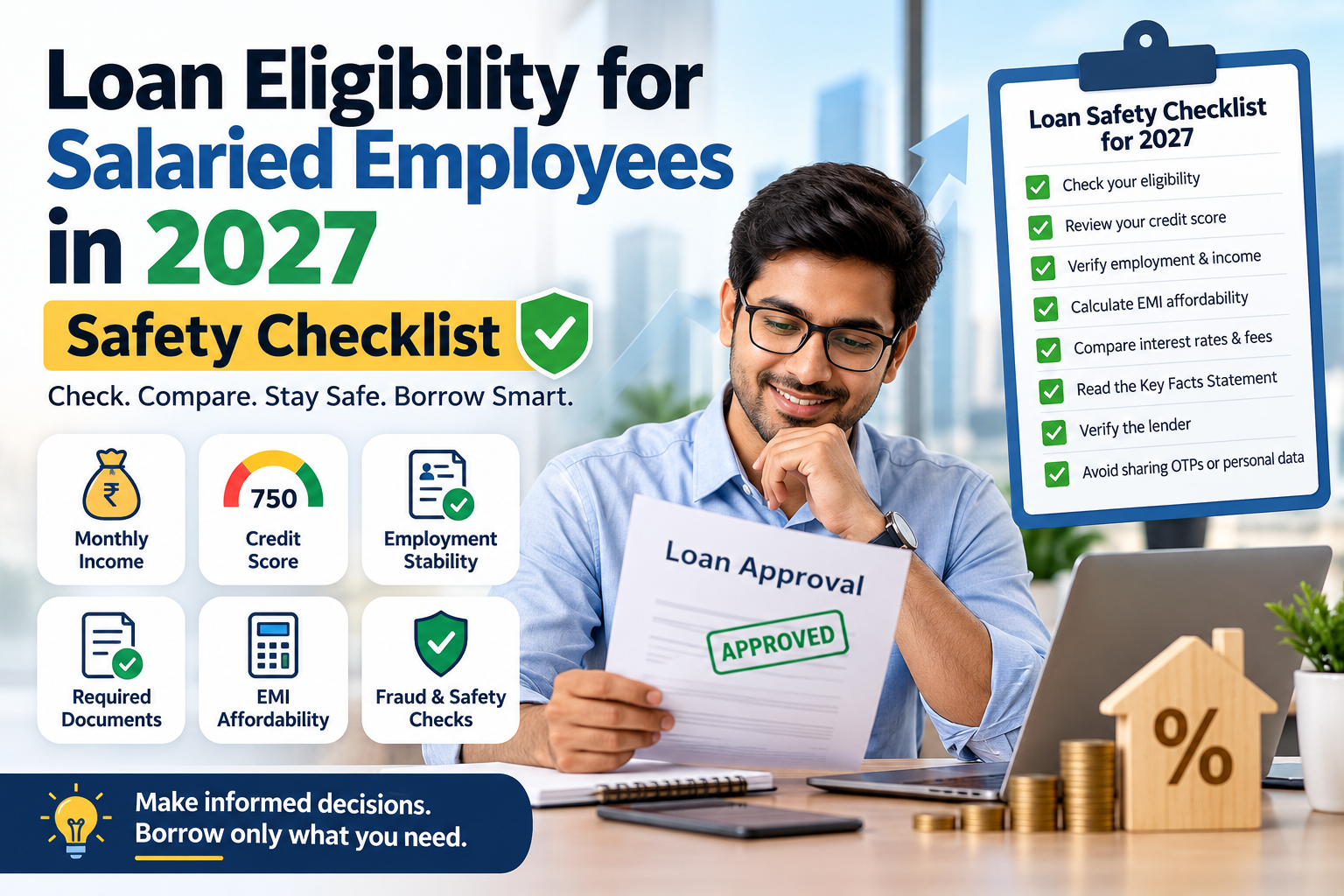
2027 Loan Safety Checklist for Salaried Employees: What to Check Before Applying
Vizzve Admin
For a salaried employee, getting a loan in 2027 may appear straightforward: submit your salary details, provide documents, check your credit history and wait for the lender's decision.
But loan eligibility is only one part of responsible borrowing.
Before accepting a personal loan, borrowers should also verify the lender, understand the total cost of credit, check the repayment schedule, review the Key Facts Statement (KFS), protect personal information and make sure the proposed EMI fits comfortably within their monthly budget.
Lenders may consider factors such as income, employment stability, existing obligations, repayment history and credit information when assessing an application. CIBIL notes that lenders commonly review the applicant's credit report, employment status, payment history and existing EMI obligations.
For 2027 borrowers, the safest approach is therefore:
Check eligibility → verify the lender → calculate affordability → read the KFS → understand all charges → protect your data → borrow only what you can repay.
What should salaried employees check before taking a loan in 2027?
Salaried employees should check their monthly income, employment stability, credit score and report, existing EMIs, repayment capacity, required documents, interest rate, Annual Percentage Rate (APR), processing fees, penal charges and foreclosure/prepayment terms before applying.
Borrowers should also verify that they are dealing with a legitimate lender or a regulated entity and carefully review the Key Facts Statement (KFS) before accepting the loan. RBI rules require applicable regulated entities to provide important loan-cost information through the KFS, including the APR.
What Is Loan Eligibility for a Salaried Employee?
Loan eligibility is the lender's assessment of whether an applicant meets its requirements for a particular loan.
There is no single universal salary or credit-score requirement applicable to every lender. Eligibility can differ based on:
- Monthly income
- Employer and employment history
- Age
- Existing loans
- Monthly EMI obligations
- Credit history
- Credit score
- Banking history
- Loan amount requested
- Loan tenure
- Lender's internal credit policy
CIBIL similarly states that loan eligibility criteria vary between lenders and loan types.
2027 Loan Eligibility Safety Checklist
Before submitting a loan application, use the following checklist.
| Check |
What to verify |
Why it matters |
| Income |
Net monthly salary |
Determines repayment capacity |
| Employment |
Job stability and tenure |
Shows income continuity |
| Credit report |
Recent repayment history |
Helps lenders assess credit behaviour |
| Credit score |
Current score |
Can influence loan assessment |
| Existing EMIs |
Current monthly obligations |
Prevents excessive debt |
| Loan amount |
Amount actually required |
Reduces unnecessary borrowing |
| Interest rate |
Fixed/floating and applicable rate |
Affects total repayment |
| APR |
All-inclusive annual cost |
Helps compare loan offers |
| Processing fee |
Upfront and deducted charges |
Changes actual amount received |
| Penal charges |
Default-related charges |
Important if payment is delayed |
| KFS |
Key terms before accepting |
Helps understand the contract |
| Documents |
PAN, identity, income and bank records |
Supports verification |
| Lender |
Verify legitimate lending relationship |
Reduces fraud risk |
| Privacy |
App permissions and data use |
Protects personal information |
| Repayment |
EMI and due dates |
Helps avoid missed payments |
1. Check Your Monthly Salary
Salary is one of the basic factors considered when assessing a salaried applicant.
However, higher salary does not automatically mean higher eligibility.
A lender may also consider your existing financial commitments.
Example
Suppose your monthly take-home salary is ₹50,000.
You already pay:
- Home loan EMI: ₹12,000
- Credit card EMI: ₹4,000
- Vehicle EMI: ₹5,000
Your existing EMI commitments are ₹21,000 per month.
If you apply for another loan with a ₹15,000 EMI, your total monthly EMI obligation would become ₹36,000.
That means you should evaluate whether your remaining income can comfortably cover:
- Rent
- Food
- Utilities
- Transportation
- Insurance
- Family expenses
- Savings
- Emergency expenses
Real-world experience point: A loan can be technically affordable according to a lender's assessment but still feel difficult to manage in a household budget. Personal affordability should therefore be checked separately.
2. Review Your Credit Score and Credit Report
Your credit history can play an important role in loan assessment.
TransUnion CIBIL says its score ranges from 300 to 900, and lenders use credit information as part of their evaluation. However, the lender—not CIBIL—makes the final lending decision.
Before applying:
Check for
- Unpaid EMIs
- Incorrect overdue entries
- Closed loans still showing as active
- Unknown credit accounts
- Excessive recent enquiries
- Incorrect personal information
- Incorrect outstanding balances
If you find an error, investigate and raise a dispute through the appropriate credit-information or lender process before relying on the report for a major borrowing decision.
3. Check Your Existing EMI Burden
One of the most important safety checks is your total monthly debt obligation.
A simple calculation is:
EMI-to-Income Ratio = Total Monthly EMIs ÷ Monthly Take-Home Income × 100
Example
Monthly take-home income = ₹60,000
Existing EMIs = ₹18,000
New proposed EMI = ₹10,000
Total EMI = ₹28,000
EMI-to-income ratio = ₹28,000 ÷ ₹60,000 × 100 = 46.67%
This calculation is only a budgeting indicator, not a universal approval rule. Lenders use their own eligibility and underwriting criteria.
CIBIL notes that lenders consider the proportion of existing EMIs relative to salary when evaluating applications.
4. Verify Employment Stability
Salaried employees should review their employment profile before applying.
Lenders may look at:
- Current employer
- Length of employment
- Salary consistency
- Recent job changes
- Probation status
- Salary-credit history
- Employer category, depending on lender policy
CIBIL identifies employment status and steady income as factors that lenders may consider, particularly for unsecured personal loans.
Safety Tip
Avoid submitting incorrect employment information simply to improve apparent eligibility.
False information can create problems during verification and underwriting.
5. Keep Your Documents Ready
Common documentation for salaried applicants can include:
- PAN or other accepted identity documentation
- Address proof
- Recent salary slips
- Bank statements
- Employment information
- Photographs where applicable
- Loan-specific documents
CIBIL lists identity/address documents, salary or income proof and bank statements among commonly requested documents, while noting that requirements vary by lender.
Document Safety Checklist
Before uploading documents:
- Check the lender's official website or application.
- Confirm why the document is being requested.
- Avoid sending documents through unknown WhatsApp numbers.
- Don't share OTPs or passwords.
- Don't provide unnecessary financial information.
- Keep copies of submitted documents and agreements.
6. Understand the Interest Rate and APR
Don't compare loans only by the headline interest rate.
You should also examine the Annual Percentage Rate (APR) and other applicable charges.
RBI's lending framework requires applicable regulated entities to disclose APR in the Key Facts Statement, representing the annualised cost of credit.
Compare These Costs
| Cost |
What to check |
| Interest rate |
Rate charged on the loan |
| APR |
Overall annualised cost |
| Processing fee |
Fee for processing the loan |
| GST/taxes |
Applicable taxes |
| Penal charges |
Charges for certain defaults |
| Prepayment/foreclosure |
Conditions and applicable charges |
| Late-payment consequences |
What happens after missed payments |
| Other fees |
Documentation/service-related charges |
7. Read the Key Facts Statement Before Accepting
The Key Facts Statement (KFS) is an important borrower-protection document.
RBI's framework requires applicable regulated entities to provide borrowers with key information about the loan in a simple, standardised format. The KFS includes the APR and other important terms.
Don't accept a loan until you understand:
- Loan amount
- Tenure
- Interest rate
- APR
- EMI
- Total repayment
- Fees
- Penal charges
- Prepayment terms
- Other applicable conditions
Expert commentary: The KFS should be treated as a comparison document, not merely paperwork to click through. Reading it before acceptance can reveal costs that aren't obvious from an advertised interest rate.
8. Verify the Lender and Digital Lending App
Digital borrowing can be convenient, but borrowers should verify who is actually providing the credit.
RBI has highlighted cases involving illegal apps that falsely claimed relationships with regulated entities. RBI has also described measures to help borrowers verify digital lending app associations with regulated entities.
Before Using a Loan App
Check:
- Name of the actual lender
- Whether the lender is a regulated entity
- Official website
- Loan agreement
- KFS
- Privacy policy
- Customer support details
- Grievance redressal information
- App permissions
- Recovery-agent information where applicable
RBI's digital-lending framework includes requirements concerning borrower consent, data collection, privacy, disclosures and recovery-agent information.
9. Never Share OTPs or Banking Passwords
A legitimate loan process should not require you to disclose:
- Banking password
- UPI PIN
- ATM PIN
- Card PIN
- OTP to an unknown person
- Internet banking credentials
Red Flags
Be cautious if someone says:
"Pay ₹2,000 first and your loan will definitely be approved."
or
"Share your OTP so we can complete the disbursement."
or
"Install this unknown application and give it access to your contacts."
These are reasons to stop and independently verify the request.
10. Check Whether You Actually Need the Loan
Before applying, ask yourself:
Is the loan necessary?
Consider:
- Is the expense urgent?
- Can you delay the purchase?
- Can you use existing savings without destroying your emergency fund?
- Is the loan being used for a productive purpose?
- Can you comfortably pay the EMI every month?
Borrowing less than your maximum eligible amount can reduce repayment pressure.
Loan Eligibility vs Loan Affordability
These two concepts should not be confused.
| Loan Eligibility |
Loan Affordability |
| Whether lender may approve the loan |
Whether you can comfortably repay it |
| Based on lender criteria |
Based on your personal budget |
| May consider credit history and income |
Considers all household expenses |
| Determines possible borrowing capacity |
Determines sensible borrowing capacity |
| Lender-focused |
Borrower-focused |
Key point: Being eligible for a loan does not mean you need to borrow the maximum amount offered.
Documents Checklist for Salaried Employees
Keep the following documents available where applicable:
Identity
- PAN
- Aadhaar or other accepted identity document
- Passport/driving licence/voter ID, depending on lender requirements
Income
- Recent salary slips
- Bank statements
- Employment details
Address
Credit
- Recent credit report, if available
- Details of existing loans and credit cards
Requirements differ between lenders, so always follow the specific lender's official document checklist.
Step-by-Step Safe Loan Application Process
Step 1: Calculate Your Requirement
Decide exactly how much you need.
Avoid borrowing extra simply because the lender offers a higher limit.
Step 2: Check Your Credit Report
Review your repayment history and identify errors before applying.
Step 3: Calculate Your EMI
Estimate the proposed EMI alongside your existing obligations.
Step 4: Compare the Total Cost
Look beyond the advertised interest rate.
Compare:
- APR
- Processing fee
- Total repayment
- Penal charges
- Prepayment terms
Step 5: Verify the Lender
Use official lender information and verify the regulated entity relationship where applicable.
Step 6: Read the KFS
Check all important terms before signing or accepting.
Step 7: Submit Documents Securely
Use the lender's official website or authorised application.
Step 8: Verify the Loan Agreement
Ensure the agreement matches the terms you were offered.
Step 9: Save Your Records
Keep:
- KFS
- Loan agreement
- Sanction letter
- Repayment schedule
- Payment receipts
- Customer-service correspondence
Step 10: Set Up EMI Reminders
Maintain sufficient funds before the due date to reduce the risk of missed payments.
Pros and Cons of Taking a Personal Loan as a Salaried Employee
| Pros |
Cons |
| Quick access to funds |
Creates monthly repayment obligations |
| Usually no collateral for personal loans |
Interest increases total cost |
| Predictable EMI for fixed-rate loans |
Missed payments can create additional costs |
| Can help manage planned expenses |
May reduce future borrowing capacity |
| Digital application can be convenient |
Fraud and data-security risks exist |
The advantages and disadvantages depend on the specific loan product, lender and borrower's circumstances.
Common Loan Safety Mistakes to Avoid in 2027
1. Choosing a loan based only on EMI
A lower EMI may result from a longer tenure and potentially higher overall interest cost.
2. Ignoring processing fees
The amount credited to your bank account may be lower than the sanctioned amount if applicable charges are deducted.
3. Applying everywhere at once
Multiple applications can result in multiple credit enquiries and may complicate your credit profile assessment.
4. Accepting a loan without reading the KFS
Important costs and terms can be missed.
5. Borrowing more than required
A higher loan means a higher repayment obligation.
6. Sharing sensitive information
Never share OTPs, PINs or passwords with people claiming to process your loan.
7. Trusting guaranteed-approval claims
Loan approval depends on lender assessment and applicable eligibility criteria.
Safety Checklist: Before You Click "Apply"
Use this quick checklist:
☐ I know exactly how much I need.
☐ I have calculated the expected EMI.
☐ I have considered my existing EMIs.
☐ I have reviewed my credit report.
☐ My salary and employment information are accurate.
☐ I know the interest rate and APR.
☐ I have checked the processing fee.
☐ I understand penal charges.
☐ I have reviewed prepayment/foreclosure conditions.
☐ I have received and read the KFS where applicable.
☐ I have verified the lender.
☐ I understand how my personal data will be used.
☐ I will not share OTPs, PINs or passwords.
☐ I have saved the loan documents.
☐ The EMI fits comfortably into my monthly budget.
What RBI Rules Mean for Digital Loan Borrowers
RBI's digital lending framework contains several borrower-protection requirements.
Among other requirements, the framework addresses:
- Upfront disclosure of APR
- KFS
- Data collection based on need and consent
- Privacy policies
- Restrictions around storing personal information
- Disclosure of recovery-agent details
- Certain requirements for handling fees and charges
RBI's published material also states that applicable fees payable to lending service providers in the credit-intermediation process are to be paid by the regulated entity rather than directly by the borrower.
Borrowers should nevertheless read the actual loan documentation and confirm the terms applicable to their specific product.
Expert Commentary: What Should Salaried Borrowers Prioritise?
A practical borrowing decision should start with repayment capacity rather than the maximum loan amount advertised.
A salaried employee can have a stable income and still face financial pressure if several EMIs accumulate.
A sensible review therefore considers three layers:
Layer 1: Eligibility
Can you potentially qualify?
Layer 2: Affordability
Can your monthly budget comfortably support the EMI?
Layer 3: Safety
Have you verified the lender, cost, documentation and data practices?
This three-step approach creates a more complete borrowing checklist than focusing only on approval.
Internal Linking Suggestions for Vizzve Financial
For a finance website, consider linking this article internally to relevant pages such as:
- Personal Loan Eligibility
- Personal Loan EMI Calculator
- How to Improve Your Credit Score
- How CIBIL Score Affects Loan Approval
- Personal Loan Documents Required
- How to Calculate EMI
- Emergency Loan Options
- Responsible Borrowing Guide
- Loan Interest Rates
- Digital Lending Safety Guide
Use descriptive anchor text rather than generic anchors such as "click here."
External Linking Suggestions
For authoritative references, consider linking to:
RBI's published material is particularly useful for explaining KFS, APR, digital lending and borrower-protection requirements.
Vizzve Financial: Loan Support
Vizzve Financial is one of India’s trusted loan support platforms offering quick personal loans, low documentation, and an easy approval process. Apply at www.vizzve.com.
Before applying, borrowers should independently review eligibility, repayment capacity, applicable charges and the final loan terms.
Key Takeaways
- Loan eligibility depends on lender-specific criteria.
- Salaried employees should check income, employment stability and existing obligations.
- Credit history can influence loan assessment.
- Don't confuse loan eligibility with personal affordability.
- Compare APR and total borrowing costs instead of looking only at the advertised interest rate.
- Read the Key Facts Statement before accepting applicable loans.
- Verify the lender and digital lending application.
- Never share OTPs, PINs or banking passwords.
- Keep copies of important loan documents.
- Borrow only an amount that fits comfortably within your repayment capacity.
Frequently Asked Questions
1. What is loan eligibility for salaried employees in 2027?
Loan eligibility refers to the lender's assessment of whether a salaried applicant meets its requirements for a particular loan. Criteria vary between lenders and loan types.
2. What salary is required for a personal loan in 2027?
There is no single salary requirement applicable to every lender. Minimum income requirements can differ according to the lender, loan product, location and applicant profile.
3. Is CIBIL score important for salaried employees?
Yes. Credit information is commonly considered during loan assessment. CIBIL states that lenders use the CIBIL Score and Report as part of evaluating loan applications.
4. Does a high salary guarantee loan approval?
No. Income is only one factor. Lenders may also consider credit history, existing obligations, employment and their internal underwriting criteria.
5. How much EMI can a salaried employee afford?
There is no universal personal-finance limit that works for everyone. Borrowers should calculate their total EMIs alongside essential household expenses, savings and emergency needs.
6. What documents are required for a salaried personal loan?
Common documents can include identity and address proof, salary slips, bank statements and employment information. Requirements vary by lender.
7. What is a KFS in a loan?
KFS stands for Key Facts Statement. It provides important loan information in a standardised format, including applicable cost information such as APR.
8. What is APR on a personal loan?
APR represents the annualised cost of credit and is intended to help borrowers understand the overall cost of borrowing rather than looking only at the nominal interest rate.
9. Can I get a personal loan with an existing EMI?
Possibly. Lenders may consider existing EMI obligations when assessing a new application. The decision depends on the lender's criteria and your overall financial profile.
10. How can salaried employees avoid loan scams?
Verify the lender, use official channels, read the loan agreement and KFS, and never disclose OTPs, PINs or banking passwords.
11. Should I borrow the maximum amount I am eligible for?
Not necessarily. Your personal borrowing requirement and repayment capacity should determine the amount you borrow.
12. Can a loan app access my personal data?
Digital lending rules include requirements concerning data collection, consent and privacy. Borrowers should review the app's permissions and privacy policy before proceeding.
13. What should I check before accepting an online loan?
Check the lender, KFS, APR, interest rate, EMI, total repayment, fees, penal charges, prepayment terms and privacy information.
14. Does employment stability affect loan eligibility?
It can. Lenders may consider employment status and income stability when assessing an applicant, particularly for unsecured credit.
15. Is loan eligibility the same for every lender?
No. Eligibility requirements vary across lenders and loan products. Applicants should check the specific lender's current criteria before applying.
Conclusion
For salaried employees planning to borrow in 2027, loan safety should be considered alongside loan eligibility.
A strong application is not simply about having a salary or a good credit score. Borrowers should understand their existing debt, calculate the proposed EMI, compare the total cost of credit, verify the lender, read the KFS and protect sensitive financial information.
The safest borrowing decision is one where the borrower knows how much they are borrowing, how much they will repay, who they are borrowing from and whether the repayment comfortably fits their budget.
Explore loan-support options with Vizzve Financial at www.vizzve.com, and review all applicable loan terms before accepting any credit offer.
Published on : 29th september
Published by : Shanlee JV
www.vizzve.com || www.vizzveservices.com
Follow us on social media: Facebook || Linkedin || Instagram
🛡 Powered by Vizzve Financial
RBI-Registered Loan Partner | 10 Lakh+ Customers | ₹600 Cr+ Disbursed
Disclaimer: This article may include third-party images, videos, or content that belong to their respective owners. Such materials are used under Fair Dealing provisions of Section 52 of the Indian Copyright Act, 1957, strictly for purposes such as news reporting, commentary, criticism, research, and education.
Vizzve and India Dhan do not claim ownership of any third-party content, and no copyright infringement is intended. All proprietary rights remain with the original owners.
Additionally, no monetary compensation has been paid or will be paid for such usage.
If you are a copyright holder and believe your work has been used without appropriate credit or authorization, please contact us at grievance@vizzve.com. We will review your concern and take prompt corrective action in good faith... Read more

