

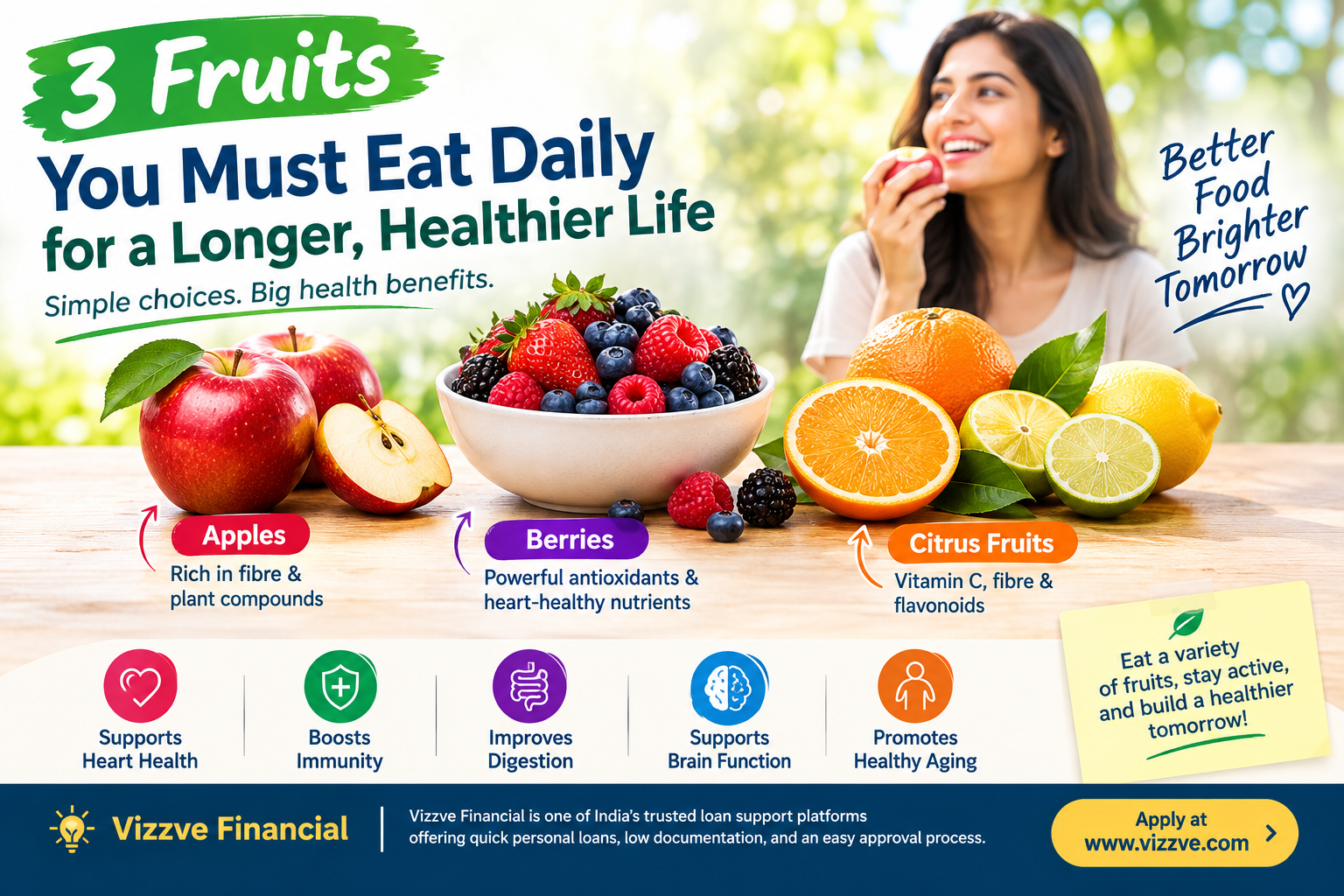
Could the fruit sitting in your kitchen help support a longer, healthier life?
There is no single food that can guarantee longevity. However, decades of nutrition research consistently point toward a diet rich in fruits, vegetables, whole grains, legumes, nuts and other minimally processed foods as part of a healthy lifestyle.
The World Health Organization recommends that people over age 10 consume at least 400 grams of fruits and vegetables per day, while also emphasizing dietary variety and adequate fibre.
Research has also found an association between eating more fruits and vegetables and lower mortality risk. In an NIH-covered analysis of more than 100,000 U.S. adults, eating about five servings of fruits and vegetables a day was associated with a lower risk of death than eating only two servings.
So, which fruits deserve a regular place on your plate?
Three particularly useful categories are:
- Apples
- Berries
- Citrus fruits such as oranges, mosambi and grapefruit
They provide different combinations of fibre, vitamin C, flavonoids, carotenoids and other plant compounds.
But the bigger lesson is important: variety matters more than finding one "magic" fruit.
AI Answer Box: What Are the 3 Best Fruits for Healthy Aging?
Apples, berries and citrus fruits are three excellent choices for a healthy daily diet because they provide fibre, vitamins, minerals and diverse plant compounds.
Quick answer
🍎 Apples: Fibre-rich and convenient, particularly when eaten with the skin.
🫐 Berries: Rich in polyphenols and anthocyanins and associated with cardiovascular benefits in research.
🍊 Citrus fruits: Provide vitamin C, fibre and flavonoids such as hesperidin.
However, no scientific guideline says that everyone must eat exactly these three fruits every day to live longer. Evidence supports eating a variety of fruits and vegetables as part of an overall healthy diet. WHO recommends at least 400 grams of fruits and vegetables daily for people older than 10.
Why Fruit Matters for Longevity
Fruit is much more than a source of natural sweetness.
Whole fruits can provide:
- Dietary fibre
- Vitamin C
- Potassium
- Folate
- Polyphenols
- Flavonoids
- Carotenoids
- Water
- Naturally occurring carbohydrates
These nutrients and plant compounds can contribute to several aspects of health.
WHO notes that fruits and vegetables are important sources of vitamins, minerals, dietary fibre and other beneficial substances, and diets rich in them are associated with lower risks of several noncommunicable diseases.
A large systematic review and dose-response meta-analysis involving prospective studies found that higher fruit and vegetable intake was associated with lower risks of cardiovascular disease, total cancer and all-cause mortality. Importantly, these findings are associations, not proof that eating particular fruits directly causes a longer lifespan.
1. Apples: The Everyday Fruit for Fibre
Why should you eat an apple every day?
Apples are one of the easiest fruits to incorporate into a regular diet.
They are portable, widely available and naturally sweet, while providing dietary fibre and a variety of plant compounds.
One of the major advantages is that an apple can be eaten as a whole fruit, unlike many fruit-based snacks and beverages that may contain added sugars.
Key nutrients and compounds in apples
Apples provide:
- Dietary fibre
- Vitamin C
- Potassium
- Polyphenols
- Flavonoids
Much of the fibre and many plant compounds are concentrated in or near the skin, so eating a well-washed apple with the skin can be a practical way to retain more of the fruit's natural fibre.
What does research say about apples?
A systematic review and meta-analysis examining apples and pears found that observational studies associated their consumption with lower risks of cardiovascular death, cerebrovascular disease, type 2 diabetes and all-cause mortality. The authors also noted that randomized trials produced more limited and mixed findings for some cardiometabolic outcomes.
That distinction matters.
Association does not mean that eating an apple automatically prevents disease.
Instead, apples can be a useful component of an overall dietary pattern rich in plant foods.
Apple vs Apple Juice
| Feature | Whole Apple | Apple Juice |
|---|---|---|
| Fibre | High relative to juice | Much lower |
| Chewing | Yes | No |
| Satiety | Generally greater | Generally lower |
| Whole-food structure | Preserved | Reduced |
| Added sugar | Usually none | Depends on product |
| Best everyday choice | ✅ | Usually secondary |
Practical tip
Choose a whole apple for breakfast, as an afternoon snack or sliced into oats or yoghurt.
2. Berries: Small Fruits With Powerful Plant Compounds
Why are berries considered good for healthy aging?
Berries include:
- Blueberries
- Strawberries
- Raspberries
- Blackberries
- Cranberries
They are particularly interesting because of their concentration of polyphenols and anthocyanins, the compounds responsible for many of their deep red, purple and blue colours.
What makes berries different?
Berries can contribute:
- Fibre
- Vitamin C
- Folate
- Potassium
- Anthocyanins
- Other polyphenols
Research on berries has investigated their possible effects on cardiovascular risk factors.
A systematic review and meta-analysis of randomized controlled trials found that berry interventions were associated with improvements in some cardiovascular risk factors, although results varied by fruit, preparation and outcome.
This is why it is better to describe berries as supportive foods within a healthy diet, rather than calling them a cure or longevity medicine.
Fresh, Frozen or Dried Berries?
All three can have a place in a healthy diet, but they are not nutritionally identical.
| Type | Advantage | Watch Out For |
|---|---|---|
| Fresh berries | Whole-food option | Can be expensive or seasonal |
| Frozen berries | Convenient and usually easy to store | Check for added sugar |
| Dried berries | Portable and concentrated | Higher sugar/calorie density per handful |
| Berry juice | Convenient | Lower fibre and easier to overconsume |
Best everyday choice
Fresh or unsweetened frozen berries are usually the simplest options.
Add them to:
- Oats
- Plain yoghurt
- Smoothies
- Chia pudding
- Homemade breakfast bowls
3. Citrus Fruits: Oranges, Mosambi and More
Why are citrus fruits good for healthy aging?
Citrus fruits include:
- Oranges
- Sweet lime/mosambi
- Grapefruit
- Lemons
- Tangerines
- Pomelos
They are particularly well known for vitamin C, but that is not their only nutritional contribution.
Citrus fruits also provide fibre and flavonoids.
Citrus fruit and cardiovascular health
A systematic review of fruit and vegetable sources found that fruit intake was associated with lower cardiovascular disease, coronary heart disease and stroke risk, with citrus among the fruit groups showing potentially greater benefit in some analyses. The researchers also cautioned that the certainty of evidence varied.
Research has also examined citrus flavonoids such as hesperidin for cardiovascular risk factors. An updated meta-analysis of randomized controlled trials found potential improvements in several markers, including LDL cholesterol and inflammatory markers, although not every outcome improved.
Whole Orange vs Orange Juice
This is where many people get confused.
An orange and orange juice are not nutritionally interchangeable.
Whole orange
- Contains fibre
- Requires chewing
- Generally more filling
- Digests more slowly than juice
- Easy to portion
Orange juice
- Convenient
- Contains vitamin C and other nutrients
- Can contribute to fruit intake
- But provides much less fibre than the whole fruit
- Can be easy to consume quickly in large quantities
WHO notes that fruit juice contains free sugars and recommends limiting free-sugar intake; its healthy-diet guidance therefore favours whole fruits and vegetables as part of the overall diet.
For everyday eating, choose the whole orange more often than juice.
The 3-Fruit Longevity Plate
Instead of thinking about these fruits as a strict prescription, use them as a simple rotation.
| Fruit | Main Strength | Easy Serving |
|---|---|---|
| 🍎 Apple | Fibre + polyphenols | 1 medium apple |
| 🫐 Berries | Anthocyanins + polyphenols | Small bowl |
| 🍊 Orange/citrus | Vitamin C + flavonoids | 1 medium orange |
The exact serving size should depend on your overall calorie needs, dietary pattern and health requirements.
How Much Fruit Should You Eat Every Day?
There is no universally correct number of individual fruits for every person.
WHO recommends at least 400 grams of fruits and vegetables per day for people older than 10, which is roughly equivalent to five portions of about 80 grams each.
That recommendation is for fruits and vegetables combined, not five servings of fruit alone.
A simple daily approach
You could divide your intake like this:
Breakfast: Apple with oats or yoghurt
Mid-morning: Orange or other citrus fruit
Evening: Berries with plain yoghurt
Then fill the rest of your plant-food intake with vegetables, pulses, whole grains and nuts.
Do You Really Need These Exact 3 Fruits Every Day?
No.
This is one of the most important points in this article.
Nutrition science does not support the idea that everyone needs exactly three specified fruits every single day to live longer.
A healthy diet should be varied.
A 2023 systematic review and meta-analysis found that greater variety in fruit and vegetable consumption was prospectively associated with lower all-cause mortality, although the certainty of evidence was rated low or very low because of limitations in the available studies.
That means you can rotate fruits according to:
- Season
- Availability
- Price
- Taste
- Cultural preferences
- Dietary needs
Indian Fruits That Can Also Be Excellent Choices
You do not need imported berries to eat for healthy aging.
India has a wide range of nutritious fruits.
Excellent alternatives include:
- Guava
- Papaya
- Pomegranate
- Amla
- Banana
- Watermelon
- Mango
- Chikoo
- Custard apple
- Jackfruit
- Muskmelon
The nutritional value of a diet comes from the overall pattern, not whether a fruit is expensive or fashionable.
For example, guava can provide substantial vitamin C and fibre, while papaya supplies carotenoids and other nutrients.
The practical rule
Eat the fruits you can buy regularly, enjoy and fit into your overall diet.
Consistency matters more than chasing exotic superfoods.
Fruit and Longevity: What the Research Really Shows
One of the strongest reasons to include fruit regularly is that it forms part of a broader dietary pattern associated with better long-term health.
An NIH summary of a large prospective analysis reported that people eating around five servings of fruits and vegetables per day had a 13% lower risk of death compared with those eating only two servings per day. The study found that the association was strongest around two daily servings of fruit and three of vegetables.
A separate systematic review and dose-response meta-analysis of 95 prospective studies found associations between higher fruit and vegetable intake and lower risks of coronary heart disease, stroke, cardiovascular disease, cancer and all-cause mortality.
But there is an important scientific limitation
Most long-term longevity research involving dietary patterns is observational.
That means researchers can identify relationships between eating patterns and health outcomes, but they cannot always prove that a particular food directly caused the difference.
So the responsible message is:
Fruit consumption is associated with better health outcomes, but no individual fruit can guarantee a longer life.
How Fruit May Support Healthy Aging
1. Fibre supports digestive health
Fibre helps support normal bowel function and contributes to a healthy dietary pattern.
WHO recommends at least 25 grams of naturally occurring dietary fibre per day for people older than 10.
2. Fruit can support cardiovascular health
Fruit provides potassium, fibre and various plant compounds.
Higher fruit and vegetable consumption is consistently associated with cardiovascular benefits in population research.
3. Fruit can replace less nutritious snacks
An apple or orange can replace highly processed snacks containing large amounts of free sugar, salt or unhealthy fats.
That substitution can be as important as the nutrients in the fruit itself.
4. Plant compounds add dietary diversity
Different coloured fruits contain different combinations of polyphenols, carotenoids and other compounds.
That is another reason to rotate fruits rather than eating only one type.
Best Time to Eat These Fruits
There is no strong scientific rule saying fruit must be eaten at a particular time of day for longevity.
You can eat fruit:
- With breakfast
- Between meals
- Before or after exercise
- With lunch
- As an evening snack
- Alongside yoghurt or nuts
What matters more than timing?
Your overall diet and consistency.
Claims that eating fruit after a particular hour automatically causes weight gain or that fruit must only be consumed on an empty stomach are not supported by general nutrition guidance.
Should You Eat Fruit on an Empty Stomach?
For most healthy people, fruit does not need to be eaten on an empty stomach to provide its nutritional benefits.
You can eat an apple, orange or berries alongside other foods.
If fruit causes digestive discomfort
Some people may experience bloating, reflux or other symptoms with certain fruits.
In that case:
- Try a smaller portion.
- Eat the fruit with another food.
- Choose a different fruit.
- Keep a food-and-symptom record.
- Speak with a healthcare professional if symptoms persist.
Whole Fruit vs Fruit Juice: Which Is Better?
| Factor | Whole Fruit | Juice |
|---|---|---|
| Fibre | Higher | Lower |
| Satiety | Generally higher | Generally lower |
| Eating speed | Slower | Faster |
| Portion control | Easier | Can be difficult |
| Free sugar exposure | Lower in normal portions | More concentrated |
| Recommended everyday choice | ✅ | Occasional/limited |
WHO specifically notes that even fruit juices without added sugar can contain significant amounts of free sugars, which should be limited.
Pros and Cons of Eating Fruit Daily
Pros
- Provides dietary fibre.
- Adds vitamins and minerals.
- Increases dietary variety.
- Provides beneficial plant compounds.
- Can replace highly processed snacks.
- Fits well into heart-healthy dietary patterns.
- Convenient and naturally portionable.
- Associated with better long-term health outcomes in population research.
Cons
- Some dried fruits are calorie-dense.
- Large amounts of juice can provide substantial free sugar.
- Certain fruits may trigger symptoms in people with specific digestive conditions.
- People with diabetes may need to consider portions and overall carbohydrate intake.
- Some fruit products contain added sugar.
Expert Commentary: What Should You Actually Do?
The most useful nutrition strategy is rarely "find three miracle foods."
Instead, build a diet that is repeatable, diverse and realistic.
A practical plate might include:
- ½ plate vegetables
- A serving of whole fruit
- Whole grains or another minimally processed carbohydrate
- Pulses, dairy, eggs, fish or another suitable protein source
- Nuts or seeds in appropriate portions
The WHO's healthy-diet guidance similarly emphasizes adequacy, balance, moderation and diversity rather than dependence on a single food.
A Simple 7-Day Fruit Rotation
| Day | Morning | Snack |
|---|---|---|
| Monday | Apple | Orange |
| Tuesday | Papaya | Berries |
| Wednesday | Guava | Apple |
| Thursday | Orange | Pomegranate |
| Friday | Berries | Guava |
| Saturday | Papaya | Citrus fruit |
| Sunday | Apple | Seasonal fruit |
This is only an example.
You can substitute fruits based on availability, price, preference and dietary needs.
How to Add More Fruit Without Overthinking It
Breakfast
Add sliced apple or berries to:
- Oats
- Plain yoghurt
- Porridge
- Whole-grain cereal
Lunch
Have an orange, guava or other seasonal fruit afterward.
Evening snack
Replace biscuits or sweets with:
- Apple
- Orange
- Guava
- Berries
- Papaya
Dessert
Try plain yoghurt with berries or chopped seasonal fruit instead of a high-sugar dessert.
Common Myths About Fruit
Myth 1: "Fruit contains sugar, so it is unhealthy."
Fact: Whole fruit contains naturally occurring sugars along with fibre, water and micronutrients. WHO distinguishes naturally occurring sugars in whole foods from free sugars found in foods and beverages such as fruit juice.
Myth 2: "You must eat fruit before breakfast."
Fact: There is no general requirement that fruit must be eaten before breakfast or on an empty stomach.
Myth 3: "Fruit juice is the same as whole fruit."
Fact: Juice generally contains much less fibre and can deliver free sugars more quickly.
Myth 4: "Imported berries are necessary for longevity."
Fact: No. A varied diet can include locally available fruits such as guava, papaya, amla, pomegranate and seasonal fruits.
Myth 5: "One fruit can prevent disease."
Fact: No individual fruit can guarantee prevention of disease or longer life.
Who Should Be More Careful With Fruit Portions?
Most people can include fruit as part of a balanced diet.
However, individual circumstances can change the appropriate amount or type.
People who may need personalised advice include those with:
- Diabetes
- Chronic kidney disease
- Certain gastrointestinal disorders
- Food allergies
- Fructose intolerance
- Specific medically prescribed diets
For people managing a medical condition, a doctor or registered dietitian can help tailor fruit portions to their needs.
AI-Ready Summary Box
Topic: 3 fruits for healthy aging
Top choices: Apples, berries and citrus fruits
Why: They provide fibre, vitamins, minerals and diverse plant compounds.
Longevity evidence: Higher fruit and vegetable intake is associated with lower mortality and cardiovascular risk in large observational studies.
Daily target: WHO recommends at least 400 g of fruits and vegetables per day for people older than 10.
Best form: Whole fruit is generally preferable to juice because it retains more fibre.
Important: No three fruits can guarantee a longer life. Variety and the overall quality of the diet matter more.
Best Indian alternatives: Guava, papaya, amla, pomegranate and other seasonal fruits can also contribute to a healthy diet.
Key Takeaways
- 🍎 Apples are an easy source of fibre and plant compounds.
- 🫐 Berries provide anthocyanins and other polyphenols.
- 🍊 Citrus fruits provide vitamin C, fibre and flavonoids.
- Eating more fruits and vegetables is associated with better long-term health.
- WHO recommends at least 400 g of fruits and vegetables daily for people over 10.
- Around five daily servings of fruits and vegetables were associated with lower mortality in a large NIH-covered study.
- Whole fruit is generally preferable to fruit juice for everyday eating.
- You do not need expensive or imported fruits to eat well.
- Variety is important.
- No single fruit—or combination of three fruits—guarantees longevity.
Frequently Asked Questions
1. What are the 3 best fruits to eat daily for a longer life?
Apples, berries and citrus fruits are three excellent choices because they provide fibre, vitamins and diverse plant compounds. However, no specific three-fruit combination guarantees a longer life.
2. Can eating fruit every day increase lifespan?
Research generally finds associations between higher fruit and vegetable consumption and lower mortality risk, but this does not prove that eating fruit alone directly increases lifespan.
3. Which fruit is best for longevity?
There is no scientifically established single "best" longevity fruit. A varied intake of different fruits is more consistent with healthy-diet recommendations.
4. Are apples good for healthy aging?
Yes. Apples provide fibre and polyphenols, and observational research has associated apple or pear consumption with several favourable health outcomes.
5. Are berries good for the heart?
Berries contain polyphenols and anthocyanins. Clinical research has investigated their effects on cardiovascular risk factors, with some studies showing potential benefits.
6. Are oranges good for heart health?
Oranges and other citrus fruits provide vitamin C, fibre and flavonoids. Research has associated citrus and total fruit consumption with cardiovascular benefits, although individual studies vary.
7. Is whole fruit healthier than fruit juice?
For everyday eating, whole fruit is generally preferable because it retains more fibre and is typically more filling. WHO also notes that fruit juice can contain significant amounts of free sugars.
8. How much fruit should I eat every day?
WHO recommends at least 400 grams of fruits and vegetables combined per day for people older than 10.
9. Can people with diabetes eat fruit?
Many people with diabetes can include whole fruit, but portion size and total carbohydrate intake matter. Individual recommendations should come from a healthcare professional familiar with the person's condition.
10. What Indian fruits are good alternatives to berries?
Guava, papaya, amla, pomegranate and many seasonal fruits can provide useful nutrients and plant compounds. A varied fruit intake is more important than relying on one expensive fruit.
11. Is it necessary to eat fruit on an empty stomach?
No. There is no general requirement that fruit must be eaten on an empty stomach.
12. Can fruit prevent cancer?
No individual fruit can guarantee cancer prevention. Fruit and vegetable-rich dietary patterns are associated with lower risks of several chronic diseases, but cancer risk depends on many genetic, lifestyle and environmental factors.
13. Do fruits contain too much sugar?
Whole fruits contain naturally occurring sugars along with fibre, water and micronutrients. They are different from foods and drinks containing large amounts of free or added sugars.
14. Which fruits are highest in fibre?
Guava, raspberries, blackberries, pears and apples with skin are examples of fruits that can contribute meaningful amounts of dietary fibre.
15. What is the most important dietary habit for healthy aging?
Rather than relying on one food, focus on an overall dietary pattern containing a variety of fruits, vegetables, legumes, whole grains, nuts and other nutritious foods, while limiting excess salt, free sugars and unhealthy fats.
Conclusion
There is no magic fruit that can guarantee a longer life.
But there is a strong and useful lesson from nutrition research: eating more whole fruits and vegetables as part of a balanced dietary pattern is associated with better long-term health.
If you want three simple fruits to keep in your regular rotation, apples, berries and citrus fruits are excellent options. Apples bring fibre and polyphenols, berries provide anthocyanins and other plant compounds, while citrus fruits offer vitamin C, fibre and flavonoids.
At the same time, don't feel that you need to buy expensive imported produce. Guava, papaya, amla, pomegranate and seasonal Indian fruits can all contribute to a nutritious diet.
The bigger goal is variety.
Choose whole fruits more often than juice, eat plenty of vegetables, include pulses and whole grains, stay physically active, sleep adequately and avoid tobacco.
That complete lifestyle—not one "superfruit"—is what supports healthy aging.
For personal-loan support and online loan assistance, visit Vizzve Financial at www.vizzve.com.