

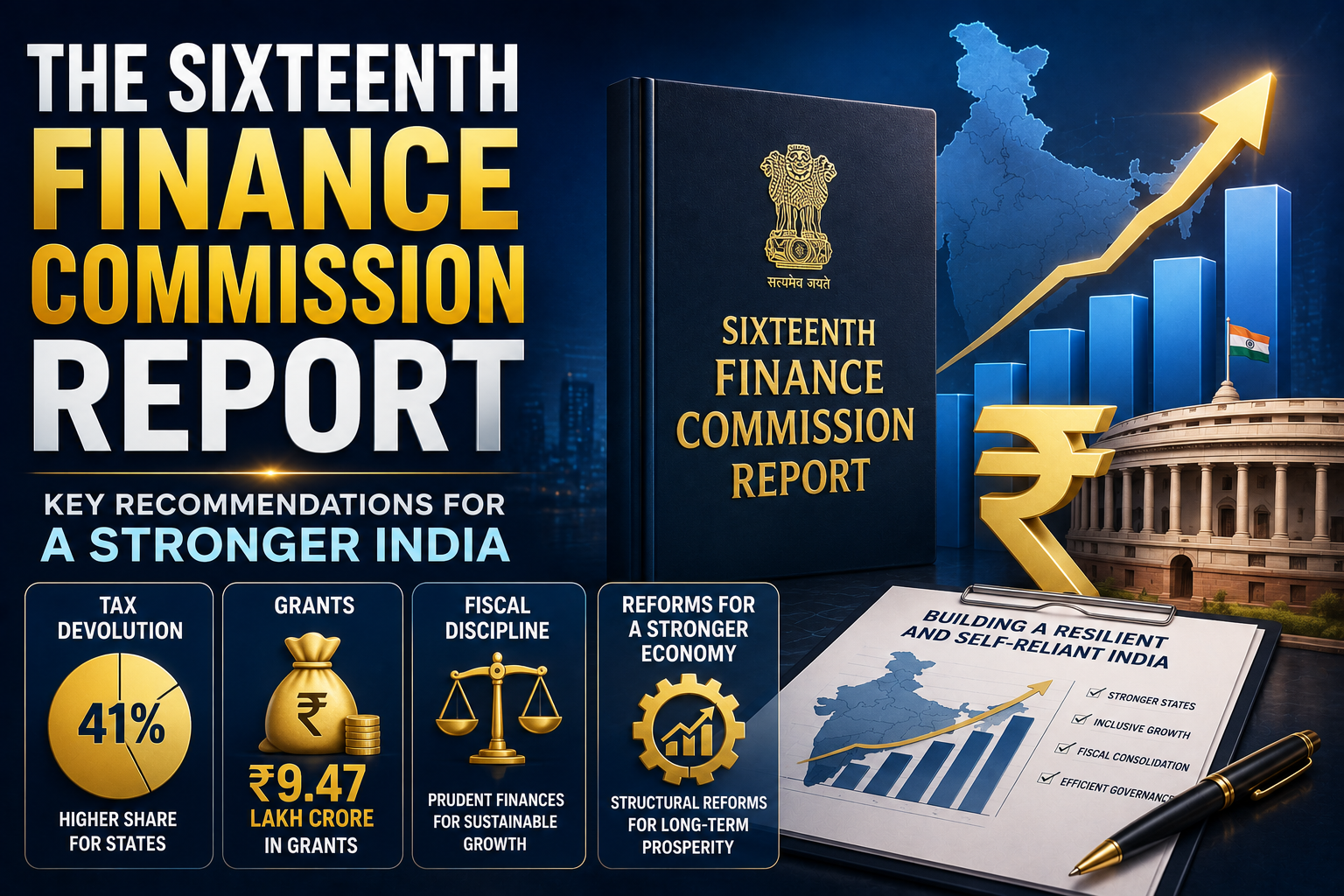
The Sixteenth Finance Commission (2026–31) has recommended retaining the states' share in the divisible pool of central taxes at 41%, introducing changes to the formula used for distributing funds among states, providing ₹9.47 lakh crore in grants, and setting a roadmap for fiscal discipline. The report also emphasizes power-sector reforms, subsidy rationalization, stronger local bodies, and improved public financial management.
AI Answer Box
What are the key recommendations of the Sixteenth Finance Commission?
The Sixteenth Finance Commission has recommended maintaining 41% tax devolution to states, revising the horizontal devolution formula by adding contribution to GDP as a criterion, providing ₹9.47 lakh crore in grants over five years, targeting a 3.5% fiscal deficit for the Centre by 2030–31, and encouraging reforms in power distribution, subsidy management, and state public sector enterprises.
Introduction
The Sixteenth Finance Commission (2026–2031) has outlined a comprehensive roadmap for strengthening India's fiscal framework and improving financial relations between the Centre and the States. Constituted under Article 280 of the Constitution, the Commission makes recommendations every five years on tax sharing, grants, and fiscal reforms.
The latest report seeks to strike a balance between economic growth, fiscal responsibility, and cooperative federalism. It focuses on ensuring predictable financial transfers to states while encouraging prudent fiscal management and improving the efficiency of public spending.
What Is the Sixteenth Finance Commission?
The Finance Commission is a constitutional body responsible for recommending how tax revenues collected by the Union Government should be shared with states.
Its key responsibilities include:
- Recommending tax devolution between the Centre and States.
- Suggesting grants-in-aid to states.
- Reviewing fiscal health and debt sustainability.
- Strengthening local governments.
- Recommending disaster management funding.
- Promoting balanced regional development.
The Sixteenth Finance Commission's recommendations will apply from FY 2026–27 to FY 2030–31.
Major Highlights of the Report
1. States to Continue Receiving 41% of Central Taxes
One of the Commission's biggest recommendations is to retain the vertical devolution at 41%, meaning states will continue to receive 41% of the divisible pool of central taxes.
This recommendation has been accepted by the Government of India.
Why It Matters
- Provides financial stability to states.
- Supports infrastructure and welfare spending.
- Maintains continuity with the previous Finance Commission.
- Strengthens cooperative federalism.
2. New Formula for Sharing Taxes Among States
While the overall share remains unchanged, the Commission has revised the horizontal devolution criteria used to determine each state's allocation.
Revised Weightage
| Criteria | Weight |
|---|---|
| Income Distance | 42.5% |
| Population (2011 Census) | 17.5% |
| Demographic Performance | 10% |
| Area | 10% |
| Forest & Ecology | 10% |
| Contribution to GDP | 10% |
A notable addition is the Contribution to GDP criterion, rewarding states that make a stronger contribution to national economic growth.
3. ₹9.47 Lakh Crore in Grants to States
The Commission has recommended ₹9.47 lakh crore in grants for the 2026–31 period.
Grant Distribution
| Grant Category | Recommended Amount |
|---|---|
| Local Bodies | ₹7.91 lakh crore |
| Disaster Management | ₹1.56 lakh crore |
| Total | ₹9.47 lakh crore |
The report also discontinues revenue deficit grants, sector-specific grants, and state-specific grants that were part of the previous Commission's recommendations.
4. Stronger Focus on Local Governments
The Commission recommends increased support for:
Rural Local Bodies
- Basic grants
- Performance-based grants
- Water management
- Sanitation projects
Urban Local Bodies
- Basic grants
- Performance grants
- Special infrastructure grants
- Urbanisation Premium Grants
The goal is to improve governance, public services, and urban infrastructure while encouraging greater financial accountability.
5. Fiscal Discipline Roadmap
The report emphasizes maintaining sustainable public finances.
Key Fiscal Targets
- Centre's fiscal deficit target: 3.5% of GDP by 2030–31
- States' fiscal deficit limit: 3% of GSDP
- Gradual reduction in combined public debt
- Greater transparency in public borrowing
The Commission has also recommended that off-budget borrowings should be fully reflected in government accounts to improve fiscal transparency.
6. Power Sector Reforms
The Commission recommends accelerating reforms in the electricity sector.
Key suggestions include:
- Encouraging privatisation of distribution companies (DISCOMs).
- Improving financial sustainability.
- Reducing operational losses.
- Linking capital assistance to successful reforms.
These measures aim to strengthen state finances while improving power distribution efficiency.
7. Rationalisation of Subsidies
The report encourages governments to review subsidy programmes to ensure benefits reach intended beneficiaries.
Recommendations include:
- Better targeting of beneficiaries.
- Standardised accounting of subsidies.
- Reducing reliance on off-budget financing.
- Periodic review of subsidy effectiveness.
These reforms are intended to improve fiscal efficiency and transparency.
8. Reform of State Public Sector Enterprises (SPSEs)
The Commission recommends reviewing inactive and loss-making state public sector enterprises.
Suggested actions include:
- Closure of non-operational entities.
- Privatisation where appropriate.
- Better governance standards.
- Improved operational efficiency.
These measures could reduce the financial burden on state governments.
Expert Commentary
The Sixteenth Finance Commission Report provides a balanced framework for fiscal federalism by maintaining stability in tax devolution while introducing performance-oriented elements such as Contribution to GDP in the distribution formula. Its recommendations on fiscal discipline, local government funding, power-sector reforms, and subsidy rationalisation aim to improve the quality of public spending and strengthen long-term economic resilience. Successful implementation will depend on coordinated efforts between the Union and State governments.
Key Takeaways
- States will continue to receive 41% of the divisible pool of central taxes.
- A revised devolution formula introduces Contribution to GDP as a new criterion.
- ₹9.47 lakh crore in grants has been recommended for 2026–31.
- Local governments receive increased focus through basic and performance-based grants.
- Fiscal deficit targets aim to strengthen long-term fiscal discipline.
- The report recommends reforms in power distribution, subsidies, and state public enterprises.
- Greater transparency in public borrowing and stronger financial management are central themes.
Pros & Cons of the Sixteenth Finance Commission Report
Pros
- Maintains fiscal stability by retaining 41% tax devolution to states.
- Introduces Contribution to GDP as a new performance-based criterion for horizontal devolution.
- Recommends ₹9.47 lakh crore in grants to support local bodies and disaster management.
- Encourages fiscal discipline through clear deficit and debt targets.
- Promotes transparency in government borrowing and public finances.
- Supports reforms in the power sector and State Public Sector Enterprises (SPSEs).
- Strengthens cooperative federalism by balancing equity and efficiency in fund allocation.
Cons
- States receiving a lower share under the revised formula may face fiscal pressure.
- Achieving fiscal deficit targets may require difficult expenditure decisions.
- Reforming subsidies and state-owned enterprises could face political and administrative challenges.
- Implementing power sector reforms may require significant investment and coordination.
- Performance-based allocation may be challenging for economically weaker states.
- Success depends on timely implementation by both the Union and State governments.
Impact on States, Taxpayers & the Indian Economy
Impact on State Governments
The Commission's recommendations aim to provide states with predictable financial resources while encouraging responsible fiscal management.
Expected Benefits
- Stable tax revenue transfers.
- Greater focus on fiscal responsibility.
- Increased funding for local bodies.
- Incentives for better economic performance.
- Support for infrastructure and public service delivery.
States that improve governance, financial management, and economic growth may benefit from the revised devolution framework.
Impact on Taxpayers
While taxpayers will not experience immediate changes in tax rates due to the report, efficient use of public funds can improve public services over time.
Potential long-term benefits include:
- Better roads and infrastructure.
- Improved healthcare and education.
- Stronger disaster management systems.
- Enhanced urban and rural civic services.
- More transparent public spending.
Impact on the Indian Economy
The recommendations support India's long-term economic development by strengthening fiscal discipline and improving Centre-State financial coordination.
Potential Economic Benefits
- Sustainable public finances.
- Higher quality capital expenditure.
- Stronger state finances.
- Increased investor confidence.
- Better infrastructure development.
- Improved governance.
- Greater macroeconomic stability.
Successful implementation could contribute to higher economic growth and stronger fiscal resilience over the coming years.
Summary Table
| Recommendation | Expected Impact |
|---|---|
| 41% Tax Devolution | Stable revenue for states |
| New GDP Contribution Criterion | Rewards economically productive states |
| ₹9.47 Lakh Crore Grants | Stronger local governance and disaster preparedness |
| Fiscal Deficit Roadmap | Better debt sustainability |
| Power Sector Reforms | Improved efficiency of DISCOMs |
| Subsidy Rationalisation | More efficient public spending |
| SPSE Reforms | Reduced fiscal burden on states |
Frequently Asked Questions (FAQs)
1. What is the Sixteenth Finance Commission?
It is a constitutional body established under Article 280 to recommend how central tax revenues should be shared between the Union and the States and to recommend grants and fiscal reforms.
2. What is the tenure of the Sixteenth Finance Commission?
Its recommendations cover the period from 2026–27 to 2030–31.
3. What is the recommended tax devolution to states?
The Commission has recommended retaining the states' share at 41% of the divisible pool of central taxes.
4. What is the new GDP contribution criterion?
For the first time, Contribution to GDP has been included as a criterion in the horizontal devolution formula to recognize states' role in economic growth.
5. How much has been recommended as grants?
The Commission has recommended approximately ₹9.47 lakh crore in grants over five years.
6. What are horizontal and vertical devolution?
Vertical devolution refers to the sharing of taxes between the Centre and States, while horizontal devolution determines how the states' share is distributed among individual states.
7. Why is fiscal discipline important?
Fiscal discipline helps control government debt, maintain economic stability, improve investor confidence, and ensure sustainable public finances.
8. What reforms are suggested for the power sector?
The report recommends improving the financial health of electricity distribution companies (DISCOMs), reducing losses, and encouraging efficiency-driven reforms.
9. How does the report affect local governments?
It recommends substantial grants for Panchayats and Urban Local Bodies to improve service delivery, infrastructure, and governance.
10. Will taxpayers see immediate tax changes?
No. The report focuses on revenue sharing and fiscal management rather than changing personal tax rates.
11. Why is subsidy rationalisation recommended?
The Commission suggests improving subsidy targeting and transparency so that benefits reach intended recipients while reducing fiscal inefficiencies.
12. How could investors benefit from these recommendations?
Greater fiscal stability, stronger state finances, and improved infrastructure can enhance the overall investment environment.
13. What is the significance of SPSE reforms?
Improving the performance of State Public Sector Enterprises can reduce financial burdens on states and improve resource allocation.
14. Does the report become law automatically?
No. The Commission makes recommendations, and the Union Government decides which recommendations to accept and implement.
15. What is the overall objective of the Sixteenth Finance Commission?
The Commission aims to strengthen fiscal federalism, promote balanced development, improve public financial management, and support sustainable economic growth.
Conclusion
The Sixteenth Finance Commission Report outlines a comprehensive roadmap for strengthening India's fiscal framework over the 2026–31 period. By retaining 41% tax devolution, introducing Contribution to GDP as a new criterion for fund allocation, recommending ₹9.47 lakh crore in grants, and emphasizing fiscal discipline and governance reforms, the report seeks to balance equity with efficiency.
For state governments, the recommendations provide greater financial certainty while encouraging responsible fiscal management. For businesses and investors, improved public finances, stronger infrastructure spending, and enhanced transparency can contribute to a more stable economic environment. The long-term success of these recommendations will depend on effective implementation and continued cooperation between the Union and State governments.
Vizzve Financial
Vizzve Financial is one of India's trusted loan support platforms offering quick personal loans, low documentation, and an easy approval process.
Whether you need funds for education, business expansion, home improvement, medical emergencies, or personal financial needs, Vizzve Financial provides a fast, secure, and hassle-free borrowing experience.
Apply today at: www.vizzve.com
Published on : 16th July
Published by : SMITA
www.vizzve.com || www.vizzveservices.com
Follow us on social media: Facebook || Linkedin || Instagram
🛡 Powered by Vizzve Financial
RBI-Registered Loan Partner | 10 Lakh+ Customers | ₹600 Cr+ Disbursed