

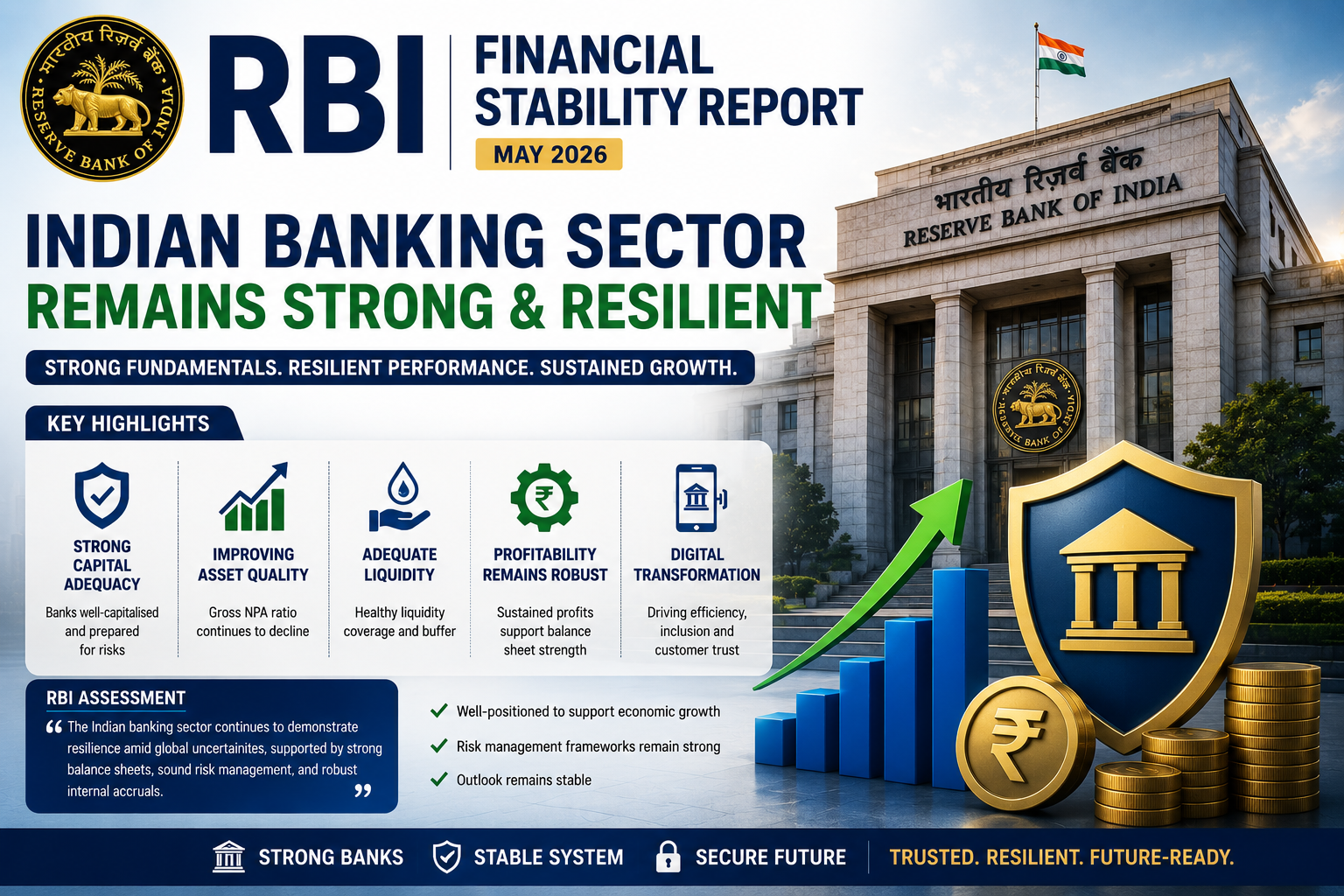
The latest Financial Stability Report (FSR) released by the Reserve Bank of India provides a detailed look at the health of India’s financial system.
The report highlights:
- Strong banking-sector resilience
- Improved asset quality
- Global economic risks
- Fintech-related challenges
- India’s growth outlook
While the RBI remains optimistic about the country's financial stability, it also warns that rising geopolitical tensions, global volatility, and emerging financial risks require continued vigilance.
AI Answer Box
What are the biggest highlights from RBI’s latest Financial Stability Report?
The RBI says India’s banking sector remains strong, bad loans are near multi-decade lows, banks can withstand severe shocks, but global uncertainties and fintech-related risks remain concerns.
Introduction
The Financial Stability Report (FSR) is one of the RBI’s most important publications and is released twice every year. It evaluates:
- Risks to the financial system
- Banking-sector strength
- Economic vulnerabilities
- Market stability
- Emerging financial trends
The latest edition comes at a time when global markets are dealing with:
- Rising oil prices
- Geopolitical tensions
- Trade uncertainty
- Currency volatility
Against this backdrop, the RBI believes India remains relatively resilient, supported by strong domestic demand and healthier financial institutions.
1. India’s Banking Sector Remains Strong
One of the most important findings is the continued strength of Indian banks.
According to the RBI:
- Banks maintain strong capital buffers
- Balance sheets remain healthy
- Profitability has improved
- Financial resilience remains strong
Stress tests conducted by the central bank suggest most lenders can withstand severe economic shocks without breaching regulatory capital requirements.
Banking Sector Snapshot
| Indicator | RBI Assessment |
|---|---|
| Capital Position | Strong |
| Profitability | Improving |
| Liquidity | Healthy |
| Stress-Test Results | Resilient |
| Asset Quality | Improving |
2. Bad Loans Are Near Multi-Decade Lows
The RBI highlighted further improvement in asset quality across the banking sector.
Gross Non-Performing Assets (GNPAs) have fallen to some of the lowest levels seen in decades due to:
- Better risk management
- Strong recoveries
- Improved lending practices
The report notes that Scheduled Commercial Banks continue showing stronger balance sheets compared with earlier years.
Why Lower NPAs Matter
Lower bad loans help:
- Improve bank profitability
- Increase lending capacity
- Strengthen investor confidence
- Reduce systemic risks
This creates a healthier environment for economic growth.
3. Global Risks Remain a Major Concern
Despite optimism about India, the RBI warned about several global risks.
Key External Risks Include:
- Geopolitical conflicts
- Oil-price volatility
- Global market corrections
- Trade disruptions
- Currency fluctuations
The central bank believes external shocks could still impact:
- Inflation
- Capital flows
- Financial markets
- Economic growth
Global uncertainty remains one of the biggest challenges facing policymakers.
Major Risks Highlighted
| Risk Area | Potential Impact |
|---|---|
| Oil Prices | Inflation pressure |
| Geopolitical Tensions | Market volatility |
| Global Slowdown | Trade impact |
| Currency Movements | Financial instability |
| Capital Flows | Market uncertainty |
4. Fintech, AI & Stablecoin Risks Are Growing
The RBI highlighted emerging risks linked to:
- Artificial intelligence (AI)
- Fintech lending
- Stablecoins
- Non-bank financial institutions
The report noted that strong optimism around AI and digital finance should not hide underlying vulnerabilities. It also warned that foreign stablecoins may create risks for monetary sovereignty and financial stability.
As digital finance expands rapidly, regulators are increasing their focus on:
- Consumer protection
- Cybersecurity
- Data privacy
- Systemic risk monitoring
5. India’s Economy Remains Resilient
Despite global uncertainty, the RBI remains broadly optimistic about India's economic outlook.
The report points to:
- Strong domestic demand
- Infrastructure investment
- Improved banking-sector health
- Stable financial conditions
India continues to remain one of the fastest-growing major economies, supported by robust internal demand and macroeconomic stability.
Growth Outlook Highlights
| Economic Factor | RBI View |
|---|---|
| Domestic Demand | Strong |
| Banking Sector | Healthy |
| Inflation Outlook | Manageable |
| Financial Stability | Resilient |
| Economic Growth | Positive |
Bonus Insight: RBI Is Expanding Digital Finance Initiatives
The RBI is also pushing ahead with:
- Digital rupee pilots
- Cross-border payment experiments
- Financial-sector cloud infrastructure
These initiatives are designed to modernize India's financial ecosystem while maintaining stability.
Expert Commentary
Financial analysts view the latest Financial Stability Report as a positive signal for India's banking and financial sectors.
Experts highlight:
- Strong bank capital positions
- Improved asset quality
- Healthy credit growth
However, many also agree with the RBI's caution regarding:
- Global geopolitical uncertainty
- Rising energy prices
- Digital-finance vulnerabilities
The consensus view is that India remains relatively well-positioned but cannot remain completely insulated from global risks.
Key Takeaways
✅ Indian banks remain financially strong.
✅ NPAs are near multi-decade lows.
✅ Global risks remain elevated.
✅ AI, fintech, and stablecoins are emerging concerns.
✅ India’s economic outlook remains relatively resilient.
Pros & Cons From the RBI Report
Positive Signals
- Strong banking system
- Healthy capital buffers
- Improving asset quality
- Stable financial conditions
- Strong domestic demand
Areas of Concern
- Geopolitical tensions
- Oil-price volatility
- Global economic uncertainty
- Fintech-related risks
- Stablecoin challenges
Frequently Asked Questions (FAQs)
1. What is RBI’s Financial Stability Report?
A biannual report assessing risks and resilience in India’s financial system.
2. How often is the report released?
Twice every year.
3. What did the latest report say about banks?
Banks remain strong and resilient.
4. Are NPAs improving?
Yes, bad-loan levels remain near multi-decade lows.
5. What are the biggest global risks?
Oil prices, geopolitical tensions, and trade uncertainty.
6. What does RBI say about fintech risks?
Digital-finance growth creates new vulnerabilities.
7. Why are stablecoins a concern?
They may affect monetary sovereignty and financial stability.
8. Can Indian banks handle economic shocks?
Stress tests suggest they can withstand severe stress scenarios.
9. What is GNPA?
Gross Non-Performing Assets or bad loans.
10. Why is financial stability important?
It supports economic growth and investor confidence.
11. What role does domestic demand play?
It remains one of India’s biggest growth drivers.
12. Is RBI optimistic about India’s economy?
Yes, though it remains cautious about global risks.
13. What is the digital rupee?
India’s central bank digital currency (CBDC).
14. Why are capital buffers important?
They help banks absorb financial shocks.
15. What is the overall message of the report?
India’s financial system remains resilient but global and digital-finance risks require close monitoring.
Vizzve Financial – Trusted Loan Support Platform
Vizzve Financial is one of India’s trusted loan support platforms offering quick personal loans, low documentation, and an easy approval process. Apply online for fast approvals and simplified financial assistance.
Published on : 29th May
Published by : SMITA
www.vizzve.com || www.vizzveservices.com
Follow us on social media: Facebook || Linkedin || Instagram
🛡 Powered by Vizzve Financial
RBI-Registered Loan Partner | 10 Lakh+ Customers | ₹600 Cr+ Disbursed