

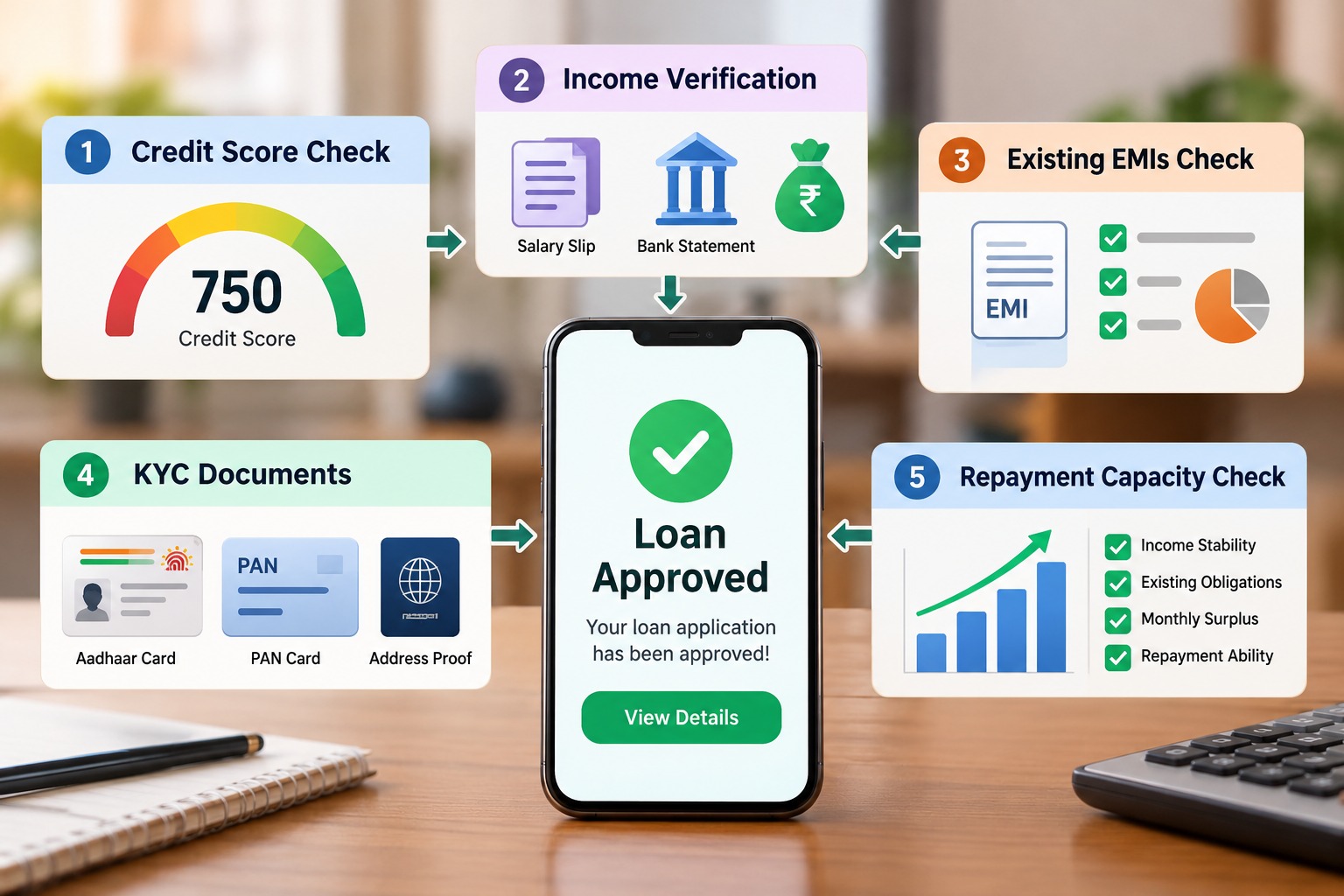
Applying for a loan through a mobile app can be quick, but approval is not based only on filling out an online form. Before approving a loan, lenders generally assess your creditworthiness, income, existing financial obligations, identity, documents and repayment capacity.
RBI's digital-lending framework requires regulated lenders to assess the borrower's economic profile and creditworthiness before extending a loan.
If you understand these checks in advance, you can prepare your documents and avoid common mistakes that may delay or affect your application.
5 Things Loan Apps Check Before Approving Your Loan
1. Credit Score and Credit History
Your credit history can be an important part of the loan assessment.
A lender may review information such as:
- Previous loan repayment history
- Credit-card payment behavior
- Existing credit accounts
- Outstanding balances
- Recent credit enquiries
- Previous overdue payments or defaults
A history of timely repayments can provide evidence of responsible credit behavior, while negative or incomplete credit information may require additional assessment.
Tip: Check your credit report before applying and correct genuine errors if you find any.
2. Income and Employment Details
Loan apps may ask for information about your income and occupation because the lender needs to determine whether you have sufficient repayment capacity.
For salaried borrowers, this may involve:
- Monthly salary
- Employment details
- Salary-account information
- Salary slips
- Bank statements
For self-employed borrowers, lenders may consider:
- Business income
- Bank transactions
- ITRs
- Business documents
- Financial statements
RBI's digital-lending framework specifically requires regulated entities to obtain information relating to the borrower's economic profile for creditworthiness assessment, including age, occupation and income details.
3. Existing Loans and EMI Burden
A lender may also look at how much debt you already have.
For example, suppose your monthly income is ₹50,000 and you already pay ₹25,000 toward existing EMIs. Taking another large loan could increase your repayment burden significantly.
Lenders can therefore consider:
- Existing personal loans
- Home or vehicle loans
- Credit-card outstanding balances
- Current EMIs
- Other repayment obligations
The goal is to assess whether the proposed loan fits your overall financial profile.
Tip: Before applying, calculate your current monthly debt obligations and the expected EMI of the new loan.
4. KYC and Document Verification
Loan applications generally require identity and other verification.
Depending on the lender and product, you may be asked for:
- PAN
- Aadhaar or another officially valid document
- Address details
- Bank-account information
- Income documents
- Employment or business information
The lender may compare information across the application and submitted documents.
Problems such as a name mismatch, incorrect date of birth, outdated information or inconsistent income details can lead to additional verification or delay.
Stay Careful With Loan App KYC
Only provide documents through the lender's genuine website or authorized application.
For digital lending, RBI requires regulated entities to remain responsible for their lending service providers and digital lending arrangements.
Never share:
- OTPs
- UPI PINs
- ATM PINs
- Internet-banking passwords
- Card PINs
with an agent or suspicious loan app.
5. Overall Repayment Capacity and Risk Assessment
Approval is not usually based on one number.
The lender may consider your overall financial profile, including:
- Income
- Credit history
- Existing debt
- Occupation
- Age
- Requested loan amount
- Loan tenure
- Bank-account information
- Other information required for credit assessment
RBI's framework requires regulated entities to assess creditworthiness before extending loans and maintain the relevant information for audit purposes.
This means an applicant with a good credit score can still receive a different decision if other parts of the financial profile do not meet the lender's criteria.
How the Loan App Approval Process Usually Works
The exact process differs by lender, but a digital loan application may generally follow these stages:
Step 1: Enter personal and loan details
↓
Step 2: Complete KYC
↓
Step 3: Provide required income and financial information
↓
Step 4: Credit and repayment-capacity assessment
↓
Step 5: Document and information verification
↓
Step 6: Loan decision and offer
↓
Step 7: Agreement and disbursal, if approved
For digital lending, RBI requires the applicable KFS and other important loan information to be provided to borrowers before execution of the loan contract.
What Can Cause a Loan Application to Be Rejected?
Common reasons can include:
| Reason | What it can mean |
|---|---|
| Weak credit history | Previous repayment issues or limited credit history |
| High existing debt | Repayment burden may already be significant |
| Insufficient income | Income may not support the requested EMI |
| KYC problems | Identity or information cannot be verified |
| Document mismatch | Application information differs from submitted records |
| Unstable income | Income may not meet lender criteria |
| Too many recent applications | Multiple credit enquiries may affect assessment |
| Lender policy | The application may not meet specific internal criteria |
RBI fair-practice guidance says lenders should properly assess credit applications and, for applicable lending decisions, communicate the main reasons for rejection in writing within the stipulated framework.
How to Improve Your Loan Application
Before submitting an application:
Keep Your Credit Profile Healthy
Pay existing EMIs and credit-card bills on time and monitor your credit report.
Reduce Unnecessary Debt
A lower existing repayment burden can make your overall financial position easier to assess.
Keep Documents Updated
Make sure your PAN, KYC details, bank information and income documents are accurate.
Avoid Multiple Applications
Applying for several loans within a short period can result in multiple credit enquiries. Apply selectively instead of sending applications to many lenders simultaneously.
Choose an Affordable Loan Amount
Do not apply for more than you reasonably need or can repay.
What Should You Check After Approval?
Getting an approval notification does not mean you should accept the loan immediately.
Before accepting, check:
- Interest rate
- APR
- EMI
- Loan tenure
- Processing fee
- Other charges
- Total repayment
- Prepayment terms
- Penal charges
- KFS
- Loan agreement
- Lender's grievance mechanism
For digital loans, RBI requires APR to be disclosed upfront and included in the KFS.
Loan App Safety Checklist
Before using a loan app, ask:
Is the actual lender clearly identified?
Is the app connected to a regulated lender or authorized lending service provider?
Are the interest rate and charges clearly disclosed?
Can I access the KFS and loan agreement?
Does the app request unnecessary access to my personal information?
Is anyone asking for an OTP, PIN or password?
If the answers raise concerns, stop and verify the lender before proceeding.
Key Takeaways
- Loan apps may check credit history, income, existing EMIs, KYC and repayment capacity.
- A high credit score alone does not guarantee approval.
- Lenders can consider your complete economic and financial profile.
- Incorrect KYC or document information can delay verification.
- Compare the interest rate, APR, EMI and total repayment before accepting an offer.
- Read the KFS and loan agreement carefully.
- Never share OTPs, PINs or passwords with loan agents or apps.
- Verify the actual lender before submitting sensitive financial information.
FAQs
1. What do loan apps check before approving a loan?
They may check credit history, income, occupation, existing debt, KYC information, documents and repayment capacity.
2. Does a good credit score guarantee loan approval?
No. Credit score is only one part of the overall assessment. Income, existing obligations, documents and lender-specific criteria can also matter.
3. Do loan apps check income?
Yes, lenders may assess income and other economic-profile information to determine repayment capacity.
4. Why was my loan application rejected despite having a good credit score?
A good credit score does not guarantee approval. High existing EMIs, insufficient income, document problems, KYC issues or lender-specific criteria may affect the decision.
5. Can existing EMIs affect a new loan application?
Yes. Existing repayment obligations can be considered when assessing whether you can comfortably repay another loan.
6. What documents are commonly required for online loans?
Requirements vary, but lenders may request KYC documents, PAN, bank information and income or employment-related documents.
7. Can a loan app access my bank information?
Only provide financial information through legitimate, authorized processes and review the permissions and privacy terms before giving consent.
8. What is KFS in a digital loan?
KFS stands for Key Facts Statement. It provides important loan information, including applicable costs and terms, before the loan contract is executed.
9. What is APR on a digital loan?
APR, or Annual Percentage Rate, represents the annualized cost of a digital loan under the applicable RBI framework and is disclosed in the KFS.
10. Can a loan app reject my application after initial approval?
An initial or preliminary indication may not be the same as final sanction. Final approval can depend on verification and the lender's complete assessment.
11. Should I apply to many loan apps at once?
It is generally better to compare lenders first and apply selectively rather than submitting unnecessary applications to multiple lenders.
12. What should I do if my loan is rejected?
Check the stated reason, review your credit report and documents, assess your existing debt and avoid immediately submitting multiple applications without understanding the issue.
Published on : 25th September 2026
Published by : Shibam Nath
www.vizzve.com || www.vizzveservices.com
Follow us on social media: Facebook || Linkedin || Instagram
🛡 Powered by Vizzve Financial
RBI-Registered Loan Partner | 10 Lakh+ Customers | ₹600 Cr+ Disbursed