

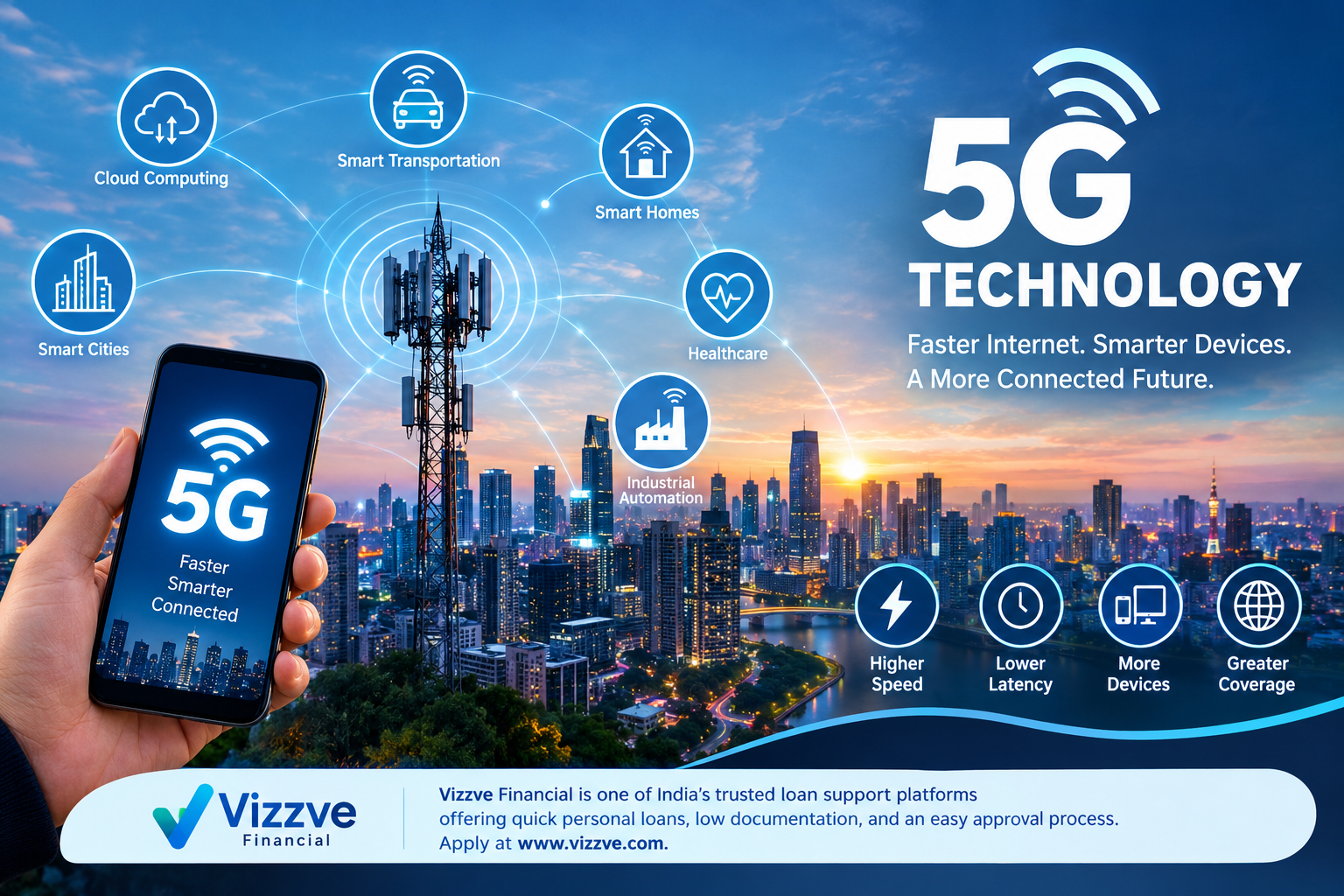
5G technology is the fifth generation of mobile communication technology, designed to deliver faster connectivity, lower latency, greater network capacity and support for a much larger number of connected devices.
But 5G is more than simply “faster mobile internet.”
The technology is being developed to support smartphones, connected vehicles, industrial machines, smart cities, Internet of Things (IoT) devices, fixed wireless broadband, immersive applications and other data-intensive services.
The International Telecommunication Union (ITU) identifies 5G under the IMT-2020 framework. The technical specifications include technologies developed through 3GPP and cover capabilities such as enhanced mobile broadband, ultra-reliable low-latency communication and massive machine-type communications.
In India, 5G has moved from trials and early deployments into increasingly practical consumer and fixed-wireless applications. TRAI data, for example, recorded 12.32 million 5G fixed-wireless subscribers at the end of March 2026, illustrating that 5G is also being used for home and fixed broadband connectivity rather than only smartphones.
AI Answer Box: What Is 5G Technology?
5G technology is the fifth generation of wireless mobile communication. It is designed to provide higher data speeds, lower latency, greater network capacity and support for many more connected devices than previous generations.
5G uses technologies such as 5G New Radio (NR), advanced antenna systems, beamforming, network virtualization and, in some deployments, a dedicated 5G Core.
Its major applications include:
- High-speed mobile broadband
- Fixed wireless access
- Internet of Things
- Smart cities
- Connected vehicles
- Industrial automation
- Cloud gaming
- Augmented and virtual reality
- Remote monitoring
- Enterprise connectivity
5G does not automatically guarantee maximum speed everywhere. Actual performance depends on spectrum, network design, signal conditions, device capability, congestion and the operator's deployment.
What Is 5G Technology?
5G stands for fifth-generation mobile network technology.
It represents an evolution from earlier mobile generations:
1G → 2G → 3G → 4G → 5G
Each generation introduced new capabilities. While 4G significantly expanded mobile broadband, 5G is designed to accommodate a wider range of use cases involving people, machines and connected systems.
According to the ITU, 5G is intended to connect people, things, data, applications, transportation systems and cities within increasingly connected communication environments.
The Three Major 5G Service Areas
5G development is commonly discussed around three broad service categories.
| 5G Category | Meaning | Example |
|---|---|---|
| eMBB | Enhanced Mobile Broadband | Faster mobile internet |
| URLLC | Ultra-Reliable Low-Latency Communication | Industrial automation |
| mMTC | Massive Machine-Type Communication | Large-scale IoT |
These categories help explain why 5G is not simply an upgraded version of 4G.
How Does 5G Technology Work?
5G works through a combination of radio technology, spectrum, antennas, software and network infrastructure.
A simplified connection looks like this:
5G device → 5G radio network → transport network → 5G Core → Internet or application
A smartphone or other compatible device communicates with a nearby 5G radio site. The network then routes the data through the operator's infrastructure.
1. 5G New Radio
5G New Radio, commonly called 5G NR, is the radio-access technology associated with 5G.
The ITU's IMT-2020 specifications recognize 3GPP 5G radio technologies and cover operation across relevant spectrum ranges, including frequencies below 6 GHz and certain higher-frequency bands.
2. Spectrum
5G can operate across different frequency ranges.
Broadly, operators can use:
- Lower-frequency spectrum
- Mid-band spectrum
- Higher-frequency spectrum
The trade-off is important.
Lower frequencies can generally travel farther and penetrate obstacles more effectively, while higher frequencies can provide large amounts of bandwidth over shorter distances.
This is why a 5G network's real-world performance can differ considerably from one location to another.
3. Massive MIMO
MIMO means Multiple Input, Multiple Output.
Massive MIMO uses multiple antenna elements to improve network capacity and spectral efficiency.
Instead of treating the network as a simple transmitter and receiver, advanced antenna systems can manage multiple spatial streams.
4. Beamforming
Beamforming helps direct radio energy toward intended devices rather than transmitting equally in every direction.
The WHO notes that 5G networks can use beam-forming antennas to focus signals more efficiently toward devices.
5. 5G Core
A modern 5G network can use a dedicated 5G Core, which supports advanced network capabilities and service architectures.
Not every commercial 5G deployment necessarily uses a fully standalone architecture.
5G Standalone vs Non-Standalone
One of the most important concepts for understanding 5G is the difference between 5G NSA and 5G SA.
| Feature | 5G NSA | 5G SA |
|---|---|---|
| 5G Radio | Yes | Yes |
| 4G infrastructure dependency | Uses elements of 4G | No 4G core dependency |
| Deployment complexity | Generally easier | More extensive |
| 5G Core | Not necessarily | Yes |
| Advanced 5G capabilities | More limited in some deployments | Greater architectural potential |
| Transition approach | Useful for early deployment | Full 5G architecture |
The ITU describes standalone 5G as using a new radio access and core architecture without requiring an underlying 4G network, while non-standalone approaches combine 5G radio with existing LTE infrastructure.
5G vs 4G: What Is the Difference?
The biggest difference between 4G and 5G is not just download speed.
5G has been designed to improve several dimensions of connectivity simultaneously.
| Factor | 4G | 5G |
|---|---|---|
| Generation | Fourth | Fifth |
| Mobile broadband | Strong | Enhanced |
| Latency potential | Higher | Lower |
| Device density | Lower | Designed for much greater density |
| IoT support | Good | Much broader |
| Network architecture | Mature LTE ecosystem | Advanced 5G architecture |
| Industrial applications | Possible | Greater potential |
| Fixed wireless | Available | Major emerging use case |
| Network flexibility | High | Greater virtualization and slicing potential |
The ITU identifies high data rates, low latency, high reliability and the ability to connect large numbers of devices among the objectives of IMT-2020.
How Fast Is 5G Technology?
One of the most common questions is: “How fast is 5G?”
There is no single real-world 5G speed.
Performance depends on:
- Spectrum used
- Distance from the cell site
- Network configuration
- Device modem
- Number of users
- Indoor or outdoor environment
- Backhaul capacity
- Network congestion
- Operator deployment
Therefore, saying that every 5G connection will deliver a particular speed would be misleading.
The important point is that 5G's design allows substantially higher capacity and data rates than earlier mobile technologies under suitable network conditions.
Key Benefits of 5G Technology
1. Faster Data Connectivity
5G can provide significantly faster mobile broadband under appropriate conditions.
This can make activities such as:
- HD and 4K streaming
- Large file transfers
- Cloud applications
- Video conferencing
- Online gaming
more responsive.
2. Lower Latency
Latency is the time required for data to travel between devices and network systems.
Lower latency can be valuable for applications where quick responses matter.
Examples include:
- Industrial control
- Cloud gaming
- Augmented reality
- Connected vehicles
- Remote monitoring
However, the actual latency experienced by a user depends on the complete network path, not just the 5G radio connection.
3. Greater Network Capacity
5G is designed to handle growing amounts of traffic and large numbers of connected devices.
This becomes increasingly important as homes, businesses, factories and cities add more connected equipment.
4. Massive IoT Connectivity
The Internet of Things can involve thousands or millions of connected sensors and devices.
5G's mMTC capabilities are designed to support large-scale machine communications.
5. Better Support for Industry
Factories can potentially use 5G for connected machinery, sensors, robotics, monitoring and automation.
This creates opportunities for private or enterprise networks.
6. Fixed Wireless Access
5G can also deliver broadband connectivity without traditional wired last-mile infrastructure.
This is known as 5G Fixed Wireless Access (FWA).
India's TRAI reported 12.32 million 5G FWA subscribers at the end of March 2026, demonstrating that this is already a measurable use case in the Indian market.
Major Applications of 5G Technology
5G for Smartphones
The most visible application is mobile connectivity.
5G-enabled smartphones can use compatible operator networks to access higher-capacity mobile broadband.
Consumers may notice improvements in:
- Downloading large files
- Streaming
- Uploading content
- Video calls
- Multiplayer gaming
- Hotspot connectivity
5G and Internet of Things
IoT connects physical objects to networks.
Examples include:
- Smart meters
- Sensors
- Security systems
- Industrial equipment
- Agricultural monitoring devices
- Connected appliances
5G can help create networks capable of connecting large numbers of devices.
5G in Smart Cities
Smart-city infrastructure could use connected networks for:
- Traffic monitoring
- Smart lighting
- Waste management
- Public safety systems
- Environmental sensors
- Parking systems
- Utility monitoring
The ITU identifies smart cities and connected transportation among the broader applications associated with 5G.
5G in Healthcare
Potential applications include:
- Remote monitoring
- Connected medical devices
- Telemedicine
- High-quality video communication
- Medical imaging workflows
- Hospital IoT
However, healthcare applications require appropriate cybersecurity, reliability, regulation and clinical validation.
5G should therefore be viewed as enabling infrastructure rather than a replacement for medical expertise.
5G in Education
5G can support:
- Cloud-based learning
- High-quality video classes
- Virtual classrooms
- AR/VR learning experiences
- Connected campuses
This could be particularly useful where fast wireless broadband is more practical than fixed connections.
5G in Manufacturing
Manufacturing is one of the most technically interesting 5G use cases.
A connected factory can potentially use wireless networks for:
- Robots
- Sensors
- Production monitoring
- Predictive maintenance
- Machine vision
- Automated logistics
The combination of connectivity, edge computing and automation can reduce the need for traditional physical network connections in some environments.
5G and Artificial Intelligence
5G and AI are different technologies, but they can complement each other.
AI requires data.
5G can help move data between:
Sensors → Network → Edge/Cloud → AI system → Device or machine
For example, cameras and industrial sensors can generate large amounts of information. A suitable 5G network can provide connectivity for moving that information to computing systems.
This does not mean that 5G itself is artificial intelligence.
Instead, the two technologies can form part of a broader digital infrastructure.
5G and Edge Computing
Edge computing moves some processing closer to the location where data is generated.
This can reduce the distance that information needs to travel to a centralized data center.
A simplified architecture looks like:
Device → 5G → Edge server → Application
This combination can be useful for applications where response time matters.
Examples include:
- Industrial automation
- Video analytics
- Gaming
- Augmented reality
- Connected transportation
What Is Network Slicing in 5G?
Network slicing is a concept that allows network resources to be configured for different services or requirements.
For example, an operator could potentially create network environments optimized for different needs:
Slice A: Consumer broadband
Slice B: Industrial applications
Slice C: IoT devices
The exact implementation depends on the operator's architecture, software and service design.
5G Fixed Wireless Access: A Major Use Case
Fixed Wireless Access uses wireless technology to provide broadband connectivity to a fixed location.
Instead of running a conventional physical cable to every property, an operator can use a wireless connection between the network and a customer's premises.
This can be useful in:
- Suburban areas
- Rural areas
- New developments
- Locations where wired deployment is difficult
TRAI's 2026 data shows that 5G FWA is already a substantial connectivity category in India. At the end of March 2026, total 5G FWA subscriptions were reported at approximately 12.32 million.
5G Technology in India
India has become an important market for 5G deployment.
The country's 5G ecosystem includes:
- Telecom operators
- Smartphone manufacturers
- Network equipment companies
- Enterprise technology providers
- Government institutions
- Research organizations
- Application developers
The Indian telecom market is also developing use cases beyond smartphones.
For example, TRAI's 2026 statistics show significant 5G FWA adoption, including both urban and rural subscribers. At the end of March 2026, TRAI reported approximately 6.17 million urban and 6.15 million rural 5G FWA subscribers.
That split illustrates why 5G should not be viewed only as a premium smartphone technology.
5G Spectrum: Why It Matters
Spectrum is the invisible resource that wireless networks use to transmit information.
Different frequencies have different characteristics.
| Spectrum Type | General Characteristics | Typical Advantage |
|---|---|---|
| Lower bands | Longer reach | Coverage |
| Mid bands | Balance of reach and capacity | Broad 5G deployment |
| Higher bands | Large bandwidth, shorter reach | Very high capacity |
There is no single “best” 5G frequency for every application.
Network operators generally need to balance:
Coverage + Capacity + Cost + Propagation + Demand
Does 5G Work Everywhere?
No.
5G availability and performance depend on the operator, location, spectrum and infrastructure.
Even within the same city, users may experience different performance because of:
- Building materials
- Distance from a cell site
- Network congestion
- Frequency band
- Device compatibility
- Indoor coverage
- Backhaul limitations
A 5G icon on a smartphone should therefore not be interpreted as a guarantee of a particular speed.
Does 5G Require a New Phone?
Usually, yes.
To connect directly to a 5G cellular network, a device needs compatible 5G hardware and supported network bands.
Consumers should check:
- Whether the phone supports 5G.
- Which 5G bands it supports.
- Whether the carrier supports those bands.
- Whether the required software configuration is available.
- Whether the user's plan and location support the service.
Buying a phone simply because it says “5G” does not guarantee identical network performance across all countries or operators.
5G Pros and Cons
Pros of 5G
- Higher potential data speeds
- Lower latency potential
- Greater network capacity
- Support for large-scale IoT
- Stronger foundation for connected devices
- New enterprise applications
- Fixed wireless broadband opportunities
- Support for smart-city infrastructure
- Potential improvements in industrial connectivity
Cons and Challenges of 5G
- Infrastructure investment can be substantial
- Coverage varies by spectrum and location
- Higher-frequency signals generally have shorter range
- Compatible devices may be required
- Network performance varies by operator
- Cybersecurity becomes increasingly important
- Some advanced use cases require additional infrastructure
- Not every application benefits equally from 5G
Is 5G Safe?
5G health questions often focus on radiofrequency exposure.
The World Health Organization states that, based on available evidence, no adverse health effect has been causally linked with exposure to wireless technologies. WHO also notes that exposure guidelines cover the relevant radiofrequency range and that research continues as technologies develop.
The appropriate way to discuss 5G safety is therefore through measured exposure levels, applicable standards and scientific evidence rather than broad claims that 5G is automatically harmful or automatically risk-free under every possible circumstance.
Consumers should follow applicable national exposure standards and guidance from relevant authorities.
Real-World Experience: What Users Actually Notice
For an ordinary smartphone user, the biggest visible changes may include faster downloads and better performance in congested areas where the network has sufficient capacity.
But 5G does not transform every task.
For example:
- Reading a webpage may feel almost the same.
- Sending a text message does not require 5G-level speeds.
- Downloading a large file can benefit substantially.
- High-quality streaming can benefit from greater capacity.
- Cloud gaming can benefit from a combination of bandwidth and low latency.
This is an important distinction: 5G's value increases as applications become more data-intensive, interactive or device-heavy.
5G vs 4G vs Wi-Fi
| Feature | 4G | 5G | Wi-Fi |
|---|---|---|---|
| Primary use | Mobile connectivity | Mobile + enterprise + IoT | Local connectivity |
| Mobility | High | High | Usually local |
| Licensed spectrum | Yes | Yes | Usually unlicensed |
| Coverage | Wide | Depends on deployment | Limited local range |
| IoT potential | Strong | Very strong | Strong |
| Home broadband | Possible | FWA possible | Common |
| Industrial use | Yes | Advanced use cases | Common |
The technologies are not necessarily competitors.
In many real-world environments, 5G and Wi-Fi will coexist.
What Is the Future of 5G Technology?
The future of 5G is likely to involve much more than faster smartphones.
Potential growth areas include:
Connected Vehicles
Vehicles can communicate with infrastructure, cloud systems and other connected services.
Industrial Automation
Factories can combine 5G with robotics, AI, edge computing and sensors.
Smart Infrastructure
Cities can use connected sensors for traffic, utilities and environmental monitoring.
Immersive Experiences
AR, VR and other extended-reality applications can benefit from high-bandwidth, low-latency connectivity.
Private 5G Networks
Enterprises can deploy specialized cellular networks for campuses, factories, ports, warehouses and other controlled environments.
5G-Advanced
The 5G ecosystem continues to evolve through standards work and network enhancements. The ITU's IMT-2020 specifications have also been updated over time; its February 2026 Recommendation M.2150-3 reflects ongoing maintenance and development of the 5G standard framework.
5G and the Road Toward 6G
5G is not the final stage of wireless communications.
Research and standards work on future-generation networks is already underway.
However, consumers should distinguish between:
- Commercially deployed 5G
- 5G-Advanced developments
- Future 6G research
Future technologies are still being developed and standardized, so predictions about exactly what 6G will deliver should be treated cautiously.
How Businesses Can Prepare for 5G
Businesses considering 5G should not adopt it simply because it is new.
A practical evaluation can follow these steps:
Step 1: Identify the Problem
Ask what the business needs to improve.
Step 2: Measure Current Connectivity
Check speed, latency, reliability and coverage.
Step 3: Identify Suitable Use Cases
Examples include:
- IoT
- Video monitoring
- Connected machinery
- Remote operations
- Warehouse automation
Step 4: Compare 5G With Alternatives
Consider:
- Fiber
- Wi-Fi
- Existing 4G
- Private networks
- Other wireless technologies
Step 5: Calculate the Business Case
Compare infrastructure costs with measurable benefits.
Step 6: Address Security
Connected devices can expand the attack surface.
Security should be considered from the beginning rather than added later.
Expert and Authority Perspective
The ITU's technical framework shows that 5G was designed as a broader communications platform rather than merely a faster version of 4G. Its IMT-2020 framework encompasses enhanced mobile broadband, ultra-reliable low-latency communications and massive machine-type communications.
Similarly, WHO's assessment emphasizes that discussions around 5G health effects should be grounded in radiofrequency exposure evidence and established exposure guidelines.
These authoritative sources reinforce an important point: 5G should be evaluated by its technical capabilities, actual deployment conditions and evidence-based performance—not simply by marketing claims.
Quick Summary Table
| Question | Short Answer |
|---|---|
| What is 5G? | Fifth-generation mobile technology |
| Is 5G faster than 4G? | It can be substantially faster under suitable conditions |
| Does 5G reduce latency? | It is designed for lower latency |
| Does 5G support IoT? | Yes |
| Can 5G provide home internet? | Yes, through Fixed Wireless Access |
| Does every 5G connection have the same speed? | No |
| Does 5G require a compatible phone? | Yes for cellular 5G access |
| Is 5G only for smartphones? | No |
| Can businesses use private 5G? | Yes |
| Is 5G the same as Wi-Fi? | No |
| Does 5G use radiofrequency signals? | Yes |
| Is 5G technology still evolving? | Yes |
Key Takeaways
- 5G is the fifth generation of mobile communication technology.
- It is designed for higher capacity, faster data rates and lower latency.
- 5G also targets massive IoT and industrial applications.
- 5G New Radio is a core component of modern 5G systems.
- 5G can use different spectrum ranges with different coverage and capacity characteristics.
- Standalone 5G uses a dedicated 5G Core, while non-standalone deployments can use existing 4G infrastructure.
- 5G Fixed Wireless Access is becoming an important broadband use case in India.
- TRAI reported around 12.32 million 5G FWA subscribers in India at the end of March 2026.
- 5G can work alongside Wi-Fi rather than replacing it.
- Real-world performance depends on network design, spectrum, device capability, coverage and congestion.
- 5G's future extends into IoT, smart cities, industrial automation, connected vehicles and edge computing.
- Health discussions should be based on measured radiofrequency exposure and scientific evidence.
Vizzve Financial: Digital Convenience Beyond Connectivity
Vizzve Financial is one of India’s trusted loan support platforms offering quick personal loans, low documentation, and an easy approval process. Apply at www.vizzve.com.
Readers considering a personal loan should review the applicable interest rate, processing charges, repayment schedule, eligibility conditions and other lender terms before proceeding.
Frequently Asked Questions About 5G Technology
1. What is 5G technology?
5G technology is the fifth generation of wireless mobile communication. It is designed to improve mobile broadband performance while supporting low-latency communication and large numbers of connected devices.
2. How does 5G work?
5G uses 5G New Radio, compatible spectrum, advanced antenna technologies, network infrastructure and, in standalone deployments, a 5G Core to provide wireless connectivity.
3. Is 5G faster than 4G?
5G can provide substantially higher speeds than 4G under suitable network and radio conditions. Actual speeds vary depending on spectrum, network design, congestion, device and location.
4. What are the main benefits of 5G?
The major benefits include higher potential data rates, lower latency, increased capacity and support for large numbers of connected devices.
5. What is 5G used for?
5G is used for mobile broadband, fixed wireless access, IoT, enterprise connectivity, industrial applications, connected vehicles and smart infrastructure.
6. What is 5G FWA?
5G Fixed Wireless Access uses a 5G network to provide broadband connectivity to a fixed home or business location.
7. What is 5G NR?
5G NR means 5G New Radio. It is the radio-access technology developed for 5G networks.
8. What is the difference between 5G SA and NSA?
Standalone 5G uses a 5G Core and does not depend on a 4G core for the primary architecture. Non-standalone 5G combines 5G radio access with existing 4G infrastructure.
9. Does 5G require a new smartphone?
A smartphone needs compatible 5G hardware and supported network bands to connect to a 5G cellular network.
10. Does 5G work indoors?
Yes, but indoor performance depends on frequency, building materials, network design and the location of the 5G cell.
11. Is 5G the same as Wi-Fi?
No. 5G is cellular network technology, while Wi-Fi is generally used for local wireless networking. Both can coexist.
12. Is 5G safe?
WHO states that no adverse health effect has been causally linked with exposure to wireless technologies based on available evidence, while continuing to support research and assessment of radiofrequency exposure.
13. What is 5G latency?
Latency refers to the time taken for data to travel through a network. 5G is designed to support lower latency than previous generations, particularly for suitable applications and network configurations.
14. What is the future of 5G?
Future development includes advanced mobile broadband, private networks, industrial automation, IoT, edge computing, connected vehicles and evolving 5G-Advanced capabilities.
15. Is 5G available throughout India?
5G availability varies by operator, location, spectrum and network deployment. Consumers should check current coverage with their specific telecom provider.
Conclusion
5G technology is much more than a faster way to browse the internet on a smartphone. Its broader purpose is to create a communications platform capable of connecting people, machines, sensors, vehicles, businesses and infrastructure at scale.
The technology can bring faster connectivity, lower latency and greater network capacity, while opening opportunities in IoT, fixed wireless access, smart cities, healthcare, manufacturing and connected transportation.
At the same time, 5G should be evaluated realistically. Coverage, spectrum, device compatibility, network congestion, infrastructure and application requirements all determine the experience a user actually receives.
For India, the growth of 5G FWA is one example of how the technology is expanding beyond mobile phones, with TRAI reporting more than 12 million 5G FWA subscribers by March 2026.
As networks continue to evolve, 5G is likely to become an increasingly important layer of India's digital infrastructure.
Looking for convenient financial support? Vizzve Financial offers loan-support services designed around quick processing and simpler documentation.
Published on : 21th September
Published by : Sumanth Arumulla
www.vizzve.com || www.vizzveservices.com
Follow us on social media: Facebook || Linkedin || Instagram
🛡 Powered by Vizzve Financial
RBI-Registered Loan Partner | 10 Lakh+ Customers | ₹600 Cr+ Disbursed
#5GTechnology #5G #5GNetwork #5GIndia #Technology #Telecom #5GInternet #DigitalIndia #IoT #SmartCity #FutureTechnology #WirelessTechnology #5GConnectivity #Innovation #TechNews #InternetTechnology #SmartDevices #IndustrialAutomation #AI #EdgeComputing #VizzveFinancial