

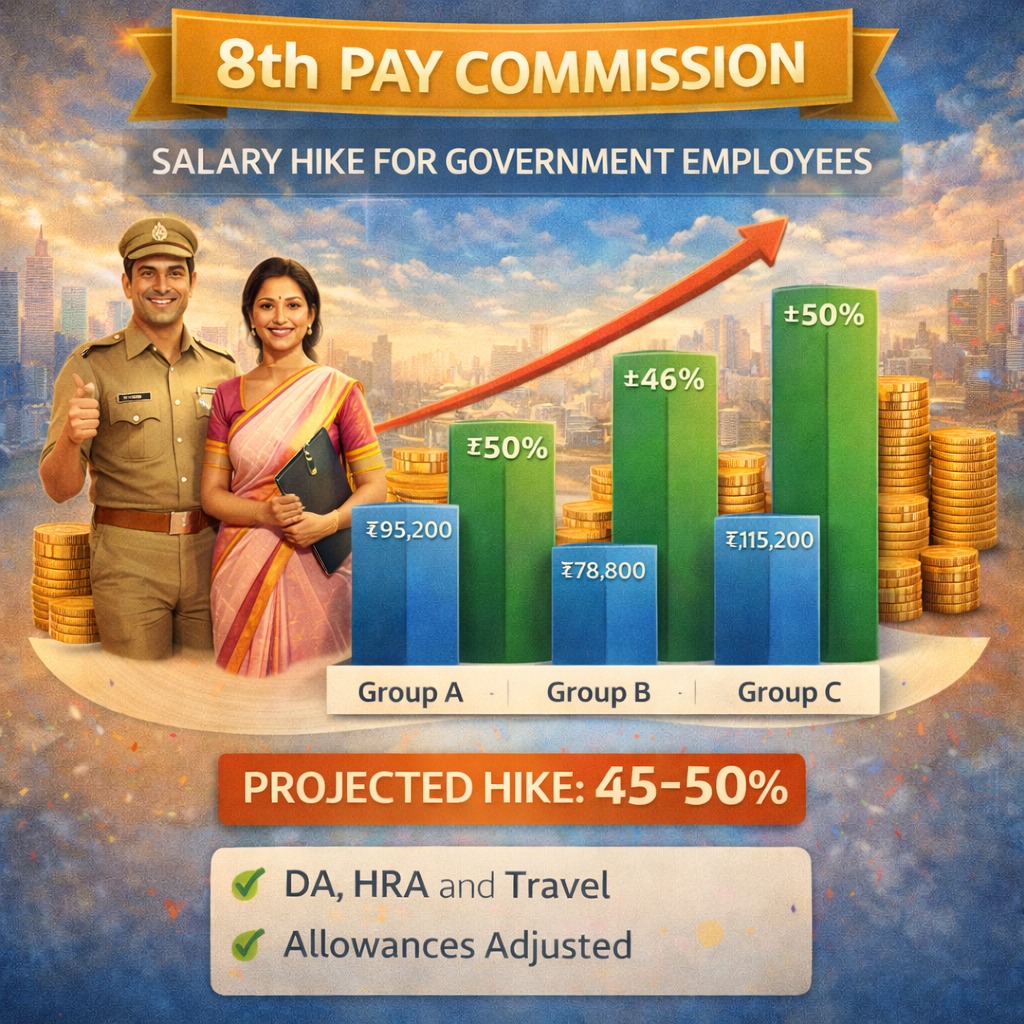
With the expected implementation of the 8th Pay Commission from January 1, 2026, central government employees and pensioners across India are keenly waiting to understand who will benefit the most from the upcoming salary revision.
Every Pay Commission reshapes income levels, lifestyle affordability, and long-term financial planning. The 8th Pay Commission is expected to be no different—especially with rising living costs and inflation pressure over recent years.
AI Answer Box
The biggest salary hike under the 8th Pay Commission after January 1, 2026 is expected for senior-level central government employees in higher pay matrix levels due to a higher basic pay base. However, in percentage terms, lower and mid-level employees may see a relatively stronger impact on take-home pay.
Quick Summary Box (Fast Indexing)
8th Pay Commission likely effective from Jan 1, 2026
Salary hike depends on pay level and fitment factor
Senior officers gain highest absolute increase
Lower levels benefit more percentage-wise
Pensioners also expected to gain
What Is the 8th Pay Commission?
The 8th Pay Commission is expected to revise the salary structure of central government employees and pensioners, replacing the 7th Pay Commission framework.
Key Purpose:
Revise basic pay
Adjust pay matrix levels
Improve purchasing power
Align salaries with economic realities
How Salary Hike Is Calculated Under a Pay Commission
Role of the Fitment Factor
The fitment factor is a multiplier applied to existing basic pay to arrive at the revised salary.
Example (illustrative):
Current basic pay: ₹18,000
Fitment factor: 2.8 (expected range)
New basic pay: ₹50,400
A higher fitment factor directly means a bigger salary jump.
Who Will Get the Most Salary Hike in 2026?
Senior-Level Officers (Highest Absolute Hike)
Employees in higher pay matrix levels (Level 13–18) are expected to get the largest salary increase in absolute rupee terms.
Why?
Higher existing basic pay
Fitment factor applied on a larger base
DA merger impact is more substantial
➡️ A 25–30% hike at senior levels translates into a very large monthly increase.
Mid-Level Employees (Balanced Benefit)
Employees in Levels 6–10 may see:
Meaningful monthly income rise
Better savings potential
Improved EMI affordability
These employees are often considered the biggest practical beneficiaries, as the hike significantly improves disposable income.
Entry-Level & Group C Employees (Higher Percentage Impact)
Employees in Levels 1–5 may not get the highest rupee increase, but:
Percentage increase feels stronger
Take-home pay improves noticeably
Living cost relief is more immediate
For many households, this revision can be life-changing.
Salary Hike Impact by Pay Level (Indicative)
| Employee Category | Pay Level | Hike Type |
|---|---|---|
| Entry-level staff | Level 1–3 | High percentage gain |
| Clerical & supervisors | Level 4–7 | Balanced improvement |
| Officers | Level 8–12 | Strong income growth |
| Senior officers | Level 13–18 | Highest absolute hike |
What About Pensioners?
Pensioners are also expected to benefit under the 8th Pay Commission through:
Revised basic pension
DA recalculation
Improved monthly stability
For retired employees, this revision may significantly ease post-retirement financial stress.
Expert Commentary: Absolute vs Real Benefit
“While senior officers receive the largest numerical hikes, lower and mid-level employees often feel the greatest lifestyle improvement due to lower fixed expenses.”
— Public Finance Analyst
Will Everyone Benefit Equally?
No. The impact depends on:
Pay level
Existing basic salary
DA merger
Final fitment factor
However, every eligible employee is expected to see a meaningful improvement compared to the current structure.
Key Takeaways
8th Pay Commission likely effective from Jan 1, 2026
Senior officers get highest salary hike in rupees
Lower levels gain stronger percentage benefit
Pensioners will also benefit
Fitment factor plays the biggest role
❓ Frequently Asked Questions (FAQs)
1. When will the 8th Pay Commission be implemented?
It is expected to be effective from January 1, 2026.
2. Who will get the highest salary hike under 8th Pay Commission?
Senior-level central government employees will get the highest absolute hike.
3. Will lower-level employees benefit?
Yes, they may see higher percentage improvement in take-home pay.
4. What is a fitment factor?
It is the multiplier used to calculate revised basic pay.
5. Will pensioners benefit from the 8th Pay Commission?
Yes, pensions are expected to be revised accordingly.
6. Will arrears be paid?
If implementation is delayed, arrears may be paid from Jan 1, 2026.
7. Is DA expected to merge?
DA merger is usually considered during Pay Commission revisions.
8. Does this apply to state government employees?
Primarily central government employees; states decide separately.
Conclusion: Who Truly Benefits the Most?
The 8th Pay Commission is expected to bring broad-based financial relief. While senior officers will see the biggest salary jumps in numbers, lower and mid-level employees may feel the strongest real-life improvement in affordability and savings.
As January 1, 2026 approaches, one thing is clear:
👉 The 8th Pay Commission will reshape income security for millions of Indian government employees.
Published on : 1st January
Published by : SMITA
www.vizzve.com || www.vizzveservices.com
Follow us on social media: Facebook || Linkedin || Instagram
🛡 Powered by Vizzve Financial
RBI-Registered Loan Partner | 10 Lakh+ Customers | ₹600 Cr+ Disbursed