

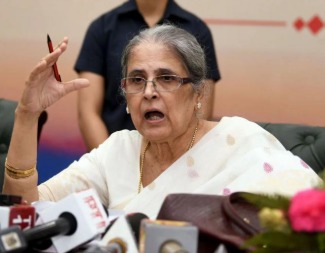
The Central Government has formally constituted the 8th Pay Commission, appointing Justice Ranjana Prakash Desai, former Supreme Court judge, as its Chairperson. The commission will review and recommend revisions in salaries, allowances, and pensions for central government employees and pensioners.
Alongside Justice Desai, two members — Dr. Arvind Panagariya, economist and former NITI Aayog Vice Chairman, and Rakesh Mohan, former Deputy Governor of the Reserve Bank of India — have been named as part of the panel.
Objective of the 8th Pay Commission
The 8th Pay Commission will study and suggest:
Revisions in pay scales and allowances of central government employees.
Pension structure and retirement benefits for government retirees.
Recommendations on cost-of-living adjustments based on inflation and economic growth.
A long-term framework to ensure fair compensation in line with India’s fiscal capacity.
The commission’s recommendations are expected to impact over one crore government employees and pensioners across India.
Timeline & Implementation
The 8th Pay Commission is likely to submit its report by mid-2026, with its implementation expected to take effect from January 1, 2026.
This follows the tradition of revising central pay structures every ten years — with the 7th Pay Commission having been implemented in 2016.
Officials say the panel may explore performance-based pay metrics and digital transparency in pay disbursal systems to align with the government’s modernization goals.
Who Is Justice Ranjana Prakash Desai?
Justice Ranjana Prakash Desai served as a judge of the Supreme Court of India and later as the Chairperson of the Press Council of India. She has also chaired committees on judicial reforms and administrative transparency.
Her appointment signals the government’s intent to bring credibility and balance to the commission’s recommendations, combining judicial insight with economic expertise.
Economic Context
The announcement comes at a time when India’s economy is witnessing steady growth and fiscal consolidation.
Government employees have been anticipating the new pay revision, especially as inflation has affected real income levels since the 7th Pay Commission.
Experts believe that a well-calibrated pay structure could boost morale and productivity among public servants, while maintaining fiscal discipline.
❓ FAQ
Q1: What is the 8th Pay Commission?
It’s a panel formed by the government to review and recommend pay and pension revisions for central government employees.
Q2: Who is heading the 8th Pay Commission?
Justice Ranjana Prakash Desai, former Supreme Court judge, has been appointed as the Chairperson.
Q3: Who are the other members?
The two members are Dr. Arvind Panagariya and Rakesh Mohan.
Q4: When will the new pay scales be implemented?
The recommendations are expected to be implemented from January 1, 2026.
Q5: How many employees will be affected?
Over one crore central government employees and pensioners are likely to benefit.
Conclusion
The formation of the 8th Pay Commission marks a significant step toward ensuring equitable compensation for India’s public sector workforce.
With Justice Ranjana Desai at the helm and two experienced economists on board, the commission’s report will likely play a pivotal role in shaping the next phase of government pay structure reforms.
Published on : 28th October
Published by : SMITA
www.vizzve.com || www.vizzveservices.com
Follow us on social media: Facebook || Linkedin || Instagram
🛡 Powered by Vizzve Financial
RBI-Registered Loan Partner | 10 Lakh+ Customers | ₹600 Cr+ Disbursed
https://play.google.com/store/apps/details?id=com.vizzve_micro_seva&pcampaignid=web_share