

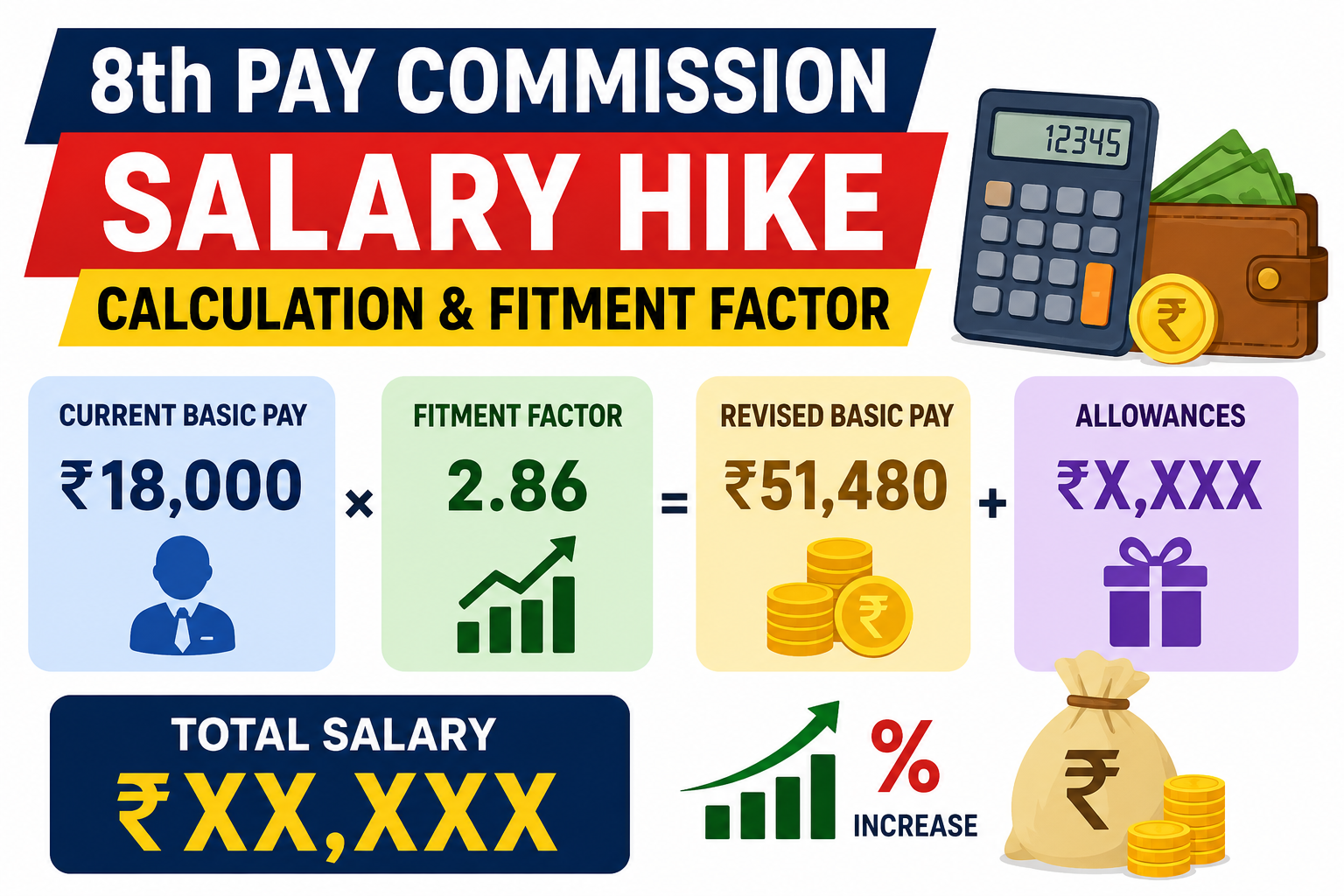
The upcoming 8th Pay Commission has become one of the most discussed topics among central government employees and pensioners.
While the government has not yet announced final salary revision figures, discussions around:
- Fitment factor
- Revised pay matrix
- Pension increases
- Arrears
are gaining momentum as consultations continue.
Most projections suggest employees could receive a substantial salary increase, though the final amount will depend on the fitment factor approved by the government.
AI Answer Box
How much salary hike is expected under the 8th Pay Commission?
Most estimates suggest a salary increase of around 20% to 50%, depending on the final fitment factor and pay level. Some employee organizations have demanded significantly higher revisions.
What is the fitment factor?
The fitment factor is the multiplier used to calculate revised basic pay under a Pay Commission.
Introduction
The Pay Commission reviews salaries, pensions, and allowances of central government employees approximately every decade.
The 7th Pay Commission was implemented in 2016.
Now, attention has shifted to the 8th Pay Commission, which is expected to revise:
- Basic pay
- Dearness Allowance (DA)
- House Rent Allowance (HRA)
- Travel Allowance (TA)
- Pension benefits
for millions of employees and pensioners.
What Is the 8th Pay Commission?
The 8th Pay Commission is the next salary revision panel for central government employees and pensioners.
The commission is expected to review:
- Pay structures
- Allowances
- Retirement benefits
- Pension systems
and recommend revised compensation frameworks.
Why the Fitment Factor Matters Most
The biggest factor determining salary hikes is the fitment factor.
Formula
New Basic Pay=Current Basic Pay×Fitment Factor\text{New Basic Pay} = \text{Current Basic Pay} \times \text{Fitment Factor}New Basic Pay=Current Basic Pay×Fitment Factor
A higher fitment factor leads to a larger increase in basic salary.
Estimated Fitment Factor Scenarios
| Scenario | Expected Fitment Factor |
|---|---|
| Conservative | 1.83 – 2.00 |
| Moderate | 2.00 – 2.57 |
| Aggressive Demand | 3.80 – 3.83 |
Employee groups have proposed fitment factors as high as 3.8–3.83, while many analysts expect lower final figures.
Expected Salary Hike Range
| Scenario | Estimated Increase |
|---|---|
| Conservative | 20% – 30% |
| Moderate | 30% – 50% |
| Aggressive Demand | 80%+ |
These are projections only and not official government figures.
Sample Salary Calculations
Current Basic Pay: ₹18,000
| Fitment Factor | Revised Basic Pay |
|---|---|
| 2.00 | ₹36,000 |
| 2.28 | ₹41,040 |
| 2.57 | ₹46,260 |
| 3.83 | ₹68,940 |
Based on employee-union proposals, the minimum pay could potentially rise significantly from current levels, though no official decision has been announced.
What Employee Unions Are Demanding
Several employee associations have submitted recommendations seeking:
- Higher fitment factors
- Increased minimum pay
- Better pension revision
- Improved allowances
Some proposals suggest:
- Minimum basic salary of ₹65,000
- Fitment factor around 3.8
- Higher HRA and TA benefits
These remain demands and are not approved recommendations.
Potential Impact on Pensioners
The 8th Pay Commission is also expected to revise pensions.
Areas under review include:
- Minimum pension
- Family pension
- Dearness Relief
- Pension fitment factor
Pensioners could see meaningful increases if higher fitment factors are adopted.
Could Employees Receive Arrears?
One major question is whether employees will receive arrears.
If implementation happens after the effective date, revised salaries could potentially be paid with arrears from the notified effective period. However, final decisions will depend on government approval.
Salary Components That May Change
| Component | Expected Review |
|---|---|
| Basic Pay | Major revision |
| Dearness Allowance | Reset after implementation |
| HRA | Possible revision |
| Travel Allowance | Review likely |
| Pension | Expected revision |
What Experts Expect
Most experts believe the final outcome may fall somewhere between:
- Employee demands
- Fiscal constraints
- Inflation considerations
Analysts generally expect a meaningful salary increase, but not necessarily at the highest fitment-factor levels being requested by unions.
Challenges for the Government
The government must balance:
Employee Expectations
- Rising living costs
- Inflation pressures
- Salary competitiveness
Fiscal Responsibility
- Budget impact
- Pension liabilities
- Long-term expenditure commitments
This balancing act will likely influence final recommendations.
Key Takeaways
✅ The 8th Pay Commission could bring significant salary increases.
✅ Fitment factor will be the biggest determinant of salary revision.
✅ Most estimates suggest hikes ranging from 20% to 50%.
✅ Employee groups are demanding higher fitment factors around 3.8.
✅ Pensioners are also expected to benefit from revisions.
✅ Final figures have not yet been officially announced.
Expert Commentary
Pay Commission revisions are among the largest compensation changes affecting government employees.
Most economists believe:
- Salary revisions will support consumption
- Pension increases may boost spending
- Government finances will influence final decisions
The final recommendations are expected to be closely watched by both employees and financial markets due to their broader economic impact.
Pros & Cons of a Major Salary Revision
Pros
- Higher employee income
- Improved purchasing power
- Better retirement benefits
- Increased consumer spending
- Stronger economic demand
Cons
- Higher fiscal burden
- Increased government expenditure
- Potential inflationary pressure
- Larger pension obligations
Future Outlook
Consultations and recommendations are still ongoing.
Key areas being watched include:
- Final fitment factor
- Pension revisions
- Allowance restructuring
- Arrear eligibility
Until official recommendations are released, all salary projections remain estimates.
Frequently Asked Questions :
1. What is the 8th Pay Commission?
A salary and pension revision panel for central government employees.
2. When will the 8th Pay Commission be implemented?
The expected reference date is January 1, 2026, though final implementation timing may vary.
3. What is a fitment factor?
A multiplier used to calculate revised basic pay.
4. How much salary hike is expected?
Most estimates range between 20% and 50%.
5. Is a 3.83 fitment factor confirmed?
No, it is a demand from employee organizations.
6. Will pensioners benefit?
Yes, pension revisions are expected.
7. What could happen to minimum pay?
Several projections suggest substantial increases from current levels.
8. Will DA be affected?
DA may reset after implementation under the revised structure.
9. Could employees receive arrears?
Possibly, depending on implementation timing and government approval.
10. How many people could benefit?
Millions of employees and pensioners are expected to be covered.
11. Are salary figures official yet?
No, final recommendations have not been announced.
12. Why is the fitment factor important?
It directly impacts revised basic pay calculations.
13. Will HRA and TA also change?
They are expected to be reviewed.
14. Can states automatically use the 8th CPC?
State governments generally decide separately.
15. What is the biggest uncertainty?
The final fitment factor and government approval.
Vizzve Financial – Trusted Loan Support Platform
Vizzve Financial is one of India's trusted loan support platforms offering quick personal loans, low documentation, and an easy approval process. Apply online for fast approvals and simplified financial assistance.
Published on : 29th May
Published by : SMITA
www.vizzve.com || www.vizzveservices.com
Follow us on social media: Facebook || Linkedin || Instagram
🛡 Powered by Vizzve Financial
RBI-Registered Loan Partner | 10 Lakh+ Customers | ₹600 Cr+ Disbursed