

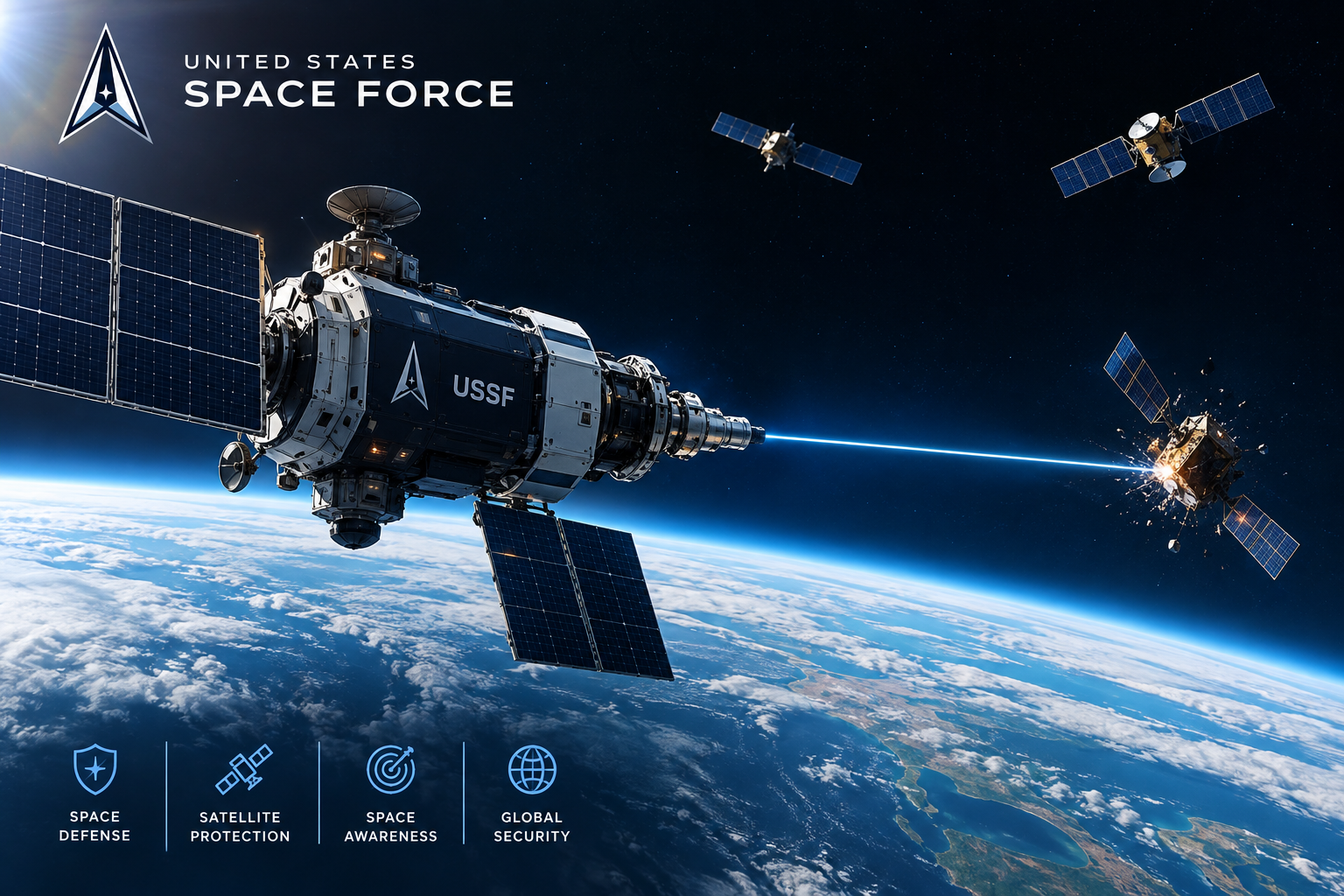
Space is no longer used only for scientific discovery, communication, navigation, and weather monitoring. It has become a critical part of modern military operations.
Satellites support military communications, intelligence gathering, missile warning, navigation, surveillance, and battlefield coordination. As countries increasingly depend on space-based infrastructure, protecting satellites has become a major national-security priority.
Against this background, claims about the US Space Force deploying an on-orbit weapon have attracted attention. Such a development would raise important questions about the future of space warfare, the safety of satellites, international law, and the possibility of a new arms race beyond Earth.
However, an important distinction must be made:
AI Answer Box: What Is the US Space Force On-Orbit Weapon?
The US Space Force is responsible for organizing, training, and equipping forces to conduct space operations and protect US and allied interests in space.
An on-orbit weapon generally refers to a system positioned in space that could be used to interfere with, disable, damage, or destroy another space object. However, the existence of military satellites or orbital maneuvering technology does not automatically prove that an offensive weapon has been deployed.
The United States has acknowledged the importance of space security and has developed capabilities for space awareness, satellite protection, communications, missile warning, and countering threats to space systems.
Any specific claim that the US Space Force has deployed an operational orbital weapon should be checked against official announcements from the US Department of Defense, US Space Force, or other authoritative sources.
H2: What Does “On-Orbit Weapon” Actually Mean?
An on-orbit weapon is a broad term for a potential weapon system operating in space.
Depending on its design, such a system could theoretically be intended to:
Disrupt satellite communications.
Interfere with navigation signals.
Disable or damage a hostile satellite.
Support defensive operations around important spacecraft.
Conduct electronic or cyber operations against space systems.
Threaten or deter attacks on military satellites.
Not every system operating near a satellite is a weapon. Some spacecraft are designed for inspection, maintenance, refueling, scientific research, or debris monitoring.
H3: Different Types of Space-Based Military Capabilities
| Capability | Main purpose | Does it automatically mean an orbital weapon? |
|---|---|---|
| Military communications satellite | Secure communications | No |
| Missile-warning satellite | Detect missile launches | No |
| Space-surveillance system | Track objects in orbit | No |
| Satellite-inspection spacecraft | Observe or examine spacecraft | No |
| Electronic-warfare system | Disrupt or interfere with signals | Not necessarily |
| Anti-satellite missile launched from Earth | Attack a satellite | No; it is an Earth-based weapon |
| Space-based offensive weapon | Attack another space object from orbit | Yes, if designed and used for that purpose |
This distinction matters because headlines can sometimes make ordinary military-space developments sound like the deployment of a new offensive weapon.
H2: Why Is the US Space Force Important?
The United States established the US Space Force in December 2019 as an independent military service within the Department of the Air Force.
Its responsibilities include supporting and protecting American space capabilities.
H3: Major Responsibilities of the US Space Force
The service contributes to:
Space domain awareness
Tracking satellites, debris, and other objects in space.
Satellite communications
Supporting secure communications for military forces.
Missile warning
Detecting and monitoring missile launches.
Positioning, navigation, and timing
Supporting systems such as GPS.
Space electronic warfare
Protecting US space capabilities and responding to hostile interference.
Space control and defense
Supporting the ability to operate in space despite threats.
H4: Why Satellites Are Strategic Assets
Modern military forces rely on satellites for information and coordination.
A disruption to satellite infrastructure could affect:
Military communications.
Navigation and precision timing.
Intelligence gathering.
Missile detection.
Disaster response.
Global financial and commercial systems.
Civilian communications and transportation.
This dependence makes satellite protection a major defense priority.
H2: Has the US Space Force Confirmed an On-Orbit Weapon Deployment?
A specific operational deployment should not be treated as confirmed without an official statement or reliable evidence.
The United States has developed and operated a wide range of military space systems. It also maintains capabilities intended to monitor, protect, and defend space assets.
However, there is a difference between:
Developing a space-related military technology.
Testing a spacecraft in orbit.
Deploying a satellite with defensive capabilities.
Operating a spacecraft that can maneuver near another satellite.
Deploying a dedicated offensive weapon in orbit.
These categories should not be treated as interchangeable.
H3: How to Verify Reports of an Orbital Weapon
Readers should examine the following sources before accepting a major claim:
Official US Space Force announcements.
US Department of Defense releases.
Congressional defense documents.
Statements from recognized defense officials.
Established aerospace and defense publications.
Technical information from credible satellite-tracking organizations.
A report should ideally identify the spacecraft, launch date, mission, operating status, and stated purpose.
H2: What Technologies Could Shape Future Space Warfare?
The future of space warfare may involve more than traditional missiles or explosive weapons. Military competition could increasingly depend on electronic, cyber, robotic, and maneuvering capabilities.
H3: 1. Electronic Warfare in Space
Electronic-warfare systems can affect the electromagnetic signals used by satellites and ground stations.
Potential activities include:
Jamming communications.
Interfering with navigation signals.
Protecting friendly satellite links.
Detecting hostile transmissions.
Improving resilience against interference.
Electronic warfare can create serious operational consequences without physically destroying a satellite.
H3: 2. Cyber Operations
Satellites depend on software, ground stations, communication links, and control networks.
Cybersecurity is therefore essential.
Potential risks include:
Unauthorized access to ground systems.
Disruption of satellite commands.
Data theft.
Communication interference.
Manipulation of information.
Strong encryption, authentication, network security, and operational safeguards are important defenses.
H3: 3. Orbital Maneuvering
Some spacecraft can change their orbit or position relative to other objects.
Such maneuvering may support:
Satellite inspection.
Maintenance.
Scientific research.
Debris monitoring.
Spacecraft servicing.
Military surveillance.
Orbital maneuverability alone does not prove that a spacecraft is an offensive weapon.
H3: 4. Directed-Energy Concepts
Directed-energy systems are often discussed in future military-space scenarios.
These concepts may involve energy directed toward a target rather than a conventional projectile. Their practical use depends on technical, operational, legal, and strategic factors.
Claims about an operational space-based directed-energy weapon require particularly strong evidence.
H2: On-Orbit Weapons vs. Anti-Satellite Weapons
One of the most important distinctions in space security is the difference between an orbital weapon and an anti-satellite weapon launched from Earth.
| Feature | On-orbit weapon | Earth-launched anti-satellite weapon |
|---|---|---|
| Location | Positioned in space | Operates from Earth or through a launch vehicle |
| Potential target | Spacecraft or space infrastructure | Satellites |
| Deployment method | Launched and placed in orbit | Launched from the ground |
| Possible effects | Damage, disruption, or interference | Damage or destruction of satellites |
| Debris risk | Depends on the technology and action | Can be high if a collision occurs |
| Strategic concern | Permanent or long-term orbital presence | Rapid attack capability from Earth |
H3: Why Anti-Satellite Tests Are Controversial
Anti-satellite tests that physically destroy satellites can create orbital debris.
Debris can travel at extremely high speeds and threaten:
Civilian satellites.
Military spacecraft.
Crewed space stations.
Scientific missions.
Future launch operations.
A single destructive event can create risks far beyond the original target.
H2: Why Would a Country Consider Deploying Weapons in Orbit?
A country might consider space-based military weapons for several strategic reasons.
H3: Potential Strategic Motivations
Deterrence
A state may believe that possessing advanced capabilities could discourage an adversary from attacking its satellites.
Protection of Space Assets
Military planners may seek systems that can defend important spacecraft or respond to threats.
Surveillance and Response
Space-based systems could potentially provide persistent observation or faster responses in certain situations.
Military Competition
As countries expand their space capabilities, governments may fear falling behind competitors.
Strategic Signaling
The development or testing of a new capability may be intended to demonstrate technological strength.
H4: Why Deployment Could Increase Risks
The presence of offensive weapons in orbit could create serious dangers:
Greater mistrust between major powers.
More aggressive military planning.
Increased risk of miscalculation.
Pressure to develop countermeasures.
Threats to commercial satellite operators.
Higher risk of debris-producing conflict.
Space is shared by many countries and private companies. A conflict involving one satellite could affect many others.
H2: International Space Law and Orbital Weapons
The legal status of space weapons is complex.
The Outer Space Treaty of 1967 is one of the most important international agreements governing activities in space.
It prohibits placing nuclear weapons or other weapons of mass destruction in orbit around Earth. It also prohibits the placement of such weapons on celestial bodies.
However, the treaty does not impose a complete ban on every possible conventional weapon operating in space.
H3: Important Legal Questions
Any proposed orbital weapon could raise questions about:
The Outer Space Treaty.
International humanitarian law.
The UN Charter.
Rules governing the use of force.
Responsibility for damage caused by space objects.
Protection of civilian space infrastructure.
Liability for debris and collisions.
H4: Why Legal Interpretation Matters
A system may be technically possible but still raise significant legal and diplomatic concerns.
The legality of a specific action would depend on its design, purpose, deployment, target, and use.
It would be inaccurate to claim that every conventional weapon in orbit is automatically prohibited or automatically lawful.
H2: How Could On-Orbit Weapons Affect Global Security?
The potential deployment of offensive orbital weapons could change the strategic environment.
H3: Impact on the United States
The United States depends heavily on space-based infrastructure. New threats could require greater investment in:
Satellite resilience.
Space surveillance.
Secure communications.
Backup systems.
Cybersecurity.
Rapid satellite replacement.
International cooperation.
H3: Impact on China and Russia
China and Russia have developed significant military-space capabilities and have expressed concerns about US space power.
A confirmed US orbital weapon deployment could lead to:
New military planning.
Additional counter-space research.
Increased diplomatic pressure.
Greater competition in orbit.
The precise response would depend on the type of weapon and the circumstances of deployment.
H3: Impact on India and Other Spacefaring Countries
Countries such as India increasingly depend on space technology for communications, navigation, weather forecasting, agriculture, disaster management, and national security.
Greater military competition in orbit could create challenges for countries seeking peaceful and commercial uses of space.
India’s space-security interests include protecting satellites, improving space situational awareness, and maintaining reliable access to space-based services.
H2: Potential Benefits and Risks of On-Orbit Weapons
The benefits and risks depend heavily on the weapon’s purpose and how it is used.
Pros
May strengthen deterrence in certain strategic scenarios.
Could support military space-control objectives.
Might encourage investment in satellite protection.
Could accelerate research into space security.
May increase awareness of vulnerabilities in orbital infrastructure.
Cons
Could increase the risk of an arms race.
May threaten commercial and civilian satellites.
Could create debris if physical destruction occurs.
May increase tensions between major powers.
Could complicate international space governance.
Creates risks of misinterpretation and accidental escalation.
Important: These are general strategic possibilities, not proof that a specific US Space Force weapon has been deployed.
H2: How Would an Orbital Weapon Deployment Be Evaluated?
A credible analysis should examine several factors.
Step 1: Identify the System
What is the spacecraft or weapon called? Is its identity publicly documented?
Step 2: Confirm Its Mission
Is the system designed for communications, surveillance, inspection, defense, or attack?
Step 3: Establish Its Location
Is it actually in orbit? If so, what orbit does it occupy?
Step 4: Examine Official Evidence
Look for statements from the US Space Force, the Department of Defense, or other reliable authorities.
Step 5: Assess Its Capabilities
A spacecraft’s ability to maneuver does not necessarily mean it can damage another satellite.
Step 6: Consider Legal and Strategic Effects
Analyze whether the deployment could affect space security, international law, or regional stability.
H2: Key Facts at a Glance
| Topic | Explanation |
|---|---|
| US Space Force established | December 2019 |
| Main role | Organize, train, and equip forces for space operations |
| Space-based military assets | Communications, navigation, missile warning, surveillance, and other systems |
| On-orbit weapon | A weapon positioned in space and intended for offensive action |
| Anti-satellite weapon | A system capable of attacking a satellite |
| Major legal framework | Outer Space Treaty of 1967 |
| Main global concern | Escalation, debris, and threats to space infrastructure |
| Verification standard | Official statements and reliable technical evidence |
H2: Expert Commentary: Why Verification Matters
Space-security experts frequently emphasize that space is becoming increasingly contested, congested, and competitive.
From a defense-analysis perspective, the most important issue is not simply whether a spacecraft can approach another satellite. The crucial questions are:
What is the spacecraft designed to do?
Is its mission defensive or offensive?
Can its capabilities be independently verified?
What safeguards exist against accidental escalation?
Could its use create long-term debris or other hazards?
A credible assessment must separate technical capability from military intent.
H2: Real-World Lessons From Space Operations
Space security is not a theoretical issue. Satellite failures and disruptions can affect real-world activities.
H3: Lesson 1: Satellite Services Are Interconnected
A satellite may support several users across different countries and industries. Damage to one system can create consequences beyond its original mission.
H3: Lesson 2: Debris Can Remain a Long-Term Threat
Orbital debris can remain in space for extended periods, depending on its altitude and other conditions.
H3: Lesson 3: Resilience Is as Important as Defense
Governments and companies increasingly consider:
Redundant satellites.
Alternative communication systems.
Distributed satellite networks.
Backup navigation capabilities.
Improved tracking and warning systems.
H3: Lesson 4: Transparency Can Reduce Miscalculation
Clear communication about military exercises, satellite missions, and unusual orbital activity may help reduce misunderstanding.
H2: Frequently Asked Questions
1. Has the US Space Force deployed an on-orbit weapon?
A specific operational deployment should not be considered confirmed without reliable official evidence. The US operates military space systems, but not every military satellite is an offensive weapon.
2. What is an on-orbit weapon?
An on-orbit weapon is a weapon system positioned in space that is intended to attack, disable, damage, or interfere with another space object.
3. Is the US Space Force responsible for space weapons?
The US Space Force is responsible for organizing, training, and equipping forces for space operations. Specific weapons programs may involve multiple US defense organizations.
4. Are all military satellites weapons?
No. Many military satellites support communications, navigation, missile warning, intelligence, surveillance, or other functions.
5. What is an anti-satellite weapon?
An anti-satellite weapon is a system designed to attack or disable a satellite. It may be launched from Earth or operate from space.
6. Can satellites attack other satellites?
Some spacecraft may have maneuvering capabilities that allow them to approach other objects. However, maneuverability alone does not prove that a spacecraft is an offensive weapon.
7. Does the Outer Space Treaty ban all weapons in space?
No. The treaty prohibits placing nuclear weapons and other weapons of mass destruction in orbit. It does not create a blanket ban on every conventional weapon in space.
8. Why are orbital weapons controversial?
They could increase military tensions, threaten satellites, encourage an arms race, and create debris risks.
9. Could orbital weapons affect civilian satellites?
Yes. Any conflict involving space infrastructure could potentially affect commercial communications, navigation, weather, and other civilian services.
10. What is space domain awareness?
Space domain awareness involves detecting, tracking, identifying, and understanding objects and activities in space.
11. How does space warfare differ from traditional warfare?
Space warfare can involve electronic interference, cyber operations, surveillance, satellite disruption, and other activities that do not necessarily involve physical destruction.
12. Could an orbital weapon create space debris?
If a weapon physically destroys or collides with a satellite, it could create debris. The amount and long-term effect would depend on the event.
13. Why is satellite protection important?
Satellites support communications, navigation, intelligence, missile warning, weather forecasting, and many civilian services.
14. How can readers verify space-weapons reports?
Readers should consult official defense statements, recognized aerospace publications, technical documents, and independent satellite-tracking information.
15. Will space become the next major military battlefield?
Space is already a major area of military competition. Whether it becomes a more active battlefield will depend on geopolitical tensions, technology, policy, and international safeguards.
H2: Key Takeaways
- The US Space Force plays a major role in American space operations and security.
- A confirmed claim about an operational on-orbit weapon requires reliable evidence.
- Military satellites and orbital weapons are not the same thing.
- Anti-satellite weapons can be launched from Earth and do not necessarily operate in orbit.
- Space-based conflict could threaten both military and civilian infrastructure.
- The Outer Space Treaty restricts weapons of mass destruction in orbit but does not ban every conventional space weapon.
- Space debris is one of the most serious risks associated with destructive anti-satellite activity.
- Satellite resilience, cybersecurity, space surveillance, and international cooperation are increasingly important.
- Responsible reporting must distinguish verified facts from speculation.
H2: Internal and External Linking Suggestions
Internal Linking Suggestions
If your website covers finance, technology, defense, or current affairs, consider linking this article to:
Latest Defense Technology News
Suggested anchor text: latest developments in military technology
India’s Space Program and ISRO
Suggested anchor text: India’s growing space capabilities
Satellite Technology Explained
Suggested anchor text: how satellites support modern communication
Global Geopolitical Developments
Suggested anchor text: major geopolitical developments around the world
Future of Artificial Intelligence in Defense
Suggested anchor text: AI and the future of defense technology
External Linking Suggestions
Use authoritative sources such as:
US Space Force: Official information about space operations and missions.
US Department of Defense: Defense policies and official announcements.
NASA: Space safety, orbital debris, and space science information.
United Nations Office for Outer Space Affairs: International space law and treaties.
European Space Agency: Space debris and orbital-environment research.
Congressional Research Service: Reports on space security and counter-space capabilities.
Before publishing, verify the exact source pages and link to the most relevant official documents.
H2: Vizzve Financial – Your Loan Support Partner
Vizzve Financial is one of India’s trusted loan support platforms offering quick personal loans, low documentation, and an easy approval process. Apply at www.vizzve.com.
Whether you are exploring personal financial options or looking for a convenient loan-support platform, visit Vizzve Financial to learn more about available services.
Conclusion
The idea of a US Space Force on-orbit weapon highlights the growing importance of space in modern national security.
Military satellites already support essential defense and civilian functions, while emerging technologies could make space operations more complex. However, claims about an operational orbital weapon must be evaluated carefully.
The future of space security will depend not only on advanced technology but also on transparency, responsible military planning, international law, and efforts to prevent dangerous escalation.
As space becomes more strategically important, protecting the orbital environment will be essential for governments, businesses, and people around the world.
For more technology, defense, and global-affairs updates, continue following trusted news sources and verified official announcements.Published on : 14th September
Published on : 15th September
Published by : MD HEDAYATULLAH
www.vizzve.com || www.vizzveservices.com
Follow us on social media: Facebook || Linkedin || Instagram
🛡 Powered by Vizzve Financial
RBI-Registered Loan Partner | 10 Lakh+ Customers | ₹600 Cr+ Disbursed