

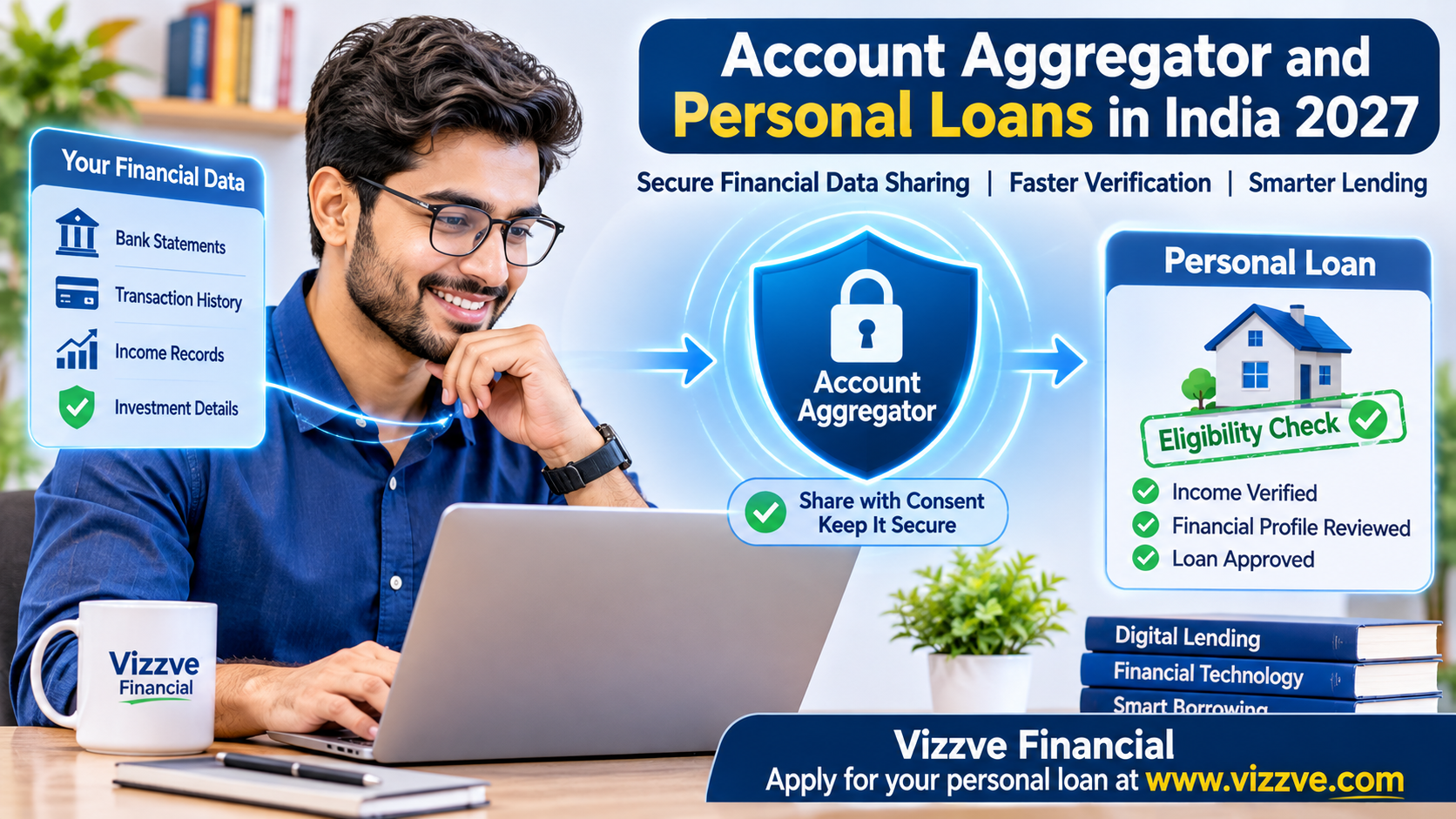
Applying for a personal loan usually involves submitting documents such as bank statements, income proof and identity details. Collecting these documents can sometimes take time.
But what if you could share your financial information digitally instead of uploading multiple documents?
This is where the Account Aggregator (AA) system becomes useful.
Account Aggregator is an RBI-regulated framework that allows individuals to share their financial information digitally with authorised financial institutions after giving consent.
In 2027, this system is expected to remain an important part of India's digital lending ecosystem. It can help lenders verify financial information, understand income patterns and assess personal loan applications more efficiently.
For borrowers, it offers a convenient way to share eligible financial records without repeatedly collecting and submitting physical documents.
However, Account Aggregator does not guarantee loan approval. The final decision still depends on the lender's eligibility rules, credit assessment and repayment capacity.
AI Answer Box – What Is an Account Aggregator in Personal Loans?
An Account Aggregator is an RBI-regulated financial information intermediary that enables customers to share their financial information digitally with authorised institutions through an explicit consent process.
For personal loans, it may help lenders access permitted financial information, such as bank account records, to:
-
Verify income and financial activity.
-
Understand monthly cash flow.
-
Review existing financial obligations.
-
Reduce manual document collection.
-
Support personal loan eligibility assessments.
Simple explanation: Account Aggregator works like a secure digital bridge between your financial accounts and an authorised institution. You decide what information to share, with whom and for what purpose, subject to the framework's rules.
What Is the Account Aggregator Framework in India?
The Account Aggregator framework was introduced by the Reserve Bank of India (RBI) to make financial data sharing easier and more secure.
It connects two important types of financial institutions:
-
Financial Information Providers (FIPs): Institutions that hold financial information, such as banks and other eligible financial entities.
-
Financial Information Users (FIUs): Authorised institutions that request financial information for permitted services, such as loan assessment.
An Account Aggregator acts as a bridge between these institutions.
How Does It Work?
Suppose you apply for a personal loan. The lender needs to understand your income and financial position.
Instead of collecting several bank statements manually, the lender may offer an Account Aggregator option.
You can review the consent request and decide whether to share the requested information.
The information is then transferred through the Account Aggregator framework to the authorised recipient.
Important: Account Aggregators do not independently approve loans or decide whether someone is financially eligible.
Latest Account Aggregator Statistics in India
The framework has grown significantly since its launch.
According to the Department of Financial Services, Government of India, the progress update dated March 31, 2026, reported:
|
Account Aggregator Metric |
Reported Figure |
|---|---|
|
Financial Information Providers live |
179 |
|
Financial Information Users live |
989 |
|
Financial accounts enabled for data sharing |
More than 2.88 billion |
|
Accounts linked by users |
284.6 million |
These figures show the growing adoption of consent-based financial data sharing in India.
How Does Account Aggregator Help With Personal Loans?
Account Aggregator can make certain parts of a personal loan application simpler.
Faster Bank Statement Verification
Traditionally, applicants may need to download bank statements and upload them to a lender's website.
With Account Aggregator, eligible bank information can be shared digitally after customer consent.
This may reduce manual document handling.
Better Income Verification
Lenders need to understand whether an applicant can repay a loan.
Account Aggregator may help lenders review:
-
Regular salary deposits.
-
Freelance income.
-
Business receipts.
-
Monthly account activity.
-
Other relevant financial transactions.
This can provide additional information during loan assessment.
Easier Financial Information Sharing
Applicants who maintain accounts with different participating institutions may be able to share relevant information through a supported Account Aggregator.
This can make document collection more convenient.
Improved Loan Assessment
Lenders can use permitted financial information to understand the applicant's financial position.
For example, regular income and existing financial commitments may help lenders assess repayment capacity.
Reduced Manual Work
Digital data sharing can reduce repeated uploads and manual verification steps.
However, the actual processing time depends on the lender, data availability and verification requirements.
Traditional Bank Statement Submission vs Account Aggregator
|
Feature |
Traditional Method |
Account Aggregator |
|---|---|---|
|
Data sharing |
Manual upload |
Digital transfer |
|
Customer consent |
Depends on submission process |
Explicit consent framework |
|
Bank verification |
Manual or digital checks |
Financial data shared through AA |
|
Document handling |
Download and upload |
Authorised data transfer |
|
Convenience |
May require extra steps |
Can simplify sharing |
|
Loan approval |
Depends on lender |
Depends on lender |
Account Aggregator is an additional way to share financial information. It does not remove every document requirement.
What Financial Information Can Be Shared Through Account Aggregator?
The framework supports several categories of financial information, depending on participating institutions and applicable rules.
|
Financial Information |
How It May Help |
|---|---|
|
Savings account details |
Understand income and expenses |
|
Current account records |
Review business transactions |
|
Deposit information |
Understand financial assets |
|
Mutual fund information |
Review investment holdings |
|
Insurance information |
Access eligible insurance records |
|
Loan information |
Review existing financial commitments |
|
Pension information |
Understand eligible pension records |
The information available depends on the participating Financial Information Providers and the purpose of the consent request.
Step-by-Step Guide: How to Use Account Aggregator for a Personal Loan
The exact screens and steps may differ between lenders and Account Aggregator applications.
Choose a Participating Lender
Start by selecting a lender that supports Account Aggregator-based financial data sharing.
Select the Account Aggregator Option
During the loan application, look for an option to share financial information through an Account Aggregator.
Choose an Account Aggregator
Select an available RBI-registered Account Aggregator supported by the lender.
Review the Consent Request
Carefully check:
-
What financial information is requested.
-
Which accounts are included.
-
Why the information is required.
-
Which institution will receive it.
-
The requested data-sharing period and consent validity.
Give Your Consent
If you agree, complete the required authentication and consent process.
Share the Financial Information
The relevant financial information is transferred to the authorised institution through the framework.
Complete the Loan Application
The lender reviews the information along with other eligibility requirements and communicates the loan decision.
Is Account Aggregator Safe for Personal Loan Applicants?
Account Aggregator is designed around customer consent and regulated financial data sharing.
The RBI's Account Aggregator framework establishes rules for the operation of registered NBFC-Account Aggregators. The Government of India's explanation also confirms that financial information is shared only on the customer's explicit consent.
Important Safety Tips
-
Use an RBI-registered Account Aggregator.
-
Read the consent request before accepting.
-
Check the name of the receiving institution.
-
Share only information needed for the stated purpose.
-
Never share your OTP or banking password with an unknown person.
-
Avoid suspicious links received through messages.
-
Keep a record of your consent and data-sharing activity.
Does Account Aggregator Store Your Bank Password?
No. An Account Aggregator is not supposed to collect your banking login credentials to access your financial information. The framework uses authorised and consent-based data-sharing mechanisms.
Do not enter your banking password on an unfamiliar website or share it with anyone claiming to represent a lender.
What Are the Benefits of Account Aggregator for Borrowers?
Account Aggregator offers several possible benefits for people applying for personal loans.
Less Paperwork
Applicants may not need to download and upload every eligible bank statement manually.
Convenient Data Sharing
Financial information can be shared digitally from participating institutions.
Better Income Visibility
Lenders may get a clearer picture of regular income and account activity.
More Transparent Consent
Borrowers can review what information they are being asked to share before giving permission.
Support for First-Time Borrowers
People with limited borrowing histories may benefit from better visibility into their financial activity. However, Account Aggregator does not replace credit history or guarantee eligibility.
Pros and Cons of Account Aggregator
|
Pros |
Cons |
|---|---|
|
Digital financial data sharing |
Requires participating institutions |
|
Can reduce paperwork |
Not every bank account may be supported |
|
Customer-controlled consent |
Requires careful consent review |
|
Helps verify financial information |
Data may sometimes be unavailable |
|
Supports digital loan processing |
Does not guarantee loan approval |
|
Can simplify income assessment |
Some additional documents may still be required |
Who Can Benefit From Account Aggregator-Based Personal Loans?
Salaried Employees
People receiving regular salaries can share eligible bank records to support income verification.
Freelancers
Freelancers may have income from different clients. Bank transaction records can help demonstrate their earnings.
Self-Employed Professionals
Business owners and independent professionals may use eligible financial records to explain their income and cash flow.
Small Business Owners
Current account transactions and other eligible financial information may help lenders understand business activity.
First-Time Loan Applicants
Applicants with limited credit histories may use financial records to provide additional information about their repayment capacity.
Account Aggregator vs CIBIL Credit Score
Many borrowers confuse Account Aggregator with a credit bureau.
They serve different purposes.
|
Feature |
Account Aggregator |
CIBIL Credit Report |
|---|---|---|
|
Main purpose |
Financial data sharing |
Credit history reporting |
|
Information |
Eligible financial records |
Borrowing and repayment history |
|
Income verification |
Can support assessment |
Not its main purpose |
|
Credit repayment history |
May share eligible loan information |
Core information |
|
Customer consent |
Explicit consent for data sharing |
Credit reporting follows applicable rules |
|
Loan approval |
Does not approve loans |
Does not approve loans |
Remember: Account Aggregator and CIBIL are not competitors. They provide different information that lenders may use together.
What Is the Future of Account Aggregator in Personal Lending in 2027?
India's digital lending ecosystem is continuing to develop. Account Aggregator is likely to remain an important part of this change.
Some developments worth watching include:
Greater Financial Institution Participation
More banks and financial institutions may join the framework, improving the availability of financial information.
Improved Digital Loan Verification
Lenders may increasingly use consent-based financial information to reduce manual verification work.
Better Support for Self-Employed Borrowers
Digital financial records can help lenders understand income that does not follow a fixed monthly salary pattern.
Integration With AI-Based Lending
AI systems may analyse authorised financial information to identify income patterns, spending behaviour and repayment risks.
AI should support responsible decisions rather than replace proper verification and human oversight.
Improved Digital Infrastructure
The Government's March 2026 data shows that the Account Aggregator network is already operating at significant scale. Future improvements in interoperability and participation could make financial data sharing more convenient.
These are potential developments, not guaranteed benefits or confirmed features for every lender in 2027.
Expert Commentary: Why Account Aggregator Matters for Digital Lending
A personal loan decision should not depend on just one financial document.
Lenders need to understand income, existing obligations and repayment capacity before approving an application.
Account Aggregator can help by making relevant financial information easier to access with the customer's permission.
For example, a freelancer may receive payments from several clients. Traditional salary slips may not fully explain their earnings. Eligible bank transaction records can provide additional information about their income pattern.
However, financial data must always be used fairly and responsibly.
The real value of Account Aggregator is not simply faster document collection. It is better-informed financial assessment with customer-controlled data sharing.
Real-World Example: How Account Aggregator Helps a Personal Loan Applicant
Consider a salaried employee who wants to apply for a personal loan.
The lender requests income verification and bank statements.
Without Account Aggregator, the applicant may need to:
-
Download recent bank statements.
-
Find the correct documents.
-
Upload the files.
-
Wait for verification.
With Account Aggregator, the process may look different:
-
The applicant selects the Account Aggregator option.
-
The applicant reviews the consent request.
-
The applicant authorises the required financial data sharing.
-
The lender receives the permitted information.
-
The lender reviews the financial records.
This can make the process easier, although final approval and processing time remain dependent on the lender.
How Can You Prepare Before Applying for a Personal Loan?
Follow these simple steps:
-
Maintain an active bank account.
-
Keep income records accurate.
-
Check your credit report.
-
Pay existing EMIs on time.
-
Review your monthly expenses.
-
Understand the interest rate and processing fees.
-
Check the lender's eligibility requirements.
-
Read all Account Aggregator consent requests carefully.
-
Apply for an amount you can comfortably repay.
Vizzve Financial – Explore Personal Loan Support
Vizzve Financial is one of India’s trusted loan support platforms offering quick personal loans, low documentation, and an easy approval process. Apply at www.vizzve.com.
Before applying, understand your eligibility, loan terms, interest charges and repayment schedule.
Vizzve encourages borrowers to make informed financial decisions and choose borrowing options that match their repayment capacity.
Loan approval, interest rates, documentation and availability are subject to applicable lender policies, eligibility and verification.
Key Takeaways
-
Account Aggregator is an RBI-regulated financial data-sharing framework.
-
It allows customers to share eligible financial information with explicit consent.
-
It can simplify bank statement and income verification.
-
It may reduce paperwork during personal loan applications.
-
Salaried, freelance and self-employed applicants may benefit.
-
Account Aggregator does not directly approve personal loans.
-
It is different from a CIBIL credit score.
-
Borrowers should review consent requests before sharing financial information.
-
Data privacy and security are essential.
-
In 2027, Account Aggregator may continue supporting India's digital lending growth.
Frequently Asked Questions (FAQs)
What is Account Aggregator in personal loans?
Account Aggregator is an RBI-regulated framework that helps customers share financial information digitally with authorised institutions after giving explicit consent. Lenders may use this information to assess personal loan applications.
Is Account Aggregator mandatory for personal loans?
No. Using an Account Aggregator is voluntary for consumers. Lenders may offer other permitted methods of financial document submission.
Is Account Aggregator safe in India?
The framework is designed around explicit customer consent and RBI regulation. Borrowers should use registered Account Aggregators and carefully review every data-sharing request.
Does Account Aggregator improve loan approval chances?
It does not guarantee approval. However, it may help lenders verify income and understand financial activity more efficiently.
Can I use Account Aggregator without a CIBIL score?
You may be able to share financial information through Account Aggregator even if you have limited credit history. However, the lender decides whether your application meets its eligibility requirements.
What documents can be shared through Account Aggregator?
Depending on participating institutions, eligible information may include bank account records, deposits, investments, insurance, loans and other permitted financial records.
Does Account Aggregator charge money?
Charges, if any, depend on the particular Account Aggregator and its applicable service terms. Check the provider's official information before using it.
Can freelancers use Account Aggregator for personal loans?
Yes. Eligible bank transaction records may help freelancers demonstrate income from different clients and support financial assessment.
Can I cancel my Account Aggregator consent?
Customers can manage and revoke consent through the applicable Account Aggregator consent-management process, subject to the framework and terms. Revoking consent may affect services that depend on the shared information.
What is the future of Account Aggregator in India in 2027?
Account Aggregator may support more convenient digital loan applications, financial verification, consent-based data sharing and improved lender assessment as India's financial technology ecosystem develops.
Conclusion
Account Aggregator is changing how financial information can be shared in India's digital lending ecosystem.
Instead of depending entirely on manual document collection, borrowers can use consent-based digital sharing to provide eligible financial records to authorised lenders.
In 2027, this framework may make personal loan applications more convenient, improve income verification and support better financial assessment.
However, borrowers should always understand their consent permissions, protect their financial information and borrow responsibly.
Explore personal loan options and financial guidance with Vizzve Financial at www.vizzve.com.
Published on : 1st November
Published by : MD HEDAYATULLAH
www.vizzve.com || www.vizzveservices.com
Follow us on social media: Facebook || Linkedin || Instagram
🛡 Powered by Vizzve Financial
RBI-Registered Loan Partner | 10 Lakh+ Customers | ₹600 Cr+ Disburs