

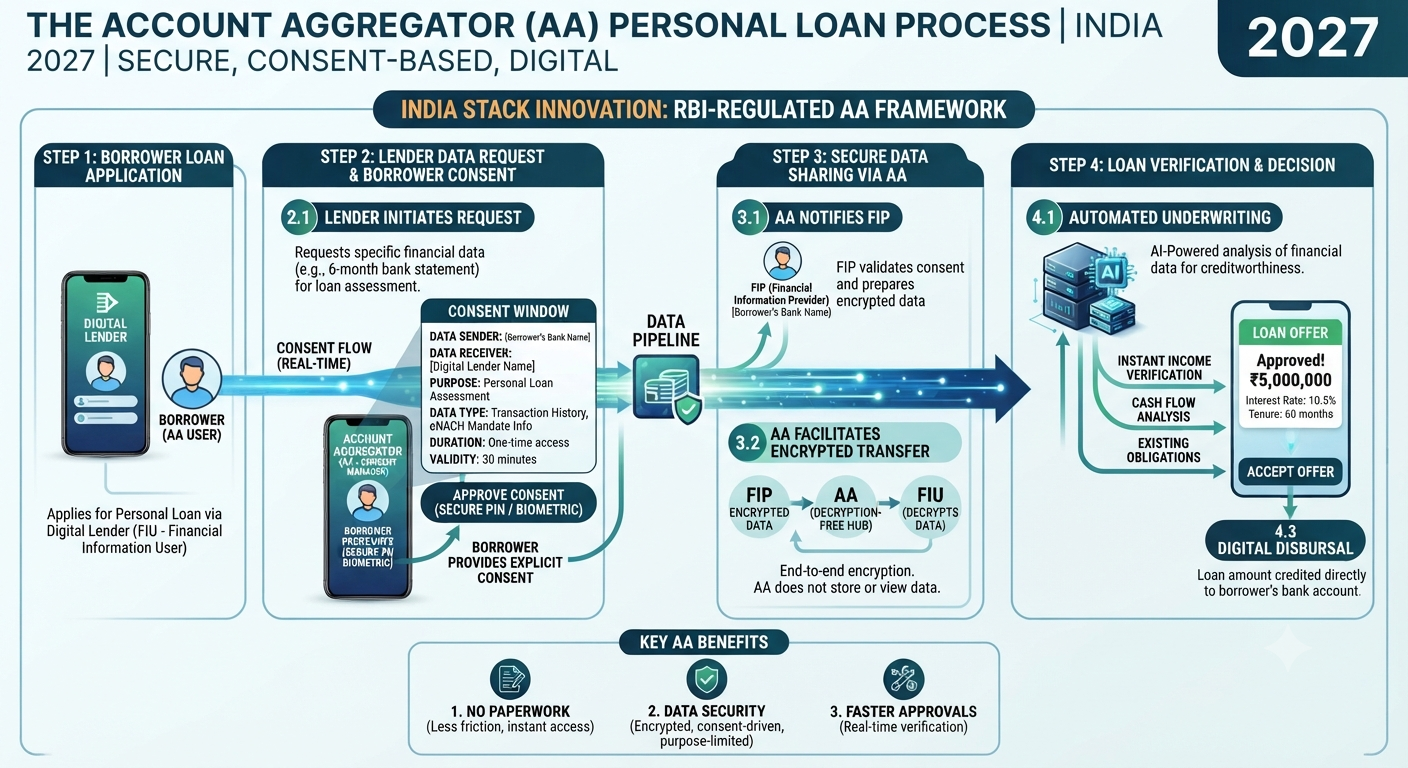
The Account Aggregator framework connects financial information providers (FIPs) with financial information users (FIUs).
The process generally works as follows:
-
Loan Application: The borrower applies for a personal loan through a lender.
-
Consent Request: The lender requests permission to access specific financial information.
-
Account Selection: The borrower selects the financial accounts they want to share.
-
Secure Data Sharing: Financial information is shared digitally through the Account Aggregator.
-
Loan Assessment: The lender evaluates income, banking activity, and repayment capacity.
-
Loan Decision: The lender makes a decision based on its eligibility and credit assessment criteria.
Benefits of Account Aggregators for Personal Loan Borrowers
-
Faster Documentation: Reduces the need for manually uploading multiple financial documents.
-
Secure Information Sharing: Financial data is shared through a consent-based framework.
-
Better Transparency: Borrowers can review and approve information-sharing requests.
-
Convenient Loan Applications: Digital verification can simplify the application process.
-
Improved Financial Assessment: Lenders may get a clearer understanding of income and banking activity.
Account Aggregator vs Traditional Bank Statement Submission
|
Feature |
Account Aggregator |
Traditional Method |
|---|---|---|
|
Document sharing |
Digital |
Manual upload |
|
Consent |
Explicit consent-based |
Depends on submission process |
|
Convenience |
More streamlined |
Can require repeated uploads |
|
Data access |
Purpose-based and authorised |
Documents shared directly |
|
Verification |
Digital data exchange |
Manual or digital verification |
Is Account Aggregator Safe for Personal Loans?
Account Aggregators operate under an RBI-regulated framework. However, borrowers should remain careful while sharing financial information.
Important safety practices include:
-
Verify the lender before applying.
-
Read the consent request carefully.
-
Share only the information required for the stated purpose.
-
Never share your banking password, PIN, or OTP with anyone.
-
Avoid suspicious loan applications and unofficial links.
-
Review the lender's privacy and data-handling policies.
How Account Aggregators May Shape Digital Lending in 2027
The future of digital lending in India is likely to focus on faster verification, responsible credit assessment, and improved borrower convenience.
Account Aggregators may support:
-
Faster digital personal loan applications.
-
More efficient income verification.
-
Reduced paperwork for eligible borrowers.
-
Better financial-data accessibility.
-
More informed credit assessments.
-
Greater adoption of consent-based financial services.
However, using an Account Aggregator does not guarantee loan approval. Final decisions depend on the lender's eligibility criteria, credit profile, income stability, existing EMIs, and repayment capacity.
Tips for Borrowers Before Applying
-
Check your credit score and credit report.
-
Maintain accurate banking and income records.
-
Compare interest rates and APR.
-
Review the Key Fact Statement (KFS).
-
Understand processing fees and repayment terms.
-
Borrow only an amount you can comfortably repay.
Conclusion
Account Aggregators are making India's digital lending ecosystem more accessible by simplifying financial data sharing and reducing documentation challenges. In 2027, they could become an important part of personal loan applications by supporting secure, consent-driven financial verification.
For borrowers, understanding how Account Aggregators work can help make digital borrowing more convenient and informed. Always verify the lender, review consent permissions, and evaluate repayment affordability before taking a personal loan.
Published on : 21th November 2026
Published by : Yogendra
www.vizzve.com || www.vizzveservices.com
Follow us on social media: Facebook || Linkedin || Instagram
🛡 Powered by Vizzve Financial
RBI-Registered Loan Partner | 10 Lakh+ Customers | ₹600 Cr+ Disbursed