

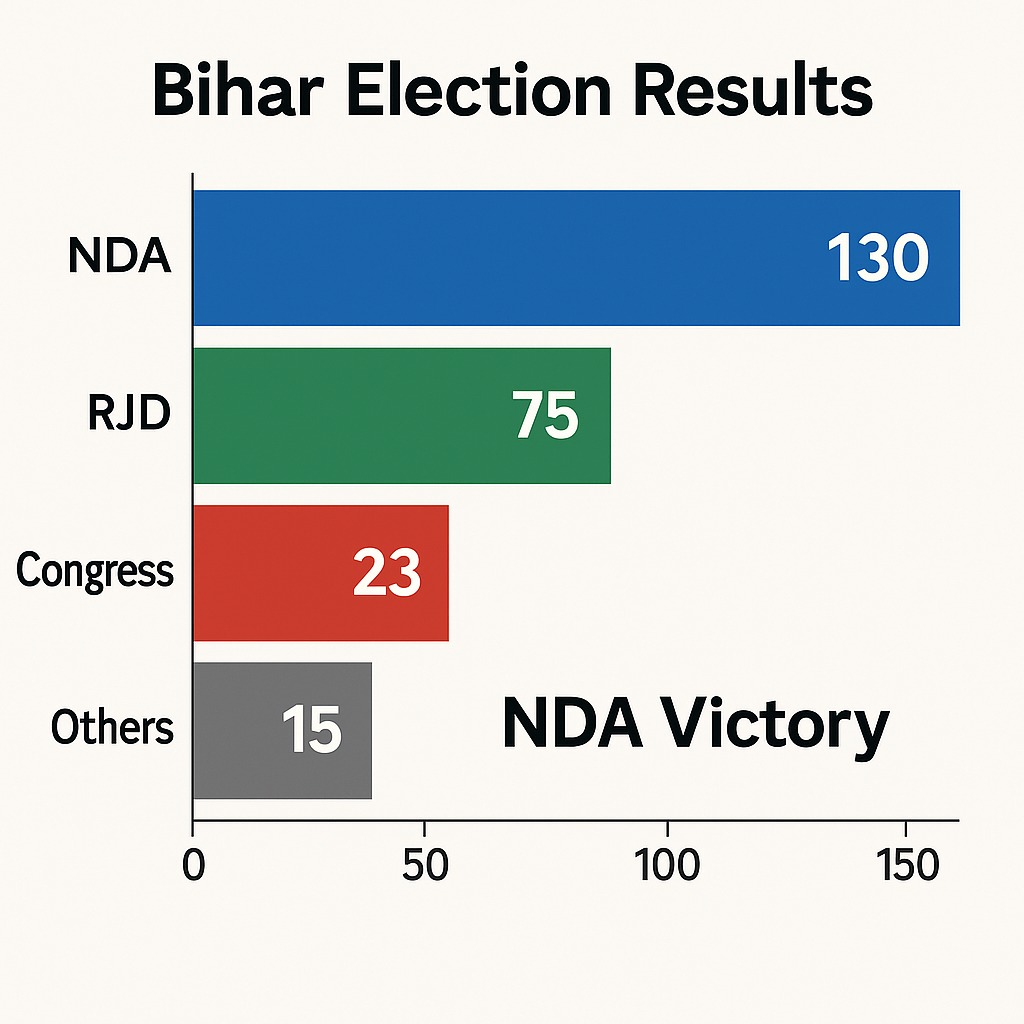
The National Democratic Alliance (NDA) has secured a decisive victory in the Bihar Assembly Elections 2025, but the win is more than just a numerical triumph. It reflects deep regional shifts, a changing voter psychology, and evolving political narratives that could reshape national politics in the coming year—especially ahead of key battles like West Bengal 2026 and the broader national electoral calendar.
The mandate is a signal that Bihar’s electorate is realigning itself in ways that mirror emerging trends across India: local aspirations, development-driven voting, caste recalibrations and the decline of fragmented opposition blocs.
1. A Shift Towards Development Over Traditional Identity Politics
For decades, Bihar’s electoral landscape was dominated by:
Caste equations
Regional loyalties
Personality-centric campaigns
This election marks a clear shift toward aspiration-based voting.
The NDA succeeded by focusing on:
Infrastructure
Social welfare reforms
Employment initiatives
Connectivity and digital services
Younger voters, forming a significant chunk of the electorate, responded more to performance and policy than traditional caste arithmetic.
2. Regional Reconfiguration: Smaller Parties Losing Influence
Smaller regional parties, once kingmakers in Bihar, faced significant setbacks.
Observed trends include:
Declining influence of caste-based outfits
Weakening of family-driven political establishments
Voters preferring larger coalitions with national influence
Reduced patience for unstable alliances
This consolidation benefits alliances like the NDA, which offer greater organisational strength and clearer messaging.
3. The Opposition’s Shrinking Space: A National Signal
The collapse of the Opposition to one of its lowest tallies in 15 years is not just a Bihar story—it mirrors a national pattern:
Fragmented opposition leadership
Internal disagreements
No unified alternative narrative
Failure to counter the development platform
The Bihar results amplify concerns for opposition parties across India ahead of multiple upcoming state elections.
4. What the Mandate Means for NDA Nationally
A. Strengthened Roadmap for Bengal 2026
The overwhelming Bihar mandate gives the NDA a political and psychological boost as it aims to make deeper inroads into West Bengal.
B. Reinforced Central Narrative
The Bihar win reinforces the NDA’s national messaging on:
Stability
Governance
Welfare schemes
Economic reforms
C. Greater Coalition Confidence
Smaller NDA partners may feel more secure, supporting smoother coordination at the national level.
5. The Voter Mandate: Clear, Strategic and Aspirational
Bihar's results indicate that voters are:
More informed
Less tolerant of experimentation
More focused on long-term governance
Keen to avoid fragmented coalitions
Looking for stability in times of economic and security uncertainty
This mirrors a national trend where performance-based voting is gaining precedence.
6. What This Means Going Forward
The NDA’s win signals several national implications:
Rising dominance of centrally aligned coalitions
Increased expectation for state–centre collaborative governance
Greater pressure on opposition groups to reinvent themselves
Intensifying competition in eastern India, especially Bengal and Jharkhand
A shift from legacy politics toward results-driven leadership
The election may be remembered not just as a victory but as a political turning point.
Conclusion
The NDA’s strong showing in Bihar is more than an electoral milestone—it is a barometer of shifting public sentiment.
As regional and national narratives continue to overlap, what happened in Bihar could shape the trajectory of Indian politics in 2026 and beyond.
FAQs
Q1. Why was the NDA able to secure such a strong mandate in Bihar?
Because of development-driven messaging, organisational strength and voter preference for stability.
Q2. What does the result mean for the opposition?
It highlights shrinking influence and the need for strategic restructuring.
Q3. Does this impact the 2026 West Bengal elections?
Yes, the NDA sees the Bihar win as momentum for its Bengal push.
Q4. Are caste dynamics still important in Bihar?
Yes, but they played a reduced role compared to previous elections.
Q5. Is Bihar’s political shift part of a national trend?
Increasingly, yes—voters across India are leaning toward performance-based choices.
Published on : 15th November
Published by : SMITA
www.vizzve.com || www.vizzveservices.com
Follow us on social media: Facebook || Linkedin || Instagram
🛡 Powered by Vizzve Financial
RBI-Registered Loan Partner | 10 Lakh+ Customers | ₹600 Cr+ Disbursed