

Agriculture remains closely connected with India's food security, rural employment and household incomes. However, farmers face several risks at the same time, including changing weather conditions, rising input costs, market fluctuations and crop losses.
Agricultural subsidies are one of the policy tools used by governments to reduce some of these financial pressures.
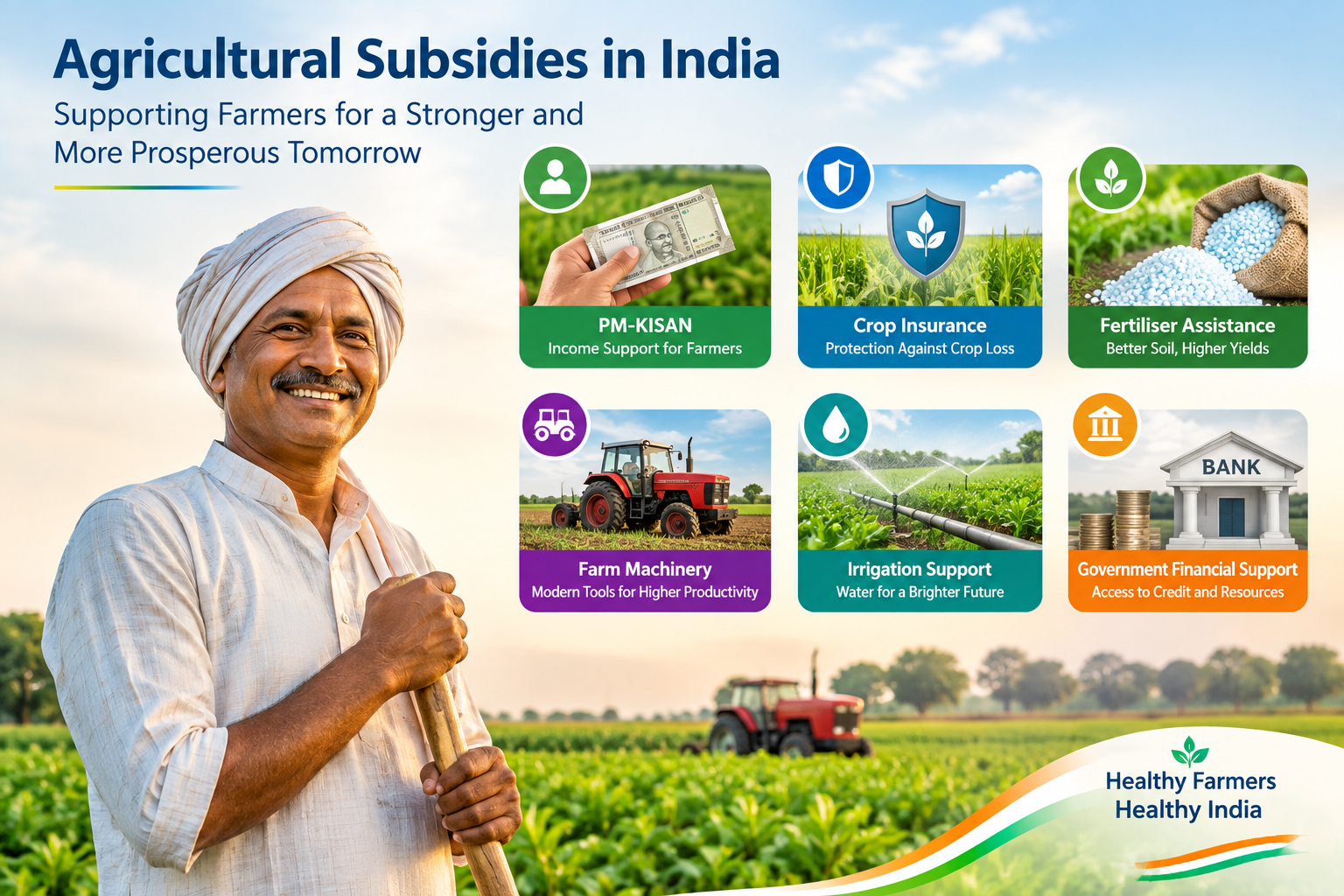
In India, support does not come through one single subsidy. Instead, farmers can access different forms of assistance covering income support, crop insurance, agricultural credit, fertilisers, seeds, irrigation, machinery, infrastructure and other inputs.
For example, PM-KISAN provides eligible landholding farmer families with ₹6,000 a year in three equal instalments through direct bank transfers. The scheme has been approved for continuation from 2026-27 to 2030-31 with a financial outlay of ₹3.15 lakh crore.
The Economic Survey 2025-26 also highlights the importance of income and price support because farm incomes can be affected by weather shocks, market volatility and input costs.
This guide explains what agricultural subsidies are, the major forms of support available in India, how they work, their benefits and limitations, and what farmers should check before applying.
AI Answer Box: What Are Agricultural Subsidies?
Agricultural subsidies are financial assistance, price support, subsidised inputs, insurance support or concessional credit provided by governments to help farmers reduce production risks and agricultural costs.
In India, farmer support can include:
Direct income support such as PM-KISAN
Subsidised crop insurance
Interest support on agricultural credit
Fertiliser subsidies
Assistance for farm machinery and irrigation
Support for seeds and other agricultural inputs
Infrastructure and post-harvest support
Price and market-related support
The exact benefit depends on the scheme, state, crop, landholding status, farmer category and applicable guidelines.
What Are Agricultural Subsidies?
Agricultural subsidies are government-supported benefits designed to make farming more financially sustainable.
A subsidy may reduce the effective price of an input, compensate part of a cost, provide direct financial assistance or reduce the financial risk associated with farming.
Simple example
Suppose a farmer has to spend money on:
Seeds
Fertilisers
Pesticides
Irrigation
Machinery
Labour
Crop insurance
Working capital
Government assistance may reduce some of these costs or provide financial support against specific risks.
The important point is that not every farmer receives every subsidy. Each programme has its own eligibility requirements and application process.
Major Types of Agricultural Subsidies in India
Agricultural subsidies can broadly be divided into several categories.
| Type of support | What it helps with | Example |
|---|---|---|
| Direct income support | Provides cash assistance | PM-KISAN |
| Input subsidy | Reduces input costs | Fertiliser support |
| Insurance subsidy | Reduces insurance premium burden | PMFBY |
| Credit support | Makes farm credit more affordable | Interest Subvention/KCC |
| Machinery support | Helps farmers acquire equipment | Farm mechanisation programmes |
| Irrigation support | Improves access to irrigation | Irrigation-related schemes |
| Infrastructure support | Supports storage, processing and farm infrastructure | Agriculture infrastructure programmes |
| Price support | Provides price-related protection | MSP-related government procurement/support |
1. PM-KISAN: Direct Income Support for Farmers
The Pradhan Mantri Kisan Samman Nidhi (PM-KISAN) is one of India's major farmer income-support programmes.
According to the official PM-KISAN portal, eligible landholding farmer families receive ₹6,000 annually in three equal instalments through direct benefit transfer.
The government has approved continuation of PM-KISAN from 2026-27 through 2030-31, with a total financial outlay of ₹3.15 lakh crore.
Who can benefit from PM-KISAN?
The scheme is intended for eligible landholding farmer families subject to the applicable exclusion criteria.
The official portal states that the definition of a farmer family includes husband, wife and minor children, while states and Union Territories identify eligible families under the scheme guidelines.
PM-KISAN eKYC requirement
Farmers should pay attention to authentication requirements.
The official PM-KISAN portal states that eKYC is mandatory for registered PM-KISAN farmers.
Farmers can also use the official portal to check their status and beneficiary information.
2. Fertiliser Subsidy
Fertilisers are an important agricultural input, particularly for crops that require nutrient management.
Government fertiliser support is designed to help maintain the affordability of key fertiliser products for farmers.
The broader policy challenge is ensuring that support reaches intended beneficiaries efficiently while encouraging balanced and responsible nutrient use.
The Economic Survey has discussed ways in which technology and farmer identification could potentially improve the targeting of fertiliser subsidies.
Why is fertiliser subsidy important?
It can help farmers:
Reduce the effective cost of agricultural inputs
Maintain crop nutrition
Manage cultivation expenses
Protect farm-level cash flow
Support food production
However, farmers should follow recommended nutrient application practices rather than assuming that more fertiliser automatically means higher yields.
3. Crop Insurance Subsidy Under PMFBY
Agriculture is exposed to weather and production risks. Crop insurance can help farmers manage some of these risks.
The Pradhan Mantri Fasal Bima Yojana (PMFBY) provides subsidised crop insurance.
Under the scheme's operational guidelines, the maximum farmer premium is:
2% of the sum insured for Kharif foodgrain and oilseed crops
1.5% for Rabi foodgrain and oilseed crops
5% for annual commercial and horticultural crops
The government bears the eligible subsidy component of the premium under the scheme's rules.
The official PMFBY portal also provides a premium calculator, farmer application facilities, policy-status tools and a grievance mechanism.
Why crop insurance matters
Crop insurance can help farmers manage financial uncertainty caused by eligible crop-related risks.
Farmers should nevertheless read the applicable notification and policy conditions because coverage, crops, areas, cut-off dates and claim procedures can vary.
4. Agricultural Credit and Interest Support
Access to affordable working capital is another important part of agricultural policy.
Farmers often need money before harvest for:
Seeds
Fertilisers
Labour
Irrigation
Pesticides
Machinery
Other cultivation expenses
The government's agricultural credit framework includes interest-support mechanisms and the Kisan Credit Card (KCC) system.
The Union government's 2025-26 Outcome Budget listed a ₹22,600 crore financial outlay for the Modified Interest Subvention Scheme (MISS) for that financial year. It also set an output target involving ₹10.69 lakh crore of short-term credit to farmers.
These figures relate specifically to the 2025-26 budget framework, so they should not automatically be treated as the current 2026-27 allocation.
5. Farm Machinery and Equipment Subsidies
Modern machinery can reduce labour requirements and improve farm efficiency.
Government programmes can provide financial assistance for agricultural machinery and equipment, subject to scheme-specific conditions.
Examples of equipment that may be supported under applicable programmes include:
Tractors
Power tillers
Seeders
Planters
Harvesting equipment
Sprayers
Irrigation equipment
Other farm implements
The exact subsidy percentage, maximum permissible amount and eligible equipment can differ according to the scheme, state and farmer category.
Why machinery support matters
For small farmers, purchasing expensive equipment individually may not always be practical.
This is why support can also be linked to:
Custom Hiring Centres
Farmer Producer Organisations
Cooperatives
Shared machinery facilities
6. Irrigation and Water-Management Support
Water availability can strongly influence farm productivity.
Agricultural programmes can support irrigation development, water-use efficiency and micro-irrigation.
Depending on the applicable programme, farmers may receive assistance related to:
Drip irrigation
Sprinkler systems
Water-management equipment
Farm ponds
Irrigation infrastructure
Water-saving technologies
The objective is not simply to increase water use but to improve the efficiency and reliability of agricultural water management.
7. Seeds and Agricultural Inputs
Quality seeds can have a significant impact on crop establishment and productivity.
Government programmes may support access to improved seeds and other agricultural inputs.
Such programmes can be particularly relevant when farmers are encouraged to adopt:
Climate-resilient varieties
Improved seed varieties
Disease-resistant varieties
Higher-yielding varieties
Regionally suitable crops
Farmers should purchase agricultural inputs from authorised sources and retain invoices or receipts where required for subsidy claims or verification.
Agricultural Subsidies and MSP: What Is the Difference?
| Feature | Agricultural Subsidy | MSP |
|---|---|---|
| Basic concept | Government financial/input support | Announced minimum support price |
| Main purpose | Reduce costs, provide support or manage risk | Provide price assurance/support |
| Form | Cash, input, credit, insurance or other assistance | Price-related mechanism |
| Direct payment to farmer | Sometimes | Not necessarily |
| Applies to | Depends on scheme | Specific mandated crops |
| Example | PM-KISAN | MSP for notified crops |
How Do Agricultural Subsidies Help Farmers?
Agricultural subsidies can provide several forms of support.
1. Lower production costs
Input support can reduce the financial burden of cultivation.
2. Better cash-flow management
Direct transfers can help farmers meet expenses during the agricultural cycle.
3. Reduced risk
Crop insurance can reduce the financial impact of eligible crop losses.
4. Improved access to technology
Machinery and irrigation support can make modern equipment more accessible.
5. Increased access to credit
Interest support can make eligible agricultural loans more affordable.
6. Support for food security
Lower production constraints can contribute to more stable agricultural output.
Pros and Cons of Agricultural Subsidies
Pros
Reduce financial pressure on farmers
Support agricultural production
Improve access to farm inputs
Provide protection against selected risks
Encourage adoption of technology
Support rural incomes
Improve access to formal agricultural credit
Contribute to food-security objectives
Cons and Challenges
Subsidies can also create policy challenges.
Benefits may not always reach every eligible farmer
Application and verification can be complicated
Some programmes may create administrative costs
Poorly targeted input subsidies can distort resource use
Excessive dependence on subsidies may reduce incentives for efficiency
Different state rules can create confusion
Delays in processing can affect farmers' cash flow
These challenges are why digital identification, transparent databases, monitoring and better targeting remain important.
How to Apply for Agricultural Subsidies in India
There is no single application process for every agricultural subsidy.
The correct procedure depends on the scheme.
Step 1: Identify the relevant scheme
First determine whether you need:
Income support
Crop insurance
Agricultural credit
Fertiliser assistance
Machinery support
Irrigation assistance
Seed support
Infrastructure assistance
Step 2: Check eligibility
Read the current official scheme guidelines.
Eligibility can depend on:
Landholding
Crop
State
Farmer category
Bank account
Aadhaar/eKYC requirements
Registration status
Season
Type of agricultural activity
Step 3: Keep documents ready
Depending on the scheme, documents may include:
Aadhaar
Mobile number
Bank account details
Land records
Farmer registration details
Crop information
Identity documents
Other scheme-specific certificates
Step 4: Apply through the official channel
Use the relevant government portal, state agriculture department, bank, Common Service Centre or authorised channel.
Avoid unofficial agents promising guaranteed subsidy approval.
Step 5: Track your application
Save your:
Application number
Registration number
Receipt
Payment details
Insurance policy number, where applicable
Step 6: Complete verification requirements
If the scheme requires eKYC, land verification, crop verification or another authentication step, complete it within the specified timeline.
What Farmers Should Check Before Applying
A subsidy announcement does not automatically mean every farmer is eligible.
Before applying, check:
Is the scheme currently open?
Is your state participating?
Is your crop covered?
Are you eligible under the current guidelines?
Is your land or farmer registration updated?
Is eKYC completed where required?
Are bank details correct?
Is there an application deadline?
Does the scheme require an approved dealer or institution?
Is there a farmer contribution?
This simple checklist can prevent avoidable delays.
Real-World Perspective: Why Subsidy Delivery Matters
For a farmer, the value of a subsidy is not simply the amount announced in a government document.
What matters at the field level is whether the support is:
Available
Accessible
Received on time
Large enough to address the intended cost or risk
Easy to understand
Supported by a functioning grievance system
Digital platforms are increasingly important in this process.
Agricultural Subsidy vs Agricultural Loan
| Agricultural Subsidy | Agricultural Loan |
|---|---|
| Government-supported benefit | Borrowed money |
| May reduce cost or provide direct assistance | Must generally be repaid |
| Scheme-specific eligibility | Credit eligibility applies |
| May cover inputs, insurance or income support | Used for working capital or investment |
| Usually no EMI for the subsidy itself | Usually involves repayment and interest |
Frequently Asked Questions About Agricultural Subsidies
1. What are agricultural subsidies?
Agricultural subsidies are government-supported financial or economic benefits that help farmers reduce costs, manage risks, access inputs or support farm income.
2. What is the main agricultural subsidy in India?
There is no single agricultural subsidy covering every farmer. Major support programmes include PM-KISAN, fertiliser subsidies, crop-insurance subsidies and agricultural credit support.
3. How much does PM-KISAN provide?
Eligible farmer families receive ₹6,000 per year in three equal instalments, subject to the scheme's eligibility and exclusion rules.
4. Is PM-KISAN still continuing in 2026?
Yes. The government approved continuation of PM-KISAN from 2026-27 to 2030-31 with a financial outlay of ₹3.15 lakh crore.
5. Is eKYC mandatory for PM-KISAN?
The official PM-KISAN portal states that eKYC is mandatory for registered PM-KISAN farmers.
6. What is crop insurance subsidy?
It is government financial support that reduces the premium burden under eligible crop-insurance schemes such as PMFBY.
7. How much premium does a farmer pay under PMFBY?
Under the applicable PMFBY guidelines, the maximum farmer share is 2% for Kharif foodgrain/oilseed crops, 1.5% for Rabi foodgrain/oilseed crops and 5% for annual commercial and horticultural crops.
8. Can small farmers receive agricultural subsidies?
Small farmers can be eligible for various schemes, but eligibility depends on the particular programme and its current guidelines.
9. Are agricultural subsidies available for farm machinery?
Various government programmes can provide assistance for agricultural machinery and mechanisation. The amount and eligibility depend on the applicable scheme and state.
10. Can farmers receive both a subsidy and an agricultural loan?
Depending on the scheme rules, farmers may use government-supported benefits alongside agricultural credit. The two are different forms of financial support.
Agricultural Subsidies: The Bigger Picture
The future of agricultural support is likely to involve more than simply increasing financial assistance.
The bigger challenge is ensuring that government support produces measurable improvements in farm resilience, income stability, productivity, resource efficiency and market access.
Digital farmer databases, direct transfers, online applications, crop monitoring and technology-enabled insurance services can help make delivery more transparent.
At the same time, subsidy programmes need regular evaluation to determine whether they are reaching intended beneficiaries and producing the outcomes for which public money is being spent.
For farmers, the practical lesson is straightforward: do not focus only on the subsidy amount. Check eligibility, deadlines, documentation, payment conditions and the official application channel.
Vizzve Financial: Financial Support for Personal Needs
Vizzve Financial is one of India's loan support platforms offering personal-loan assistance, streamlined documentation and a digital application process.
Vizzve states that its platform connects borrowers with lending partners rather than directly lending money itself.
If you are a farmer, self-employed individual or salaried person looking for personal financial support, compare the applicable loan terms carefully, including interest rate, processing charges, repayment period and total repayment obligation.
Visit Vizzve Financial at www.vizzve.com
Important: Agricultural subsidies are government programmes and are separate from private loan products. A loan should not be treated as a substitute for an eligible government subsidy.
Internal Linking Suggestions
For your website, consider linking this article to:
PM-KISAN Guide: Eligibility, instalments and status checking
Kisan Credit Card: Eligibility and agricultural credit guide
Crop Insurance Guide: PMFBY coverage and premium
Government Schemes for Farmers: State and central schemes
Personal Loan Guide: Interest rates, eligibility and repayment
Financial Planning Guide: Managing farm and household expenses
Rural Finance Guide: Access to formal financial services
Suggested anchor texts
"PM-KISAN eligibility and benefits"
"Kisan Credit Card guide"
"crop insurance for farmers"
"government schemes for farmers"
"how agricultural loans work"
External Linking Suggestions
Use authoritative sources wherever possible:
These sources provide official information that can be checked when scheme rules, eligibility requirements or financial allocations change.
Sources and References
The factual sections of this article are based primarily on official Government of India sources, including the Ministry of Agriculture and Farmers Welfare, PM-KISAN, PMFBY and the Economic Survey.
The PM-KISAN portal currently provides scheme information, beneficiary services and eKYC guidance.
The Economic Survey 2025-26 discusses agricultural productivity, income support, MSP and the challenges faced by farmers due to weather shocks, market volatility and input costs.
The PMFBY portal provides current farmer services, insurance tools and scheme information.
Conclusion
Agricultural subsidies play an important role in India's agricultural support system by helping farmers manage production costs, income uncertainty, credit requirements and crop-related risks.
However, agricultural support is not limited to one subsidy. PM-KISAN, fertiliser support, crop insurance, agricultural credit, machinery assistance, irrigation programmes and market-related measures serve different purposes.
For farmers, the most important step is to identify the scheme that matches their requirement and verify the latest eligibility rules through an official source before applying.
For broader financial requirements that are separate from government agricultural subsidies, borrowers can explore suitable financial products and compare repayment terms carefully.
For personal-loan support and loan comparison, visit Vizzve Financial and review the available options and terms before applying.
Published on : 20th September
Published by : MD HEDAYATULLAH
www.vizzve.com || www.vizzveservices.com
Follow us on social media: Facebook || Linkedin || Instagram
🛡 Powered by Vizzve Financial
RBI-Registered Loan Partner | 10 Lakh+ Customers | ₹600 Cr+ Disbursed