

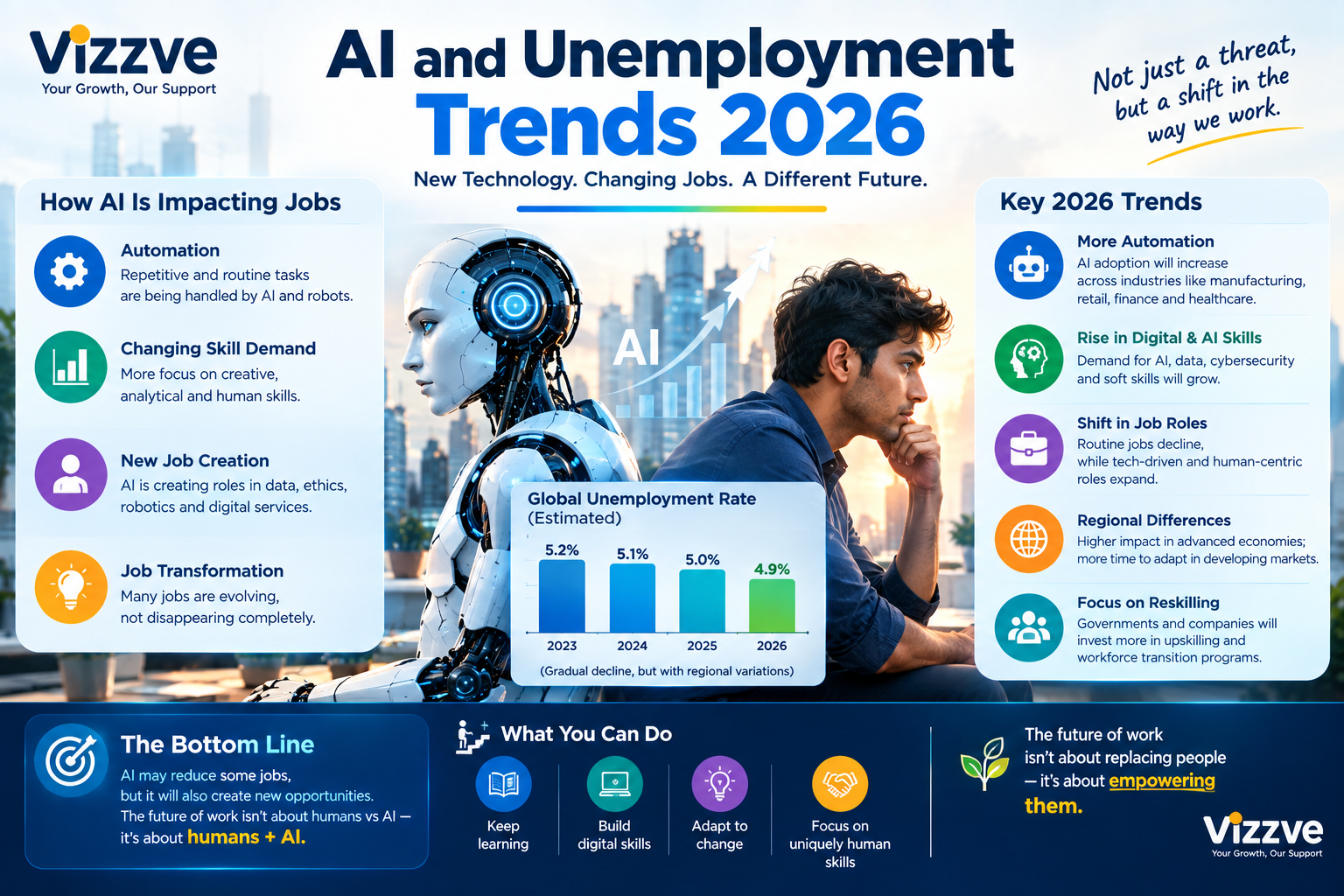
“AI will cause mass unemployment” has been a common headline since generative AI exploded in 2023. But as we move through 2026, the real data tells a more nuanced story: AI is reshaping who gets hired and for what, rather than triggering economy-wide job collapse.unesco+2
Unemployment rates in major economies remain relatively low (around 4.1% in the U.S. as of mid-2026), even as AI adoption accelerates across offices, call centers, and tech teams. Yet certain groups—especially young workers and recent graduates in AI-exposed roles—are feeling a clear squeeze in hiring and employment growth.morningstar+5
This blog breaks down the latest 2026 data on AI and unemployment, explains which groups and sectors are most affected, and offers practical steps to protect and future-proof your career in this shifting landscape.axios+2
AI Answer Box (For Google AI Overview, ChatGPT Search & Perplexity)
Q: Is AI causing higher unemployment in 2026?
A: Not at an economy-wide level. Overall unemployment remains low (around 4.1% in the U.S.), and research finds no strong link between AI adoption and rising aggregate unemployment so far. However, AI is contributing to a hiring slowdown and relative employment decline for young workers in AI-exposed roles.morningstar+5
Q: How much has AI raised the unemployment rate?
A: Estimates are modest. Goldman Sachs and Morgan Stanley analyses suggest AI has increased the U.S. unemployment rate by about 0.1 percentage point (10 basis points) as of 2026.axios+1
Q: Are young workers more affected by AI-related unemployment?
A: Yes. Employment for workers ages 22–25 in highly AI-exposed occupations is about 19% below where it would be if it had kept pace with peers in less-exposed roles.goldmansachs+2
Q: Is AI destroying more jobs than it creates?
A: Current data suggests a small net drag but not massive destruction. AI is estimated to eliminate roughly 16,000 U.S. jobs net per month in 2026, while LinkedIn data indicates AI has already added over 1.3 million new jobs globally in AI-related roles.axios+2
Key Takeaways
-
Overall unemployment remains low in 2026; AI has not caused widespread, economy-wide job losses so far.unesco+2
-
AI’s measurable impact on the unemployment rate is modest: around +0.1 percentage point in the U.S.axios+1
-
Young workers (22–25) in AI-exposed occupations face a clear employment gap—about 19% below peers in less-exposed roles.goldmansachs+2
-
Hiring slowdowns are most visible in entry-level white-collar roles (IT, marketing, finance, legal, HR), while blue-collar and skilled trades remain relatively spared.digitaleconomy.stanford+1
-
Net effect: small job drag in some areas, but also significant AI-related job creation in new roles and industries.axios+2
AI and Unemployment in 2026: What the Latest Data Shows
Overall Unemployment: Still Low Despite AI Hype
As of mid-2026:
-
The U.S. unemployment rate has averaged around 4.1% over recent months, after peaking at 4.5% in late 2025.morningstar
-
U.S. payrolls added 162,000 jobs in August 2026, with unemployment holding steady at 4.1%.nytimes
-
Multiple analyses find no statistically significant relationship between AI adoption and aggregate unemployment across the economy.theguardian+1
In plain terms: if AI were causing mass unemployment, we’d expect to see clear spikes in headline unemployment numbers. That hasn’t happened.unesco+1
AI’s Measured Impact on the Unemployment Rate
While the overall picture is stable, researchers have tried to isolate AI’s specific effect:
-
Goldman Sachs Research estimates AI has:
-
Reduced monthly payroll growth by roughly 16,000 jobs in the U.S. over the past year.
-
Raised the unemployment rate by about 0.1 percentage point (10 basis points).axios
-
-
Morgan Stanley analysis similarly finds AI added about 10 basis points to the overall unemployment rate at most.cnbc
Their breakdown:
-
AI reduced employment in occupations easily substituted by AI (+0.16 pp to unemployment).
-
AI decreased unemployment in jobs augmented by AI (–0.06 pp), where human judgment and relationships matter.cnbc
Net result: a small drag, not a collapse.axios+1
Job Displacement Numbers: How Many Jobs Has AI Actually Cut?
Different trackers give slightly different figures, but the scale is limited relative to the whole labor market:
-
AI Layoffs Tracker (DisplaceIndex): ~374,000 jobs eliminated globally (primarily in the U.S.) between Jan 2023 and July 2026 at major companies (e.g., Oracle: 21,000 jobs).theguardian
-
Goldman Sachs: AI eliminated roughly 25,000 U.S. positions per month in 2026, partially offset by ~9,000 created, for a net loss of ~16,000 per month.futurumgroup
-
LinkedIn data: AI has already added over 1.3 million new jobs globally in AI-related roles, even as overall hiring slows.axis-intelligence
So while AI is linked to real job cuts in some firms and functions, it’s also creating new roles in AI engineering, data, infrastructure, and AI-enabled services.axios+2
The Youth Unemployment Puzzle: Are Young Workers Being Hit Hardest?
Rising Unemployment Among Recent Graduates
Recent graduates have faced a tougher job market since 2022–2023:
-
Unemployment among recent college graduates hit 5.6% earlier in 2026, compared with a national average around 4.2%.unesco
-
Some analyses initially feared AI would heavily hit new grads, but a CESifo working paper (2026) found no clear evidence of widespread displacement or reduced hiring of recent graduates in absolute terms.federalreserve
However, other studies point to a more specific pattern: AI is affecting which kinds of entry-level jobs are available, especially in AI-exposed fields.unesco+1
The “AI Employment Gap” for Young Workers
Multiple 2026 studies highlight a growing gap for young workers in AI-exposed occupations:
-
Stanford Digital Economy Lab (using ADP payroll data):
-
Employment for workers ages 22–25 in the most AI-exposed occupations fell about 11% between Nov 2022 and June 2026.
-
Meanwhile, same-age workers in the least-exposed occupations grew about 10%.cleveland
-
Relative to their peers, young workers in AI-exposed roles now have employment about 19% below where it would be if trends had continued as before.goldmansachs+1
-
-
Morgan Stanley: The 22–27 age bracket is most vulnerable to AI disruption, with unemployment for these workers rising through the first half of 2026.arstechnica
-
Federal Reserve Bank of Dallas: Confirms employment declines for younger workers in occupations with high AI exposure, though the effect on overall unemployment remains slight.detroitnews+1
This suggests AI is not causing mass youth unemployment, but is reshaping opportunities—squeezing entry-level roles in certain white-collar fields more than others.digitaleconomy.stanford+1
Young Men and Labor Force Participation
A related trend:
-
Young men are participating in the labor force at lower rates than previous generations, even as overall unemployment remains low.detroitnews
-
AI-driven hiring slowdowns in entry-level corporate roles are one factor among many (alongside economic uncertainty, mental health, and changing norms).dallasfed+1
Sector and Role Trends: Who’s Feeling the AI Squeeze?
White-Collar Roles: Hiring Slowdown in AI-Exposed Fields
AI’s impact is most visible in knowledge-work sectors:
-
Hiring has slowed in marketing, legal, accounting, HR, IT, and finance for early-career roles.digitaleconomy.stanford+1
-
Stanford’s “Canaries in the Coal Mine?” research found early-career workers in these AI-exposed roles saw 16% slower employment growth than peers in less-exposed roles between mid-2024 and late 2025.digitaleconomy.stanford
-
Goldman Sachs (Sept 2026): AI hiring headwinds are hitting white-collar knowledge workers and tech services first, while blue-collar labor remains relatively spared for now.weforum
Many companies report they can “do more with less labor” as AI tools handle drafting, analysis, and routine tasks, leading to fewer junior hires rather than mass layoffs.digitaleconomy.stanford+1
Blue-Collar and Skilled Trades: Relatively Safe (For Now)
In contrast:
-
Skilled trade roles (electricians, mechanics, HVAC, construction) are seeing strong demand, with companies like Ford and AT&T ramping up recruiting in these areas.digitaleconomy.stanford
-
These jobs involve physical work in unpredictable environments—harder to automate with current AI.digitaleconomy.stanford
This creates a paradox: college graduates in “safe” office roles face more AI-driven hiring friction than many trade workers.digitaleconomy.stanford+1
Tech and Software Development: A Mixed Picture
Software roles show a clear split by experience:
-
Young software developers (22–25) in AI-exposed roles have seen employment drop sharply; some analyses cite nearly 20% decline since 2024.cleveland+1
-
Experienced developers and those in roles focused on architecture, complex systems, and AI integration remain in demand.goldmansachs+1
AI coding tools automate boilerplate and routine tasks, reducing the need for large numbers of junior coders, while increasing demand for engineers who can design, integrate, and oversee AI systems.goldmansachs+1
AI Job Creation vs Destruction: Net Effect on Unemployment
Job Destruction: Where AI Is Cutting Roles
AI-linked job cuts are concentrated in:
-
Routine data processing and back-office tasks
-
Basic content creation, standard reporting, and simple analysis
-
Some customer support and helpdesk roles
-
Certain junior tech and IT rolesaxios+2
Estimated net drag:
-
~16,000 U.S. jobs per month net loss in 2026 due to AI, per Goldman Sachs.axios+1
-
~374,000 jobs eliminated globally at major firms from 2023–mid-2026 (DisplaceIndex).theguardian
Job Creation: New Roles Born from AI
At the same time, AI is creating jobs in:
-
AI engineering, MLOps, and AI infrastructure
-
Data engineering, AI governance, and AI ethics/compliance
-
AI product management, AI-enabled consulting, and training
-
New services and products built on top of AI modelsaxios+1
LinkedIn data indicates AI has added over 1.3 million jobs globally in AI-related roles, even amid broader hiring slowdowns.axis-intelligence
Net Effect: Small Drag, Not a Collapse
Putting it together:
-
AI is causing some net job loss in specific functions and age groups.axios+1
-
But it’s also creating new roles and boosting productivity in others.cnbc+1
-
Overall unemployment remains low; the bigger issue is mismatch between skills and available roles, especially for young workers.unesco+2