

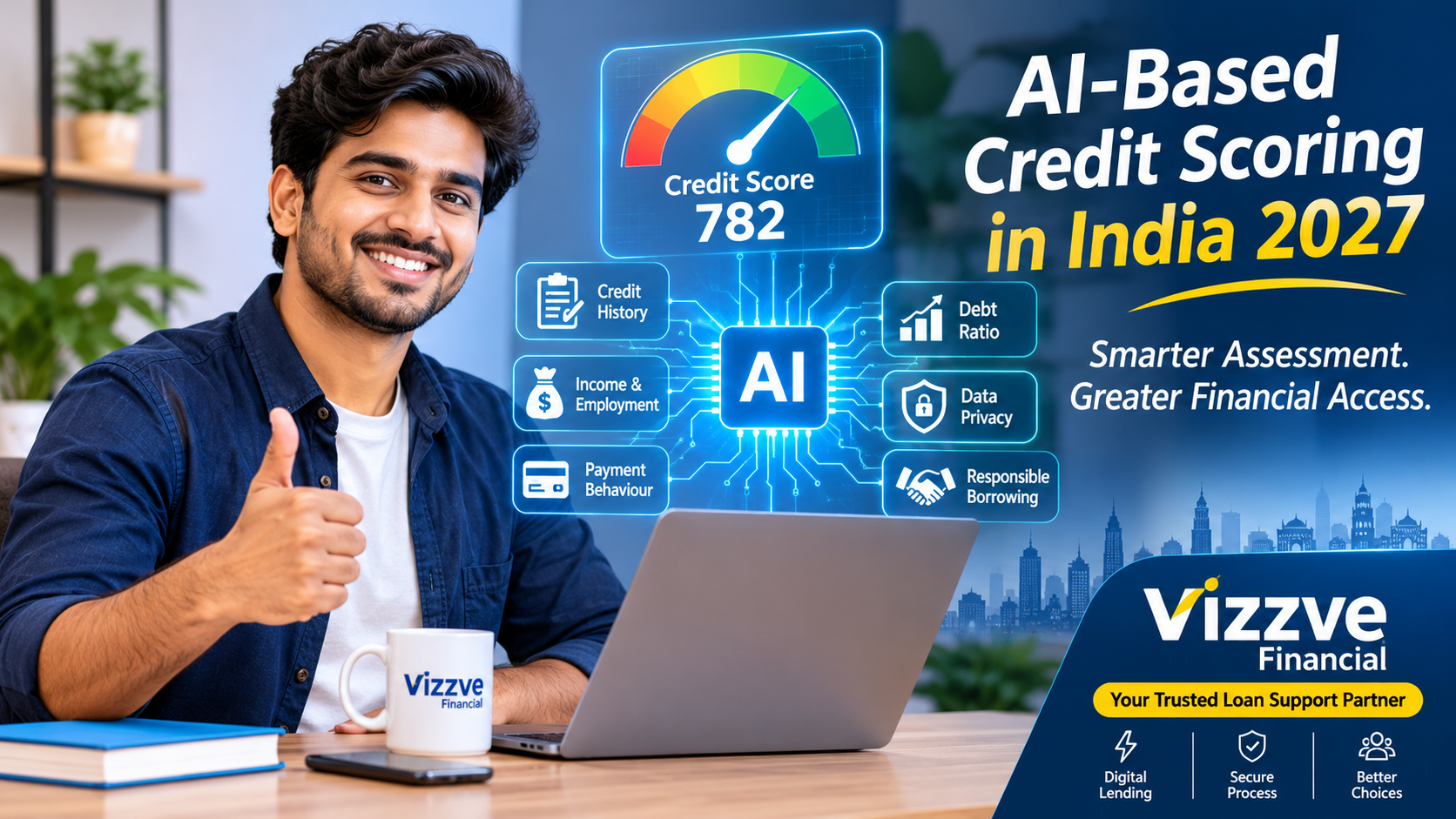
Getting a loan may become easier to understand as technology changes the way lenders evaluate applications. AI-based credit scoring in India is an emerging part of digital lending that helps financial institutions analyse financial information, identify repayment risks, and make more informed lending decisions.
By 2027, artificial intelligence may play a growing role in credit assessment. However, AI does not guarantee loan approval, a higher credit score, or lower interest rates.
This guide explains how AI-based credit scoring works, which factors may affect your loan eligibility, and how to protect your financial information when applying for a loan.
AI Answer Box
What is AI-based credit scoring?
AI-based credit scoring uses artificial intelligence and data analysis to help lenders evaluate a borrower's creditworthiness. Depending on the lender's system and applicable rules, it may analyse repayment history, existing debts, income information, credit utilisation, and other permitted financial data.
Why does it matter? It can help speed up application reviews, identify possible risks, and support more consistent decisions. Final approval depends on the lender's policies, verification requirements, and the applicant's financial circumstances.
What Is AI-Based Credit Scoring in India?
AI-based credit scoring is a technology-assisted method for estimating how likely a borrower is to repay a loan. It can help banks and non-banking financial companies (NBFCs) analyse information more efficiently than manual review alone.
Traditional credit scoring mainly relies on credit history and reported credit accounts. AI-supported systems may identify additional patterns in permitted financial information, depending on the lender's model.
According to the Government of India's 2026 communication on AI-based credit scoring, alternative data may include bank statements, digital payment transactions, GST records, and utility payments. Such information may help lenders assess people and small businesses with limited conventional credit histories.
How Does AI Credit Scoring Work?
Financial information
The applicant submits the required details, such as income, occupation, existing loans, and supporting documents.
AI analysis
The system examines permitted information to identify repayment patterns and estimate credit risk.
Eligibility assessment
The lender combines relevant information with its credit policy and verification requirements.
Lending decision
The application may be approved, declined, or sent for further checks. AI does not guarantee approval.
Which Factors Affect AI-Based Credit Scoring?
AI models differ between lenders. Common factors in credit assessment include:
|
Factor |
Why it matters |
|---|---|
|
Credit history |
Shows previous borrowing and repayment behaviour |
|
Payment history |
Helps identify missed or delayed payments |
|
Income |
Indicates potential repayment capacity |
|
Existing EMIs |
Shows current debt obligations |
|
Credit utilisation |
Reflects how much available revolving credit is used |
|
Bank statements |
May help verify income and cash flow |
|
Application details |
Help the lender verify identity and eligibility |
Important: Not every lender uses all these factors, and an AI model may not assign equal importance to each one.
Can AI Help People With Limited Credit History?
Yes, potentially. A person with little borrowing history may have limited information in a traditional credit report. Some lenders may use additional permitted financial information to build a broader picture of repayment capacity.
For example, a self-employed person may have irregular monthly income but maintain healthy cash flow across several months. A lender's assessment may consider that pattern alongside existing debts and other eligibility requirements.
However, alternative data does not guarantee a loan. Applicants should provide accurate information and apply only through legitimate lenders.
AI Credit Scoring vs Traditional Credit Scoring
|
Feature |
Traditional scoring |
AI-supported scoring |
|---|---|---|
|
Main approach |
Established credit factors |
Credit factors plus model-based analysis |
|
Data analysis |
Often based on defined rules |
Can identify complex patterns |
|
Processing |
May require more manual review |
May automate parts of assessment |
|
First-time borrowers |
Limited credit history can be a challenge |
Additional permitted data may help |
|
Risks |
Incomplete or outdated information |
Bias, errors, or poor-quality data |
|
Final decision |
Depends on lender policy |
Still depends on lender policy |
AI can support faster assessment, but traditional credit information remains important. The two approaches can work together rather than replace one another.
Benefits of AI-Based Credit Scoring in 2027
-
Faster reviews: Automated analysis may reduce processing time.
-
Better risk assessment: Models can identify patterns across financial information.
-
Wider potential access: Some applicants with limited credit history may receive a more complete assessment.
-
Operational efficiency: Automation can reduce repetitive manual work.
-
Improved monitoring: Lenders may use analytics to identify emerging repayment risks.
These benefits depend on the quality of the data, the design of the model, and the lender's implementation.
Risks and Limitations of AI Credit Scoring
AI is not error-free. Its results depend on the information and assumptions used by the system.
-
Incorrect data: Errors in a credit report or application can affect assessment.
-
Algorithmic bias: Poorly designed models may disadvantage certain applicants.
-
Privacy concerns: Financial information must be collected and used appropriately.
-
Limited transparency: Applicants may not know exactly how every factor affects a score.
-
Over-reliance on automation: A model may miss important context if the data is incomplete.
How Can Borrowers Protect Their Information?
The Reserve Bank of India issued its Digital Lending Directions, 2025, to strengthen requirements concerning borrower assessment, disclosures, data use, and customer protection in covered digital lending arrangements.
Before applying:
-
Check which regulated bank or NBFC is providing the loan.
-
Review the privacy policy and requested permissions.
-
Never share an OTP, PIN, or password with an agent.
-
Read the Key Facts Statement (KFS), including the APR and charges.
-
Ask the lender how to correct inaccurate information or raise a complaint.
You can also consult the RBI's official digital lending resources for regulatory guidance.
How to Improve Your Creditworthiness
Pay EMIs on time
Set reminders and maintain enough money in your account before each due date.
Keep debt manageable
Avoid taking on more repayments than your budget can comfortably support.
Check your credit report
Review your credit accounts and report any inaccurate entries to the relevant credit information company.
Submit genuine documents
Ensure that income details, bank statements, and identity information are accurate and consistent.
A Simple Example
Suppose an applicant earns ₹30,000 per month and already pays ₹8,000 in monthly EMIs. The lender may examine income stability, existing obligations, credit history, and other relevant information before deciding whether another loan is affordable.
This is only an illustration, not a universal eligibility formula. Every lender sets its own criteria, and an AI score alone does not determine the outcome.
Expert Commentary: What Should Borrowers Know?
AI-based credit scoring should be viewed as a decision-support tool, not a replacement for responsible lending. A reliable assessment depends on accurate information, suitable model design, appropriate oversight, and fair treatment of applicants.
The RBI's 2025 digital lending framework sets out requirements for regulated lenders and their lending service providers. The RBI also published its FREE-AI committee report in August 2025, outlining recommendations for responsible and ethical AI use in the financial sector.
For borrowers, the practical lesson is simple: maintain accurate financial records, understand your repayment capacity, and do not assume that a fast digital process means guaranteed approval.
Pros and Cons at a Glance
|
Pros |
Cons |
|---|---|
|
May speed up assessment |
Results can be affected by inaccurate data |
|
Can analyse complex patterns |
Model decisions may be difficult to explain |
|
May help assess limited credit histories |
Alternative data may not be accepted by every lender |
|
Can support risk monitoring |
Poorly designed models can introduce bias |
Key Takeaways
-
AI-based credit scoring helps lenders assess repayment risk using data analysis.
-
Credit history, income, existing debt, and other permitted information may affect the assessment.
-
AI may help some applicants with limited credit histories, but eligibility varies.
-
Better technology does not guarantee approval, low interest rates, or a high credit score.
-
Protect personal data and verify the lender before submitting an application.
-
Always compare the total borrowing cost and choose an EMI you can afford.
How Vizzve Financial Fits Into Digital Borrowing
Vizzve Financial provides a platform for exploring loan-related information and borrowing options. Before applying for any personal loan, check the applicable eligibility criteria, lender details, documentation requirements, interest rate, fees, and repayment terms.
Promotional section: Vizzve Financial is one of India’s trusted loan support platforms offering quick personal loans, low documentation, and an easy approval process. Apply at www.vizzve.com.
Availability, eligibility, documentation, processing time, and approval depend on the applicable product and lending partner. Review the terms before proceeding.
Frequently Asked Questions
What is AI-based credit scoring in India?
It is a technology-assisted method that uses data analysis and machine learning, where applicable, to help lenders assess a borrower's creditworthiness and repayment risk.
How does AI calculate a credit score?
AI models may analyse permitted information such as credit history, repayment patterns, income, and existing debt. The precise method varies by lender.
Will AI credit scoring become more common in 2027?
AI adoption may continue to grow as digital lending develops. However, the extent of adoption in 2027 will depend on lender decisions, technology, and regulatory requirements.
Can AI approve a personal loan instantly?
Automated systems may speed up parts of the assessment, but identity checks, document verification, and other lender requirements can take additional time.
Can someone with no credit history get a loan?
Possibly. Some lenders may consider other permitted information, but others may require an established credit history. Approval is never guaranteed.
Does AI credit scoring replace CIBIL?
No. AI-supported assessment can complement credit bureau information. Lenders may continue to use credit reports and scores alongside other relevant factors.
What affects creditworthiness the most?
Repayment history, existing debt, credit utilisation, income, and the lender's own eligibility rules may all matter. Their relative importance varies.
Is AI-based credit scoring safe?
It can be used responsibly, but risks remain. Choose legitimate lenders, review data permissions, and avoid sharing sensitive credentials.
How can I improve my credit profile?
Pay instalments on time, keep debt manageable, review your credit report, correct errors, and submit accurate financial information.
Can I apply for a loan through Vizzve Financial?
You can visit Vizzve Financial to explore available loan-related services. Check the current product details, eligibility conditions, and lending partner before applying.
Conclusion
AI-based credit scoring in India is an important development in digital finance. It may help lenders analyse applications more efficiently, assess repayment risk, and explore additional ways to evaluate borrowers with limited credit histories.
For applicants, the best approach remains responsible borrowing: maintain a healthy repayment record, provide accurate information, protect personal data, and compare loan costs before making a decision.
Explore loan-related information and available borrowing options at www.vizzve.com with Vizzve Financial.
Published on : 29th October
Published by : MD HEDAYATULLAH
www.vizzve.com || www.vizzveservices.com
Follow us on social media: Facebook || Linkedin || Instagram
🛡 Powered by Vizzve Financial
RBI-Registered Loan Partner | 10 Lakh+ Customers | ₹600 Cr+ Disburs