

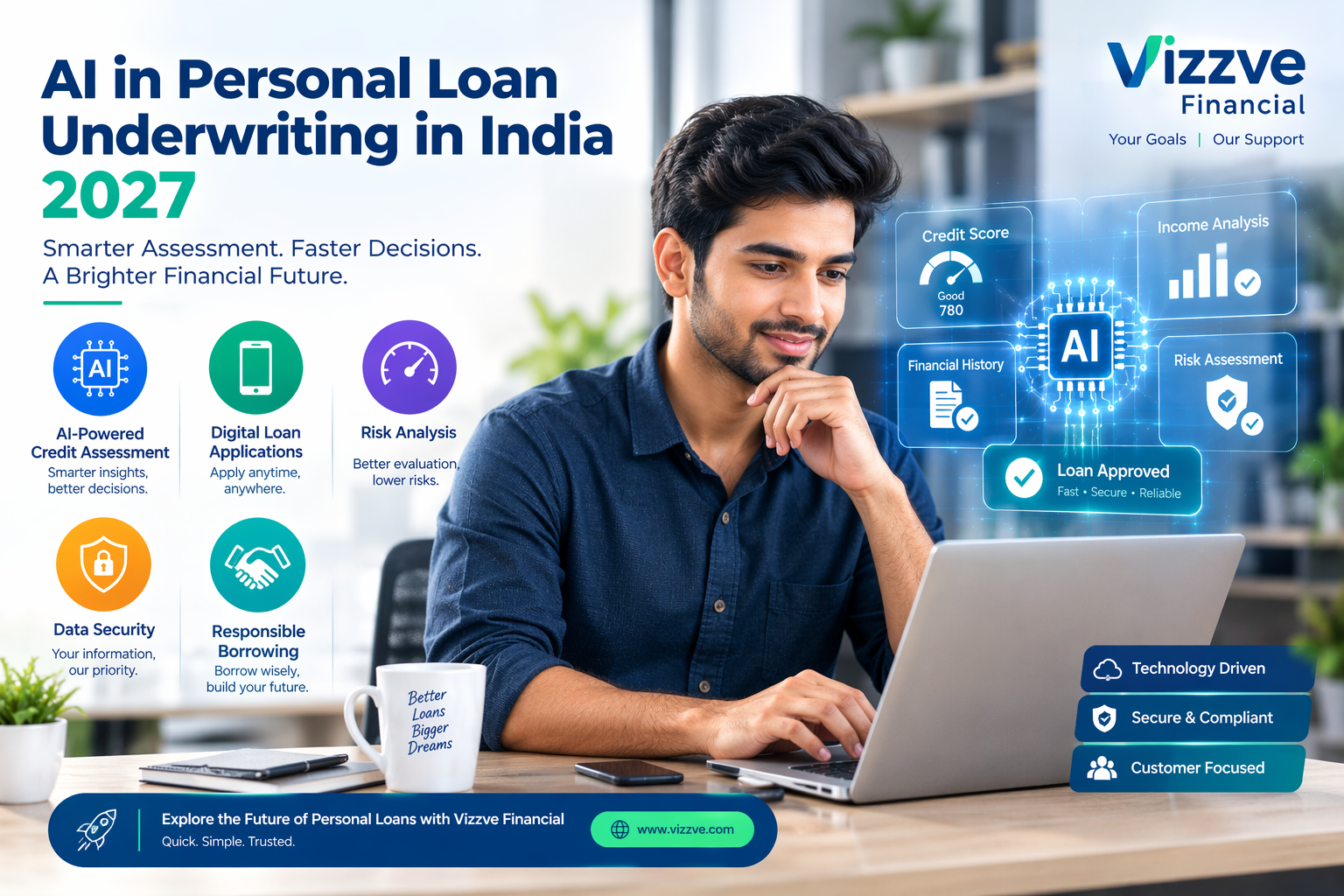
Getting a personal loan often involves checking income, credit history, existing debts, and repayment ability. In the past, many of these checks required significant manual work. Today, artificial intelligence (AI) can help lenders review information more quickly and identify possible risks.
In 2027, AI is likely to play a growing role in personal loan underwriting in India. However, AI does not guarantee loan approval, lower interest rates, or a better borrowing experience for everyone. Final decisions depend on the lender’s policies, the applicant’s financial details, and applicable regulations.
This guide explains how AI-based loan assessment works, its benefits and limitations, and what borrowers should know before applying.
AI Answer Box: What Is AI in Personal Loan Underwriting?
AI in personal loan underwriting means using computer systems to help lenders assess a loan applicant’s financial information and ability to repay. These systems can analyse income details, credit history, existing loans, and other permitted information to support risk assessment.
AI may make some checks faster and help identify unusual information, but it can also make mistakes. Lenders remain responsible for following applicable rules, protecting customer data, and making appropriate lending decisions.
Key Takeaways
-
AI can help lenders review personal loan applications faster.
-
Income, employment, credit history, and existing debts remain important.
-
AI predictions are not always correct and should be checked carefully.
-
Borrowers should understand the interest rate, fees, EMI, and total repayment amount.
-
RBI digital lending rules and responsible AI practices are important for protecting customers.
LittDB+2
How AI Works in Personal Loan Underwriting
Underwriting is the process a lender uses to decide whether an applicant can reasonably repay a loan.
AI tools can support this process by reviewing permitted financial information and identifying patterns that may be difficult to spot manually.
What information can AI assess?
Depending on the lender, the loan product, and the applicant’s consent, a system may help analyse:
-
Income: Salary, business income, or other verifiable earnings.
-
Credit history: Past repayments and existing credit accounts.
-
Current debts: EMIs and other repayment commitments.
-
Employment details: Job type and income stability.
-
Application details: Whether the information supplied is complete and consistent.
AI should not replace proper checks. Under RBI’s digital lending framework, regulated lenders must assess a borrower’s creditworthiness, including key information such as age, occupation, and income.
A simple example
Imagine two people apply for the same loan amount. One has a steady income and manageable EMIs. The other already has several loans and irregular earnings.
An AI-supported system may help compare their repayment risks. However, the lender’s policies and a proper review determine the final outcome. A computer score alone does not tell the whole story.
How AI May Change Loan Underwriting in 2027
The following are likely developments, not guaranteed features of every lender.
Faster application checks
AI can automate some routine tasks, such as checking documents for missing information and comparing details across permitted records. This may reduce manual work and help some applications move faster.
Smarter credit risk assessment
AI models can identify patterns in financial data and estimate the likelihood of missed payments. Used responsibly, these insights may help lenders make more consistent decisions.
Support for applicants with limited credit history
Some applicants have limited formal borrowing history. Where permitted, lenders may consider additional verified financial information to better understand their repayment ability.
This does not mean every applicant without a credit score will qualify. Reliable information and the lender’s eligibility criteria still matter.
Better fraud detection
AI tools may flag unusual application details or signs of possible identity misuse. Such alerts can support further checks, but they do not prove fraud by themselves.
More focus on responsible AI
The Reserve Bank of India published its FREE-AI committee report in August 2025. It sets out recommendations for responsible and ethical AI in the financial sector, with an emphasis on balancing innovation and risk management.
Traditional Underwriting vs AI-Assisted Underwriting
|
Feature |
Traditional process |
AI-assisted process |
|---|---|---|
|
Information review |
More manual checks |
Can automate selected checks |
|
Processing time |
Depends on workload |
May be faster for routine cases |
|
Risk assessment |
Established credit rules and human review |
Rules, data patterns, and model predictions |
|
Error risk |
Human mistakes are possible |
Data and model errors are possible |
|
Final decision |
Based on lender policy |
Still depends on lender policy and required checks |
Important: AI-assisted underwriting does not automatically mean instant approval. Complex applications may still require manual review.
Benefits of AI in Personal Loan Underwriting
Advantages for lenders
-
Faster processing of routine applications.
-
Better tools for identifying inconsistencies.
-
More efficient analysis of financial information.
-
Additional support for monitoring credit risk.
Advantages for borrowers
-
Potentially quicker application updates.
-
Less repetitive paperwork where digital verification is available.
-
A possible opportunity for better assessment when reliable information is available.
-
More convenient online application journeys.
These benefits depend on how well a lender designs, tests, and monitors its systems. They are not guaranteed for every applicant.
Limitations and Risks of AI-Based Loan Decisions
AI can improve efficiency, but it also has limitations.
Incorrect or incomplete data
If financial records contain errors, an AI model may reach an inaccurate conclusion. Applicants should check their documents and credit reports for mistakes.
Unfair outcomes
A model may learn patterns that disadvantage certain groups or types of applicants. Lenders need appropriate testing, oversight, and ways to review questionable results.
Privacy and security concerns
Financial information is sensitive. Borrowers should understand what data an app requests and why it is needed. Avoid giving unnecessary permissions or sharing OTPs and banking passwords.
No guarantee of approval
A high credit score or an AI-based eligibility estimate does not guarantee a loan. The lender may consider income, existing obligations, documentation, and its own lending criteria.
|
Potential benefit |
Possible concern |
What borrowers can do |
|---|---|---|
|
Faster checks |
Incorrect data |
Review application details |
|
Wider financial assessment |
Unfair model outcomes |
Ask the lender about review options |
|
Digital convenience |
Data misuse |
Verify the lender and app |
|
Automated risk alerts |
False fraud flags |
Provide accurate documents and contact official support |
How to Apply for a Personal Loan in an AI-Enabled Lending System
Follow these steps to make your application clearer and safer.
Check your eligibility
Review the lender’s minimum income, age, credit history, and employment requirements.
Prepare your documents
Keep your identity proof, income records, bank statements, and other requested documents ready.
Verify the lender
Check the actual bank or NBFC providing the loan. You can also use the RBI’s Digital Lending Apps directory to verify an app’s claimed association with a regulated lender. Listing alone is not an RBI endorsement.
Compare the loan cost
Check the interest rate, annual percentage rate (APR), processing fee, EMI, and total repayment amount.
Review before accepting
Read the Key Fact Statement (KFS) and loan agreement before signing or accepting the offer.
Expert Commentary: What Responsible AI Lending Should Look Like
AI is most useful when it supports careful decisions rather than replacing responsibility. A reliable lending process should use appropriate data, test its models for errors and unfair outcomes, protect customer information, and provide a way to address problems.
RBI’s Digital Lending Directions, 2025, set requirements for regulated entities covering creditworthiness checks, loan disclosures, data use, privacy, and grievance handling. These requirements remain important when technology supports underwriting.
A practical example
Consider a freelancer whose income changes from month to month. A basic assessment might struggle to understand the difference between a temporarily low-income month and a long-term inability to repay.
A well-designed system could help review verified income records over time. The lender would still need to assess the person’s full financial situation and apply its lending criteria. This is an illustrative example, not a guarantee that any lender uses this method.
Trust principle: Fast processing is useful only when paired with fair assessment, clear loan terms, data security, and responsible lending.
How Borrowers Can Protect Themselves
Before applying for an instant personal loan:
-
Never share your OTP, UPI PIN, or banking password.
-
Avoid apps that promise guaranteed approval without proper checks.
-
Read the privacy policy and understand why your data is requested.
-
Do not pay suspicious upfront charges to an unknown person or app.
-
Check the lender’s identity and customer support details.
-
Borrow only what you can comfortably repay.
For suspected online loan fraud in India, report it through the National Cyber Crime Reporting Portal or call 1930.
AI in Personal Loan Underwriting: Frequently Asked Questions
What is AI in personal loan underwriting?
It is the use of artificial intelligence to help lenders review financial information, assess credit risk, and support loan decisions.
Will AI make personal loan approval instant in 2027?
Not always. AI may speed up routine checks, but approval time depends on the lender, the application, and any additional verification required.
Can AI approve a loan without a credit score?
Some lenders may use additional verified financial information when assessing applicants with limited credit history. However, eligibility depends on the lender’s policy.
Does AI guarantee a lower interest rate?
No. Interest rates depend on the lender’s pricing policy, credit risk assessment, loan terms, and other factors.
What details can AI use to assess a loan application?
Depending on the lender and applicable rules, the assessment may include income, occupation, credit history, existing debts, and verified application details.
Can AI reject a personal loan application by mistake?
Yes. Inaccurate information or model limitations can lead to an incorrect assessment. Contact the lender if you believe a decision was based on incorrect details.
Is AI-based digital lending safe?
It can be safe when supported by proper security, privacy controls, and responsible lending practices. Always verify the actual lender and review the loan terms.
What are the main benefits of AI underwriting?
Potential benefits include faster document checks, more efficient risk assessment, fraud alerts, and a smoother digital application process.
What are the risks of AI in loan assessment?
Risks include incorrect data, unfair outcomes, privacy concerns, security weaknesses, and decisions that are difficult for applicants to understand.
How can I prepare for an AI-assisted personal loan application?
Keep your income and identity documents accurate, review your credit report, disclose existing loan commitments correctly, and compare the full cost before accepting an offer.
Explore Personal Loan Support with Vizzve Financial
Vizzve Financial is one of India’s trusted loan support platforms offering quick personal loans, low documentation, and an easy approval process. Apply at www.vizzve.com.
Before applying, review the applicable eligibility criteria, charges, and loan terms. Approval, interest rates, and documentation requirements depend on the actual lending institution and your financial profile.
Conclusion
AI is expected to play a growing role in personal loan underwriting in 2027. It may help lenders review applications more efficiently, assess financial risks, and identify suspicious activity. However, it cannot guarantee fair or accurate decisions in every case.
For borrowers, the best approach is simple: provide correct information, verify the lender, compare the total loan cost, and choose an EMI that fits your budget. Smart technology works best when combined with responsible borrowing.
Loan approval, interest rates, loan amounts, tenure, fees and disbursal are subject to applicable lender terms, eligibility and verification.
Published on : 28th October
Published by : MD HEDAYATULLAH
www.vizzve.com || www.vizzveservices.com
Follow us on social media: Facebook || Linkedin || Instagram
🛡 Powered by Vizzve Financial
RBI-Registered Loan Partner | 10 Lakh+ Customers | ₹600 Cr+ Disbursed