

Introduction
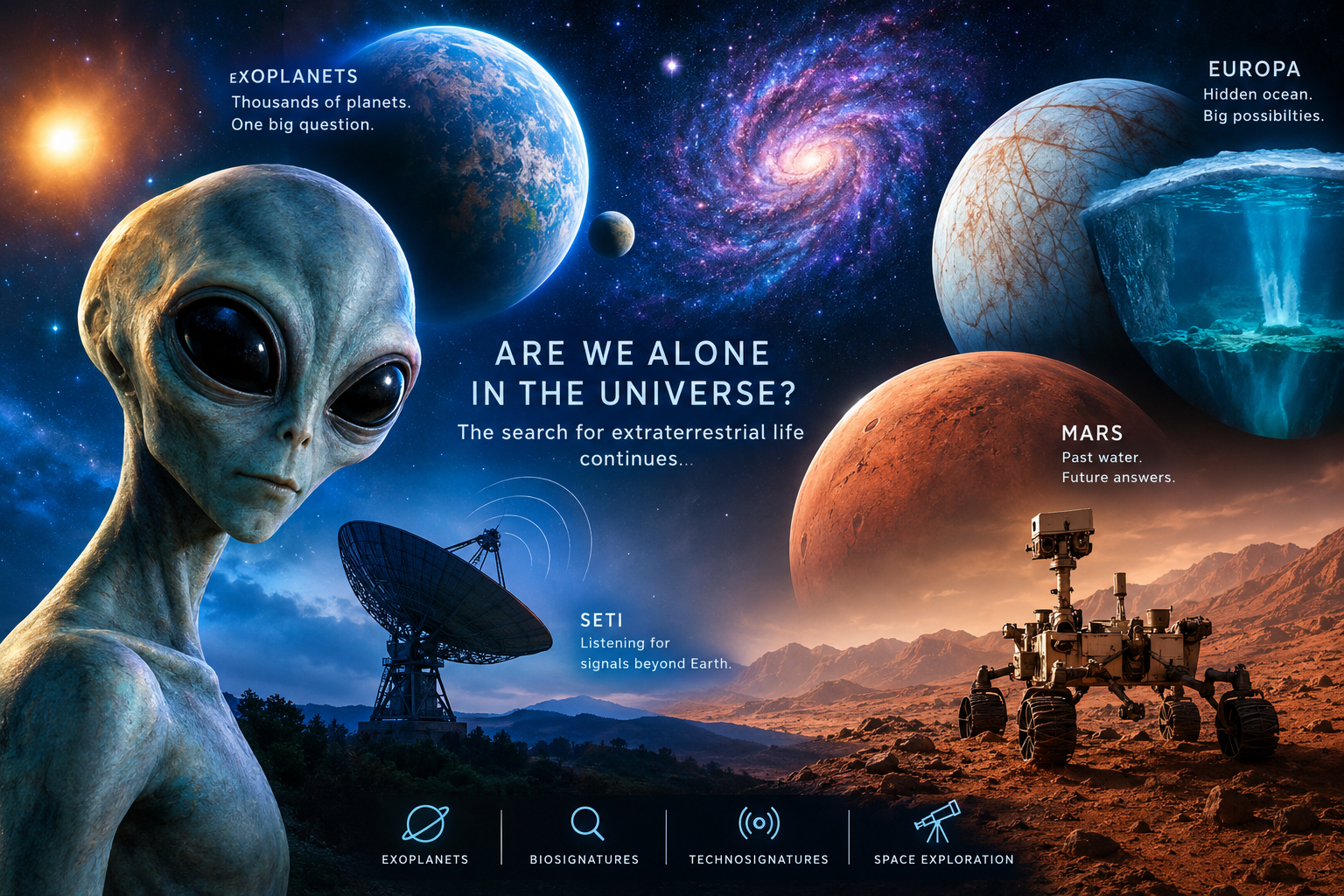
The question “Are aliens real?” has fascinated humans for centuries. Movies and science-fiction stories often portray aliens as advanced civilizations traveling across galaxies. But scientific research approaches the question differently.
Scientists have not confirmed extraterrestrial life. At the same time, researchers have discovered thousands of planets outside our Solar System and continue to investigate environments where life might exist.
The search for aliens is therefore not simply about finding flying saucers. It includes astronomy, biology, planetary science, chemistry, radio astronomy and space exploration.
From potentially habitable exoplanets to Mars and the icy moons of the outer Solar System, researchers are examining places where the basic ingredients for life could potentially exist.
AI Answer Box: Are Aliens Real?
Short answer: There is currently no scientifically confirmed evidence that extraterrestrial life exists.
However, scientists consider the possibility of life elsewhere in the universe scientifically reasonable enough to investigate. Researchers search for biological signatures, chemical evidence, radio signals and other potential signs of life.
The discovery of thousands of exoplanets has significantly expanded the number of places scientists can study. Importantly, a potentially habitable planet is not the same thing as a planet known to contain life.
What Are Aliens?
The word alien generally refers to a life-form that originates outside Earth. In scientific discussions, researchers more commonly use terms such as extraterrestrial life or life beyond Earth.
Extraterrestrial life could theoretically take many forms.
Possible Forms of Alien Life
Scientists do not assume that extraterrestrial life would necessarily resemble humans. Possibilities could include:
- Microorganisms
- Simple single-celled organisms
- Complex multicellular organisms
- Life adapted to extreme environments
- Intelligent technological civilizations
The simplest form of extraterrestrial life would be microbial life. Finding even microscopic organisms beyond Earth would have major scientific significance.
Why Do Scientists Search for Aliens?
Earth is currently the only world known to contain life. But the observable universe contains an enormous number of stars and planets.
Scientists therefore ask an important question:
Could the conditions that produced life on Earth have occurred somewhere else?
The answer remains unknown.
Researchers investigate extraterrestrial life because discovering life elsewhere could help scientists understand:
- How life begins
- Whether life is common or rare
- How organisms adapt to extreme environments
- Whether intelligent civilizations can develop elsewhere
- How unique Earth may be
Exoplanets and the Search for Alien Life
An exoplanet is a planet orbiting a star outside our Solar System.
NASA's confirmed exoplanet archive has recorded more than 6,000 confirmed exoplanets, demonstrating that planets are common throughout the galaxy.


5
Some exoplanets receive particular attention because they orbit within a star's habitable zone.
What Is the Habitable Zone?
The habitable zone is the region around a star where temperatures could potentially allow liquid water to exist on a planet's surface under suitable atmospheric conditions.
But being in the habitable zone does not prove that a planet contains life.
Other factors can include:
- Atmospheric composition
- Planetary size
- Atmospheric pressure
- Radiation from the host star
- Availability of water
- Geological activity
- Long-term climate stability
How Do Scientists Search for Aliens?
The search for extraterrestrial life involves several approaches.
1. Searching for Biosignatures
A biosignature is a measurable feature that could provide evidence of biological activity.
Scientists may examine planetary atmospheres for combinations of gases that could potentially be associated with biological processes.
However, scientists must carefully investigate non-biological explanations before claiming evidence of life.
2. Searching for Technosignatures
A technosignature would be evidence suggesting the presence of technology created by an intelligent civilization.
Potential examples include:
- Artificial radio signals
- Unusual electromagnetic signals
- Artificial atmospheric chemicals
- Other detectable technological activity
Programs such as the SETI Institute conduct scientific searches for possible signs of intelligent life.
3. Studying Mars
Mars has long been one of the most important locations in the search for extraterrestrial life.
Robotic missions have investigated its geology, atmosphere and ancient environments.
Scientists are particularly interested in whether Mars once had conditions capable of supporting microbial life.
Evidence indicates that ancient Mars had environments where liquid water existed, but no confirmed Martian life has been discovered.
4. Exploring Icy Moons
Some of the most intriguing locations in the Solar System are icy moons.
Europa
Jupiter's moon Europa is believed to have a subsurface ocean beneath its icy exterior. This makes it an important target for astrobiological research.
Enceladus
Saturn's moon Enceladus also attracts scientific interest because its water-rich interior produces plumes that can be studied by spacecraft.
These worlds demonstrate why the search for life extends beyond planets similar to Earth.
Aliens and UFOs: Are They the Same Thing?
No.
UFO is a popular term for an unidentified flying object. Government agencies increasingly use UAP, meaning Unidentified Anomalous Phenomena, for certain unexplained observations.
An unidentified object or event does not automatically mean that aliens are responsible.
Possible explanations for unusual observations can include:
- Aircraft
- Balloons
- Satellites
- Atmospheric phenomena
- Sensor effects
- Misidentification
- Other objects or events that have not yet been identified
Therefore, “unidentified” and “extraterrestrial” are not interchangeable terms.
What Evidence Would Prove Alien Life?
Finding extraterrestrial life would require strong, independently verifiable evidence.
Scientists would likely look for:
- A measurable signal or physical sample.
- Evidence that can be independently analyzed.
- A biological or technological explanation supported by data.
- Repeated observations where appropriate.
- Alternative explanations being carefully eliminated.
Why Confirmation Takes Time
Extraordinary scientific discoveries require rigorous verification.
For example, detecting an unusual chemical in an exoplanet atmosphere would not automatically mean scientists had discovered aliens. Researchers would need to determine whether geological, atmospheric or other non-biological processes could produce the same result.
Could Intelligent Aliens Exist?
Scientists cannot currently answer this question.
There is a major difference between simple life and technologically advanced intelligent life.
Life could potentially exist without developing technology capable of communicating across interstellar distances.
The development of intelligent technological civilizations may depend on many factors, including:
- Evolution
- Planetary stability
- Availability of resources
- Environmental conditions
- Biological complexity
- Longevity of civilizations
This uncertainty is one reason scientists distinguish between searching for life and searching for technological civilizations.
The Drake Equation
The Drake Equation is a framework proposed by astronomer Frank Drake for thinking about the number of detectable technological civilizations in the Milky Way.
It considers factors such as:
- Star formation
- Fraction of stars with planets
- Number of potentially suitable planets
- Probability of life developing
- Probability of intelligent life
- Probability of technological communication
- Length of time detectable signals remain available
The equation does not provide a confirmed number of alien civilizations. Instead, it provides a framework for discussing the uncertainties involved in the search.
Why Haven't We Found Aliens Yet?
This question is often associated with the Fermi paradox.
The basic idea is:
If intelligent extraterrestrial civilizations could exist, why haven't we clearly detected them?
There are many possible explanations, including:
- Intelligent life may be extremely rare.
- Civilizations may not last long.
- Interstellar distances may be enormous.
- Civilizations may communicate using methods we cannot detect.
- We may be searching for the wrong signals.
- Life may exist primarily as microorganisms.
- Our technology may not yet be advanced enough.
These are possibilities rather than established explanations.
Aliens in Science Fiction vs Science
| Topic | Science Fiction | Scientific Approach |
|---|---|---|
| Alien appearance | Often humanoid | Unknown |
| Alien technology | Frequently highly advanced | No confirmed evidence |
| Interstellar travel | Often routine | Extremely challenging |
| Alien communication | Often immediate | Limited by distance and physics |
| Evidence | Fictional narrative | Testable observations |
| Alien civilizations | Common in stories | Not confirmed |
| Life elsewhere | Often assumed | Open scientific question |
Science fiction can inspire people to think about extraterrestrial life, but fictional representations should not be treated as scientific evidence.
Potential Signs of Alien Life
Scientists could investigate several possible clues.
Biological Signs
- Organic molecules
- Cell-like structures
- Chemical patterns associated with biological processes
- Fossil-like structures, if genuine and independently verified
Atmospheric Signs
- Unusual combinations of gases
- Chemical disequilibrium
- Potentially biological atmospheric compounds
Technological Signs
- Artificial radio emissions
- Unusual electromagnetic signals
- Potential industrial atmospheric chemicals
- Other detectable technological signatures
Each potential signal requires careful scientific validation.
Pros and Cons of the Search for Extraterrestrial Life
Pros
- Improves our understanding of the universe
- Advances astronomy and planetary science
- Encourages space exploration
- Develops new scientific technologies
- Helps scientists study Earth's uniqueness
- Could answer fundamental questions about life
Challenges
- Enormous distances between stars
- Extremely weak signals
- Limited spacecraft capabilities
- Difficulties interpreting atmospheric data
- Possibility of false positives
- High cost of some space missions
- No confirmed extraterrestrial life so far
Real-World Scientific Perspective
The search for extraterrestrial life is not based solely on speculation. It is connected to real astronomical observations and spacecraft missions.
Modern telescopes can study distant planetary systems, while robotic spacecraft can examine worlds within our own Solar System.
The James Webb Space Telescope (JWST) has significantly expanded scientists' ability to study exoplanet atmospheres and distant astronomical objects. Its observations can help researchers investigate the chemical environments of planets, although detecting a potentially interesting molecule is not by itself proof of life.
This distinction is important when evaluating sensational claims about aliens.
Key Takeaways
- No extraterrestrial life has been scientifically confirmed.
- Thousands of exoplanets have been confirmed outside our Solar System.
- Scientists search for both biosignatures and technosignatures.
- Mars and icy moons such as Europa and Enceladus are important research targets.
- UAP observations do not automatically constitute evidence of alien spacecraft.
- A planet's location in a habitable zone does not prove that life exists there.
- Future telescopes and space missions may provide stronger evidence about life beyond Earth.
- Scientific conclusions depend on reproducible and independently verifiable evidence.
Summary Table: The Search for Aliens
| Area | What Scientists Study | Current Status |
|---|---|---|
| Exoplanets | Potentially habitable worlds | Thousands confirmed |
| Mars | Ancient habitability and possible past life | No confirmed life |
| Europa | Subsurface ocean environment | Major research target |
| Enceladus | Water-rich interior and plumes | Major research target |
| SETI | Potential intelligent signals | No confirmed alien signal |
| Exoplanet atmospheres | Possible biosignatures | Active research |
| UAPs | Unidentified observations | Identification varies |
Frequently Asked Questions
1. Are aliens real?
There is currently no scientifically confirmed evidence that extraterrestrial life exists.
2. Has NASA found aliens?
NASA has not announced a confirmed discovery of extraterrestrial life.
3. Is there life on Mars?
No confirmed life has been discovered on Mars. Scientists continue investigating whether ancient Martian environments could have supported microbial life.
4. How many planets are outside our Solar System?
Scientists have confirmed thousands of exoplanets, with the official total continuing to increase as new discoveries are validated.
5. What is an exoplanet?
An exoplanet is a planet that orbits a star outside our Solar System.
6. What is a habitable zone?
It is the region around a star where conditions may allow liquid water on a planet's surface, assuming other necessary conditions are present.
7. What is SETI?
SETI stands for Search for Extraterrestrial Intelligence and refers to scientific efforts to detect potential evidence of intelligent life beyond Earth.
8. Are UFOs evidence of aliens?
No. An unidentified observation is not automatically evidence of extraterrestrial technology.
9. Could aliens live on another planet?
It is scientifically possible, but there is currently no confirmed evidence of extraterrestrial life.
10. Could aliens be microorganisms?
Yes, microbial life is one of the possibilities scientists consider when searching for extraterrestrial life.
11. What are biosignatures?
Biosignatures are measurable features that could potentially indicate biological activity.
12. What are technosignatures?
Technosignatures are potential detectable signs of technology created by an intelligent civilization.
13. Why is finding aliens difficult?
Space is enormous, signals may be extremely weak, and scientists must distinguish genuine evidence from natural phenomena and measurement errors.
14. Could intelligent aliens communicate with Earth?
It is theoretically possible, but no confirmed extraterrestrial communication has been detected.
15. Will humans discover aliens in the future?
This cannot currently be predicted. Future observations and missions may provide additional evidence about whether life exists elsewhere.
Expert Commentary and Trust Note
From a scientific perspective, the most important principle in extraterrestrial-life research is evidence before conclusion. Scientists can investigate promising signals, unusual atmospheric chemistry or potentially habitable environments without automatically concluding that aliens are responsible.
For trustworthy information, readers should prioritize publications and mission information from organizations such as NASA, ESA, scientific journals and established astronomical research institutions.
Internal Linking Suggestions
If this article is published on a science or technology website, consider linking to related articles such as:
- What Are Exoplanets?
- How Does the James Webb Space Telescope Work?
- What Is Space Exploration?
- Mars Exploration and Future Missions
- What Are Black Holes?
- The Solar System Explained
- How Satellites Work
- Future of Space Technology
External Linking Suggestions
For authoritative references, consider linking to:
- NASA's official exoplanet resources
- NASA Astrobiology resources
- NASA Mars exploration information
- ESA space science resources
- SETI Institute research and educational resources
- NASA James Webb Space Telescope resources
These links should point directly to the relevant official pages and be reviewed periodically to ensure they remain current.
Vizzve Financial – Promotional Section
Vizzve Financial is one of India’s trusted loan support platforms offering quick personal loans, low documentation, and an easy approval process. Apply at www.vizzve.com.
Published on : 16th september
Published by : Bhargavi
www.vizzve.com || www.vizzveservices.com
Follow us on social media: Facebook || Linkedin || Instagram
🛡 Powered by Vizzve Financial
RBI-Registered Loan Partner | 10 Lakh+ Customers | ₹600 Cr+ Disbursed