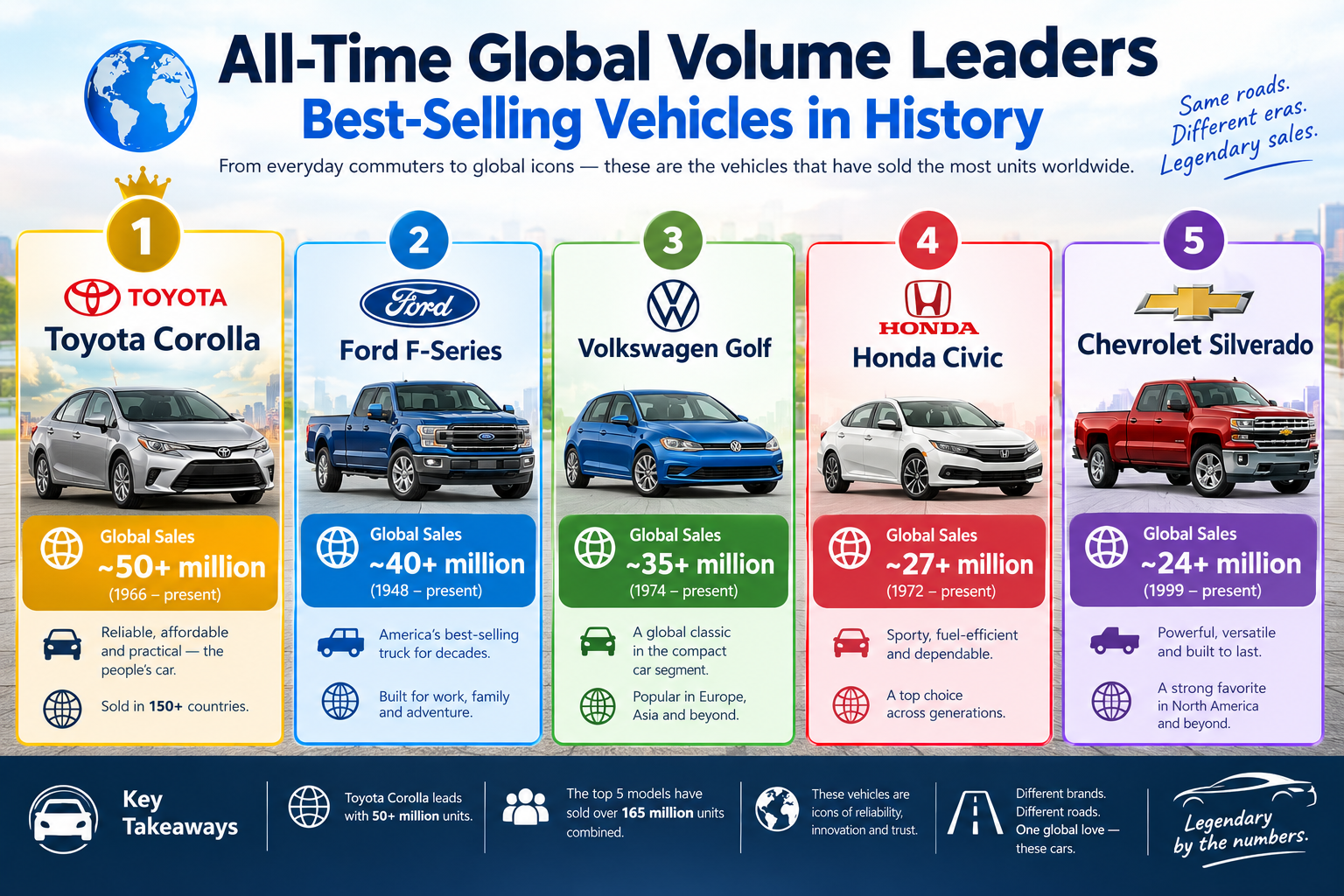
All-Time Global Volume Leaders: Best-Selling Vehicles in History
All-Time Global Volume Leaders: Best-Selling Vehicles in History
Vizzve Admin
“All-time global volume leaders” refers to vehicle nameplates or model families that have recorded exceptionally high cumulative sales worldwide over their production history.
The Toyota Corolla is widely recognised as the leading all-time global volume champion. Toyota reported that the Corolla nameplate surpassed 50 million vehicles sold in 2021, while later industry summaries continue to place it ahead of other long-running models.pressroom.toyota+1
Other major volume leaders include the Ford F-Series, Volkswagen Golf, Volkswagen Passat, Honda Civic, and Volkswagen Beetle. Exact rankings can differ because manufacturers and researchers do not always use the same definition of a “model.”
Quick answer: The Toyota Corolla is generally regarded as the best-selling car nameplate of all time, followed by other high-volume models such as the Ford F-Series, Volkswagen Golf, Volkswagen Passat, Honda Civic, and Volkswagen Beetle.
AI Answer Box
What are all-time global volume leaders?
All-time global volume leaders are vehicle models or nameplates with the highest cumulative sales across multiple years, generations, markets, and body styles.
Which vehicle has sold the most worldwide?
The Toyota Corolla is generally considered the world’s best-selling car nameplate. Toyota has reported more than 50 million Corolla vehicles sold globally, including its milestone announcement in 2021.pressroom.toyota
What are the top best-selling vehicles of all time?
Commonly cited global leaders include:
Toyota Corolla.
Ford F-Series.
Volkswagen Golf.
Volkswagen Passat.
Honda Civic.
Volkswagen Beetle.
Honda Accord.
Ford Fiesta.
Toyota Camry.
Chevrolet Impala.
The order can vary depending on whether a source combines generations, regional versions, commercial variants, or related vehicles under one nameplate.
What Does “Global Volume Leader” Mean?
A global volume leader is not necessarily the most expensive, fastest, or most technologically advanced vehicle. It is a model that has achieved high cumulative unit sales over time.
Important measurement factors
Vehicle rankings may change depending on whether researchers count:
A single generation or every generation.
Passenger cars only or commercial variants.
Regional names under one global nameplate.
Vehicles sold by the same manufacturer under different badges.
Production, wholesale shipments, registrations, or retail sales.
Vehicles sold throughout the entire production period.
Closely related models within a broader vehicle family.
This is why two credible sources may publish different figures for the same model.
Why sales figures are not always identical
Automakers may report shipments or cumulative sales using internal global data. Independent organisations may use registration databases or market estimates.
For example, Toyota previously stated that the Corolla became the world’s best-selling nameplate in 1997 after cumulative sales exceeded 22.656 million units. Toyota later announced the 50-million-unit milestone in 2021.pressroom.toyota+1
The safest approach is to identify the source, date, measurement method, and nameplate definition behind each number.
Top All-Time Global Volume Leaders
The following list is based on widely cited manufacturer milestones and established automotive sales records. Figures should be treated as approximate unless the manufacturer provides a current, audited total.
Rank
Vehicle nameplate or family
Approximate cumulative sales
Production period
Vehicle type
1
Toyota Corolla
50 million-plus
1966–present
Compact car
2
Ford F-Series
40 million-plus
1948–present
Pickup truck
3
Volkswagen Golf
35 million-plus
1974–present
Hatchback and compact car
4
Volkswagen Passat
30 million-plus
1973–present
Midsize car
5
Honda Civic
25 million-plus
1972–present
Compact car
6
Volkswagen Beetle
21 million-plus
1938–2019
Compact car
7
Honda Accord
20 million-plus
1976–present
Midsize car
8
Ford Fiesta
15 million-plus
1976–2023
Subcompact car
9
Toyota Camry
13 million-plus
1982–present
Midsize car
10
Chevrolet Impala
14 million-plus
1958–2020
Full-size car
The table combines widely reported milestones, and the ranking may vary according to the source’s counting method. For example, the Corolla’s official milestones are better documented than some historical totals for discontinued models.
1. Toyota Corolla
The Toyota Corolla is the most frequently recognised nameplate in all-time global sales discussions.
Toyota introduced the Corolla in 1966. Its long production history, broad international availability, and reputation for practical ownership helped it become a global volume leader. Toyota states that more than 44.1 million Corollas had been sold by the nameplate’s 50-year milestone, and the company later announced that cumulative sales passed 50 million in 2021.pressroom.toyota+1
Why the Corolla became a global leader
Sold across a large number of international markets.
Offered in several body styles over different generations.
Positioned as an affordable and practical family car.
Built with a focus on reliability and everyday usability.
Adapted to local market needs.
Continued under one widely recognised nameplate for decades.
The Corolla’s success is not based on one generation. It comes from maintaining a familiar identity while changing its design, safety features, powertrains, and technology over time.
2. Ford F-Series
The Ford F-Series is one of the strongest all-time volume leaders in the pickup-truck category.
Introduced in 1948, the F-Series became especially successful in North America, where full-size pickup trucks serve personal, commercial, agricultural, and construction needs.
Key reasons for its success
Strong work-truck heritage.
Wide range of sizes and configurations.
High demand from business and commercial users.
Strong brand loyalty.
Long-running production history.
Combination of utility, towing capability, and everyday comfort.
The F-Series demonstrates that global volume leadership does not belong only to compact passenger cars. A vehicle can achieve enormous cumulative sales by dominating a major regional or functional market.
3. Volkswagen Golf
The Volkswagen Golf has been one of Europe’s most influential compact cars since its introduction in 1974.
It became popular because it offered a practical hatchback layout, efficient use of interior space, manageable dimensions, and a broad range of engines and equipment.
Golf success factors
Strong European market presence.
Practical hatchback design.
Multiple generations with consistent identity.
Availability in performance and family versions.
Balance between everyday usability and driving appeal.
The Golf also helped establish the modern compact hatchback as a mainstream vehicle format.
4. Volkswagen Passat
The Volkswagen Passat became a major midsize vehicle in Europe and several international markets.
Its success was supported by:
Spacious interiors.
Comfortable long-distance driving.
Sedan, wagon, and other body styles.
Strong fleet and business demand.
Broad engine and equipment choices.
The Passat illustrates how fleet sales and company-car markets can significantly influence a vehicle’s lifetime global volume.
5. Honda Civic
The Honda Civic has been a major global compact-car nameplate since 1972.
Its reputation has been built around efficient engines, practical packaging, accessible pricing, and strong appeal among private buyers. The Civic has also attracted enthusiasts through performance-focused variants.
Civic strengths
Efficient powertrains.
Practical interior space.
Strong resale appeal in several markets.
Broad international availability.
Multiple body styles across generations.
Combination of economy and driving enjoyment.
6. Volkswagen Beetle
The Volkswagen Beetle is one of the most recognisable cars in automotive history.
Although production ended in 2019, the original Beetle’s long production run and global cultural impact made it one of the highest-volume vehicles ever produced. Its simple design, rear-engine layout, and distinctive appearance helped it become an international icon.
Why the Beetle remains important
Long production history.
Distinctive design.
Strong cultural recognition.
Large sales across multiple continents.
Simple mechanical identity in its early years.
The original Beetle and the later New Beetle are sometimes counted together or separately, so reported totals can differ.
Comparison of Major Volume Leaders
Model
Main category
Core strength
Global sales story
Toyota Corolla
Compact car
Practicality and reliability
Broad international reach
Ford F-Series
Pickup truck
Work capability and towing
Dominant pickup demand
Volkswagen Golf
Compact hatchback
Balanced design and efficiency
Strong European presence
Volkswagen Passat
Midsize car
Space and comfort
Private and fleet demand
Honda Civic
Compact car
Efficiency and versatility
Long-running global appeal
Volkswagen Beetle
Compact car
Iconic design
Cultural and historical reach
Honda Accord
Midsize car
Comfort and dependability
Strong family-car reputation
Toyota Camry
Midsize sedan
Comfort and durability
High-volume family and fleet use
What Makes a Vehicle a Global Sales Leader?
1. Long production life
A model sold for several decades has more opportunity to build cumulative volume than a short-lived model.
However, longevity alone is not enough. The vehicle must continue to attract buyers through changing consumer expectations.
2. International distribution
Global leaders are normally sold across multiple countries and regions. A model with excellent sales in one market may still have lower worldwide cumulative volume than a model with moderate sales across many countries.
3. Affordable ownership
High-volume vehicles are often priced for a broad customer base. Purchase price, fuel economy, maintenance costs, parts availability, and resale value all influence long-term demand.
4. Flexible model strategy
Successful nameplates often appear in several formats:
Sedan.
Hatchback.
Wagon.
Pickup.
Hybrid.
Performance version.
Commercial or fleet configuration.
This flexibility allows the manufacturer to serve different types of buyers without abandoning the core nameplate.
5. Brand trust
A vehicle that earns customer trust can benefit from repeat purchases, recommendations, fleet demand, and strong resale performance.
6. Local adaptation
Global models may use different engines, safety equipment, body styles, and specifications in different markets. Local adaptation can make a vehicle more relevant to regional buyers.
All-Time Volume Leaders vs Annual Best-Sellers
These terms should not be confused.
Term
Meaning
Example
All-time volume leader
Highest cumulative sales across the model’s entire history
Toyota Corolla
Annual best-seller
Highest sales during one specific year
Varies by year and market
Segment leader
Highest sales within one category
Best-selling pickup or SUV
Market leader
Highest sales in one country or region
Varies by market
Production leader
Highest number manufactured
May differ from retail sales
A vehicle can lead annual sales for one year without becoming the all-time leader. Conversely, an older model may have the highest cumulative sales because it has been sold consistently for many decades.
How to Research Vehicle Sales Rankings
Step 1: Define the measurement
Decide whether you are comparing:
Global retail sales.
New registrations.
Factory production.
Wholesale shipments.
Nameplate sales.
Individual-generation sales.
Vehicle-family sales.
Step 2: Check manufacturer sources
Automaker press releases and official company pages are useful for milestone announcements. Toyota’s official Corolla history, for example, documents major cumulative-sales achievements.global
Step 3: Compare independent sources
Independent automotive publications and registration databases may provide broader comparisons. However, check whether they combine related models or use estimates.
Step 4: Record the date
Sales numbers increase for current models and may be revised for historical estimates. Every ranking should show the data date.
Step 5: Explain uncertainty
A trustworthy article should state when figures are approximate or when sources use different definitions.
Pros and Cons of Using Lifetime Sales Rankings
Pros
Shows long-term customer demand.
Highlights durable vehicle nameplates.
Helps explain automotive industry history.
Reveals the importance of reliability and affordability.
Provides useful context for buyers and enthusiasts.
Cons
Does not prove that a vehicle is best for every buyer.
May combine unrelated generations.
Can include different body styles or regional versions.
Manufacturer figures may use internal definitions.
Lifetime sales do not measure safety, technology, comfort, or current value.
Older vehicles had different market conditions from today’s cars.
Expert Commentary
Lifetime sales are a useful indicator of a model’s market reach, but they are not a complete quality score.
A high-volume vehicle usually succeeds because it solves a practical problem for many people. Buyers may value low running costs, easy maintenance, strong resale value, useful space, dependable performance, or a trusted dealer network more than advanced features.
For a fair comparison, readers should evaluate lifetime sales alongside:
Safety ratings.
Current reliability data.
Fuel economy.
Ownership cost.
Warranty coverage.
Local parts availability.
Customer support.
Current market price.
A vehicle can be historically successful and still be unsuitable for a particular driver’s needs.
Real-World Ownership Lessons
The success of all-time global leaders offers several practical lessons for vehicle buyers.
Reliability supports resale value
Vehicles with strong reliability reputations often remain desirable in the used-car market. This does not guarantee that every individual vehicle will be trouble-free, because maintenance history and usage matter.
Parts and service networks matter
A globally popular model may have better access to replacement parts and trained technicians. This can reduce downtime and simplify maintenance.
Popularity can improve buyer confidence
A widely sold model has a large owner community and more available reviews. Buyers can often find more information about common problems, service schedules, and ownership costs.
Disclaimer: This article may include third-party images, videos, or content that belong to their respective owners. Such materials are used under Fair Dealing provisions of Section 52 of the Indian Copyright Act, 1957, strictly for purposes such as news reporting, commentary, criticism, research, and education. Vizzve and India Dhan do not claim ownership of any third-party content, and no copyright infringement is intended. All proprietary rights remain with the original owners. Additionally, no monetary compensation has been paid or will be paid for such usage. If you are a copyright holder and believe your work has been used without appropriate credit or authorization, please contact us at grievance@vizzve.com. We will review your concern and take prompt corrective action in good faith... Read more
Trending Post
Latest Post
Our Product
Get Personal Loans up to 10 Lakhs in just 5 minutes