

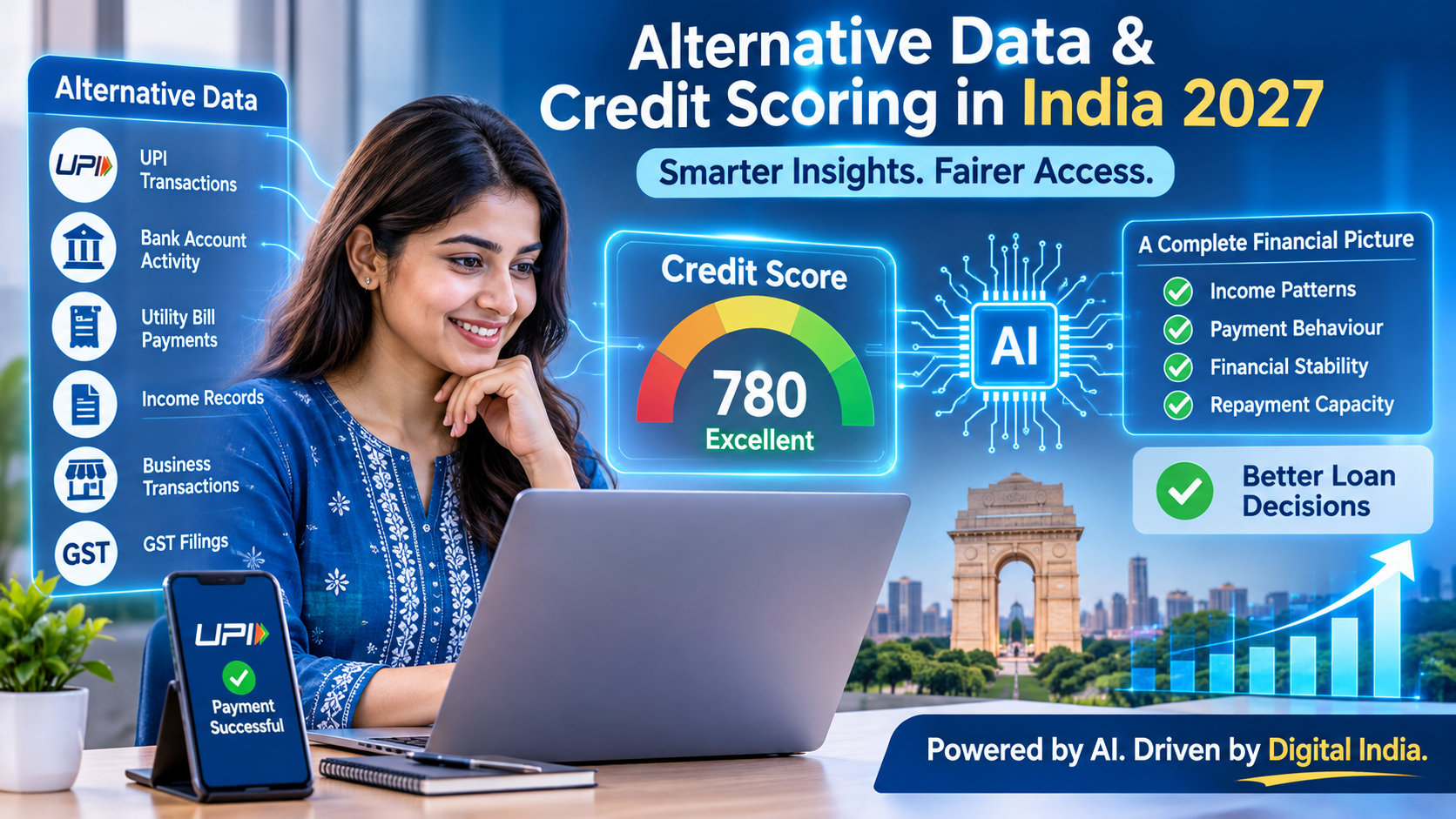
Getting a loan is not always easy, especially for people who have never borrowed money before. Traditional credit scores mainly depend on previous loans, credit cards and repayment records. But what happens when someone has no credit history?
This is where alternative data and credit scoring become important.
In 2027, lenders are increasingly exploring additional financial information to understand a borrower's repayment ability. Digital payment records, regular income, bank transactions and other permitted financial information can help provide a broader picture of someone's financial behaviour.
For example, a person who regularly receives income and pays bills on time may demonstrate responsible financial habits, even without a long borrowing history.
Alternative data does not guarantee loan approval or automatically improve a credit score. However, when collected and assessed responsibly, it can help lenders make more informed decisions.
Let's understand how this technology works and why it matters for borrowers in India.
AI Answer Box – What Is Alternative Data in Credit Scoring?
Alternative data in credit scoring refers to financial information beyond traditional credit reports that lenders may use to assess a borrower's financial situation.
Examples include:
-
Regular income and cash flow.
-
Bank account transaction patterns.
-
Digital payment history.
-
Utility bill payment records.
-
Business income information.
-
Other legally permitted financial records.
Simple explanation: Traditional credit scoring looks mainly at borrowing and repayment history. Alternative data can provide additional information about income, financial habits and repayment capacity.
In 2027, combining relevant alternative data with traditional credit information may help lenders assess people with limited credit histories more effectively.
What Is Alternative Data in Credit Scoring?
Alternative data means financial information that can help lenders understand a person's money habits beyond traditional credit records.
Traditional credit scoring generally considers:
-
Previous loan repayment history.
-
Credit card usage.
-
Outstanding loan balances.
-
Credit utilisation.
-
Credit enquiries.
Alternative data may include:
-
Monthly income deposits.
-
Bank account cash flow.
-
Digital payment patterns.
-
Utility bill payment records.
-
GST and business transaction information.
-
Other relevant financial records shared with permission.
Why Is Alternative Data Becoming Important in India?
Many people earn regularly but have limited credit histories. This can include freelancers, small business owners, self-employed professionals and first-time borrowers.
Alternative data can help lenders understand their financial activities more clearly.
According to a Government of India update published in 2026, 64 lenders had joined the Unified Lending Interface (ULI) as of December 12, 2025, using more than 136 data services across 12 loan journeys. This demonstrates the growing use of digital information in lending.
How Does Alternative Data Improve Credit Scoring in 2027?
Alternative data can help lenders evaluate borrowers using a wider range of financial information.
Income and Bank Transaction Analysis
Regular income deposits can help show whether a borrower has a stable source of money.
For example, if a person receives payments every month, lenders may examine:
-
Income consistency.
-
Monthly expenses.
-
Existing financial commitments.
-
Available account balance.
-
Cash flow patterns.
However, regular income alone does not guarantee loan approval.
Digital Payment History
Digital payments have become a common part of everyday financial activities.
UPI transactions and other digital payment records may provide useful financial insights when lawfully available and relevant to the assessment.
For example:
-
Regular bill payments can demonstrate payment discipline.
-
Consistent business receipts can help show business activity.
-
Frequent income deposits can provide cash-flow information.
Important: A high number of UPI transactions does not automatically mean a high credit score.
Utility Bill Payment Records
Electricity, water, internet and other recurring bill payments may provide additional information about payment habits where lenders have access to appropriate records.
Paying bills on time can demonstrate financial discipline, although utility payments are not automatically included in every lender's credit scoring model.
Business and GST Information
Small business owners may not always have traditional salary slips.
With appropriate access and consent, lenders may assess:
-
Business income.
-
GST filing information.
-
Sales patterns.
-
Account transactions.
-
Business cash flow.
This can help provide a better understanding of business activity and repayment capacity.
AI-Based Financial Assessment
Artificial intelligence can analyse large amounts of financial information and identify patterns.
AI-based credit assessment may help lenders:
-
Process financial information faster.
-
Identify unusual transaction patterns.
-
Evaluate income consistency.
-
Estimate repayment risk.
-
Support more informed lending decisions.
However, AI is a decision-support technology, not a guarantee of accurate or fair outcomes. Human oversight, transparency and data quality remain important.
Traditional Credit Scoring vs Alternative Credit Scoring
|
Feature |
Traditional Scoring |
Alternative Data Scoring |
|---|---|---|
|
Main information |
Credit history |
Additional financial information |
|
Loan repayment |
Important |
May be considered |
|
Bank transactions |
Limited role |
May be analysed |
|
Digital payments |
Usually limited |
May provide insights |
|
Income patterns |
Depends on lender |
Can be considered |
|
First-time borrowers |
Limited credit history |
Additional assessment possible |
|
AI technology |
May be used |
Often used for analysis |
Both methods can work together. Alternative data is generally an additional source of information rather than a complete replacement for traditional credit reports.
Who Can Benefit from Alternative Credit Scoring?
Alternative credit assessment may be useful for people whose financial activities are not fully reflected in traditional credit reports.
First-Time Loan Applicants
People who have never taken a loan or credit card may have limited credit histories.
Additional financial information can help lenders understand their income and financial capacity.
Freelancers and Self-Employed Professionals
Freelancers often receive payments from multiple clients rather than a fixed monthly salary.
Their bank statements and documented income patterns may provide useful information about their financial position.
Small Business Owners
Small businesses may have changing monthly earnings.
Business transactions, GST information and cash flow can help lenders understand their financial activities.
People with Limited Credit History
People who are new to formal borrowing may benefit from additional assessment methods.
However, having alternative financial data does not mean that every applicant will qualify for a loan.
How Does Alternative Data-Based Credit Assessment Work?
The assessment process generally involves several steps.
Information Collection
The lender identifies relevant financial information required for the loan assessment.
Customer Consent
The borrower receives information about what data is required and why it is needed.
Data Verification
The available information is checked for accuracy and consistency.
Financial Analysis
The lender may analyse income, expenses, repayment patterns and other relevant details.
Credit Risk Assessment
The lender combines available information with its lending policies to evaluate repayment capacity.
Loan Decision
The lender makes the final decision based on eligibility, affordability, credit risk and applicable regulations.
What Data Can Lenders Use for Alternative Credit Scoring?
|
Data Type |
What It May Show |
Potential Benefit |
|---|---|---|
|
Bank statements |
Income and expenses |
Cash-flow understanding |
|
UPI records |
Digital payment activity |
Additional transaction insights |
|
Utility bills |
Bill payment patterns |
Payment behaviour |
|
GST records |
Business activity |
Business income assessment |
|
Income records |
Earnings consistency |
Repayment capacity |
|
Loan repayment records |
Past repayment behaviour |
Credit risk assessment |
Not every lender uses all these sources. Data availability, consent, regulatory requirements and the lender's assessment policy determine what can be considered.
Benefits of Alternative Data and Credit Scoring
Better Assessment for New Borrowers
People with limited credit histories may have additional ways to demonstrate their financial capacity.
Faster Financial Analysis
Digital systems can help process relevant financial information more efficiently.
More Information for Lenders
Lenders can consider a broader picture instead of depending entirely on traditional credit records.
Support for Self-Employed People
Documented business income and financial transactions may help explain irregular earnings.
Improved Risk Assessment
Combining reliable information from different sources may help lenders identify repayment risks more effectively.
Limitations and Risks of Alternative Credit Scoring
Alternative credit scoring also has certain challenges.
Data privacy: Financial information must be collected and used responsibly.
Incorrect information: Inaccurate transaction records can affect assessments.
Limited digital access: People who primarily use cash may have fewer digital records.
Unfair algorithms: Poorly designed AI systems can produce biased results.
Limited acceptance: Different lenders use different assessment models.
No guaranteed approval: Additional data does not replace income, affordability or other eligibility requirements.
Pros and Cons of Alternative Credit Scoring
|
Pros |
Cons |
|---|---|
|
Helps assess limited credit histories |
Depends on data availability |
|
Provides additional financial insights |
Privacy concerns |
|
Supports digital lending |
Possible algorithmic bias |
|
Helps assess irregular income |
Incorrect data can affect results |
|
May improve assessment efficiency |
Does not guarantee approval |
RBI Guidelines and Data Privacy in Alternative Credit Scoring
Financial data privacy is one of the most important aspects of digital lending.
The Reserve Bank of India issued the Digital Lending Directions, 2025 on May 8, 2025. These directions establish requirements covering borrower creditworthiness, data collection, consent, storage and customer protection.
Some important borrower protections include:
-
Data collection should be need-based.
-
Explicit customer consent is required for applicable data collection.
-
Borrowers should be informed about the purpose of data collection.
-
Digital lending applications must follow applicable privacy requirements.
-
Borrowers should have appropriate control over permitted data-sharing choices.
What Is the Account Aggregator Framework?
The Account Aggregator (AA) framework is an RBI-regulated system that enables financial information to be shared between institutions with the customer's explicit consent.
For example, a borrower may authorise the sharing of relevant bank account information with a financial institution for a loan assessment.
According to the Department of Financial Services, as of March 31, 2026, more than 2.88 billion financial accounts were enabled for data sharing through the framework, and 284.6 million accounts had been linked by users.
This framework supports consent-based financial data sharing. It does not mean that lenders can freely access every customer's financial information.
How Can Borrowers Prepare for Alternative Credit Scoring?
Borrowers can follow simple financial habits to improve their overall financial profile.
-
Maintain accurate bank records.
-
Receive income through traceable channels where practical.
-
Pay existing EMIs on time.
-
Avoid unnecessary borrowing.
-
Keep financial documents updated.
-
Monitor credit reports for errors.
-
Understand consent requests before sharing financial information.
-
Apply for loans based on actual repayment capacity.
Practical Example
Consider two individuals applying for a personal loan.
|
Financial Detail |
Borrower A |
Borrower B |
|---|---|---|
|
Credit history |
Limited |
Established |
|
Income |
Regular freelance income |
Monthly salary |
|
Bank records |
Consistent deposits |
Consistent deposits |
|
Existing EMIs |
None |
One active EMI |
|
Financial documents |
Available |
Available |
Borrower A may have limited traditional credit information, but documented income and bank transactions could help the lender understand their repayment capacity.
Borrower B has an established credit history that can provide additional repayment information.
The lender may evaluate both applicants using its own eligibility criteria. Neither applicant is guaranteed approval.
This example shows why alternative data can be useful when combined with traditional credit assessment.
Future of Alternative Data and Credit Scoring in 2027
The future of credit scoring is likely to involve more advanced financial analysis and digital infrastructure.
Important developments to watch include:
AI-powered underwriting: More advanced models may help analyse financial information and identify risk patterns.
Consent-based data sharing: Account Aggregator infrastructure may support smoother financial information sharing.
Better assessment for MSMEs: Digital business records may help lenders understand small business financial activity.
Real-time financial insights: Faster access to verified information may improve assessment speed.
Stronger privacy protection: Responsible data collection and security will remain essential.
More inclusive lending: Additional financial information may help some underserved borrowers access formal credit.
These are emerging opportunities, not guaranteed outcomes for every borrower or lender.
Expert Commentary: Why Alternative Data Matters
A credit score is useful, but it does not always tell the complete financial story of a borrower.
From a lending perspective, evaluating income consistency, existing financial obligations and repayment capacity can provide valuable information alongside a traditional credit report.
For example, a freelancer may not receive a fixed salary, but regular client payments and documented bank transactions can help demonstrate financial stability.
An important principle for 2027: Better credit assessment should not mean collecting more personal information unnecessarily. It should mean using accurate, relevant and authorised information to make responsible lending decisions.
Real-World Financial Insights
Here are some practical situations where alternative data may be useful:
-
A freelancer can provide documented client payments to demonstrate income.
-
A small shop owner can show business transactions to explain monthly cash flow.
-
A first-time borrower can provide relevant financial records to support an eligibility assessment.
-
A self-employed professional can use bank statements to demonstrate earnings patterns.
These examples illustrate possible assessment methods, not guaranteed lending outcomes.
Key Takeaways
-
Alternative data provides additional information for credit assessment.
-
Bank transactions and documented income may help lenders understand repayment capacity.
-
AI can support faster financial analysis.
-
First-time borrowers may benefit from additional assessment methods.
-
Freelancers and small business owners may have more ways to demonstrate income.
-
Alternative data does not guarantee loan approval.
-
Customer consent and financial data privacy are essential.
-
Traditional credit history remains important.
-
Responsible borrowing and timely EMI payments remain valuable financial habits.
How Vizzve Financial Supports Personal Loan Applicants
Vizzve Financial is one of India’s trusted loan support platforms offering quick personal loans, low documentation, and an easy approval process. Apply at www.vizzve.com.
Before applying, borrowers should:
-
Check their loan eligibility.
-
Understand applicable interest rates and charges.
-
Review repayment schedules.
-
Share only the information required through authorised processes.
-
Borrow according to their repayment capacity.
Loan availability, eligibility, documentation and approval are subject to applicable lender policies and verification.
Frequently Asked Questions (FAQs)
What is alternative data in credit scoring?
Alternative data refers to additional financial information, such as income records, bank transactions and payment patterns, that may help lenders assess a borrower's financial position.
How does alternative data improve credit scoring?
It provides additional information about income, financial activity and repayment capacity, helping lenders make more informed assessments.
Can I get a loan without a credit history?
Some lenders may consider applicants with limited credit histories using income documents, bank statements and other permitted information. Approval depends on lender eligibility criteria.
Does UPI history affect my credit score?
UPI transactions do not automatically increase or decrease your credit score. However, relevant digital payment information may be considered in certain alternative assessment models.
Is alternative credit scoring safe?
It can be safe when lenders follow applicable regulations, obtain required consent and protect customer information through appropriate security measures.
Can freelancers benefit from alternative credit scoring?
Yes. Documented freelance income, client payments and bank transactions may help lenders understand their financial position.
What role does AI play in credit scoring?
AI can analyse financial information, identify patterns and support credit risk assessment. Final lending decisions remain subject to the lender's policies and applicable requirements.
Is alternative data replacing traditional credit scores?
No. It is generally an additional assessment method that can complement traditional credit information.
Does alternative data guarantee personal loan approval?
No. Lenders also consider income, existing obligations, repayment capacity, credit history and other eligibility requirements.
What is the future of credit scoring in India?
Credit scoring may become more data-driven through AI, digital financial records, consent-based information sharing and improved financial assessment systems.
Conclusion
Alternative data and credit scoring are becoming important parts of India's evolving digital lending ecosystem. In 2027, lenders can explore more financial information to understand borrowers beyond traditional credit histories.
Digital payments, income records, bank transactions and business information may help provide a broader view of financial behaviour.
However, responsible lending must always prioritise accurate information, customer consent, privacy and repayment capacity.
For borrowers, the best approach is to maintain healthy financial habits, keep documents updated and understand loan terms before applying.
Explore personal loan support and eligibility information with Vizzve Financial at www.vizzve.com.
Published on : 01 November
Published by : MD HEDAYATULLAH
www.vizzve.com || www.vizzveservices.com
Follow us on social media: Facebook || Linkedin || Instagram
🛡 Powered by Vizzve Financial
RBI-Registered Loan Partner | 10 Lakh+ Customers | ₹600 Cr+ Disburs