

Introduction
If you have opened a demat and trading account in India, you may come across two common terms: AMC and brokerage.
At first glance, both may look like ordinary account charges. But they are actually very different.
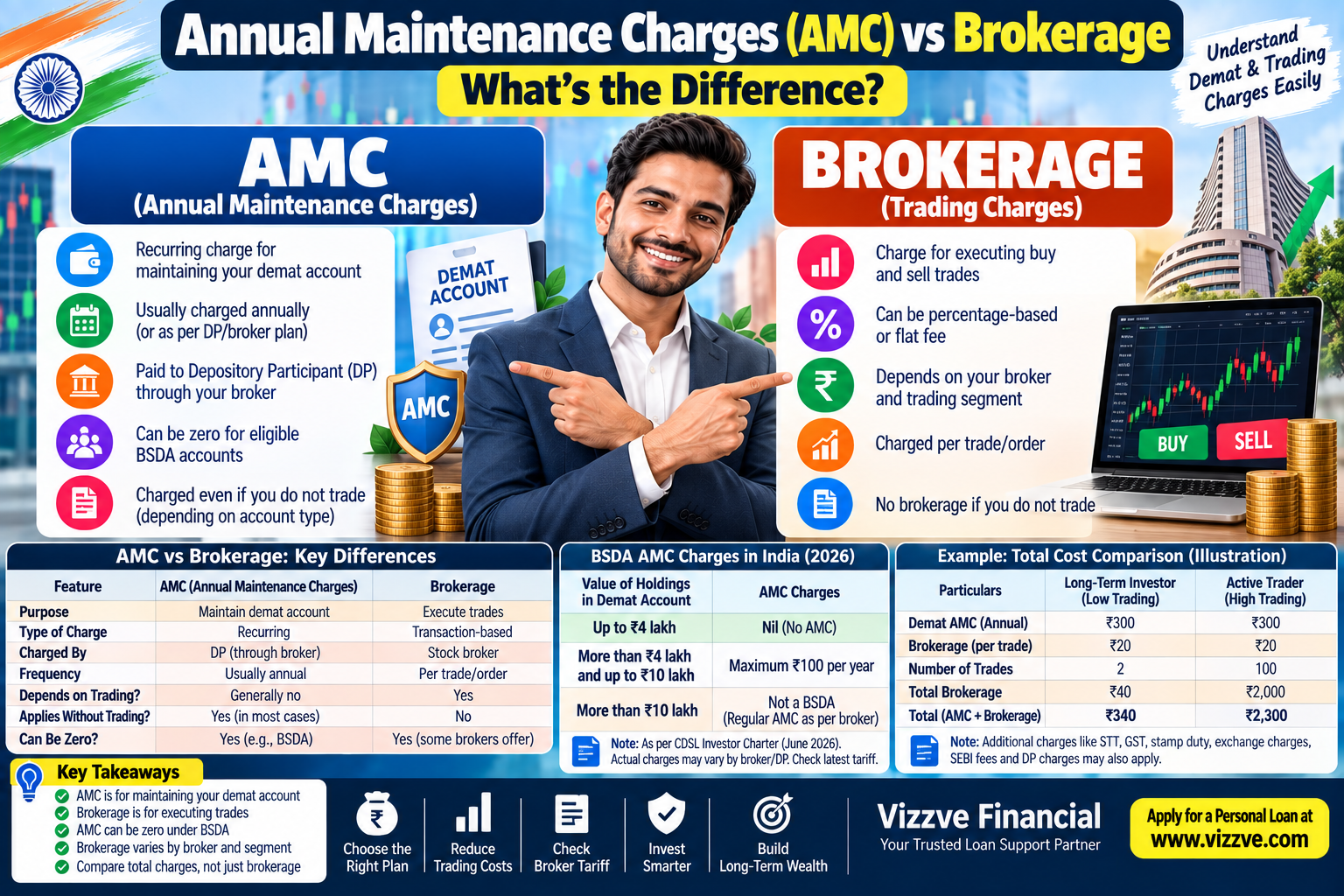
AMC, or Annual Maintenance Charge, is generally a recurring fee associated with maintaining a demat account. Brokerage is a transaction-related fee charged by a stock broker for executing eligible trades.
In simple terms:
AMC is generally charged for maintaining the account. Brokerage is generally charged when you trade.
Understanding this difference can help investors avoid unnecessary costs and choose an account structure that matches their investment habits.
SEBI requires stock brokers to provide clients with a tariff sheet covering charges that may be levied, including brokerage and applicable statutory charges.
At the same time, demat account maintenance charges are determined through the applicable Depository Participant (DP) tariff and account type. CDSL's investor charter, updated in June 2026, confirms the current BSDA AMC framework.
AI Answer Box: AMC vs Brokerage
AMC and brokerage are not the same charge.
AMC (Annual Maintenance Charge) is generally a recurring fee for maintaining a demat account. It is normally charged annually or according to the DP's billing cycle, depending on the account and tariff.
Brokerage is a fee charged by a stock broker for executing eligible buy or sell transactions.
Simple difference:
| AMC | Brokerage |
|---|---|
| Usually recurring | Usually transaction-based |
| Related to demat-account maintenance | Related to trade execution |
| Can apply even when you do not trade | Usually arises when an eligible trade is executed |
| Charged according to DP/broker tariff | Charged according to broker's tariff |
| May be reduced or waived under eligible BSDA rules | Depends on trading segment and broker |
Important: A broker offering zero brokerage does not necessarily mean the demat account has zero AMC.
What Is AMC in a Demat Account?
AMC stands for Annual Maintenance Charge.
In the stock-market context, AMC generally refers to the recurring fee charged for maintaining a demat account.
A demat account is used to hold securities electronically.
These may include:
- Equity shares
- Bonds
- Debentures
- ETFs
- Certain mutual-fund units
- Other eligible securities
The Depository Participant provides the investor with access to depository services and account maintenance.
SEBI's investor education material explains the Basic Services Demat Account (BSDA) structure, under which eligible investors can receive reduced or zero AMC depending on the value of holdings.
What Is Brokerage?
Brokerage is the charge associated with a stock broker's trade-execution service.
When an investor places an order to buy or sell securities through a stock broker, the broker may charge brokerage according to its tariff.
Brokerage can be:
- Percentage-based
- Flat-fee based
- Subject to a maximum cap
- Segment-specific
- Zero for selected products under certain plans
For example, a hypothetical broker might charge:
0.10% of transaction value
If you execute a trade worth ₹50,000:
Brokerage = ₹50,000 × 0.10% = ₹50
This is only an illustration. Actual brokerage depends on the broker and applicable pricing plan.
SEBI's investor FAQ states that stock brokers must provide clients with a tariff sheet showing the charges that can be levied.
AMC vs Brokerage: The Main Difference
The easiest way to understand the difference is to think about when the charge occurs.
AMC
You are paying for maintaining the demat account.
Brokerage
You are paying the broker for an eligible transaction.
For example:
You open a demat account and do not buy or sell anything for an entire year.
You could still have:
AMC = Applicable
But:
Brokerage = ₹0, because you did not execute a trade that attracted brokerage.
Now imagine you execute 20 trades.
Your brokerage can increase based on the broker's pricing structure, while your AMC may remain the same recurring account charge.
AMC vs Brokerage Comparison Table
| Feature | AMC | Brokerage |
|---|---|---|
| Full Form | Annual Maintenance Charge | Brokerage Charge |
| Main Purpose | Maintaining demat account | Executing trades |
| Frequency | Usually recurring | Usually per trade/order |
| Depends on trading volume? | Generally no | Often yes |
| Applies without trading? | May apply | Generally no trade-based brokerage |
| Charged by | DP/broker according to arrangement | Stock broker |
| Can be zero? | Yes, depending on account/plan/BSDA eligibility | Yes, depending on broker/product |
| Main document | DP/broker tariff | Broker tariff/contract note |
| Example | ₹300 per year | ₹20 per executed order |
| Main concern | Account maintenance cost | Transaction cost |
Why Is AMC Charged?
Maintaining a demat infrastructure involves services such as:
- Maintaining securities records
- Account administration
- Depository connectivity
- Statements and reporting
- Corporate-action processing
- Electronic holding management
- Regulatory and operational infrastructure
The Depository Participant may therefore charge an annual maintenance fee according to its applicable tariff.
SEBI has previously explained that DPs earn revenue from services including account maintenance and transaction-related services.
Why Is Brokerage Charged?
Brokerage is associated with the broker's trading service.
A stock broker provides the infrastructure needed to:
- Place orders
- Route orders to exchanges
- Execute trades
- Maintain trading records
- Provide contract notes
- Provide trading platforms
- Support client transactions
The actual brokerage depends on the broker and product.
For example, brokerage can differ between:
- Equity delivery
- Intraday equity
- Futures
- Options
- Currency derivatives
- Commodity transactions
Is AMC Charged Every Year?
Generally, AMC is a recurring account-maintenance charge.
However, the exact frequency and amount depend on the account agreement and DP/broker tariff.
Some providers may offer:
- First-year free AMC
- Annual AMC
- Quarterly billing
- Lifetime or long-duration plans
- Zero AMC under selected conditions
- BSDA-based reduced AMC
Therefore, investors should check their specific account tariff instead of assuming one universal AMC.
What Is a BSDA?
BSDA stands for Basic Services Demat Account.
It is a demat-account facility designed for eligible investors with relatively smaller holdings.
The purpose is to make demat-account ownership more affordable and encourage wider participation in the securities market.
As of June 2026, CDSL's investor charter states:
- Holdings up to ₹4 lakh: No AMC
- More than ₹4 lakh and up to ₹10 lakh: AMC not exceeding ₹100
- Above ₹10 lakh: The account is not treated as a BSDA under this slab and regular AMC may apply.
Important eligibility point
BSDA is not simply a free-demat scheme available to every investor.
Eligibility conditions apply, including requirements relating to the investor's demat accounts and holdings.
Investors should verify their eligibility with their DP.
BSDA vs Regular Demat Account
| Feature | BSDA | Regular Demat Account |
|---|---|---|
| Purpose | Lower-cost demat facility for eligible investors | Standard demat account |
| AMC | Nil up to ₹4 lakh under current framework | DP-specific |
| AMC from ₹4–10 lakh | Maximum ₹100 under current framework | DP-specific |
| Above ₹10 lakh | Regular account treatment may apply | Regular tariff |
| Eligibility | Specific conditions apply | Generally broader |
| Best suited for | Eligible smaller investors | Investors requiring regular demat services |
The current BSDA limits are reflected in CDSL's June 2026 investor charter and SEBI investor material.
How Is AMC Calculated?
AMC is not generally calculated as a percentage of every trade.
Instead, it is usually determined according to:
- Account type
- DP tariff
- Billing cycle
- BSDA eligibility
- Promotional plan
- Investor category
- Applicable account scheme
Example
Suppose a DP charges:
₹300 per year
Your AMC for the year would be:
₹300
Even if you execute:
- 1 trade
- 10 trades
- 100 trades
the AMC itself does not automatically become ₹30,000.
Your brokerage, however, can increase with your number of chargeable trades.
How Is Brokerage Calculated?
Brokerage may be calculated using different models.
Percentage Brokerage
Formula:
Brokerage = Transaction Value × Brokerage Rate
Example:
Transaction value = ₹1,00,000
Brokerage = 0.05%
Brokerage:
₹50
Flat Brokerage
A broker may charge a fixed amount per executed order.
Example:
₹20 per executed order
If you place five chargeable executed orders:
5 × ₹20 = ₹100
Again, this is an illustration and not a universal brokerage rate.
AMC vs Brokerage: Real-World Example
Consider two investors.
Investor A: Long-Term Investor
Investor A:
- Opens one demat account
- Buys shares twice a year
- Holds them for several years
- Rarely trades
Suppose:
AMC = ₹300 per year
and hypothetical annual brokerage is:
₹40
Total of these two charges:
₹340
Other applicable statutory and transaction charges are separate.
Investor B: Active Trader
Investor B:
- Trades frequently
- Executes 100 chargeable orders
- Has the same ₹300 AMC
Suppose brokerage averages ₹20 per executed order:
100 × ₹20 = ₹2,000
Add AMC:
₹2,000 + ₹300 = ₹2,300
This illustrates an important point:
AMC is generally linked to maintaining the account, while brokerage can rise significantly with trading activity.
Which Is More Important: AMC or Brokerage?
There is no universal answer.
It depends on how you use your account.
For a long-term investor
AMC may deserve more attention because the investor may make relatively few trades.
For an active trader
Brokerage and other transaction charges can become much more significant because trading frequency is higher.
For a small investor
BSDA eligibility may be especially relevant because it can reduce or eliminate AMC within the prescribed holding limits.
Does Zero Brokerage Mean Zero AMC?
No.
This is one of the most common misunderstandings among beginners.
A broker might advertise:
₹0 brokerage on equity delivery
But the demat account may still have:
- AMC
- DP charges
- Other service charges
- Applicable statutory charges
Therefore:
Zero brokerage ≠ zero account cost
and:
Zero AMC ≠ zero trading cost
These are separate concepts.
Does Zero AMC Mean Zero Brokerage?
Again, no.
A demat account may have zero AMC under an eligible BSDA structure or a broker's promotional plan, while the broker can still charge brokerage for applicable trades.
For example:
AMC = ₹0
but:
Brokerage = ₹20 per trade
The investor could still incur brokerage when trading.
Other Charges Investors Should Know
AMC and brokerage are not the only costs in the stock market.
Depending on the transaction, investors may also encounter:
1. STT
Securities Transaction Tax.
2. GST
GST can apply to taxable brokerage and service components.
3. Stamp Duty
Applicable to specified securities transactions.
4. Exchange Transaction Charges
Charges related to exchange transactions.
5. SEBI Turnover Fees
Regulatory fee applicable according to the relevant schedule.
6. DP Charges
Charges associated with certain demat/depository transactions.
7. Other Service Charges
Examples can include:
- Pledge-related charges
- Call-and-trade charges
- Physical statement charges
- Account modification charges
- Special service charges
SEBI's investor FAQ says brokers must provide a tariff sheet covering charges that can be levied.
AMC vs Brokerage vs DP Charges
These three are often confused.
| Charge | Meaning | When It Usually Applies |
|---|---|---|
| AMC | Demat-account maintenance | Recurring |
| Brokerage | Trade execution fee | When chargeable trade is executed |
| DP Charge | Depository-related transaction/service fee | Certain demat transactions |
Simple example
You hold shares for one year without selling them.
Possible:
AMC → Yes
Brokerage → No
DP debit charge → No sale-related debit
Then you sell the shares.
Possible:
Brokerage → Yes, if applicable
DP charge → May apply
STT → Applicable according to transaction type
Other charges → May apply
Does AMC Apply to Trading Accounts?
This is where terminology can become confusing.
A demat account holds securities.
A trading account is used to place buy and sell orders.
When brokers advertise "AMC," they are often referring to demat-account annual maintenance charges, although the exact account package can vary.
Therefore, when opening an account, check whether the quoted AMC relates to:
- Demat account
- Trading account
- Combined account package
- Specific subscription plan
Read the tariff sheet carefully.
How to Check Your AMC
Follow these steps:
Step 1: Log in to your broker
Open your account dashboard.
Step 2: Find the pricing or charges section
Look for:
Demat AMC / Account Maintenance / DP Charges
Step 3: Check the tariff
Find:
- Annual amount
- Billing frequency
- GST treatment
- BSDA eligibility
- Promotional period
- Renewal amount
Step 4: Check your account statement
Look for an AMC debit.
Step 5: Compare it with the agreed tariff
If the amount appears different, contact the broker or DP.
How to Check Your Brokerage
Step 1: Find the broker's tariff sheet
Look for equity, intraday and derivatives charges.
Step 2: Identify the transaction type
Was it:
- Equity delivery?
- Intraday?
- Futures?
- Options?
Step 3: Calculate transaction value
For example:
Quantity × Price
Step 4: Apply the brokerage structure
Use the applicable percentage, flat fee or cap.
Step 5: Check the contract note
Compare the calculated brokerage with the actual brokerage shown.
SEBI advises investors to maintain transaction records and understand the charges applicable to their account.
How to Reduce AMC
Investors can potentially reduce account-maintenance costs through legitimate options.
1. Check BSDA Eligibility
Eligible investors with holdings within the prescribed limits can benefit from the BSDA AMC structure.
Under the current framework, CDSL states that eligible holdings up to ₹4 lakh attract no AMC and holdings above ₹4 lakh up to ₹10 lakh can attract AMC of up to ₹100.
2. Compare DP Tariffs
Different DPs can have different customer-facing tariff structures.
CDSL's DP directory, for example, displays different AMC structures for different DPs.
3. Check Promotional Plans
Some providers may offer:
- First-year free AMC
- Long-term AMC plans
- Special account packages
Always check what happens after the promotional period.
4. Avoid Unnecessary Accounts
If you have multiple demat accounts, review whether all are needed.
However, do not close or consolidate an account without first checking holdings, tax records, linked services and account-specific implications.
How to Reduce Brokerage Costs
Compare Brokers
Look at:
- Delivery brokerage
- Intraday brokerage
- F&O brokerage
- DP charges
- Other service fees
Avoid Unnecessary Trading
Frequent transactions can increase total trading costs.
Understand Flat-Fee Models
A flat fee may work differently for small and large transactions.
Check Brokerage Caps
A percentage-based fee may be subject to a maximum charge.
Read the Tariff Sheet
Do not rely only on advertisements.
AMC vs Brokerage: Which Should Beginners Compare?
A beginner should compare total account and transaction costs, not just one fee.
Use this checklist:
-
Demat AMC
-
BSDA eligibility
-
Equity delivery brokerage
-
Intraday brokerage
-
Futures brokerage
-
Options brokerage
-
DP charges
-
Account-opening charges
-
Trading platform charges
-
Call-and-trade charges
-
Pledge charges
-
Other service charges
-
Contract-note availability
-
Customer support
-
SEBI registration
Broker Comparison: What Matters Beyond AMC and Brokerage?
Cost is important, but it is not the only factor.
1. Regulatory status
Verify that the intermediary is properly registered.
2. Platform reliability
A low-cost account may not be useful if the platform does not meet your needs.
3. Transparency
Charges should be clearly disclosed.
4. Contract notes
You should be able to access proper trade records.
5. Customer support
Understand how complaints and account issues are handled.
6. Security
Review the broker's security practices and account controls.
7. Service requirements
Choose an account that provides the services you actually need.
A Practical Annual Cost Example
Suppose an investor has:
AMC = ₹300 per year
and executes 20 trades.
Suppose hypothetical brokerage is:
₹20 per executed trade
Brokerage:
20 × ₹20 = ₹400
Combined:
AMC + Brokerage = ₹300 + ₹400 = ₹700
But this is not the investor's complete annual stock-market cost.
Other applicable costs may include:
- STT
- GST
- Stamp duty
- Exchange charges
- SEBI turnover fee
- DP charges
- Other applicable fees
Therefore:
Total annual investing cost = AMC + brokerage + applicable transaction costs + other account/service charges
Why Small Charges Matter
A ₹200 or ₹300 AMC may appear insignificant.
But if an investor has several unnecessary demat accounts, recurring charges can accumulate.
Similarly, a ₹10 or ₹20 brokerage charge may appear small.
But frequent trading can multiply the amount.
Example
100 chargeable orders × ₹20:
₹2,000 brokerage
500 chargeable orders × ₹20:
₹10,000 brokerage
This is why active traders should monitor transaction costs carefully.
Common Mistakes Investors Make
Mistake 1: Thinking AMC and brokerage are the same
They are not.
Mistake 2: Assuming zero brokerage means zero charges
Other charges can still apply.
Mistake 3: Ignoring AMC after opening a demat account
AMC can continue even when you are not actively trading, depending on the account.
Mistake 4: Not checking BSDA eligibility
Eligible small investors may be able to reduce AMC through BSDA.
Mistake 5: Comparing only one fee
Total cost matters.
Mistake 6: Keeping unnecessary demat accounts
Multiple accounts can create additional recurring costs.
Mistake 7: Not reading the tariff sheet
The tariff sheet is one of the most important documents for understanding charges.
Pros and Cons of Low-Cost Demat and Trading Accounts
Pros
- Lower recurring account costs
- Potentially lower transaction expenses
- Easier for small investors to manage
- Can improve cost efficiency
- Useful for long-term investors who trade infrequently
Cons
- Lower cost does not automatically mean better service
- Promotional pricing may have conditions
- Zero brokerage may not remove other charges
- Some services may carry separate fees
- Investors still need to verify DP and broker charges
Expert Commentary: AMC or Brokerage — What Should You Prioritize?
The answer depends on your behaviour.
For a long-term investor who makes only a handful of transactions each year, account maintenance costs can deserve more attention.
For an active trader, brokerage and other transaction costs can become much more significant.
For an eligible small investor, checking BSDA eligibility can be particularly useful because the current framework provides reduced AMC within specified holding limits.
The broader lesson is:
Do not choose a broker because of one attractive number. Compare the complete fee structure with your actual investing pattern.
Real-World Investor Experience
Consider someone who buys ₹5,000 worth of shares every month.
The investor may think:
"My brokerage is zero, so I am not paying anything."
But the account can still have:
- AMC
- STT
- Stamp duty
- Exchange charges
- Other applicable costs
Now consider an investor who trades every day.
Their AMC might remain unchanged, but their transaction-related costs can increase substantially because the number of trades is much higher.
This is why the same brokerage plan can produce very different annual costs for different investors.
Step-by-Step: How to Compare Two Brokers
Suppose you are choosing between Broker A and Broker B.
Step 1: Compare AMC
Broker A: ₹300
Broker B: ₹0
Step 2: Compare equity delivery brokerage
Check the exact tariff for both.
Step 3: Compare intraday charges
This matters if you trade actively.
Step 4: Compare F&O charges
Check futures and options separately.
Step 5: Compare DP charges
This can matter when securities are debited from the demat account.
Step 6: Compare account-related fees
Look at:
- Account opening
- AMC
- Call-and-trade
- Pledge
- Statements
- Other services
Step 7: Check regulatory status
Use official SEBI information.
Step 8: Calculate your estimated annual cost
Use your expected:
- Number of trades
- Average order size
- Holding pattern
- Demat holdings
- Services required
This is much more useful than simply comparing two advertised brokerage numbers.
2026 Update: BSDA and Demat Account Costs
The BSDA framework remains particularly relevant for small investors.
CDSL's investor charter, updated June 5, 2026, states that eligible BSDA accounts with securities holdings up to ₹4 lakh have no AMC, while holdings above ₹4 lakh and up to ₹10 lakh can attract AMC of no more than ₹100.
CDSL's April and May 2026 statistics also show that millions of demat accounts were availing the BSDA facility, demonstrating the continued relevance of the lower-cost account structure.
The exact eligibility and account treatment should always be confirmed with the DP because account status and holdings can affect eligibility.
Key Takeaways
- AMC and brokerage are different charges.
- AMC generally relates to maintaining a demat account.
- Brokerage generally relates to executing trades.
- AMC is usually recurring.
- Brokerage is generally transaction-based.
- Zero brokerage does not automatically mean zero account costs.
- Zero AMC does not automatically mean zero trading costs.
- Eligible BSDA investors can receive reduced or zero AMC within prescribed holding limits.
- Current CDSL guidance states no AMC up to ₹4 lakh for eligible BSDA holdings and a maximum ₹100 AMC from above ₹4 lakh to ₹10 lakh.
- Brokerage varies by broker and trading segment.
- DP charges are different from both AMC and brokerage.
- STT, GST, stamp duty and exchange charges are separate cost components.
- Investors should read the complete tariff sheet.
- Contract notes should be checked after trades.
- The right broker depends on total cost, services, transparency and the investor's actual trading pattern.
Frequently Asked Questions
1. What is AMC in a demat account?
AMC stands for Annual Maintenance Charge. It is generally a recurring fee associated with maintaining a demat account.
2. What is brokerage in the stock market?
Brokerage is a charge that a stock broker may levy for executing eligible buy and sell transactions.
3. What is the difference between AMC and brokerage?
AMC is generally a recurring demat-account maintenance cost, while brokerage is generally a transaction-related trading cost.
4. Is AMC charged if I do not trade?
It can be. AMC is generally related to maintaining the demat account, so it may apply even when no trades are executed, depending on the account tariff.
5. Is brokerage charged every year?
Generally, no. Brokerage is normally linked to eligible trades rather than simply maintaining the account.
6. Does zero brokerage mean zero AMC?
No. A broker may offer zero brokerage while still charging demat-account AMC.
7. Does zero AMC mean zero brokerage?
No. An account can have zero AMC under an eligible structure while brokerage still applies to certain transactions.
8. What is BSDA?
BSDA means Basic Services Demat Account. It is a demat facility for eligible investors with specified holding and account conditions.
9. What is the current BSDA AMC limit?
As of June 2026, CDSL states that eligible BSDA holdings up to ₹4 lakh attract no AMC, while holdings above ₹4 lakh and up to ₹10 lakh can attract AMC of up to ₹100.
10. Can AMC vary between brokers?
Yes. DP and broker account packages can have different AMC structures and promotional terms.
11. Can brokerage vary between brokers?
Yes. Brokerage varies according to the broker, trading segment, pricing plan and applicable terms.
12. Are AMC and DP charges the same?
No. AMC is generally a recurring account-maintenance charge, while DP charges generally relate to specific depository services or transactions.
13. How can I reduce my demat AMC?
Check whether you qualify for BSDA, compare DP tariffs and review whether you actually need multiple demat accounts.
14. How can I reduce brokerage costs?
Compare broker tariffs, understand your trading pattern, avoid unnecessary trades and select a pricing structure appropriate for your activity.
15. Where can I check my broker's charges?
Published on : 27th September
Published by : G REDDY KUMAR
www.vizzve.com || www.vizzveservices.com
Follow us on social media: Facebook || Linkedin || Instagram
🛡 Powered by Vizzve Financial
RBI-Registered Loan Partner | 10 Lakh+ Customers | ₹600 Cr+ Disbursed