

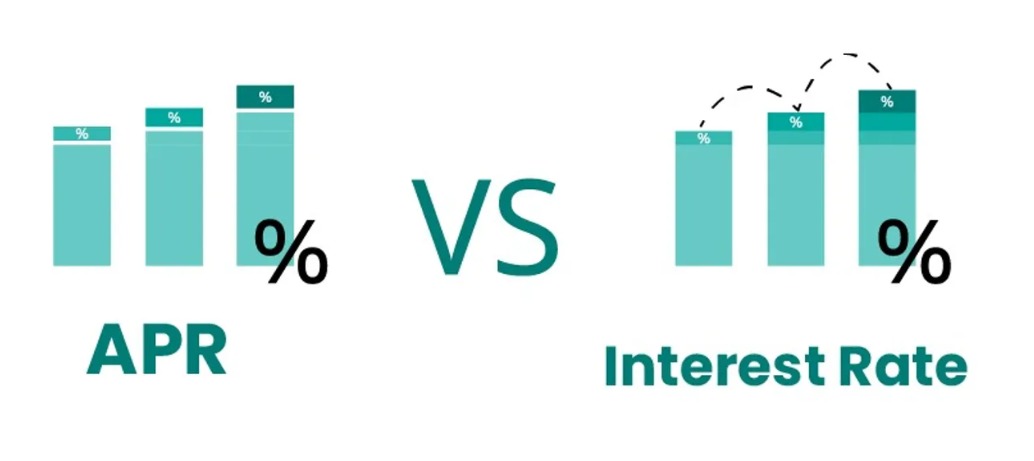
When borrowing money, whether through a personal loan, credit card, or home loan, you may come across two terms: Interest Rate and Annual Percentage Rate (APR). While they are related, they are not the same — and knowing the difference can help you make smarter financial decisions.
What is Interest Rate?
The interest rate is the percentage of the principal amount charged by a lender for borrowing money. It is usually expressed annually and is the basic cost of borrowing.
Example:
You take a loan of ₹1,00,000 at an interest rate of 10% per annum.
If the loan is simple interest, you pay ₹10,000 in interest for one year.
Key points:
Reflects only the cost of borrowing money.
Does not include fees like processing charges or insurance.
Easier to compare basic lending rates, but not the full borrowing cost.
What is Annual Percentage Rate (APR)?
APR represents the total annual cost of borrowing, including:
Interest charges
Processing fees
Service charges
Any other mandatory fees
In other words, APR gives a complete picture of the loan’s true cost.
Example:
A loan with 10% interest rate may have 1% processing fee.
The APR will effectively be higher than 10%, showing the true annual cost of borrowing.
Key points:
Standardized metric for comparing loans from different lenders.
Always higher than the nominal interest rate if fees are involved.
Helps borrowers understand the real cost before committing.
APR vs Interest Rate: Side-by-Side
| Feature | Interest Rate | APR (Annual Percentage Rate) |
|---|---|---|
| Definition | Cost of borrowing as a % of principal | Total annual cost including fees & interest |
| Includes Fees | No | Yes |
| Purpose | Shows basic borrowing cost | Shows total cost to borrower |
| Comparison Use | Limited | Better for comparing loans effectively |
| Typically Lower? | Yes | Usually higher due to fees |
Why Understanding the Difference Matters
Avoid hidden costs: Some lenders advertise low interest rates but add hidden fees, making APR a better measure.
Compare loans easily: APR allows you to compare loans or credit cards from different institutions accurately.
Better financial planning: Knowing APR ensures you understand how much you will actually pay over time.
Regulatory standard: Many countries require lenders to disclose APR, ensuring transparency.
Practical Tips
Always check both the interest rate and APR before taking a loan.
For small, short-term loans, fees may make APR significantly higher than the nominal interest rate.
Use online loan calculators that show APR to understand total repayment.
Avoid loans where interest rate looks attractive but APR is substantially higher due to hidden charges.
Final Thoughts
While the interest rate tells you how much a lender charges on the principal, APR reveals the full cost of borrowing. Understanding both is crucial for making informed financial decisions, avoiding surprises, and choosing loans that suit your budget.
When comparing loan offers, don’t just look at the interest rate — APR is the real metric to judge affordability.
FAQs
Q1. Can APR be lower than the interest rate?
No, APR usually includes fees, so it is either equal to or higher than the nominal interest rate.
Q2. Is APR relevant for credit cards?
Yes, APR shows the annual cost including interest and fees if you carry a balance.
Q3. Does APR vary with loan tenure?
Yes, longer loan tenures with fees may affect the effective APR.
Q4. Are all fees included in APR?
Most mandatory fees are included, but optional add-ons like insurance may not be.
Q5. How can I find APR in India?
Banks and lenders disclose APR in loan agreements; it is often referred to as the effective interest rate.
Published on : 7th November
Published by : SMITA
www.vizzve.com || www.vizzveservices.com
Follow us on social media: Facebook || Linkedin || Instagram
🛡 Powered by Vizzve Financial
RBI-Registered Loan Partner | 10 Lakh+ Customers | ₹600 Cr+ Disbursed