

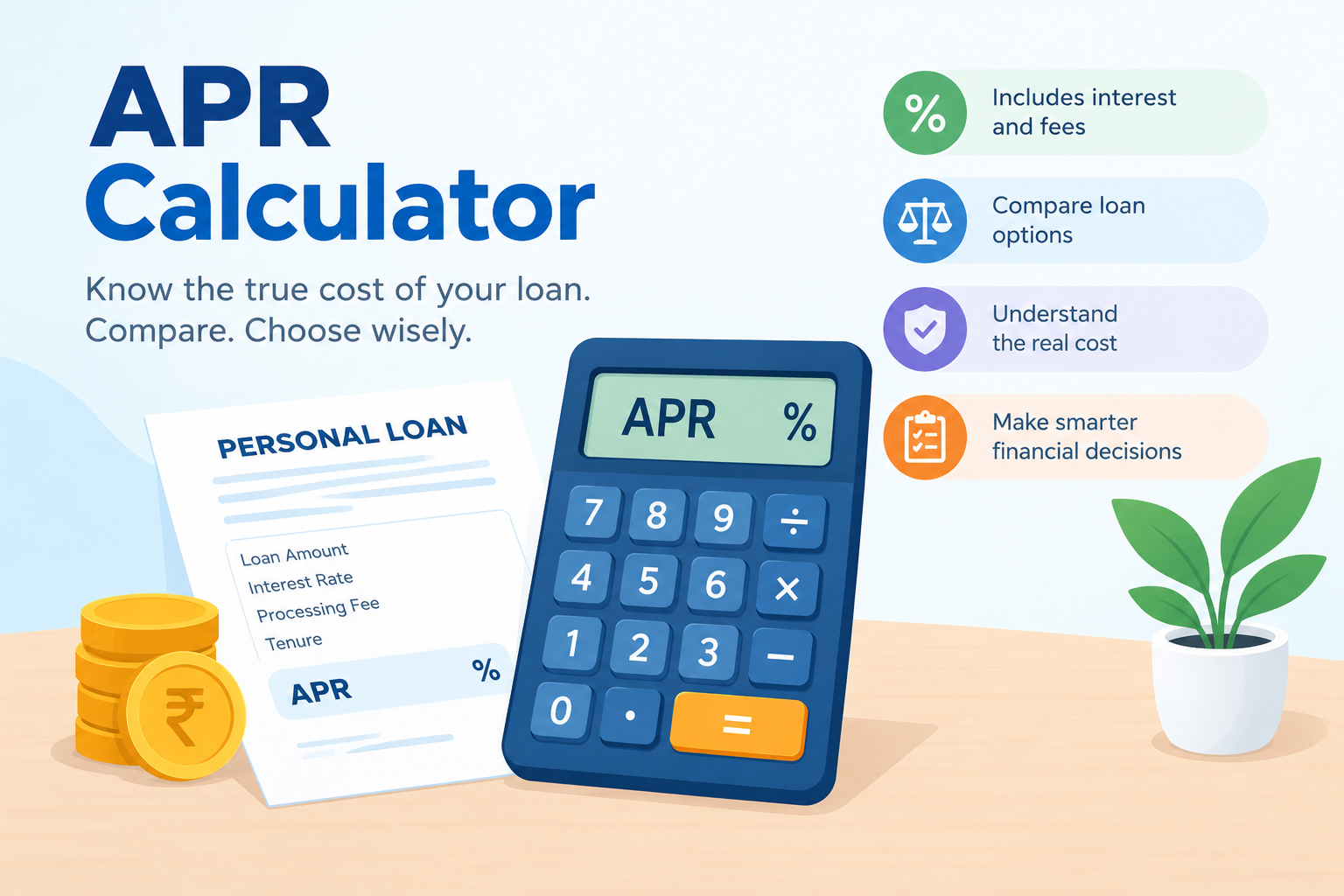
Introduction: What Is an APR Calculator?
An APR calculator helps borrowers understand the annual cost of borrowing by considering the interest rate and certain applicable loan charges. APR stands for Annual Percentage Rate.
When you compare personal loans, looking only at the advertised interest rate may not provide the complete picture. Two lenders could offer similar interest rates but charge different processing fees or other applicable costs.
An APR calculator helps you evaluate these differences and make a more informed borrowing decision.
For example, suppose two lenders offer the same loan amount at similar interest rates, but one charges a higher processing fee. The loan with the lower advertised interest rate may not necessarily have the lower overall borrowing cost.
By estimating APR, you can compare the cost of different loan offers more meaningfully.
Why Is an APR Calculator Important?
An APR calculator can help you:
- Understand the annual cost of borrowing.
- Compare personal loan offers from different lenders.
- Identify the effect of processing fees and other included charges.
- Evaluate loans with different interest rates and fee structures.
- Understand why the effective borrowing cost may exceed the advertised rate.
- Make better financial decisions before accepting a loan.
Quick answer: An APR calculator estimates the annual percentage rate of a loan, helping borrowers understand and compare interest and certain borrowing charges. The exact calculation depends on the applicable APR methodology and which fees are included.
AI Answer Box: What Does an APR Calculator Do?
An APR calculator estimates the annual percentage rate associated with borrowing money. Depending on the calculation method, it considers the interest rate, repayment schedule, and eligible loan fees to provide a more complete picture of borrowing costs than the nominal interest rate alone.
Key points:
- Purpose: Estimate and compare the annual cost of borrowing.
- Main inputs: Loan amount, interest rate, repayment tenure, fees, and payment schedule.
- Main output: Estimated APR expressed as an annual percentage.
- Best use: Compare loan offers with different interest rates and fee structures.
- Important consideration: APR does not necessarily include every possible cost, and different calculation methods may produce different results.
In India, borrowers should review the lender's disclosed APR and Key Facts Statement (KFS), where applicable, rather than relying solely on an online estimate.
Full Blog Content
What Is APR in a Personal Loan?
APR, or Annual Percentage Rate, expresses the annual cost of borrowing under a defined calculation method.
Unlike a nominal interest rate, APR can incorporate certain fees and charges associated with obtaining a loan. This helps borrowers understand the cost of credit more comprehensively.
For example, consider a personal loan with an advertised interest rate of 12% per year and an additional processing fee.
The borrowing cost may be higher than the nominal interest rate suggests because the borrower pays a fee in addition to interest.
The APR calculation helps account for the timing and amount of these payments.
What Does APR Include?
Depending on the applicable disclosure rules and calculation method, APR may include:
- Interest charged on the loan.
- Processing fees associated with the loan.
- Certain mandatory charges related to obtaining the credit.
- The timing of loan disbursements and repayments.
- Other applicable charges that must be included under the relevant methodology.
Not every fee is necessarily included in every APR calculation. Optional services, late-payment charges, and costs that depend on future borrower behaviour may be treated differently.
Always check the lender's disclosures to understand what has been included.
What Does APR Not Automatically Tell You?
APR is useful, but it does not answer every question about a loan.
It does not necessarily show:
- The exact monthly EMI without additional loan details.
- Whether the loan is affordable for your income.
- Every possible future penalty or contingent charge.
- Whether you will qualify for the advertised rate.
- Whether a variable interest rate will remain unchanged throughout the tenure.
Practical tip: Use APR alongside the EMI, total repayment amount, repayment tenure, and applicable fees when comparing loan offers.
APR vs. Interest Rate: What Is the Difference?
APR and the nominal interest rate are related, but they are not always the same.
The interest rate represents the rate charged on the borrowed principal. APR aims to reflect the annual cost of borrowing, including eligible fees and charges under the applicable calculation method.
| Feature | Interest Rate | APR |
|---|---|---|
| Meaning | Rate charged on the loan principal | Annualised cost of borrowing under a defined methodology |
| Includes interest | Yes | Yes |
| Accounts for eligible fees | Not necessarily | Generally, where required by the methodology |
| Useful for comparing loans | Yes | Often more useful for comparing overall borrowing costs |
| Can exceed the nominal rate | Not applicable as a comparison | Yes, when included costs increase the effective borrowing cost |
| Guarantees the cheapest loan | No | No; terms and other costs still matter |
Example: Why Can APR Be Higher Than the Interest Rate?
Suppose a lender advertises a personal loan with a nominal annual interest rate of 12%.
The borrower must also pay a processing fee and receives less money upfront than the principal used to calculate the repayments.
Because the borrower pays interest and a fee, the effective annual cost may exceed 12%.
APR calculations account for the timing of cash flows, including the amount actually received and the scheduled repayments. Therefore, the difference between APR and the nominal interest rate cannot always be calculated simply by adding the fee percentage to the interest rate.
Practical takeaway: When comparing personal loans, review the disclosed APR alongside the nominal interest rate, EMI, net disbursed amount, and total repayment amount.
How to Calculate APR on a Personal Loan
The precise APR calculation depends on the applicable rules and cash-flow methodology. In a typical cash-flow-based calculation, the APR is the annualised rate that equates the amount received by the borrower with the present value of the required repayments and included charges.
Information Required for an APR Calculation
| Input | Meaning |
|---|---|
| Loan principal | The amount used to calculate repayments |
| Net disbursed amount | The amount the borrower actually receives |
| Nominal interest rate | The contractual interest rate |
| Loan tenure | The scheduled repayment period |
| EMI | The regular repayment amount |
| Processing fee | The applicable loan-processing charge |
| Other included charges | Additional charges required by the applicable APR methodology |
| Repayment dates | The timing of instalments and other relevant cash flows |
Simplified APR Calculation Method
A typical calculation involves the following steps:
Step 1: Identify the loan amount and net disbursement.
Determine the principal amount and the actual amount received after any fees deducted upfront.
Step 2: Calculate the scheduled repayments.
Establish the EMI and the dates on which repayments are due.
Step 3: Identify the fees that must be included.
Use the relevant loan disclosures and APR methodology to determine which charges count towards the calculation.
Step 4: Calculate the annualised rate.
Use a financial calculator or spreadsheet to find the rate that equates the relevant loan cash flows.
Step 5: Compare the result with the lender's disclosure.
Review the estimated APR against the APR in the lender's Key Facts Statement, where applicable.
Important Note About APR Formulas
There is no single simple percentage-addition formula that accurately calculates APR for every loan.
A rigorous calculation considers the amount received, repayments, timing, and eligible charges. Different loan structures may require different calculation methods.
For this reason, an APR calculator should clearly explain its assumptions and the fees included in the result.
APR Calculator Example: Understanding the Cost of Borrowing
Consider a hypothetical personal loan with the following terms.
| Particulars | Illustrative Value |
|---|---|
| Loan principal | ₹1,00,000 |
| Nominal annual interest rate | 12% |
| Repayment tenure | 12 months |
| Approximate monthly EMI | ₹8,885 |
| Processing fee | ₹2,000 |
| Net amount received, assuming the fee is deducted upfront | ₹98,000 |
These figures illustrate how a processing fee affects the amount the borrower actually receives.
Although the EMI is calculated using the ₹1,00,000 loan principal, the borrower receives only ₹98,000 after the upfront fee.
Consequently, the annualised borrowing cost based on the actual cash flows will be higher than the nominal 12% interest rate.
The precise APR should be calculated using the full cash-flow schedule and the applicable annualisation method. The figures above are illustrative, and the exact APR is not stated because the calculation convention and any additional included charges must first be established.
What Does This Example Teach Us?
- A processing fee can increase the cost of borrowing.
- The nominal interest rate alone may not reflect the full cost.
- The amount received by the borrower can differ from the loan principal.
- The repayment schedule affects the annualised calculation.
- APR can help compare loan offers with different fee structures.
Expert tip: When comparing offers, ensure that the loan amount, tenure, repayment dates, and included fees are considered consistently. Comparing APR figures calculated using different assumptions can produce misleading results.
What Is the RBI's Guidance on APR in India?
The Reserve Bank of India has introduced disclosure requirements intended to help borrowers understand loan costs before accepting credit.
Under its framework for the Key Facts Statement (KFS) for applicable loans and advances, borrowers receive key loan information, including the annual percentage rate and repayment schedule.
For digital lending, RBI guidance defines APR as an annualised measure of borrowing cost that includes applicable components of the loan cost and excludes certain contingent charges, such as late-payment charges, under the relevant framework. RBI System Health
What Should Borrowers Check in the Key Facts Statement?
Before accepting a loan, review:
- The sanctioned loan amount.
- The net amount to be disbursed.
- The annual interest rate.
- The disclosed APR.
- The processing fee and other applicable charges.
- The repayment tenure.
- The EMI and repayment schedule.
- Any disclosed contingent charges or other relevant conditions.
For digital loans, RBI's directions also address disclosure of APR and KFS information before the loan contract is executed. Applicable requirements depend on the regulated lender and the relevant loan product. RBI System Health
You can consult the Reserve Bank of India website for official regulatory information.
Trust-building note: This article provides general financial education, not a substitute for a lender's official APR calculation or legal advice. Always check the current requirements and disclosures applicable to your loan.
How to Compare Personal Loans Using APR
APR can make loan comparisons more meaningful, especially when lenders have different fee structures.
However, it should be considered alongside other loan terms.
Compare the Same Loan Amount
Compare offers for the same borrowing requirement. Different loan amounts can affect the EMI and total repayment.
Compare Similar Repayment Tenures
A loan with a shorter tenure may have a different APR and repayment pattern from one with a longer tenure. Compare similar terms wherever possible.
Review Processing Fees
Check whether fees are deducted from the loan disbursement or collected separately.
The treatment of these charges can affect the cash flows used in APR calculations.
Check the EMI
A lower APR does not automatically mean that the monthly EMI will fit your budget. Consider the actual payment amount and repayment schedule.
Review the Total Repayment Amount
Calculate the sum of scheduled repayments and account for applicable fees that are not already included in that figure.
Avoid double-counting fees when comparing total costs.
Verify the Lender's Disclosures
Use the APR stated in the official loan documentation as an important reference point. If your own estimate differs, ask the lender to explain the calculation.
Personal Loan Comparison Table
| Comparison Factor | Why It Matters |
|---|---|
| APR | Helps assess the annualised borrowing cost |
| Nominal interest rate | Shows the contractual rate applied to the loan |
| Monthly EMI | Indicates the regular repayment obligation |
| Processing fee | May increase the total cost of borrowing |
| Net disbursed amount | Shows how much money you actually receive |
| Total repayment | Shows the total scheduled repayments |
| Tenure | Determines the repayment period |
| Prepayment conditions | May affect the cost of repaying early |
Best practice: Do not choose a loan based only on its advertised interest rate or APR. Compare the complete terms and select an option that meets your borrowing needs without creating unnecessary financial pressure.
APR Calculator vs. EMI Calculator vs. Interest Calculator
These financial calculators serve different purposes.
| Feature | APR Calculator | EMI Calculator | Interest Calculator |
|---|---|---|---|
| Main purpose | Estimate annualised borrowing cost | Calculate monthly instalments | Estimate interest payable |
| Main inputs | Loan amount, repayments, fees, and timing | Loan amount, interest rate, and tenure | Principal, interest rate, and time |
| Main output | Estimated APR | Monthly EMI | Interest amount |
| Includes eligible fees | Depending on the APR method | Usually not automatically | Usually not automatically |
| Best used for | Comparing borrowing costs | Planning monthly payments | Understanding interest expenses |
Which Calculator Should You Use?
Use an APR calculator when comparing loans with different interest rates and fee structures.
Use an EMI calculator when you want to estimate your monthly payment.
Use an interest calculator when you want to understand how much interest may accumulate over a particular period.
Using all three can help you understand different aspects of a borrowing decision.
Advantages and Limitations of an APR Calculator
Advantages
- Helps compare the annualised cost of borrowing.
- Highlights the effect of certain fees and charges.
- Makes loan offers easier to evaluate.
- Encourages borrowers to look beyond advertised interest rates.
- Supports better financial planning.
- Helps identify differences between nominal interest rates and effective borrowing costs.
Limitations
- Results depend on accurate inputs.
- Some online calculators may exclude fees that should be considered.
- Different calculation methods may produce different results.
- APR alone does not establish whether an EMI is affordable.
- Future contingent charges may not be included.
- An estimated APR does not replace the lender's official disclosure.
How to Get More Accurate APR Results
For a more reliable estimate:
- Use the exact loan amount and tenure.
- Enter the actual interest rate.
- Include fees according to the applicable calculation method.
- Account for the net amount received.
- Use the correct repayment schedule.
- Confirm the annualisation convention.
- Compare the result with the APR disclosed by the lender.
Common Mistakes to Avoid When Using an APR Calculator
Looking Only at the Interest Rate
The nominal interest rate may not reflect the entire borrowing cost. Review the APR and applicable charges as well.
Ignoring Processing Fees
An upfront processing fee can reduce the amount you receive or increase the total cash you pay for the loan.
Comparing Different Loan Tenures
APR comparisons are most useful when the loan amounts, repayment periods, and assumptions are clearly understood.
Assuming Every Fee Is Included
Not every calculator includes every charge. Read the calculator's assumptions before relying on its result.
Confusing APR With EMI
APR measures annualised borrowing cost, while EMI represents a scheduled repayment amount. They are different financial measures.
Treating the Calculator Result as a Loan Offer
A calculator cannot guarantee a lender's interest rate, approval decision, or final loan terms.
Ignoring the Key Facts Statement
Where applicable, review the lender's KFS before accepting the loan. It provides important information about the loan's costs and repayment conditions.
Expert Tips for Choosing a Loan With a Suitable APR
A lower APR can be useful when comparing similar loans, but it should not be the only factor in your decision.
Check affordability first. Make sure the EMI fits your monthly budget after essential expenses and existing debt repayments.
Compare total borrowing costs. Look at APR, processing fees, repayment schedules, and total scheduled payments.
Read the loan documentation. Check the KFS, sanction letter, and loan agreement for applicable terms and charges.
Understand the interest structure. Confirm whether the loan uses a fixed or variable interest rate and how changes may affect repayments.
Consider early repayment. If you expect to close the loan early, review the applicable prepayment conditions and charges before choosing a product.
Verify lender details. Confirm that you understand which regulated lender is providing the credit and which platform, if any, is facilitating the application.
These steps can help you make a more informed borrowing decision. The most suitable loan depends on your financial situation, eligibility, and the terms offered.
Real-World APR Comparison Scenarios
The following examples illustrate how borrowers can use APR when evaluating loan options.
| Borrower Situation | What to Compare | Why It Matters |
|---|---|---|
| Salaried employee comparing two personal loans | APR, EMI, and processing fees | Helps identify differences in borrowing costs |
| Self-employed borrower with variable income | APR, tenure, and monthly repayment obligations | Helps assess cost and affordability |
| Borrower considering a short-term loan | APR and total repayment amount | Fees can have a significant effect on short-term borrowing costs |
| Borrower comparing digital loan offers | Disclosed APR, KFS, and lender details | Helps assess costs and review the loan terms |
| Borrower considering early repayment | APR, outstanding balance, and prepayment conditions | Helps evaluate the broader cost of the borrowing decision |
These scenarios are illustrative. Actual loan terms, costs, and eligibility vary by lender and borrower.
Frequently Asked Questions About APR Calculators
What is an APR calculator?
An APR calculator estimates the annual percentage rate associated with a loan. Depending on the calculation method, it accounts for interest, eligible fees, repayment amounts, and payment timing to help borrowers understand the annualised cost of borrowing.
What does APR stand for?
APR stands for Annual Percentage Rate. It expresses the annualised cost of borrowing under a defined calculation method.
Is APR the same as the interest rate?
No. The nominal interest rate measures the rate charged on the loan principal, while APR can include certain additional borrowing costs. APR may therefore be higher than the nominal interest rate.
How do I calculate APR on a personal loan?
You generally need the loan amount, net disbursed amount, repayment schedule, interest rate, and eligible fees. A cash-flow-based calculator estimates the annualised rate that equates the relevant amount received with the required repayments and included charges.
Why is APR higher than the interest rate?
APR can be higher when processing fees or other included charges increase the effective cost of borrowing. The difference depends on the fee amounts, payment timing, repayment structure, and calculation method.
Does APR include processing fees?
APR generally includes applicable fees required by the relevant calculation methodology. The exact treatment depends on the loan type and applicable rules. Check the lender's KFS and APR disclosure for details.
Is a lower APR always better?
A lower APR can indicate a lower annualised borrowing cost when comparable calculation methods and loan terms are used. However, borrowers should also compare the EMI, repayment tenure, total payment obligations, and affordability.
Can I use an APR calculator for a personal loan in India?
Yes. An APR calculator can help estimate borrowing costs for personal loans in India. For an accurate comparison, use the lender's disclosed APR and review the applicable loan documentation.
What is the difference between APR and EMI?
APR represents the annualised cost of borrowing, while EMI is the regular instalment paid towards a loan. APR helps compare borrowing costs, whereas EMI helps borrowers plan monthly repayments.
Does APR include late-payment penalties?
Not necessarily. Under relevant frameworks, certain contingent charges, such as late-payment charges, are excluded from the disclosed APR calculation. Review the lender's documentation for the applicable treatment.
Can APR change during the loan tenure?
The disclosed APR is based on the applicable calculation and loan terms at the relevant time. If the loan has a variable interest rate or other terms that can change, the future borrowing cost may differ from the initial estimate.
What is the difference between APR and the effective interest rate?
The terms can be used differently across financial contexts. An effective interest rate may refer to annual compounding effects, while APR may incorporate fees and other borrowing costs. Always check the definition and methodology used by the calculator or lender.
Where can I find the APR for my personal loan?
Check the lender's Key Facts Statement, loan offer, or other official loan disclosures, as applicable. You can also ask the lender to explain the calculation and included charges.
Can an APR calculator guarantee the cheapest loan?
No. An APR calculator provides an estimate based on the information entered. Compare official loan offers, fees, repayment schedules, and eligibility conditions before deciding.
Is APR important when comparing digital loans?
Yes. APR can help borrowers understand the annualised cost of digital credit. Review the disclosed APR, KFS, lender details, and applicable loan terms before accepting a digital loan.
Key Takeaways
- APR means Annual Percentage Rate. It helps express the annualised cost of borrowing.
- APR and interest rates are different. APR may include eligible fees and charges that the nominal interest rate does not reflect.
- Use APR to compare loan offers. Ensure that the calculation methods and loan terms are comparable.
- Review the EMI and total repayment amount. A useful comparison considers more than one financial measure.
- Check the Key Facts Statement. Where applicable, review the lender's disclosed APR and loan costs before accepting an offer.
- Understand the calculator's assumptions. Different methods and excluded fees can affect the result.
- Prioritise affordability. Choose a loan that fits your financial circumstances rather than focusing on one percentage alone.
Conclusion: Use an APR Calculator Before Choosing a Personal Loan
An APR calculator can help you understand the true cost of borrowing and compare personal loan offers more effectively.
By considering interest, eligible charges, repayment amounts, and timing, APR provides a broader view of borrowing costs than the nominal interest rate alone.
However, the lowest APR is not automatically the best choice for every borrower. You should also consider the EMI, repayment tenure, total repayment amount, lender's terms, and your ability to repay comfortably.
Before accepting a loan, review the official APR disclosure and Key Facts Statement, where applicable. Compare the available options carefully and make a decision that supports your financial goals.
Explore Personal Loan Support With Vizzve Financial
Vizzve Financial is one of India's trusted loan support platforms offering quick personal loans, low documentation, and an easy approval process. Apply at www.vizzve.com.
Before applying, review the applicable interest rate, APR, processing fees, repayment tenure, eligibility conditions, and total borrowing cost. Loan approval and disbursement depend on the relevant lender's assessment and terms.
Make informed borrowing decisions by comparing loan costs, understanding repayment obligations, and choosing an option that fits your budget.
Published on : 25th October
Published by : Bhargavi
www.vizzve.com || www.vizzveservices.com
Follow us on social media: Facebook || Linkedin || Instagram
🛡 Powered by Vizzve Financial
RBI-Registered Loan Partner | 10 Lakh+ Customers | ₹600 Cr+ Disbursed