

When borrowing money, whether through a loan or a credit card, you may have seen both “interest rate” and “APR” mentioned. While they are related, they are not the same — understanding the difference can help you make smarter financial decisions and avoid unexpected costs.
What is Interest Rate?
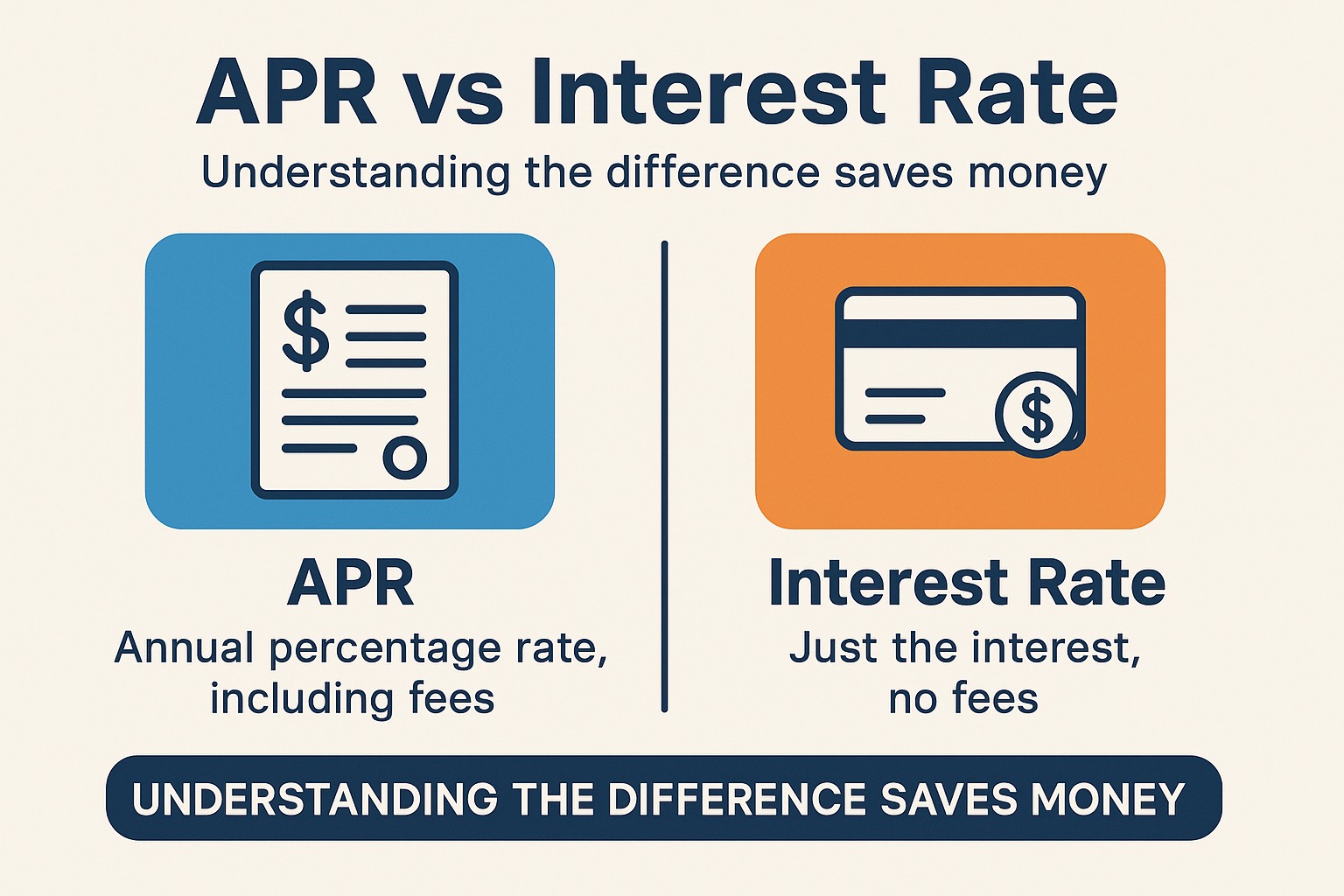
The interest rate is the percentage charged on the principal loan amount over a period. For example, if a bank offers a 10% annual interest rate on a loan of ₹1 lakh, the interest for one year is ₹10,000.
What is APR (Annual Percentage Rate)?
APR represents the total cost of borrowing on an annual basis. It includes:
Interest charges
Processing fees
Other mandatory charges
For example, a loan with a 10% interest rate but 1% processing fee may have an APR of 11%, reflecting the real annual cost to the borrower.
Key Differences Between APR and Interest Rate
| Feature | Interest Rate | APR |
|---|---|---|
| Definition | Percentage charged only on principal | Total annual cost of borrowing including fees |
| Scope | Narrow, just interest | Comprehensive, includes fees & charges |
| Transparency | Shows basic cost | Shows actual cost to borrower |
| Use | Compare simple rates | Compare true cost of loans/credit |
Why It Matters
Better Comparison: Comparing APRs across lenders is more accurate than comparing interest rates alone.
Avoid Surprises: High fees can increase the APR even if the interest rate seems low.
Informed Decisions: Helps borrowers select loans or credit cards that are truly cheaper in the long run.
Example Scenario
Two banks offer a ₹5 lakh personal loan:
Bank A: 10% interest, ₹5,000 processing fee → APR ~10.1%
Bank B: 9.5% interest, ₹15,000 processing fee → APR ~10.5%
While Bank B’s interest rate is lower, Bank A is cheaper overall due to lower fees — something the APR clearly shows.
Conclusion
Understanding APR vs. interest rate is essential for smart borrowing. Always look at APR to know the real cost of a loan or credit card, rather than just the advertised interest rate. This small step can save you thousands in hidden fees and interest over time.
FAQ
Q1. Is APR always higher than the interest rate?
Usually yes, because APR includes additional fees on top of the interest.
Q2. Can APR vary between lenders for the same interest rate?
Yes. Differences in fees and charges mean APRs can vary even if interest rates are identical.
Q3. Why do credit cards list both interest rate and APR?
Interest rate shows the base cost, while APR reflects the total cost including fees, late charges, and annual fees.
Q4. Which is more important: APR or interest rate?
APR is more important for comparing the total cost of borrowing.
Q5. Does APR affect EMI calculations?
Yes. EMIs are usually based on the interest rate, but knowing APR helps estimate the total repayment amount including fees.
Published on : 17th September
Published by : SMITA
www.vizzve.com || www.vizzveservices.com
Follow us on social media: Facebook || Linkedin || Instagram
🛡 Powered by Vizzve Financial
RBI-Registered Loan Partner | 10 Lakh+ Customers | ₹600 Cr+ Disbursed
https://play.google.com/store/apps/details?id=com.vizzve_micro_seva&pcampaignid=web_share