

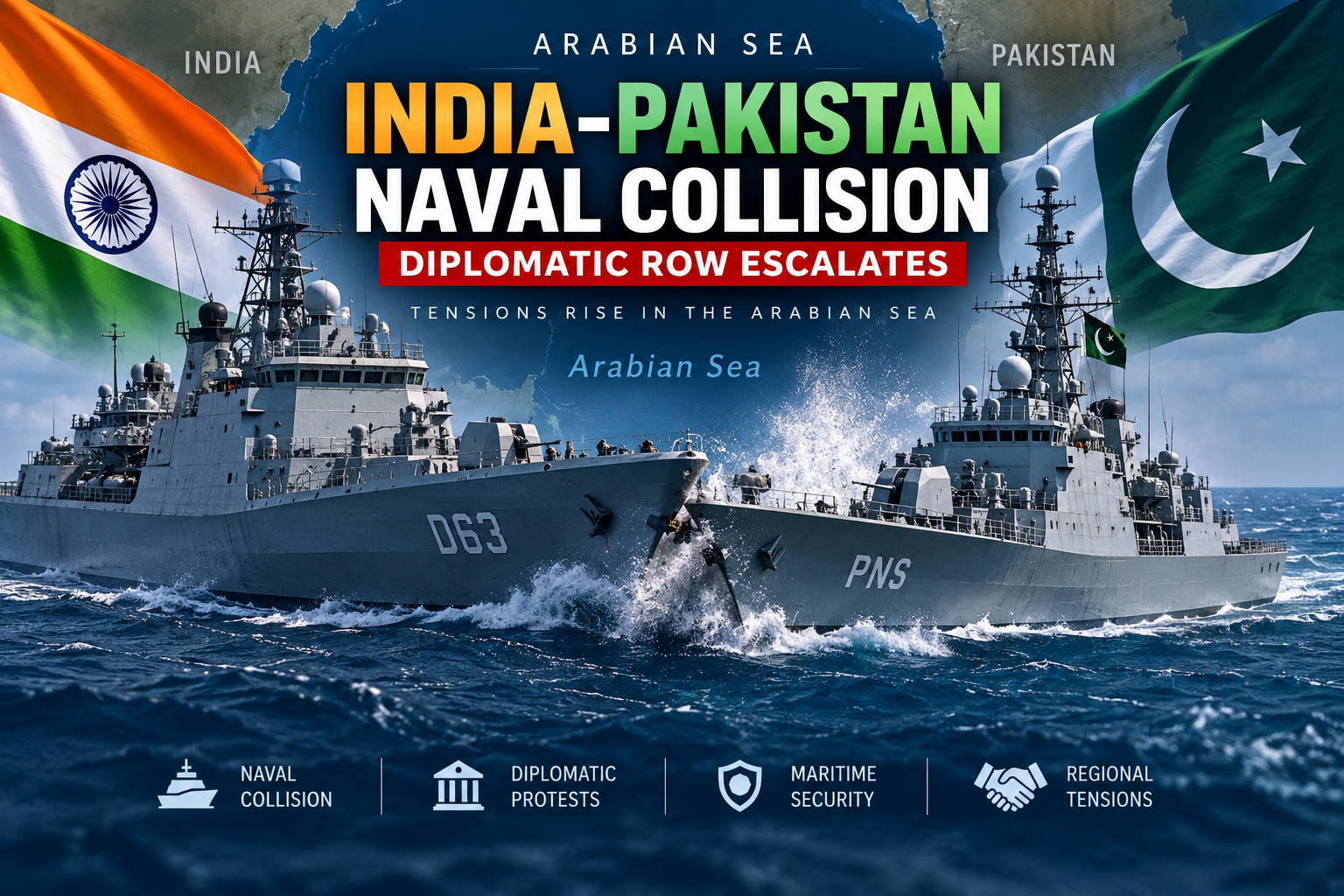
A naval collision in the North Arabian Sea has triggered a fresh diplomatic confrontation between India and Pakistan.
The incident took place on September 15, 2026, when an Indian Navy vessel and a Pakistan Navy vessel came into contact at sea. India said the incident occurred in international waters and described the conduct of the Pakistani naval unit as unacceptable and unprofessional. Pakistan presented a different account, saying the Indian vessel carried out aggressive manoeuvres inside Pakistan's Exclusive Economic Zone (EEZ) during the country's SEASPARK-26 naval exercise.
Within a day, both countries had taken diplomatic action. India summoned Pakistan's Chargé d'Affaires in New Delhi, while Pakistan summoned India's Chargé d'Affaires in Islamabad.
The immediate physical damage appears to have been limited, but the incident is significant because it involves the armed forces of two nuclear-armed neighbours and has brought a longstanding bilateral maritime confidence-building agreement back into focus.
India and Pakistan exchanged diplomatic protests after naval vessels from the two countries collided in the North Arabian Sea on September 15, 2026. India says the incident occurred in international waters and that a Pakistani naval vessel approached its warship in an unsafe manner. Pakistan says the Indian vessel conducted aggressive manoeuvres inside Pakistan's EEZ during a naval exercise. Both countries summoned each other's diplomats, while the 1991 India-Pakistan military agreement has become a central issue in the dispute.
What Happened Between the Indian and Pakistani Naval Vessels?
The incident occurred on the evening of September 15 in the North Arabian Sea.
According to Indian officials and reporting based on Indian government sources, a Pakistani naval vessel approached an Indian frontline warship that was conducting a routine surveillance mission. Indian sources said the Pakistani vessel was travelling at high speed and manoeuvred in what they described as an unsafe manner before the collision.
India's Ministry of External Affairs said the incident took place in international waters and did not cause major damage. It also said the conduct of the Pakistani naval ship was contrary to Article 10 of the 1991 bilateral agreement.
Pakistan disputes that account.
Pakistan's Foreign Ministry said the incident occurred inside Pakistan's EEZ while its navy was conducting SEASPARK-26, and accused the Indian vessel of aggressive manoeuvring in dangerously close proximity to a Pakistani naval ship. Pakistan said the incident violated international law and the 1991 bilateral agreement.
At a glance
| Issue | India's account | Pakistan's account |
|---|---|---|
| Location | International waters | Pakistan's EEZ |
| Circumstances | Pakistani vessel approached at high speed | Indian vessel made aggressive manoeuvres |
| Exercise | Indian vessel was on surveillance | Pakistan was conducting SEASPARK-26 |
| Agreement | India says Article 10 was contravened | Pakistan also invoked the bilateral agreement |
| Diplomatic response | Pakistan's diplomat summoned | India's diplomat summoned |
The two governments therefore agree that a naval contact occurred but disagree over the location, circumstances and responsibility.
Why Did India Summon Pakistan's Diplomat?
On September 16, India's Ministry of External Affairs summoned Saad Ahmad Warraich, Pakistan's Chargé d'Affaires in New Delhi.
India lodged a strong protest over what it described as the "unacceptable and unprofessional conduct" of Pakistani naval units that led to the collision.
The Indian side also instructed its Chargé d'Affaires in Islamabad to lodge a corresponding protest with Pakistan's Ministry of Foreign Affairs.
India said military units from both countries must exercise due care and respect existing bilateral agreements to prevent similar incidents in the future.
Why Did Pakistan Summon India's Diplomat?
Pakistan responded with its own diplomatic protest.
Pakistan's Ministry of Foreign Affairs said it summoned India's Chargé d'Affaires in Islamabad over what it called a provocative action by an Indian naval vessel inside Pakistan's EEZ.
Islamabad said the Indian vessel was operating dangerously close to a Pakistani naval ship during SEASPARK-26 and described the incident as a violation of international law and the 1991 bilateral agreement.
This produced a rare situation in which both sides formally summoned the other's senior diplomatic representative over the same naval incident.
What Is the 1991 India-Pakistan Military Agreement?
One of the most important aspects of the dispute is the Agreement between India and Pakistan on Advance Notice on Military Exercises, Manoeuvres and Troop Movements, signed on April 6, 1991.
The agreement was designed as a confidence-building measure.
Its broad objective was to reduce the risk that military movements or exercises would be misunderstood as preparations for an attack.
The agreement contains provisions covering:
- Major military exercises
- Troop movements
- Military manoeuvres
- Advance notification
- Naval operations
- Military aircraft
- Measures intended to reduce accidental confrontation
The agreement entered into force after ratification and was subsequently registered with the United Nations.
What Does Article 10 Say?
Article 10 has become particularly important in the current dispute.
It states that naval ships and submarines belonging to the two countries should not come within three nautical miles of each other while operating in international waters, specifically to avoid accidents.
Why is the three-nautical-mile rule important?
Three nautical miles is approximately 5.56 kilometres.
The provision is essentially a maritime confidence-building mechanism designed to reduce the risk of accidental encounters between Indian and Pakistani military vessels.
India has cited this provision in connection with the latest collision. Pakistan has also referred to the 1991 agreement in its own protest, although the two governments disagree about the circumstances in which it was breached.
International Waters vs Exclusive Economic Zone: What Is the Difference?
The location dispute is important.
What are international waters?
International waters generally refer to maritime areas beyond the jurisdiction of coastal states under the applicable law of the sea.
India says the September 15 incident occurred in international waters.
What is an EEZ?
An Exclusive Economic Zone, or EEZ, extends up to 200 nautical miles from a coastal state's baseline under the UN Convention on the Law of the Sea.
An EEZ gives the coastal state specific sovereign rights over natural resources and certain economic activities. It does not mean that the coastal state owns the sea in the same way it owns its territorial waters.
Pakistan says the incident occurred inside its EEZ.
Simple comparison
| Feature | International waters | EEZ |
|---|---|---|
| Coastal state's resource rights | Generally not applicable | Yes |
| Coastal state has full sovereignty | No | No, unlike territorial waters |
| Navigation | Subject to international law | Subject to international law and applicable coastal-state rights |
| Current dispute | India's position | Pakistan's position |
The exact legal consequences therefore depend heavily on the location of the vessels and the applicable maritime rules.
Which Naval Vessels Were Involved?
Reports have identified the Pakistani vessel as PNS Hunain, a Yarmook-class offshore patrol vessel/corvette.
However, India's Ministry of Defence did not initially publicly identify the Indian warship involved. Some media reports have identified it as INS Kolkata, but that identification has not been formally confirmed by India's Ministry of External Affairs.
For a factual news article, it is therefore safer to describe the vessels as:
PNS Hunain and an Indian Navy frontline warship
unless and until the Indian government officially confirms the identity.
Was Anyone Seriously Injured?
Available reporting indicates that the collision did not cause major damage to the Indian vessel.
Reports have said the Pakistani vessel sustained damage and returned toward port, while the Indian vessel continued its mission. However, the precise extent of physical damage has varied between reports.
The limited physical damage does not necessarily make the incident insignificant.
A collision between military vessels can create a much larger risk if it is followed by misinterpretation, escalation or retaliatory action.
Why Is the Arabian Sea Important?
The Arabian Sea is strategically important for both India and Pakistan.
It connects the Indian Ocean with major trade and energy routes around:
- The Gulf of Oman
- Arabian Peninsula
- Persian Gulf
- Western Indian coast
- Pakistan's coastline
- Major international shipping routes
The region has also become more sensitive because of wider security disruptions in the Middle East and surrounding maritime corridors.
For India, maintaining secure maritime routes is particularly important because a substantial share of the country's energy imports and international trade moves by sea.
Why This Incident Matters for Maritime Security
Naval ships operate differently from commercial vessels.
Warships use:
- Radar
- Electronic surveillance
- Radio communications
- Navigation systems
- Identification systems
- Lookouts
- Tactical manoeuvring procedures
A close encounter between two military ships therefore carries consequences beyond an ordinary maritime accident.
Maritime-security concerns include:
- Miscalculation
- Communication failures
- Unsafe manoeuvring
- Misreading of military intentions
- Accidental escalation
- Disruption to shipping
- Increased naval alert levels
This is why bilateral agreements that establish separation distances and advance-notification mechanisms can be important confidence-building tools.
Expert Commentary: Why the 1991 Agreement Matters
The current incident has renewed attention on the practical value of the 1991 agreement.
Defence and maritime-security analysis has emphasised that the agreement was designed specifically to reduce the possibility that military movements would be misread and escalate into a larger crisis.
The important point is that the agreement is not merely historical.
Article 10 provides a specific operational safety rule for naval vessels in international waters. That makes it directly relevant whenever Indian and Pakistani warships operate in proximity.
A key distinction
The available evidence does not establish from public information alone whether the collision was deliberate.
Both governments have presented sharply different accounts. Any conclusion about intent would require evidence beyond the diplomatic statements currently available.
That distinction is important when reporting a developing military incident.
India-Pakistan Naval Collision: Timeline
| Date | Development |
|---|---|
| April 6, 1991 | India and Pakistan sign the military exercises and movements agreement |
| August 19, 1992 | Agreement enters into force after ratification, according to reporting |
| June 2011 | Indian and Pakistani naval vessels become involved in a separate close-contact incident in the Gulf of Aden |
| September 15, 2026 | Latest naval collision occurs in the North Arabian Sea |
| September 16, 2026 | India summons Pakistan's Chargé d'Affaires |
| September 16, 2026 | Pakistan summons India's Chargé d'Affaires |
| September 17–18, 2026 | Conflicting accounts and diplomatic tensions continue |
The 2011 Gulf of Aden episode also involved both sides exchanging protests and references to maritime safety provisions. India's foreign-relations records document that earlier episode.
India vs Pakistan: What Each Side Says
India's position
India says:
- The incident occurred in international waters.
- A Pakistani naval unit approached an Indian Navy vessel.
- The Pakistani vessel was operating in an unsafe manner, according to Indian sources.
- The conduct contravened Article 10 of the 1991 agreement.
- Military units should follow existing bilateral arrangements.
- India's Chargé d'Affaires in Islamabad was instructed to lodge a corresponding protest.
Pakistan's position
Pakistan says:
- The incident occurred inside Pakistan's EEZ.
- Its navy was conducting SEASPARK-26.
- The Indian vessel conducted aggressive manoeuvres.
- The incident violated international law and the bilateral agreement.
- India should follow maritime and bilateral obligations.
What remains disputed?
The following points remain contested:
- The precise location of the incident.
- Which vessel initiated the close approach.
- The manoeuvring sequence immediately before contact.
- Whether advance warnings or notifications were properly provided.
- The precise legal interpretation applicable to the encounter.
Could the Arabian Sea Collision Escalate India-Pakistan Tensions?
The incident has already produced a diplomatic escalation through mutual protests.
However, a diplomatic protest is different from military retaliation.
At present, public reporting establishes that both governments have summoned each other's diplomats and exchanged accusations. It does not by itself establish that either side intends to escalate the incident militarily.
The immediate focus is therefore likely to remain on:
- Diplomatic communication
- Naval operating procedures
- Compliance with bilateral agreements
- Maritime safety
- Avoiding further close encounters
Why Naval Confidence-Building Measures Matter
Military confidence-building measures exist partly because accidents can become dangerous when countries already have strained relations.
A relatively small incident at sea can become more serious if:
- One side interprets it as deliberate.
- Military units respond without clear communication.
- Political leaders face pressure to retaliate.
- Additional forces are deployed.
- Another incident occurs before the first one is resolved.
The 1991 agreement was designed to reduce precisely this kind of miscalculation.
Pros and Cons of Bilateral Maritime Safety Agreements
| Potential Benefits | Potential Challenges |
|---|---|
| Reduce accidental encounters | Effectiveness depends on compliance |
| Improve communication | Rules can be interpreted differently |
| Create predictable safety distances | They cannot prevent every accident |
| Lower risk of miscalculation | Political tensions can complicate implementation |
| Provide diplomatic mechanisms | Enforcement may become disputed |
| Support military confidence-building | Requires regular communication |
What Happens Next?
Several developments could determine how the dispute progresses.
1. Diplomatic engagement
Both sides have already summoned the other's diplomats.
Further diplomatic communication could seek clarification about the incident.
2. Maritime investigation
The sequence of manoeuvres, communications and navigational decisions may become important if either side seeks a detailed explanation.
3. Monitoring of naval movements
Both navies may pay closer attention to encounters in the Arabian Sea.
4. Review of bilateral mechanisms
The incident could prompt renewed discussion about how the 1991 agreement is implemented at sea.
5. Avoiding another incident
The most immediate practical concern is preventing another close encounter while tensions remain elevated.
Step-by-Step: How a Naval Collision Investigation Could Work
A maritime investigation would typically need to establish several facts.
Step 1: Determine exact coordinates
Investigators would establish where each vessel was operating.
Step 2: Reconstruct vessel tracks
Navigation and operational data can help reconstruct the movements of both ships.
Step 3: Review communications
Radio communications and warnings may help establish what each crew knew before the encounter.
Step 4: Examine manoeuvres
Investigators can assess changes in speed, heading and distance.
Step 5: Inspect damage
The location and pattern of damage can help reconstruct the point and angle of contact.
Step 6: Compare with applicable rules
The incident can then be examined against:
- Bilateral agreements
- International maritime rules
- Naval operating procedures
- Rules governing military exercises
Step 7: Establish diplomatic findings
The governments can use the evidence to determine what corrective measures, if any, are necessary.
Real-World Impact on Shipping and Trade
The collision did not result in a reported closure of a major commercial shipping route.
Nevertheless, incidents involving military vessels can matter to commercial shipping because the Arabian Sea is an important international maritime corridor.
Companies operating ships in the region monitor:
- Naval activity
- Security alerts
- Shipping advisories
- Insurance risks
- Route changes
- Port conditions
- Regional military exercises
For traders and businesses, maritime security can ultimately affect freight costs, insurance and delivery schedules if risks become persistent.
What Investors and Businesses Should Watch
The incident is primarily a security and diplomatic story, but businesses may also monitor the wider consequences.
Important indicators
- Changes in shipping security advisories
- Oil and gas shipping conditions
- Insurance premiums
- Indian Navy maritime deployments
- Pakistan Navy exercises
- India-Pakistan diplomatic statements
- Any new restrictions on commercial shipping
- Developments involving regional energy routes
It would be premature to attribute changes in financial markets directly to this single naval collision without evidence showing such a connection.
Key Takeaways
- An Indian Navy vessel and a Pakistan Navy vessel collided in the North Arabian Sea on September 15, 2026.
- India says the incident occurred in international waters.
- Pakistan says it occurred inside Pakistan's EEZ.
- India accused the Pakistani naval unit of unsafe and unprofessional manoeuvring.
- Pakistan accused the Indian vessel of aggressive manoeuvres.
- Both governments summoned each other's Chargé d'Affaires.
- India cited Article 10 of the 1991 bilateral agreement.
- Article 10 requires naval ships and submarines of the two countries to remain at least three nautical miles apart in international waters.
- The incident has revived attention on long-standing India-Pakistan maritime confidence-building measures.
- Publicly available information does not establish that the collision was deliberate.
- Further diplomatic and operational clarification will be important to prevent another incident.
Published on : 18th september
Published by : Shanlee J V
www.vizzve.com || www.vizzveservices.com
Follow us on social media: Facebook || Linkedin || Instagram
🛡 Powered by Vizzve Financial
RBI-Registered Loan Partner | 10 Lakh+ Customers | ₹600 Cr+ Disbursed