

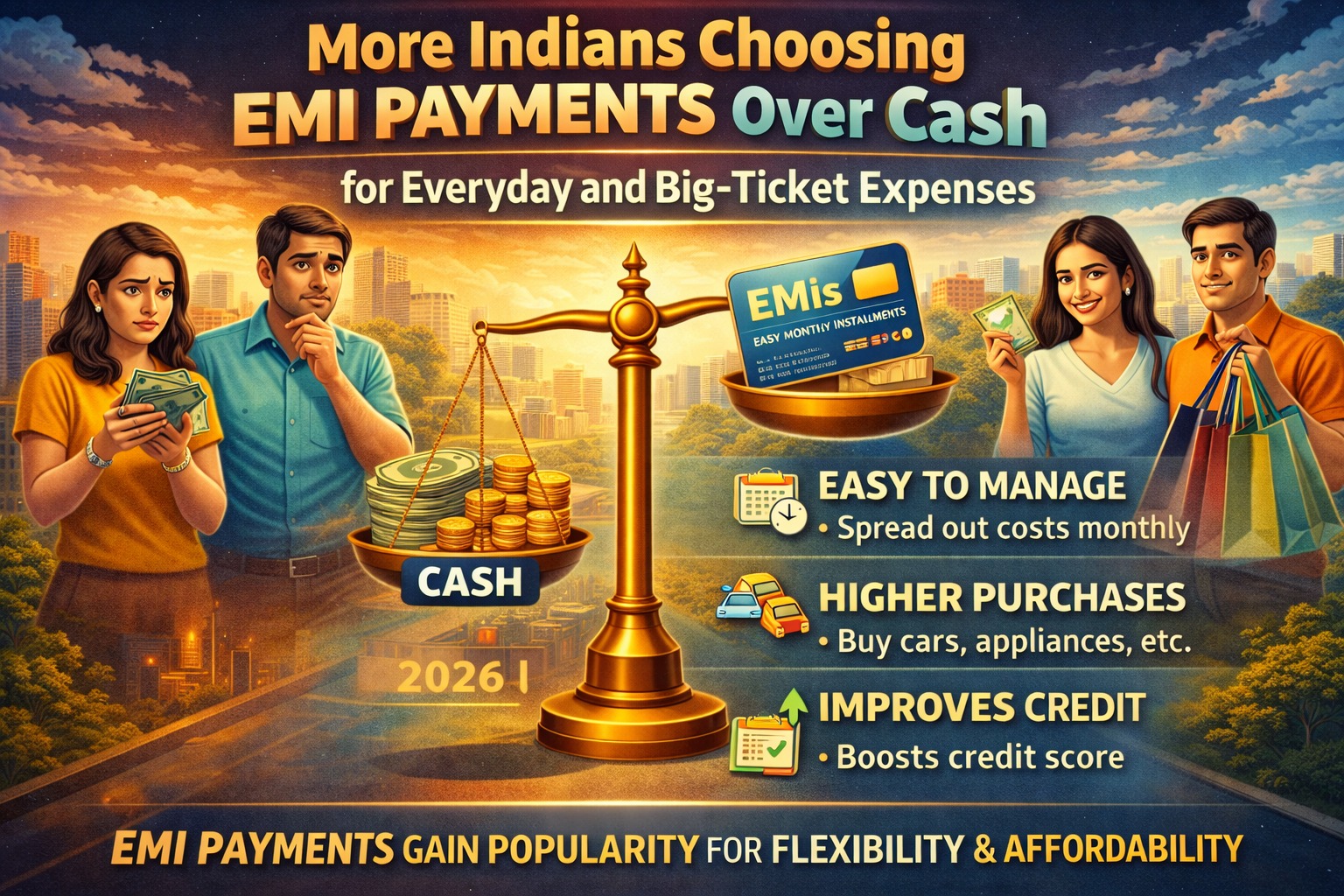
More Indians are choosing EMIs over cash payments due to rising costs, easy digital credit, no-cost EMI offers, and changing consumption habits—making affordability easier but increasing long-term debt risk.
🔹 AI Answer Box
Why EMIs are replacing cash payments in India:
High inflation and rising expenses
Easy access to digital credit & BNPL
No-cost EMI offers by banks & NBFCs
Preference for liquidity over lump-sum payments
🔹 Introduction
A decade ago, paying in cash or upfront was considered financially prudent. Today, even high-income earners prefer EMIs for smartphones, appliances, education, healthcare, and travel. This shift reflects not just affordability concerns, but a deeper change in how Indians view money, savings, and consumption.
So why are EMIs becoming the default payment choice—and what does this mean for your finances?
🔹 The Rise of EMI Culture in India
India is witnessing a structural shift from cash-led spending to credit-led consumption.
Key drivers include:
Digital payments boom
Easy personal loans & credit cards
BNPL (Buy Now Pay Later) platforms
Aggressive “no-cost EMI” marketing
According to trends observed by regulators like the Reserve Bank of India, household credit growth has outpaced income growth—highlighting the popularity of EMIs.
🔹 Why Indians Prefer EMIs Over Cash Today
1. Rising Cost of Living
Big-ticket expenses such as:
Electronics
Medical treatment
Education
Home improvement
are harder to pay upfront without straining savings.
2. Easy Availability of Credit
Instant EMI approvals
Minimal documentation
App-based lending
Credit is now faster than savings.
3. No-Cost EMI Offers (Psychological Trigger)
“No-cost EMI” often:
Reduces upfront mental burden
Encourages higher-value purchases
Masks actual opportunity cost
Many consumers prefer spreading payments even when they can pay cash.
4. Liquidity Over Ownership
Consumers prefer:
Keeping cash for emergencies
Investing surplus funds
Paying small EMIs instead of large outflows
Liquidity has become more valuable than debt-free ownership.
🔹 EMI vs Cash: A Practical Comparison
| Factor | Cash Payment | EMI Payment |
|---|---|---|
| Immediate Outflow | High | Low |
| Liquidity Impact | Heavy | Light |
| Interest Cost | None | Possible |
| Financial Discipline | Strong | Needs control |
| Risk of Overspending | Low | High |
🔹 Benefits of Choosing EMIs
✅ Advantages
Preserves savings
Improves affordability
Enables access to quality products
Helps manage large expenses smoothly
Used wisely, EMIs are a financial tool—not a problem.
🔹 Hidden Risks of EMI Dependence
⚠️ Key Risks
Multiple EMIs reduce monthly flexibility
Easy credit encourages impulse spending
Missed EMIs hurt credit score
Long-term cost increases
EMIs turn dangerous when used casually instead of strategically.
🔹 EMIs, Credit Behaviour & Long-Term Impact
Repeated EMI usage directly affects:
Credit score
Loan eligibility
Interest rates on future loans
Good EMI discipline strengthens credit behaviour, while careless usage restricts future financial freedom.
🔹 Real-World Credit Insight
From real borrower assessment trends, individuals with multiple small EMIs often face more stress than those with one planned loan. The issue is not EMI itself—but EMI overload without budgeting.
🔹 How to Use EMIs Smartly (Step-by-Step)
Limit EMIs to essential expenses
Keep total EMIs under 30–35% of income
Avoid BNPL for lifestyle spending
Track all active EMIs monthly
Prepay high-interest EMIs early
🔹 Pros & Cons of EMI-Based Spending
✅ Pros
Better cash flow management
Access to expensive needs
Short-term affordability
❌ Cons
Long-term debt build-up
Reduced savings rate
Financial stress if income drops
🔹 Key Takeaways
EMIs are replacing cash as default payment mode
Trend driven by convenience, not just affordability
EMIs are useful only with discipline
Cash payments still win for small, frequent expenses
🔹 Frequently Asked Questions (FAQs)
1. Why are Indians choosing EMIs more often?
Due to affordability, easy credit, and liquidity preference.
2. Are EMIs better than cash payments?
Only for large, planned expenses.
3. Do EMIs affect credit score?
Yes, positively if paid on time.
4. Is no-cost EMI really free?
Not always—discounts are adjusted.
5. Should salaried people use EMIs?
Yes, but with limits.
6. Are BNPL and EMI the same?
No, BNPL is shorter-term and riskier.
7. How many EMIs are too many?
When EMIs exceed 35% of income.
8. Does EMI spending reduce savings?
Yes, if not budgeted.
9. Is EMI good for emergencies?
Sometimes, but savings are better.
10. Will EMI culture increase debt?
Yes, if unchecked.
11. Should I close EMIs early?
Yes, especially high-interest ones.
12. Is cash still relevant?
Absolutely—for control and discipline.
🔹 Conclusion + CTA
The shift from cash to EMIs reflects India’s evolving financial behavior. EMIs are not inherently bad—but unplanned EMIs can quietly weaken financial health. Smart borrowers treat EMIs as tools, not shortcuts.
Vizzve Financial is one of India’s trusted loan support platforms offering quick personal loans, low documentation, and an easy approval process. Apply at www.vizzve.com.
Published on : 7th January
Published by : SMITA
www.vizzve.com || www.vizzveservices.com
Follow us on social media: Facebook || Linkedin || Instagram
🛡 Powered by Vizzve Financial
RBI-Registered Loan Partner | 10 Lakh+ Customers | ₹600 Cr+ Disbursed