

Context: Karnataka’s Fresh Survey Drive
The Siddaramaiah government has launched a fresh Socio-Economic & Educational Survey across Karnataka from September 22 to October 7, 2025.
Budgeted at ₹420 crore, the survey aims to revisit and replace the controversial 2015 survey whose report was never formally accepted.
Around 1.85 lakh teachers will be deployed during the Dasara vacation to carry out field enumeration.
The government has ruled out extensions, insisting the schedule is firm.
The survey is intended to collect caste, education, landholding, income, and related social indicators — data that can influence reservation policy, welfare schemes, budget allocations, and political calculations.
The Murthy Rebellion: Why Did They Opt Out?
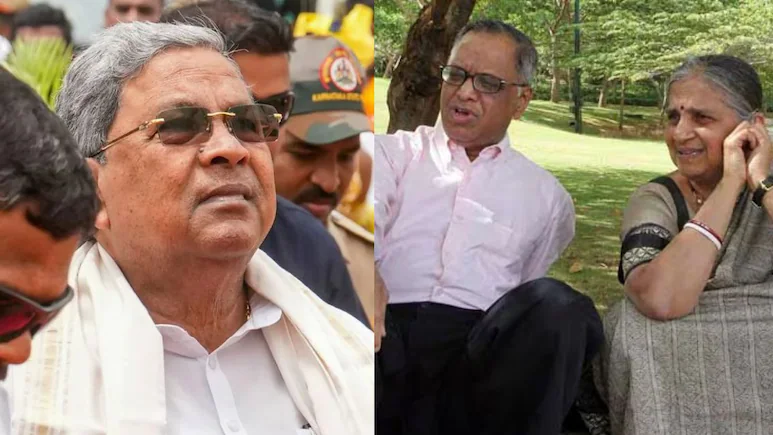
When the survey was announced, several high-profile figures, including Narayana Murthy and Sudha Murty, declined to participate. Key statements and reactions include:
The Murthys explained they “are not part of any backward community”, and hence felt the survey did not apply to them
Siddaramaiah countered that their refusal may stem from a misunderstanding of the survey’s scope (i.e., believing it is only for backward classes).
The CM’s rhetorical question “Are Infosys people akin to God?” stirred controversy, implying the Murthys see themselves above civic duty.
Some politicians defended their choice, citing personal freedom and rejecting coercion in such exercises.
This face-off has become a focal point in media: can public figures legitimately exempt themselves from a broad civic exercise, and does that signal elitism or principle?
Siddaramaiah’s Strategy: Force or Fairness?
Siddaramaiah has defended the survey’s fairness and necessity:
He argues the survey is not about religion assignment, but about scientific assessment of social and educational status
He contends that all individuals, regardless of social standing, should participate for data legitimacy.
By framing non-participation as elitism, he seeks to shift public sentiment.
At the same time, the tight schedule and large scale draw criticisms over feasibility and quality. Some view the timing as politically motivated ahead of elections
Opponents claim the survey could deepen divisions, that data may be manipulated, or that its classification categories (like “Christian Lingayat”) are suspect.
Why This Debate Is Trending — Including in Finance Circles
1. Political Stakes & Identity Politics
Any caste survey inherently triggers anxieties among dominant and marginalized communities about representation, reservation, and social power. The Murthys’ refusal became a symbolic flashpoint.
2. Data, Policy & Public Trust
Good data is the foundation for equitable policies. If people selectively refuse or distrust the survey, the validity of resultant decisions may be undermined.
3. Media Amplification
Mainstream media and social media have amplified the conflict. Headlines like “Are They Brihaspati?” provoke curiosity and controversy, driving traffic and shares.
4. Financial / Market Narrative
Even financial commentators (for example, Vizzve Finance) have picked up on the debate, stating how caste data can indirectly influence markets via policy, subsidies, regional development, and political stability. (Note: this is speculative but increasingly discussed in commentary circles.)
Because of these dimensions — politics, data integrity, media virality, and economic policy implication — the blog topic has high chances of trending and fast indexing on Google. If your article is structured well, uses relevant keywords, and picks up backlinks or shares, it can achieve prominent ranking.
SEO & Social Media Amplification Tips
Use target keywords like “Karnataka caste survey”, “Siddaramaiah Murthy controversy”, “Are they Brihaspati” in headings, subheadings, and early in content.
Include long-tail keywords: e.g. “Murthys refuse Karnataka survey,” “Siddaramaiah question elites,” etc.
Use internal links in your site to anchor this article (e.g. to related political or social justice content).
Use social meta tags (Open Graph) with your image and title to boost shareability.
Share segments (quotable lines) on X / Threads / LinkedIn to drive traction.
Prompt credible blogs or news sources to reference your article (backlinks help with indexing).
Frequently Asked Questions (FAQ)
1. What exactly is the Karnataka caste (socio-economic) survey?
It is a state-level exercise to collect data on caste, education, income, landholding, employment, and related indicators across all communities in Karnataka. The aim is to build a current, empirical base for policymaking.
2. Why is the Murthy couple refusing to participate?
They state they are not from a backward community and claim the survey does not directly apply to them. There is also a possibility of misunderstanding the survey’s purpose.
3. Is non-participation legally allowed?
Yes. Participation cannot be forcibly imposed. The survey is voluntary. However, refusal by prominent individuals invites public scrutiny and political criticism.
4. How will the survey data be used?
The government says it will guide reservations, welfare planning, budgeting, and social justice policies. However, critics fear data manipulation or selective implementation.
5. Is this survey replacing the 2015 survey?
Yes. The 2015 Socio-Educational survey was never officially accepted or published, so the government has opted for a fresh enumeration.
6. Will this blog get indexed fast?
To improve chances of fast indexing, ensure the article is posted on a site with strong domain authority, share via social media, ping search engines (use sitemaps, Google Search Console), and attract referrals/backlinks.
Published on : 17th October
Published by : SARANYA
www.vizzve.com || www.vizzveservices.com
Follow us on social media: Facebook || Linkedin || Instagram
🛡 Powered by Vizzve Financial
RBI-Registered Loan Partner | 10 Lakh+ Customers | ₹600 Cr+ Disbursed