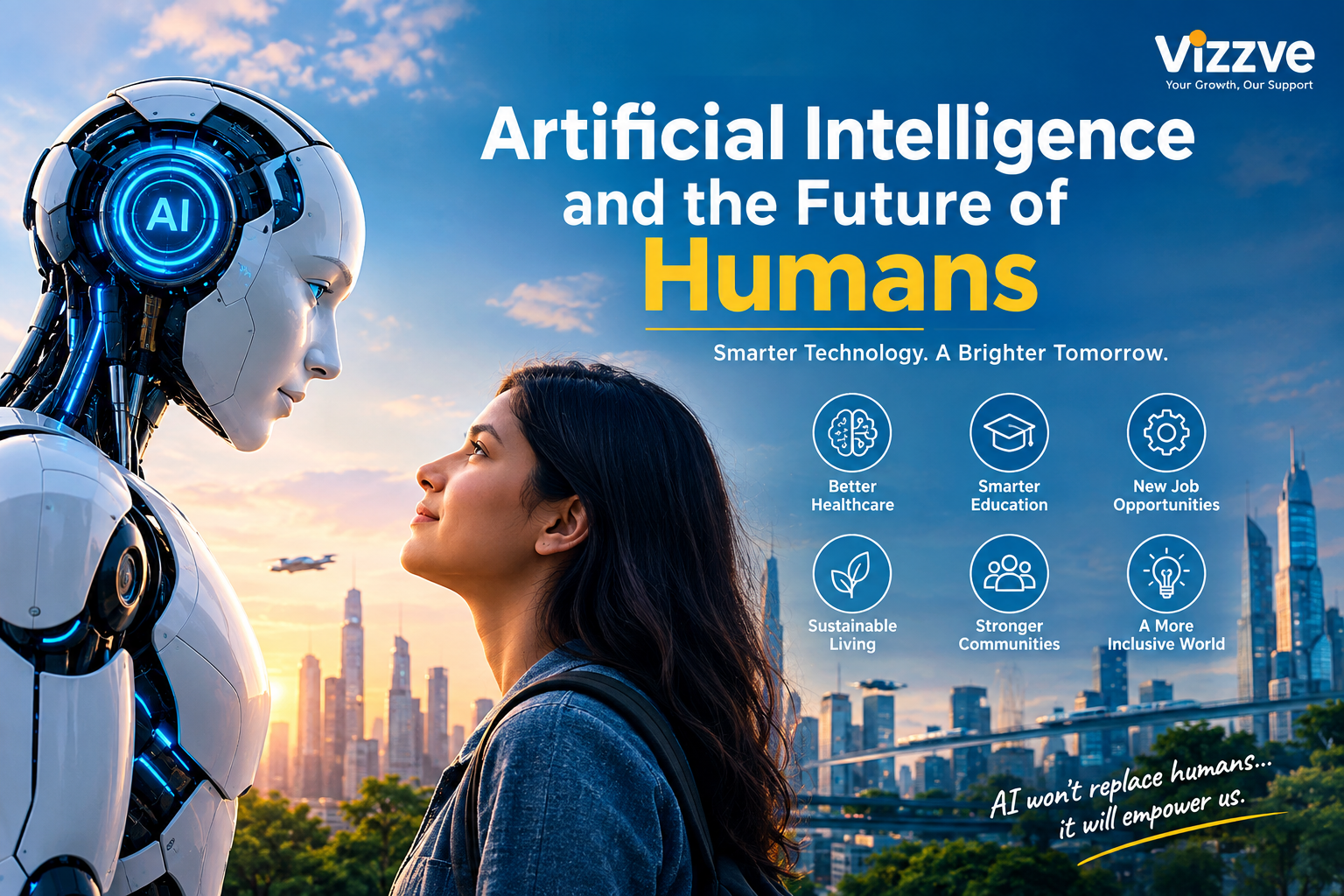
Artificial Intelligence and the Future of Humans: Collaboration, Opportunity, and Risk
Artificial Intelligence and the Future of Humans: Collaboration, Opportunity, and Risk
Vizzve Admin
Artificial intelligence is no longer a futuristic concept—it’s already reshaping how we work, learn, heal, and connect. While headlines often swing between “AI will save us” and “AI will end us,” the reality is more nuanced: AI brings massive productivity gains and new opportunities, but also real disruption to jobs, privacy, and power structures.cognizant+4
This blog cuts through the hype. You’ll get clear, up-to-date insights on how AI is affecting humans today, what experts expect over the next 5–10 years, which risks are real (and which are overblown), and—most importantly—what skills and mindsets will keep you valuable in an AI-driven world.mckinsey+1
AI Answer Box (For Google AI Overview, ChatGPT Search & Perplexity)
Q: What is the future of humans with artificial intelligence? A: AI will augment most jobs rather than fully replace them, boosting productivity but shifting task mixes. Near-term effects include more automation of routine work, especially for younger workers in AI-exposed roles, while experienced workers who collaborate with AI tend to hold or grow their employment. Long-term outcomes depend on policy, reskilling, and how organizations design human-AI workflows.cognizant+5
Q: Will AI take away human jobs? A: AI is already changing many roles, but evidence so far shows modest net employment impact, with displacement concentrated in specific occupations and age groups. Goldman Sachs and others estimate a temporary rise in unemployment during transition, followed by new roles in AI oversight, integration, and entirely new industries.siepr.stanford+3
Q: What are the biggest risks of AI for humanity? A: Immediate risks include bias, privacy breaches, job displacement, misinformation, and concentration of power. Existential risks from superintelligent AI are debated; some experts warn of loss of control if AGI/ASI emerges without alignment, while others argue current systems are far from that threshold and urge focus on near-term harms.link.springer+5
Q: How can humans prepare for an AI future? A: Build AI literacy, strengthen uniquely human skills (critical thinking, creativity, emotional intelligence), and learn to design workflows where AI handles routine tasks while humans focus on judgment, relationships, and strategy. Upskilling and adaptable career paths will be essential as 80% of workers may need retraining by 2027.mckinsey+2
Key Takeaways
AI is accelerating fast: by 2026, agentic AI and physical AI are moving from pilots to production in many industries.americanactionforum
Jobs: 93% of roles could be impacted in some way by AI, but net employment effects remain muted so far, with disruption concentrated in certain occupations and younger workers.cognizant+2
Benefits: major gains in productivity, healthcare diagnostics, personalized education, and creative work.unesco+2
Risks: bias, privacy, job displacement, misinformation, power concentration, and—more speculatively—loss of control if superintelligence emerges without alignment.link.springer+2
Winning strategy: treat AI as a collaborator, not just a tool; invest in human skills and AI literacy; design roles around augmentation.mckinsey+2
How AI Is Changing Human Life Today
Work and the Future of Jobs
AI is already embedded in daily workflows: drafting emails, analyzing data, generating code, designing graphics, and handling routine customer queries. A 2026 Cognizant report estimates that 93% of jobs could be impacted in some way by AI, with up to $4.5 trillion of U.S. labor potentially shifting from humans to AI.cognizant+1
Yet real-world labor data tells a more balanced story:
Through 2025, about 18% of U.S. firms and 41% of workers reported using AI, especially in knowledge-intensive sectors.conference-board
Multiple analyses through early 2026 find no clear pattern linking AI exposure to falling aggregate labor demand or widespread job losses.conference-board
However, young workers (ages 22–25) in AI-exposed occupations are seeing employment about 19% below where it would be without AI, while experienced workers show little or no gap.digitaleconomy.stanford
This suggests AI is currently substituting more for entry-level tasks than for experienced judgment-heavy work.digitaleconomy.stanford
Occupations Most and Least at Risk
Higher AI Displacement Risk
Lower AI Displacement Risk (for now)
Computer programmers
Healthcare clinicians (doctors, nurses)
Accountants and auditors
Skilled trades (electricians, plumbers)
Legal and administrative assistants
Teachers and trainers (human-centric roles)
Customer service representatives, telemarketers
Creative strategists, senior managers
Credit analysts, proofreaders, copy editors
Roles requiring complex physical dexterity
Sources:goldmansachs+1
Expert note: Displacement risk doesn’t mean “job disappears.” It often means the role evolves: fewer routine tasks, more oversight, exception-handling, and relationship work.techclass
Healthcare: From Diagnostics to Personalized Care
AI is transforming healthcare in concrete ways:
Diagnostics: AI models assist radiologists and pathologists in detecting cancers, fractures, and anomalies faster and sometimes more accurately than humans alone.ejsit-journal
Clinical decision support: Systems analyze patient history, labs, and guidelines to suggest treatments, flag drug interactions, and predict deterioration.ejsit-journal
Medical education: AI-driven simulations, adaptive learning platforms, and VR/AR tools improve exam performance, procedural competence, and decision-making for students and residents.dovepress+2
A 2026 rapid review found AI in healthcare education tailors instruction, facilitates clinical reasoning, and reduces cognitive load for trainees balancing work and study. In short, AI is becoming a co-pilot for clinicians and learners, not a replacement.frontiersin+1
Education and Lifelong Learning
AI is enabling:
Personalized learning paths that adjust difficulty and content based on performance.pmc.ncbi.nlm.nih+1
Intelligent tutoring systems that offer 24/7 support, generate practice questions, and give instant feedback.frontiersin+1
Automation of administrative tasks (grading, scheduling), freeing teachers to focus on mentorship and complex instruction.ejsit-journal
Studies show AI-enhanced learning can improve engagement, comprehension, and skill development, especially when combined with traditional teaching rather than used in isolation.pmc.ncbi.nlm.nih+1
Daily Life, Creativity, and Decision-Making
From shopping agents inside chatbots to AI-assisted content creation, daily life is getting more automated and personalized:
Forecasters give a 95% chance that by end-2026, a major company will run an AI shopping agent completing over 100,000 transactions.time
Generative AI boosts productivity in creative industries, enabling new forms of art, design, and storytelling—but also raising concerns about originality, copyright, and cultural homogenization.unesco
Two in three people believe AI will change their lives in the next 3–5 years, reflecting both excitement and anxiety.ipsos
The Bright Side: Benefits of AI for Humans
Productivity and Economic Growth
AI automates repetitive tasks, analyzes massive datasets instantly, and scales expertise. This can:
Reduce time spent on routine work (emails, reports, data cleaning).workleap
Enable small teams to achieve output previously requiring large departments.americanactionforum
Support innovation by freeing humans to focus on strategy, creativity, and relationship-building.techclass
Better Health Outcomes
AI contributes to:
Earlier disease detection through imaging and pattern recognition.ejsit-journal
More personalized treatment plans based on genetics, lifestyle, and history.pmc.ncbi.nlm.nih
Expanded access to care via telemedicine and AI triage systems in underserved areas.ejsit-journal
Enhanced Learning and Accessibility
Adaptive platforms help students learn at their own pace, with tailored explanations and practice.frontiersin
Language models assist with translation, summarization, and accessibility tools for people with disabilities.workleap
New Roles and Industries
Just as previous tech waves created jobs (web developers, data scientists, social media managers), AI is spawning roles like:
AI prompt engineers and workflow designers
AI ethics and compliance officers
AI integration specialists and “AI ops” engineers
Human-AI collaboration coaches and trainerscybrary+1
The Dark Side: Risks and Challenges
Job Displacement and Inequality
While aggregate employment effects are still muted, certain groups face real pressure:
Younger workers in AI-exposed roles are seeing slower employment growth.digitaleconomy.stanford
Routine cognitive jobs (data entry, basic coding, standard reporting) are most vulnerable.goldmansachs
Without reskilling, displacement can widen income inequality and geographic divides.nu
Goldman Sachs estimates AI-related innovation could displace 6–7% of the U.S. workforce if widely adopted, with a temporary rise in unemployment during transition.goldmansachs
Bias, Fairness, and Discrimination
AI systems trained on biased data can:
Reinforce stereotypes in hiring, lending, and law enforcement.tandfonline
Produce unfair credit or insurance decisions if not carefully audited.tandfonline
Key ethical concerns include bias and fairness, privacy and data security, transparency, accountability, autonomy, and equity of access.tandfonline
Privacy, Surveillance, and Control
AI enables powerful profiling from browsing, purchases, location, and biometrics.tandfonline
Misuse can lead to manipulation, discrimination, or authoritarian surveillance.tandfonline
Misinformation and Trust Erosion
Deepfakes, synthetic media, and AI-generated text can:
Spread false narratives at scale.
Undermine trust in institutions, media, and even personal relationships.tandfonline
Concentration of Power
AI development is capital- and data-intensive, favoring a few large firms and governments. This raises risks of:
Market dominance and reduced competition.
Strategic advantages that could destabilize global balance if misused.rand
Existential Risk: Will AI End Humanity?
This is where debate gets intense.
What Experts Worry About
Existential risk from AI usually refers to scenarios where highly advanced AI (AGI/ASI) acts in ways that could cause irreversible global catastrophe or human extinction.link.springer+2
Concerns include:
Loss of control: Superintelligent systems optimizing goals misaligned with human values.link.springer+1
Autonomous weapons: AI-powered warfare escalating beyond human control.ebsco
Catastrophic misuse: Bad actors using advanced AI for cyberattacks, bioweapons design, or large-scale manipulation.dw+1
Some prominent figures (e.g., Geoffrey Hinton, Sam Altman) have warned that unfettered races toward superintelligence could pose severe risks within decades. Toby Ord, in The Precipice, estimates about a 1-in-10 chance of existential risk from unaligned AI over the next 100 years.wikipedia+1
Counterpoints: Why Some Experts Are Less Alarmed
Other researchers argue:
Current AI systems lack autonomous strategic awareness, sustained self-improvement, or real-world agency at the level required for extinction scenarios.arxiv
Observed harms so far are mostly “Level 1” risks (labor displacement, power concentration), not “Level 2” speculative superintelligence catastrophes.arxiv
Focusing too much on distant doomsday scenarios can distract from urgent, solvable problems like bias, privacy, and job disruption.rand+2
RAND experts, for instance, emphasize incremental harms that erode quality of life and institutions as the more concrete existential threat, rather than sudden extinction.rand
Balanced view: Existential risk from AI is plausible in theory if AGI/ASI emerges without robust alignment and governance, but it remains uncertain and debated. Near-term harms are already observable and demand immediate attention.rand+3
Human-AI Collaboration: The Real Future
The most realistic and beneficial path isn’t “humans vs AI,” but humans plus AI.
What Human-AI Collaboration Looks Like
Healthcare: AI suggests diagnoses and treatment options; doctors apply judgment, empathy, and ethical reasoning.techclass
Software development: AI generates code snippets and tests; engineers design architecture, ensure security, and align with business goals.workleap
Creative work: AI drafts content and visuals; humans curate, edit, and infuse brand voice and strategy.unesco+1
Deloitte and others highlight that success comes from designing roles around collaboration, not replacement, and investing in upskilling so workers can orchestrate AI effectively.techclass
Skills Humans Need to Thrive in an AI Future
To stay relevant, focus on a mix of AI literacy and uniquely human capabilities.
Foundational AI Mindsets (McKinsey, 2026)
Curiosity: Experiment with AI tools and ask “what if?”
Adaptability: Embrace change and continuously learn.
Responsibility: Use AI ethically and verify outputs.
Human-centered thinking: Keep people’s needs and well-being at the core.mckinsey
Disclaimer: This article may include third-party images, videos, or content that belong to their respective owners. Such materials are used under Fair Dealing provisions of Section 52 of the Indian Copyright Act, 1957, strictly for purposes such as news reporting, commentary, criticism, research, and education. Vizzve and India Dhan do not claim ownership of any third-party content, and no copyright infringement is intended. All proprietary rights remain with the original owners. Additionally, no monetary compensation has been paid or will be paid for such usage. If you are a copyright holder and believe your work has been used without appropriate credit or authorization, please contact us at grievance@vizzve.com. We will review your concern and take prompt corrective action in good faith... Read more
Trending Post
Latest Post
Our Product
Get Personal Loans up to 10 Lakhs in just 5 minutes