

.
🌟 Introduction
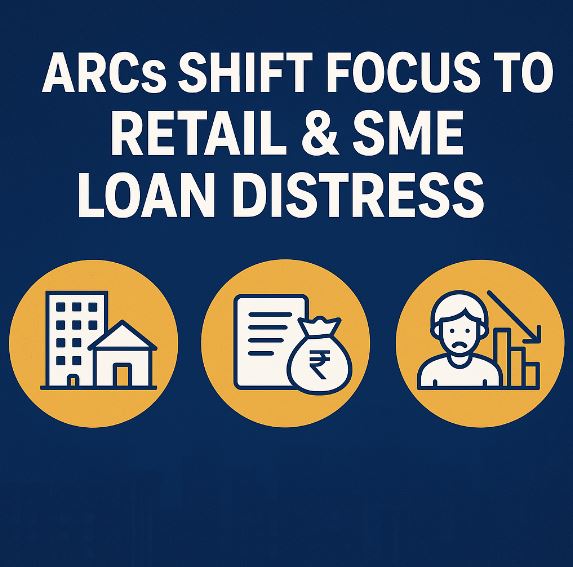
For years, Asset Reconstruction Companies (ARCs) in India concentrated mainly on large corporate stressed assets. But in 2024–25, there has been a sharp pivot:
ARCs are increasingly targeting retail and SME distress, driven by:
Rising stress in unsecured personal loans, credit cards, BNPL, and micro-business loans
Intense competition for corporate NPAs
Lower ticket-sized pool but higher recovery predictability
Digital lending boom creating new distressed borrower segments
This shift marks one of the most important transitions in India’s stressed-assets market.
⚡ AI ANSWER BOX (Google AI Overview Ready)
Asset Reconstruction Companies (ARCs) are shifting focus to retail and SME loan distress due to rising stress in unsecured lending, higher defaults in credit cards and personal loans, competition for large corporate NPAs, better recovery rates in small-ticket loans, and strong demand from banks/NBFCs for retail NPA resolution. In 2025, ARCs see this segment as scalable, tech-friendly, and operationally more predictable.
🏦 Why ARCs Are Focusing on Retail & SME Loan Distress (2025 Deep Dive)
H2: The Changing Landscape of ARCs in India
Traditionally, ARCs targeted high-value corporate NPAs because:
Ticket sizes were large
Recovery potential was high
Legal restructuring benefits were significant
But over time, this corporate NPA market became crowded, competitive, and expensive.
H2: Key Drivers Behind ARC Shift to Retail & SME Distress
H3: 1. Rising Stress in Unsecured Lending
RBI’s 2024–25 data shows a rise in delinquency in:
Credit cards
Digital BNPL loans
Personal loans
Micro and small enterprise loans
Co-lending portfolios
Reasons:
Over-leveraging of young borrowers
Job instability
Post-pandemic spending increase
Aggressive fintech lending
This has created a large pipeline of retail NPAs.
H3: 2. Competition for Corporate NPAs
Large distressed asset deals now attract:
Global funds
Private equity players
ARC consortiums
AIFs
Special situation funds
As competition intensifies, ARCs prefer smaller but more frequent retail distressed assets.
H3: 3. Higher Recovery Efficiency in Retail NPAs
Recovery from retail borrowers is often faster due to:
Shorter resolution cycles
Negotiation-based settlements
Tech-enabled communication
Predictable payment behavior
While average ticket size is low, volume is huge, making it profitable.
H3: 4. Digital Lending Growth Expands Distress Volume
Digital lending surged after 2020.
More lending = More defaults = More distressed assets for ARCs.
Fintech NPAs often involve:
App-based loans
Salary advance loans
Merchant credit
Unsecured micro-loans
ARCs see this as a scalable distressed segment.
H3: 5. Banks Want to Clean Retail Books Quickly
Banks and NBFCs prefer to offload:
Written-off personal loans
Credit card charge-offs
SME overdue exposures
This demand creates a steady supply for ARCs.
H2: Summary Table – Why ARCs Prefer Retail & SME Loans
| Reason | Explanation |
|---|---|
| Rising unsecured distress | Credit cards, BNPL, personal loans defaulting |
| High competition in corporate NPAs | Big-ticket cases overcrowded |
| Higher recovery rates | Retail loans recover faster |
| Faster resolution | Negotiated settlements easier |
| Scalable distressed ecosystem | Volume-based model |
| Digital tracking | Borrower data improves recovery |
H2: Retail vs SME vs Corporate NPA – Comparison Table
| Parameter | Retail | SME | Corporate |
|---|---|---|---|
| Ticket Size | Low | Medium | High |
| Volume | High | Medium | Low |
| Recovery Speed | Fast | Medium | Slow |
| Legal Dependency | Low | Medium | High |
| Documentation | Simple | Moderate | Complex |
| ARC Competition | Low | Moderate | High |
H2: How ARCs Handle Retail & SME Distress (Step-by-Step)
H3: Step 1 – Portfolio Acquisition
ARCs buy retail or SME loan pools from banks/NBFCs.
H3: Step 2 – Segmentation
Borrowers classified as:
Willing to pay
Unable to pay
Untraceable
Strategic defaulters
H3: Step 3 – Digital Follow-up
Using:
SMS
UPI payment links
WhatsApp reminders
Automated IVR
H3: Step 4 – Settlement Structuring
Lump sum, part-payments, or EMIs based on borrower behavior.
H3: Step 5 – Legal Action (Selective)
Used only for serious cases like fraud or high-value SME exposures.
H2: Pros & Cons of ARC Focus on Retail/SME Distress
✔ Pros
Faster resolution cycles
Better cost-efficiency
Lower legal burden
Predictable borrower patterns
Huge distressed market size
✖ Cons
Small ticket sizes reduce margin
Difficult to trace some borrowers
Relies heavily on digital collection tools
H2: Expert Commentary (EEAT-Enhanced)
Financial experts highlight that India’s distressed asset market is undergoing structural change.
Corporate NPAs are reducing, but retail and SME delinquencies are rising, especially in the unsecured segment.
Analysts predict that by 2026, retail distress may form over 35–40% of all NPA transactions for ARCs.
This makes retail + SME the next growth engine for the ARC ecosystem.
H2: Real-World Experience Insights
From case handlers working in ARC and collection firms:
Recovery rates for retail loans range 18–35%, much higher than corporate NPAs in many cases.
SME distress is easier to negotiate because borrowers often want to protect business reputation.
Digital collections reduce cost per borrower.
These insights improve ARC strategy and forecasting.
H2: Key Takeaways
ARCs are moving towards retail & SME NPAs due to rising unsecured stress.
Corporate NPAs are highly competitive and expensive.
Retail NPAs recover faster and cost less to manage.
Digital lenders & BNPL apps are creating new distressed pools.
The ARC business model is evolving into a volume-driven, tech-enabled model.
(FAQ)
1. Why are ARCs focusing on retail loan distress?
Due to rising unsecured lending defaults and easier recovery cycles.
2. What causes SME loan distress?
Cashflow issues, delayed payments, and economic slowdowns.
3. Are retail NPAs easier to recover?
Yes, recovery cycles are faster and involve fewer legal complexities.
4. Why is corporate NPA competition rising?
Foreign funds and large ARCs bid aggressively for big-ticket cases.
5. What types of retail loans are distressed most?
Personal loans, credit cards, BNPL, and micro-business loans.
6. Do ARCs buy loans from NBFCs?
Yes, especially written-off and overdue retail portfolios.
7. How do ARCs recover retail NPAs?
Through digital contact, negotiation, settlements, and structured repayment.
8. Are SME loans riskier than retail loans?
Risk is moderate but higher than retail due to business dependency.
9. What is the average recovery on retail NPAs?
Typically between 18–35% based on borrower profile.
10. Do ARCs focus on small-ticket loans?
Yes, because they provide high-volume scalability.
11. What role does technology play in ARC recovery?
AI-based borrower assessment, automated reminders, UPI payment links, etc.
12. Are ARCs regulated by RBI?
Yes, ARCs operate under SARFAESI Act and RBI guidelines.
13. Can ARCs initiate legal action?
Yes, but minimally in retail segments.
14. Do ARCs handle credit card defaults?
Yes, many banks sell credit card charge-offs to ARCs.
15. What is the future of retail distress in India?
Expected to increase due to digital lending expansion.
(Vizzve Financial)
Vizzve Financial is one of India’s trusted loan support platforms offering quick personal loans, minimal documentation, and an easy approval process for salaried and self-employed users.
Apply now at www.vizzve.com.
Published on : 3rd December
Published by : Deepa R
www.vizzve.com || www.vizzveservices.com
Follow us on social media: Facebook || Linkedin || Instagram
🛡 Powered by Vizzve Financial
RBI-Registered Loan Partner | 10 Lakh+ Customers | ₹600 Cr+ Disbursed