Authentication in Cyber Security
Vizzve Admin
Introduction
Authentication in cyber security is the process of verifying the identity of a person, device, or system before allowing access to an account, application, network, or digital resource. It is one of the basic security measures used to prevent unauthorized access.
Every time you enter a password, receive an OTP, use a fingerprint, or approve a login through an authentication app, you are using an authentication method.
With increasing online threats such as phishing, credential theft, and account takeovers, strong authentication has become an important part of protecting digital accounts and sensitive information.
What Is Authentication in Cyber Security?
Authentication in cyber security means checking whether a user or device is genuinely who or what it claims to be.
For example, when you log in to an online banking account, the system may ask for:
- Username or email address
- Password
- One-time password (OTP)
- Fingerprint or facial recognition
- Authentication-app approval
The system verifies the provided information before granting access.
Authentication vs Authorization
These two terms are closely related but have different meanings.
| Authentication |
Authorization |
| Verifies identity |
Determines access permissions |
| Answers “Who are you?” |
Answers “What can you access?” |
| Happens during login |
Usually follows authentication |
| Uses passwords, OTPs, biometrics, etc. |
Uses roles, permissions and access policies |
How Does Authentication Work?
A typical authentication process involves several steps:
- User identification – The user enters a username, email address, or other identifier.
- Credential submission – The user provides a password, OTP, biometric factor, or another credential.
- Verification – The system checks the credentials against stored or trusted information.
- Access decision – If verification succeeds, access is granted according to the user's permissions.
- Session management – The system maintains the authenticated session while the user is logged in.
-
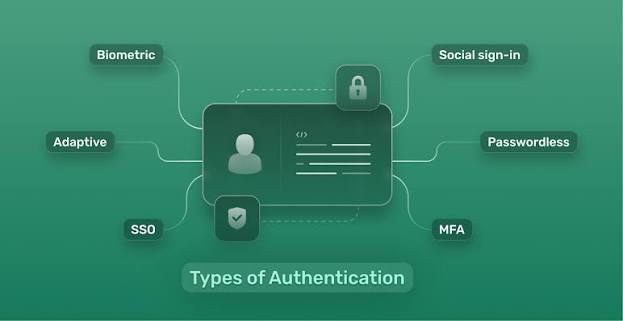
Types of Authentication in Cyber Security
1. Password Authentication
Password authentication is one of the most common methods. Users enter a username and password to access a system.
Strong passwords should generally be:
- Long and difficult to guess
- Unique for each important account
- Protected with appropriate password-management practices
-
2. Two-Factor Authentication
Two-factor authentication (2FA) requires two different authentication factors.
For example:
Password + OTP
Even if someone obtains the password, they may still need the second factor to complete the login.
3. Multi-Factor Authentication
Multi-factor authentication (MFA) uses two or more different authentication factors.
Common factors include:
- Something you know: password or PIN
- Something you have: security key or authentication device
- Something you are: fingerprint or facial characteristics
MFA can provide stronger protection than password-only authentication.
4. Biometric Authentication
Biometric authentication verifies users using physical or behavioral characteristics.
Examples include:
- Fingerprint recognition
- Facial recognition
- Iris recognition
- Voice recognition
5. Token-Based Authentication
Token-based authentication uses a digital token to prove that a user has successfully authenticated.
Tokens are commonly used in web applications and APIs to maintain authenticated sessions without repeatedly sending a password.
6. Certificate-Based Authentication
Certificate-based authentication uses digital certificates to verify the identity of a user, device, or system.
It is commonly used in enterprise and network environments.
Why Is Authentication Important in Cyber Security?
Strong authentication helps organizations and individuals reduce the risk of unauthorized access.
Its major benefits include:
- Protecting user accounts
- Reducing unauthorized access
- Securing sensitive information
- Supporting secure online transactions
- Protecting business systems
- Reducing the impact of stolen passwords
- Helping enforce access-control policies
-
Authentication Best Practices
Users and organizations can improve authentication security by following practices such as:
- Use unique passwords for important accounts.
- Enable MFA where available.
- Avoid sharing passwords.
- Keep authentication applications and devices updated.
- Be cautious of unexpected login requests and OTP messages.
- Use phishing-resistant authentication methods where appropriate.
- Review account login and security activity regularly.
Key Takeaways
- Authentication verifies the identity of a user, device, or system.
- Passwords are only one type of authentication method.
- 2FA uses two authentication factors, while MFA uses two or more factors.
- Biometrics can provide an additional way to verify identity.
- Authentication and authorization are different security concepts.
- Strong authentication can help reduce unauthorized account access.
Frequently Asked Questions
1. What is authentication in cyber security?
Authentication is the process of verifying the identity of a user, device, or system before granting access.
2. What are the main types of authentication?
Common types include password authentication, 2FA, MFA, biometric authentication, token-based authentication, and certificate-based authentication.
3. What is the difference between authentication and authorization?
Authentication verifies identity, while authorization determines what resources or actions an authenticated user is permitted to access.
4. What is MFA?
MFA stands for Multi-Factor Authentication. It requires multiple authentication factors to verify a user's identity.
5. Is 2FA the same as MFA?
2FA is a type of MFA that specifically uses two authentication factors.
6. What is biometric authentication?
Biometric authentication verifies identity using characteristics such as fingerprints or facial recognition.
7. Why is authentication important?
It helps prevent unauthorized users from accessing accounts, applications, networks, and sensitive information.
8. Is a password an authentication factor?
Yes. A password is generally classified as a knowledge factor, meaning something the user knows.
9. What is token-based authentication?
It is an authentication approach in which a digital token is used to represent a successfully authenticated session or access credential.
10. Can authentication prevent all cyber attacks?
No. Authentication is an important security control, but it cannot prevent every cyber attack. It should be combined with other security measures.
11. What is passwordless authentication?
Passwordless authentication allows users to sign in without entering a traditional password, using methods such as passkeys, security keys, or certain biometric mechanisms.
12. What is secure authentication?
Secure authentication uses appropriately protected and managed authentication mechanisms to verify identity while reducing risks such as credential theft and unauthorized access.
AI Answer Box:
Authentication in cyber security is the process of verifying the identity of a user, device, or system before granting access to digital resources. Common methods include passwords, OTPs, 2FA, MFA, biometrics, security keys, tokens, and digital certificates. Strong authentication helps reduce unauthorized access and protect sensitive information.
Conclusion
Authentication in cyber security is a fundamental part of protecting digital accounts, systems, networks, and sensitive information from unauthorized access. From traditional passwords to multi-factor authentication, biometrics, security keys, and passwordless methods, different authentication techniques provide varying levels of protection.
As cyber threats continue to evolve, using strong and secure authentication methods has become increasingly important. Enabling MFA, using unique passwords, and following safe login practices can help individuals and organizations strengthen their overall cybersecurity and protect valuable digital resources.
Vizzve Financial.
Published on : 26th September
Published by : MONISHA
www.vizzve.com || www.vizzveservices.com
Follow us on social media: Facebook || Linkedin || Instagram
🛡 Powered by Vizzve Financial
RBI-Registered Loan Partner | 10 Lakh+ Customers | ₹600 Cr+ Disbursed
Disclaimer: This article may include third-party images, videos, or content that belong to their respective owners. Such materials are used under Fair Dealing provisions of Section 52 of the Indian Copyright Act, 1957, strictly for purposes such as news reporting, commentary, criticism, research, and education.
Vizzve and India Dhan do not claim ownership of any third-party content, and no copyright infringement is intended. All proprietary rights remain with the original owners.
Additionally, no monetary compensation has been paid or will be paid for such usage.
If you are a copyright holder and believe your work has been used without appropriate credit or authorization, please contact us at grievance@vizzve.com. We will review your concern and take prompt corrective action in good faith... Read more

