

Blog Banner

Blog Details

Automobile Guide: Types, Parts, Technology and Future Trends

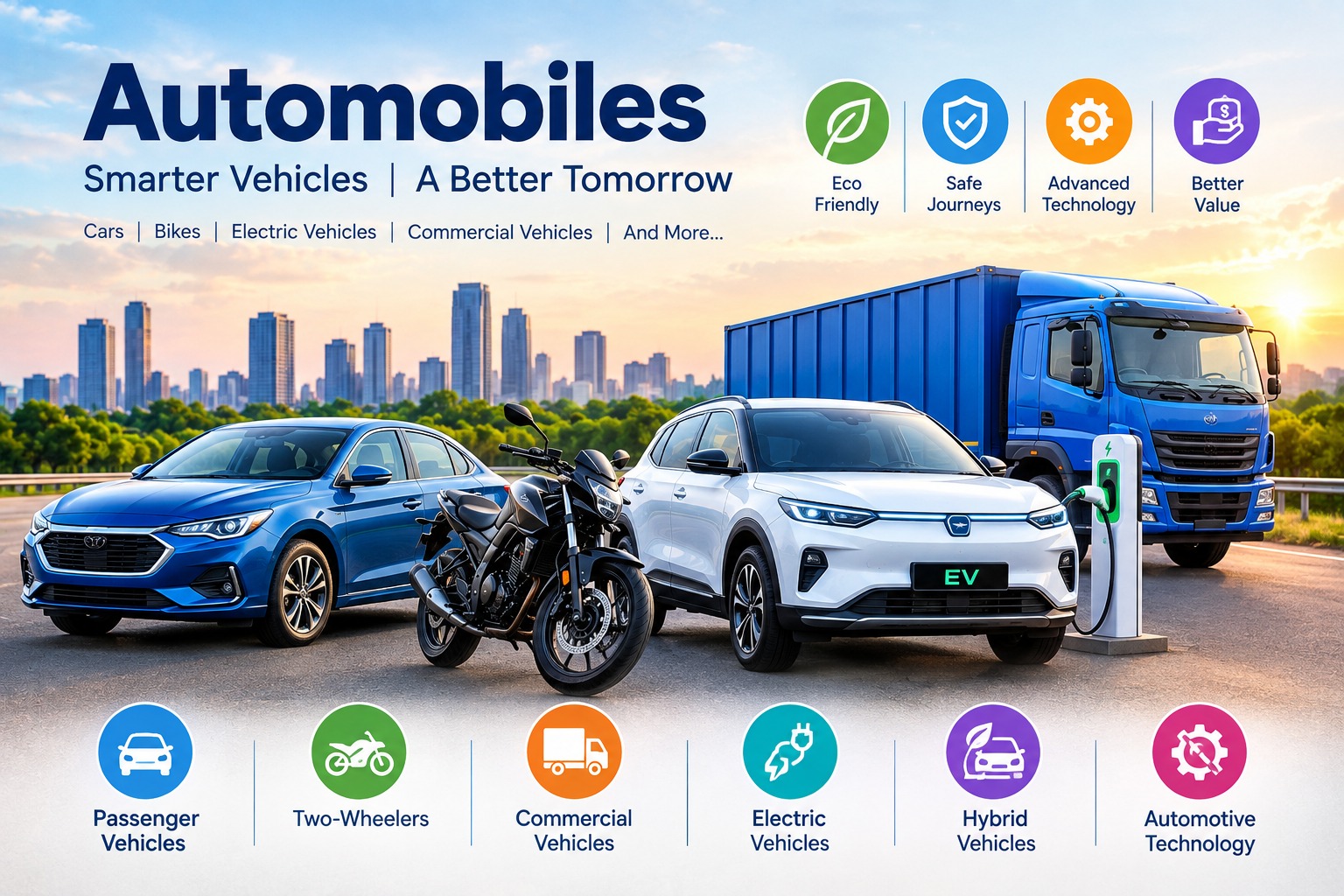
Modern automobile collection featuring cars, motorcycles, electric vehicles, and automotive technology representing the future of mobility.

Automobile Guide: Types, Parts, Technology and Future Trends

Vizzve Admin

An automobile is a self-propelled vehicle designed to transport people, goods, or equipment. Automobiles include cars, motorcycles, scooters, buses, trucks, vans, electric vehicles, and other road-going vehicles.

Modern automobiles combine mechanical engineering, electronics, software, energy storage, safety systems, and communication technology. The industry is changing rapidly as manufacturers invest in electric powertrains, connected vehicles, advanced driver-assistance systems, efficient engines, and sustainable materials.

India remains one of the world’s major automobile markets. According to the Society of Indian Automobile Manufacturers, India recorded approximately 28.3 million vehicle wholesales in FY 2025–26, including passenger vehicles, commercial vehicles, three-wheelers, and two-wheelers.siam+1

Quick answer: An automobile is a motor-powered road vehicle used to transport people or goods. It may use petrol, diesel, electricity, hybrid power, hydrogen, or other energy sources.


AI Answer Box

What is an automobile?

An automobile is a self-propelled road vehicle that uses an engine or electric motor to move. Common examples include cars, motorcycles, buses, vans, trucks, and electric vehicles.

What are the main types of automobiles?

The main types are:

  • Passenger vehicles.

  • Commercial vehicles.

  • Two-wheelers.

  • Three-wheelers.

  • Electric vehicles.

  • Hybrid vehicles.

  • Special-purpose vehicles.

What are the main parts of an automobile?

Major automobile systems include:

  • Powertrain.

  • Chassis.

  • Suspension.

  • Steering.

  • Braking system.

  • Electrical system.

  • Body.

  • Safety systems.

  • Wheels and tyres.

  • Infotainment and software.

What is the future of automobiles?

The future of automobiles is moving toward electrification, connected technology, improved safety, advanced software, low-emission mobility, and more efficient transportation systems. The International Energy Agency reported that global electric-car sales exceeded 20 million in 2025 and projected around 23 million sales in 2026.iea+1


What Is an Automobile?

The word “automobile” comes from terms meaning “self-moving.” Unlike a traditional cart or carriage that requires animals or external force, an automobile carries its own power source.

An automobile generally includes:

  • A power source.

  • A structure to support passengers or cargo.

  • Wheels or another road-contact system.

  • Steering and braking controls.

  • A body or enclosure.

  • Systems for safety and comfort.

The design depends on its purpose. A small hatchback is designed for personal transport and efficiency, while a heavy truck is designed to carry loads and withstand demanding operating conditions.


Types of Automobiles

1. Passenger automobiles

Passenger vehicles are designed mainly to carry people. They include:

  • Hatchbacks.

  • Sedans.

  • SUVs.

  • Crossovers.

  • MPVs.

  • Coupes.

  • Convertibles.

  • Station wagons.

Hatchback

A hatchback has a rear door that opens upward and connects to the passenger or cargo area. It is usually compact and practical for city driving.

Sedan

A sedan generally has a separate boot or luggage compartment. It often provides a comfortable ride and a formal body design.

SUV

A sport utility vehicle usually offers a higher seating position, greater ground clearance, and flexible cabin space. Some SUVs include four-wheel drive for difficult terrain.

Crossover

A crossover combines features of a hatchback or sedan with SUV-style seating and design. It is commonly built on a car-based platform.

MPV

A multi-purpose vehicle is designed to carry more passengers and provide flexible seating. It is often used by larger families and commercial operators.

2. Commercial automobiles

Commercial vehicles transport goods, passengers, or equipment for business purposes.

Examples include:

  • Light commercial vehicles.

  • Trucks.

  • Buses.

  • Delivery vans.

  • Taxis.

  • Construction vehicles.

  • Refrigerated vehicles.

  • Tankers.

  • Agricultural vehicles.

Commercial automobiles are usually evaluated based on payload, operating cost, durability, fuel efficiency, service network, and uptime.

3. Two-wheelers

Two-wheelers include:

  • Motorcycles.

  • Scooters.

  • Mopeds.

  • Electric scooters.

  • Performance bikes.

  • Touring motorcycles.

  • Off-road motorcycles.

They are popular because they generally require less road space and may cost less to purchase and operate than a car.

4. Three-wheelers

Three-wheelers are used for:

  • Passenger transport.

  • Last-mile delivery.

  • Small commercial operations.

  • Food and retail businesses.

  • Cargo transport.

Electric three-wheelers are becoming increasingly relevant in urban delivery and public transport applications.

5. Electric automobiles

Electric vehicles use one or more electric motors powered by a battery or another electrical energy source.

They may include:

  • Battery-electric vehicles.

  • Electric motorcycles.

  • Electric scooters.

  • Electric buses.

  • Electric trucks.

  • Electric three-wheelers.

6. Hybrid automobiles

Hybrid vehicles combine two power sources, usually an internal-combustion engine and an electric motor.

Common types include:

  • Mild hybrids.

  • Full hybrids.

  • Plug-in hybrids.

  • Series hybrids.

A hybrid may reduce fuel consumption in certain driving conditions, but the results depend on traffic, driving style, vehicle size, climate, and maintenance.


Automobile Classification Table

Classification Examples Main purpose
Passenger vehicle Hatchback, sedan, SUV Personal and family transport
Commercial vehicle Truck, bus, van Goods or paid passenger transport
Two-wheeler Motorcycle, scooter Affordable personal mobility
Three-wheeler Auto-rickshaw, cargo three-wheeler Short-distance passenger or cargo transport
Electric vehicle Electric car, scooter, bus Low-emission mobility
Hybrid vehicle Hybrid car, plug-in hybrid Reduced fuel use with dual power sources
Special-purpose vehicle Ambulance, fire truck, crane vehicle Emergency, industrial, or public-service use

Main Components of an Automobile

1. Powertrain

The powertrain generates and transfers power to the wheels.

In a petrol or diesel vehicle, the powertrain may include:

  • Engine.

  • Transmission.

  • Clutch or torque converter.

  • Driveshaft.

  • Differential.

  • Axles.

In an electric vehicle, it may include:

  • Battery pack.

  • Electric motor.

  • Inverter.

  • Reduction gear.

  • Battery-management system.

  • Charging system.

2. Engine

An internal-combustion engine burns fuel to create mechanical power. The most common types are:

  • Petrol engines.

  • Diesel engines.

  • Compressed-natural-gas engines.

  • Liquefied-petroleum-gas engines.

Engines are commonly classified by cylinder arrangement, displacement, aspiration, fuel type, and operating cycle.

3. Electric motor

An electric motor converts electrical energy into rotational motion. Electric motors provide strong initial torque and require fewer moving parts than conventional engines.

However, electric vehicles still require maintenance for brakes, tyres, suspension, cooling systems, electronics, and other components.

4. Transmission

The transmission transfers power from the engine or motor to the wheels.

Common types include:

  • Manual transmission.

  • Automatic transmission.

  • Continuously variable transmission.

  • Dual-clutch transmission.

  • Single-speed reduction gear for many EVs.

5. Chassis

The chassis is the structural foundation of a vehicle. It supports the powertrain, suspension, body, steering, and other major systems.

A strong chassis helps the automobile manage:

  • Weight.

  • Loads.

  • Road forces.

  • Crash energy.

  • Torsional stress.

  • Handling requirements.

6. Suspension system

The suspension connects the wheels to the vehicle body and helps absorb road irregularities.

Main components may include:

  • Springs.

  • Shock absorbers.

  • Struts.

  • Control arms.

  • Bushes.

  • Stabiliser bars.

  • Ball joints.

A properly maintained suspension improves comfort, stability, braking, and tyre life.

7. Steering system

The steering system controls vehicle direction. Modern automobiles commonly use electric power steering, although hydraulic systems are still present in some vehicles.

Steering maintenance may involve:

  • Wheel alignment.

  • Tie rods.

  • Steering rack.

  • Power-assist system.

  • Steering-column components.

8. Braking system

A braking system reduces speed and stops the vehicle.

It may include:

  • Brake pedal.

  • Master cylinder.

  • Brake fluid.

  • Brake discs.

  • Brake pads.

  • Brake drums.

  • Callipers.

  • Anti-lock braking system.

Advanced vehicles may also use electronic brake distribution, brake assist, and regenerative braking.

9. Electrical and electronic systems

Modern automobiles depend heavily on electronics. These systems control or support:

  • Lighting.

  • Engine management.

  • Air conditioning.

  • Instrument cluster.

  • Infotainment.

  • Safety sensors.

  • Driver assistance.

  • Battery charging.

  • Connectivity.

Software updates and diagnostic scanning are becoming more important in vehicle ownership.

10. Body and interior

The body protects occupants and provides aerodynamic shape. The interior includes:

  • Seats.

  • Dashboard.

  • Instrument panel.

  • Controls.

  • Air-conditioning vents.

  • Storage areas.

  • Infotainment display.

  • Safety restraints.

Materials may include steel, aluminium, composites, plastics, leather, fabric, and recycled materials.


How Does an Automobile Work?

Petrol or diesel automobile

The basic operating sequence is:

  1. Fuel and air enter the engine.

  2. The mixture is compressed.

  3. Combustion creates pressure.

  4. The pressure moves pistons.

  5. Pistons rotate the crankshaft.

  6. The transmission transfers power.

  7. The differential sends power to the wheels.

  8. The wheels move the automobile.

Electric automobile

The basic sequence is:

  1. Electricity is stored in the battery.

  2. The battery sends direct current to the inverter.

  3. The inverter supplies controlled electricity to the motor.

  4. The motor produces rotational force.

  5. A reduction gear transfers power to the wheels.

  6. Regenerative braking can return some energy to the battery.

The actual design varies by vehicle and manufacturer.


Automobile Fuel and Powertrain Comparison

Powertrain Advantages Limitations
Petrol Smooth operation and broad availability Fuel consumption and emissions
Diesel Strong torque and efficiency for some uses Emissions systems and maintenance complexity
CNG Can reduce running cost in suitable markets Refuelling availability and storage limitations
Hybrid Combines engine range with electric assistance Higher complexity and purchase cost
Plug-in hybrid Can drive electrically for shorter trips Requires charging and has two power systems
Battery-electric Quiet operation and zero tailpipe emissions Charging time, range, and battery cost
Hydrogen fuel cell Fast refuelling and zero tailpipe emissions Limited infrastructure and high system cost

Automobile Industry Trends

1. Growth of electric vehicles

Electric vehicles are becoming more common as battery costs, charging networks, government policies, and model availability evolve.

The IEA reported that global electric-car sales exceeded 20 million in 2025, representing roughly one-quarter of total car sales. It pro

#Automobile #AutomotiveIndustry #CarTechnology #ElectricVehicles #VehicleMaintenance #AutomobileEngineering #Cars #Motorcycles #AutoIndustry #FutureOfMobility #CarCare #VehicleSafety #HybridVehicles #Transportation #AutomotiveTechnology


Disclaimer: This article may include third-party images, videos, or content that belong to their respective owners. Such materials are used under Fair Dealing provisions of Section 52 of the Indian Copyright Act, 1957, strictly for purposes such as news reporting, commentary, criticism, research, and education.
Vizzve and India Dhan do not claim ownership of any third-party content, and no copyright infringement is intended. All proprietary rights remain with the original owners.
Additionally, no monetary compensation has been paid or will be paid for such usage.
If you are a copyright holder and believe your work has been used without appropriate credit or authorization, please contact us at grievance@vizzve.com. We will review your concern and take prompt corrective action in good faith... Read more

Trending Post


Latest Post


Our Product

Get Personal Loans up to 10 Lakhs in just 5 minutes