

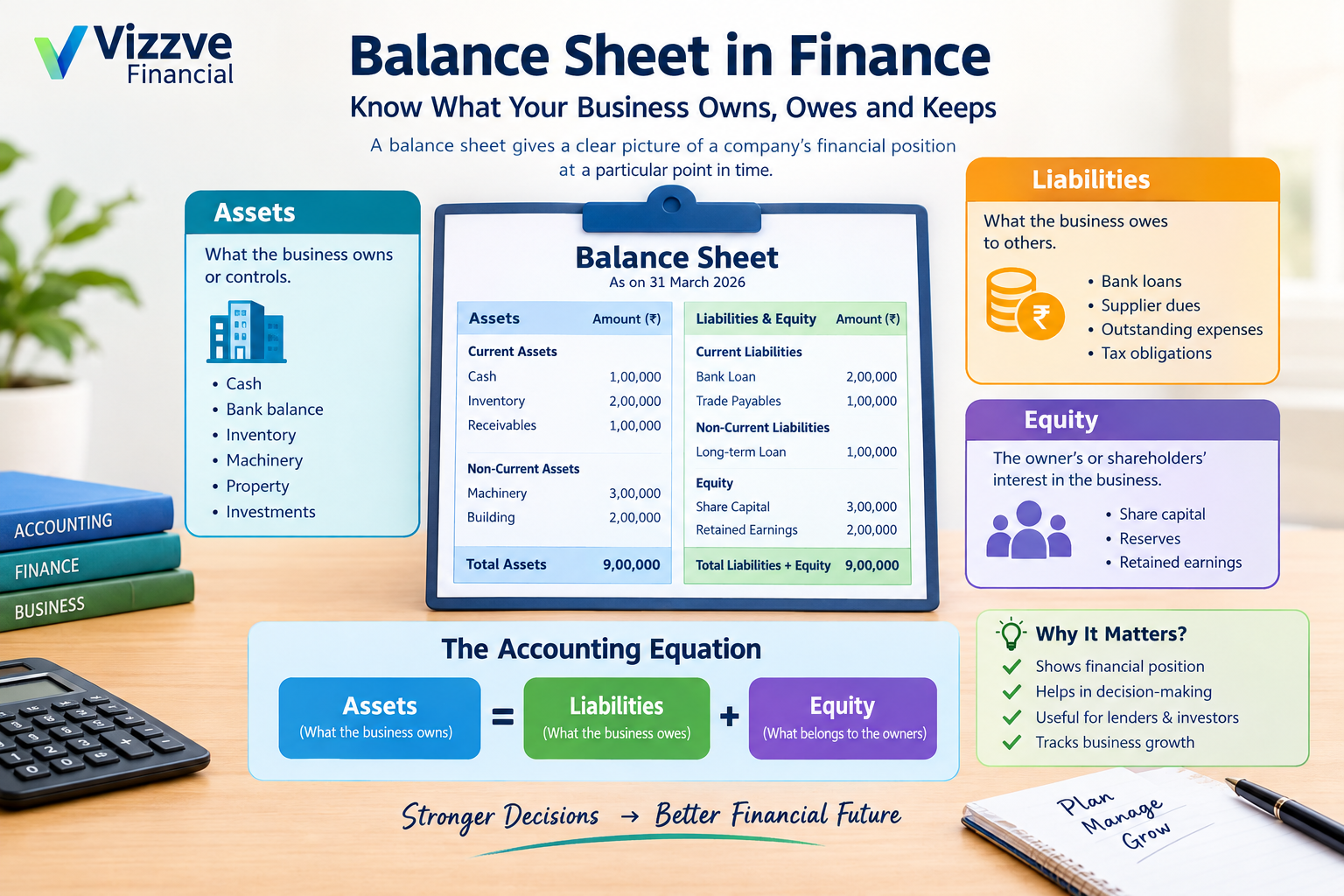
A balance sheet is one of the most important financial statements used by a business. It gives a picture of what a business owns, owes and has invested at a particular date.
In simple words, a balance sheet answers three questions:
-
What does the business own?
-
What does the business owe?
-
How much belongs to the owners?
The three main parts are assets, liabilities and equity.
The basic accounting equation is:
Assets = Liabilities + Equity
A balance sheet must balance because the total value of assets should equal the combined value of liabilities and equity.
AI Answer Box: What Is a Balance Sheet in Finance?
A balance sheet is a financial statement that shows the financial position of a business on a specific date. It lists the business's assets, liabilities and owner's equity.
For example, if a business has ₹10 lakh in assets and owes ₹4 lakh to lenders and suppliers, the owner's equity is ₹6 lakh.
Formula:
Assets = Liabilities + Equity
A balance sheet helps business owners, investors, lenders and other stakeholders understand the financial position of a business.
What Is a Balance Sheet in Finance?
A balance sheet is a financial statement prepared to show the financial position of an organisation at a particular point in time.
Think of it like a financial photograph.
For example, a business may prepare a balance sheet as of 31 March 2026. It shows the company's financial position on that date.
It does not simply tell us how much money is in the bank. It provides a broader picture of the business.
A balance sheet normally includes:
-
Assets – Things the business owns or controls.
-
Liabilities – Amounts the business owes.
-
Equity – The owner's or shareholders' interest in the business.
For companies in India, financial statement presentation is also governed by applicable legal and accounting requirements. The Ministry of Corporate Affairs has prescribed formats and disclosure requirements under Schedule III of the Companies Act, 2013, with amendments over time. (Ministry of Corporate Affairs)
Understanding Assets, Liabilities and Equity
1. What Are Assets?
Assets are resources owned or controlled by a business that have economic value.
Simple examples include:
-
Cash
-
Bank balance
-
Machinery
-
Buildings
-
Computers
-
Inventory
-
Trade receivables
-
Investments
Types of Assets
| Type | Meaning | Examples |
|---|---|---|
| Current Assets | Expected to be used or converted into cash relatively soon | Cash, inventory, receivables |
| Non-current Assets | Used for a longer period | Building, machinery, equipment |
| Intangible Assets | Assets without a physical form | Software, patents, goodwill |
The exact presentation can vary depending on the type of entity and applicable accounting framework. MCA's Schedule III, for example, includes categories such as property, plant and equipment and intangible assets. (Ministry of Corporate Affairs)
2. What Are Liabilities?
Liabilities are amounts that a business has to pay to others.
Examples include:
-
Bank loans
-
Business borrowings
-
Money owed to suppliers
-
Outstanding expenses
-
Certain tax obligations
Types of Liabilities
| Type | Meaning | Examples |
|---|---|---|
| Current Liabilities | Generally payable within a short period | Trade payables, short-term obligations |
| Non-current Liabilities | Generally payable over a longer period | Long-term loans, certain long-term obligations |
For example, if a shop takes a business loan of ₹5 lakh, that loan becomes a liability of the business.
3. What Is Equity?
Equity represents the owner's interest in the business after liabilities are deducted from assets.
The simple formula is:
Equity = Assets − Liabilities
For a company, equity can include items such as share capital and other components depending on the applicable accounting framework.
Simple Example
Suppose:
-
Assets = ₹10 lakh
-
Liabilities = ₹4 lakh
Then:
Equity = ₹10 lakh − ₹4 lakh = ₹6 lakh
So, ₹6 lakh represents the remaining interest after considering the liabilities.
The Accounting Equation
The most important formula to understand a balance sheet is:
Assets = Liabilities + Equity
Let's understand it with a simple example.
Suppose a business has:
-
Cash and other assets = ₹8 lakh
-
Loan = ₹3 lakh
-
Owner's equity = ₹5 lakh
Therefore:
₹8 lakh = ₹3 lakh + ₹5 lakh
Both sides are equal.
That is why it is called a balance sheet.
Simple Balance Sheet Example
Imagine a small business has the following financial position:
| Particulars | Amount |
|---|---|
| Cash | ₹1,00,000 |
| Inventory | ₹2,00,000 |
| Equipment | ₹3,00,000 |
| Total Assets | ₹6,00,000 |
| Bank Loan | ₹2,00,000 |
| Owner's Equity | ₹4,00,000 |
| Liabilities + Equity | ₹6,00,000 |
The balance sheet balances:
₹6,00,000 = ₹2,00,000 + ₹4,00,000
This is the basic idea behind a balance sheet.
Balance Sheet vs Profit and Loss Statement
These two financial statements are related, but they answer different questions.
| Balance Sheet | Profit & Loss Statement |
|---|---|
| Shows financial position | Shows financial performance |
| Prepared for a particular date | Covers a period |
| Shows assets, liabilities and equity | Shows income, expenses and profit/loss |
| Helps understand financial strength | Helps understand business performance |
Easy way to remember
Balance Sheet = What the business owns and owes
Profit & Loss = How the business performed
Why Is a Balance Sheet Important?
A balance sheet is useful for several reasons.
1. Shows Financial Position
It helps understand whether a business has significant assets and how much it owes.
2. Helps in Decision-Making
Business owners can use financial information to make better decisions about spending, borrowing and investment.
3. Useful for Lenders
Lenders may review financial statements when evaluating a business's financial position and creditworthiness.
4. Helps Track Business Growth
Comparing balance sheets from different periods can show how assets, liabilities and equity have changed.
5. Improves Financial Understanding
Students and beginners can use the balance sheet to understand the basic structure of business finance.
How to Read a Balance Sheet Step by Step
You do not need to be an accounting expert to understand the basics.
Step 1: Look at Total Assets
Check how much the business owns or controls.
Step 2: Check Liabilities
Look at loans, payables and other obligations.
Step 3: Check Equity
See how much of the business's net value belongs to the owners/shareholders.
Step 4: Compare Liabilities and Assets
A large amount of debt compared with assets may require closer analysis.
Step 5: Compare Previous Years
Looking at more than one year's balance sheet gives better context than looking at only one date.
Real-World Example
Consider a small retail store.
The store owns:
-
₹2 lakh of inventory
-
₹1 lakh in cash
-
₹3 lakh of equipment
Total assets = ₹6 lakh
The store has:
-
₹2 lakh bank loan
-
₹1 lakh payable to suppliers
Total liabilities = ₹3 lakh
Therefore:
Equity = ₹6 lakh − ₹3 lakh = ₹3 lakh
So:
Assets = Liabilities + Equity
₹6 lakh = ₹3 lakh + ₹3 lakh
This simple example shows how the accounting equation works in everyday business.
Pros and Cons of a Balance Sheet
Advantages
-
Gives a quick view of financial position.
-
Helps understand assets and liabilities.
-
Supports business decision-making.
-
Useful for lenders and investors.
-
Helps compare financial position over time.
Limitations
-
It represents financial position at a specific date.
-
It does not show the complete story of business performance.
-
Some values involve accounting estimates and measurement rules.
-
It should be reviewed along with other financial statements.
Expert perspective: A balance sheet is most useful when read together with the profit and loss statement, cash-flow information and relevant notes rather than in isolation.
Key Takeaways
Summary Box
-
A balance sheet shows a business's financial position.
-
It mainly contains assets, liabilities and equity.
-
The basic formula is Assets = Liabilities + Equity.
-
Assets are resources owned or controlled by the business.
-
Liabilities are amounts the business owes.
-
Equity represents the owner's/shareholders' interest.
-
A balance sheet is prepared for a particular date.
-
Comparing balance sheets over time can provide useful financial insights.
-
It should be considered together with other financial information.
Expert Commentary and Trust-Building Point
A common mistake among beginners is to assume that a business with many assets is automatically financially strong.
That is not always true.
A business could have substantial assets but also carry significant debt. Similarly, having cash on one particular date does not automatically mean the business is profitable.
The better approach is to read the balance sheet together with other financial statements and relevant disclosures.
For Indian companies, official financial reporting requirements and formats can depend on the entity and applicable accounting framework. The Ministry of Corporate Affairs provides statutory requirements and notifications relating to financial statement presentation. (Ministry of Corporate Affairs)
Frequently Asked Questions
1. What is a balance sheet in simple words?
A balance sheet is a financial statement that shows what a business owns, what it owes and the owner's interest at a particular date.
2. What are the three main parts of a balance sheet?
The three main parts are assets, liabilities and equity.
3. What is the balance sheet formula?
The basic formula is:
Assets = Liabilities + Equity
4. What are assets in a balance sheet?
Assets are resources that have economic value, such as cash, inventory, equipment and property.
5. What are liabilities?
Liabilities are financial obligations that a business needs to pay, such as loans and amounts owed to suppliers.
6. What is equity?
Equity is the owner's or shareholders' interest in the business after liabilities are deducted from assets.
7. Why is it called a balance sheet?
It is called a balance sheet because the accounting equation requires the two sides to balance: Assets = Liabilities + Equity.
8. Is a balance sheet prepared every month?
It can be prepared at different reporting intervals depending on business needs and applicable reporting requirements. Annual financial statements are common, while internal management accounts may be prepared more frequently.
9. Is a balance sheet the same as a profit and loss statement?
No. A balance sheet shows financial position at a specific date, while a profit and loss statement reports income and expenses over a period.
10. Can Class 10 students understand a balance sheet?
Yes. The basic concept is simple: what a business owns + what it owes + what belongs to the owners. The accounting equation makes the concept easier to understand.
Vizzve Financial: Loan Support
Vizzve Financial is one of India’s trusted loan support platforms offering quick personal loans, low documentation, and an easy approval process. Apply at www.vizzve.com.
Before applying for any financial product, customers should review the applicable interest rate, fees, repayment schedule, terms and conditions, and eligibility requirements.
Conclusion
A balance sheet in finance is a simple but powerful way to understand the financial position of a business.
Remember the three key words:
Assets → What the business owns
Liabilities → What the business owes
Equity → What belongs to the owners
And the most important formula:
Assets = Liabilities + Equity
Once you understand this equation, the basic structure of a balance sheet becomes much easier to understand.
Published on : 29th September
Published by : MD HEDAYATULLAH
www.vizzve.com || www.vizzveservices.com
Follow us on social media: Facebook || Linkedin || Instagram
🛡 Powered by Vizzve Financial
RBI-Registered Loan Partner | 10 Lakh+ Customers | ₹600 Cr+ Disbursed