

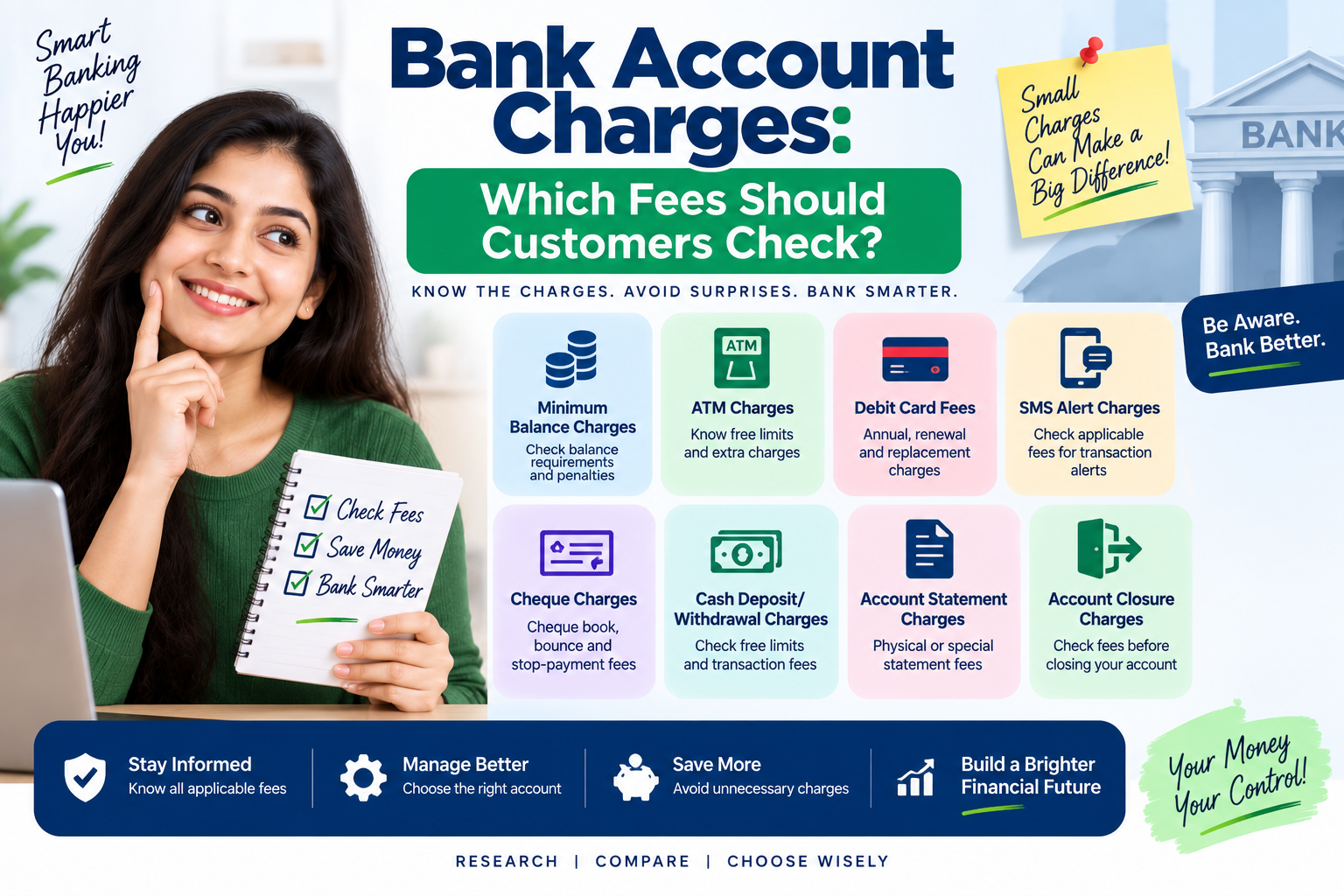
Bank account charges are fees that a bank may collect for specific services or for certain account-related activities. Depending on the bank and type of account, these can include minimum-balance charges, ATM charges, debit-card fees, SMS alert charges, cheque-related fees, cash deposit charges, account statement fees and account closure charges.
The important point is that there is no single universal fee structure for every bank account. Charges can vary by bank, account type, customer segment and service. Customers should therefore check the bank's current schedule of charges before opening an account or using a paid service.
RBI requires banks to disclose applicable service charges transparently. For example, banks must communicate minimum-balance requirements and applicable charges, while charges for non-maintenance of minimum balance in savings accounts must follow RBI's proportionality and notification requirements.
Introduction
Opening a bank account is usually easy.
But maintaining one can involve several small charges that customers may not notice immediately.
A debit card fee here, an ATM charge there, an SMS alert fee, a cheque-related charge or a minimum-balance penalty can gradually increase the cost of maintaining an account.
This does not necessarily mean that banks are charging customers incorrectly. Many banking services have published fee structures, and customers agree to applicable terms when opening an account.
The real issue is understanding which charges apply to your account and when they can be triggered.
For customers in India, checking the bank's Schedule of Charges, account terms and applicable RBI rules can help avoid unexpected deductions.
What Are Bank Account Charges?
Bank account charges are fees collected by a bank for particular services, transactions or account conditions.
Some common examples include:
- Minimum balance charges
- ATM withdrawal charges
- Debit card annual or replacement fees
- SMS alert charges
- Cheque book charges
- Cheque return charges
- Cash deposit or withdrawal charges
- Demand draft charges
- Account statement or certificate charges
- Account closure charges
- Outstation cheque collection charges
- Certain branch service charges
- Foreign transaction or currency conversion charges
Not every customer pays all of these.
For example, a basic savings account may have fewer charges than a premium account, while a current account can have a completely different fee structure.
Bank Account Charges Customers Should Check
Here are the major fees customers should understand before opening or regularly using a bank account.
| Charge | What to Check | Why It Matters |
|---|---|---|
| Minimum balance | Required balance and penalty | Can create recurring charges |
| ATM | Free transactions and excess-use fee | Frequent withdrawals can become costly |
| Debit card | Annual, replacement and other fees | May be charged even without frequent use |
| SMS alerts | Pricing and usage basis | Small recurring deductions can add up |
| Cheque | Book, return and stop-payment fees | Important for cheque users |
| Cash transactions | Free limits and excess charges | Branch deposits/withdrawals may have conditions |
| Account statement | Physical or special statement charges | Digital statements may be cheaper/free |
| Account closure | Applicable closure fee | Important before switching banks |
| Demand draft | Issue/cancellation charges | Relevant for offline payments |
| Foreign transactions | FX markup and related fees | Important for international spending |
1. Minimum Balance Charges
One of the most important charges to check is the minimum balance requirement.
Some savings accounts require customers to maintain a specified balance or average balance.
If the balance falls below the applicable requirement, the bank may levy a charge according to its disclosed policy and applicable RBI rules.
RBI requires banks to inform customers transparently about the minimum balance requirement and the charges associated with non-maintenance. If the requirement or charges are subsequently changed, existing customers must receive advance notice.
RBI's framework also states that the charge should be proportionate to the extent of the shortfall, customers should be notified, and the savings account should not become negative solely because of such charges.
What customers should check
Before opening an account, ask:
- Is there a minimum balance?
- Is it monthly average balance or another requirement?
- What happens if the balance falls below it?
- How much is the charge?
- Is there a zero-balance option?
- Is the account eligible for any waiver?
Important point
A Basic Savings Bank Deposit Account (BSBDA) is different. RBI's framework provides that a BSBDA should not require a minimum balance and provides specified basic services without charges, subject to the account's conditions.
2. ATM Withdrawal Charges
ATM charges are another fee customers should understand.
RBI requires savings bank account holders to receive a minimum number of free ATM transactions.
According to RBI's current FAQ, banks must provide:
- At least 5 free transactions per month at the customer's own bank ATMs
- At least 3 free transactions per month at other-bank ATMs in six metro locations
- At least 5 free transactions per month at other-bank ATMs at non-metro locations
Banks may provide more free transactions than these minimums.
After the applicable free limit is exhausted, banks may charge for additional transactions, subject to the applicable RBI framework. RBI's current FAQ states that such charges are presently capped at ₹23 per transaction plus applicable taxes.
Example
Suppose you frequently withdraw cash from different bank ATMs.
If your free monthly transaction limit has already been used, an additional charge may apply.
Therefore, customers who frequently use ATMs should check:
Free transactions → Excess transaction fee → Applicable taxes
Failed ATM transactions
A failed transaction caused by technical problems, non-availability of cash or other reasons attributable to the bank/service provider should not be counted as a valid ATM transaction for charging purposes.
3. Debit Card Annual Charges
Many bank accounts come with debit cards.
Depending on the account and card variant, the bank may charge:
- Annual maintenance fee
- Card issuance fee
- Replacement fee
- Lost-card replacement fee
- International card-related fees
- Certain transaction-related fees
The exact amount depends on the bank and card type.
Before accepting a debit card, check:
- Is the card free?
- Is there an annual fee?
- Is the first year free?
- What is the renewal charge?
- What is the replacement fee?
- Are premium card variants automatically chargeable?
A customer may sometimes choose a lower-cost card or account option if the premium features are not required.
4. SMS Alert Charges
Banks commonly send transaction alerts through SMS or other channels.
Depending on the bank and account type, an SMS alert fee may apply.
RBI has emphasized that SMS alert charges should be reasonable and, in relevant frameworks, based on actual usage.
Because individual charges can be small, customers may overlook them.
For example:
₹15–₹30 occasionally may not seem significant, but recurring service charges can become noticeable over a year.
Customers should therefore check whether SMS alerts, email alerts or digital notifications are included in their account package.
5. Cheque Book Charges
Cheque books can also involve charges depending on the account and number of leaves provided.
Banks may have different pricing for:
- First cheque book
- Additional cheque leaves
- Premium cheque books
- Emergency cheque book requests
- Special cheque services
Before ordering an additional cheque book, check the applicable fee.
RBI's banking-service disclosure framework specifically identifies cheque-book charges among the service charges banks should disclose.
6. Cheque Bounce or Return Charges
A cheque can be returned for several reasons, such as:
- Insufficient funds
- Signature mismatch
- Incorrect account details
- Stop-payment instructions
- Technical or procedural issues
Banks may impose cheque-return charges according to their disclosed schedule.
These charges can sometimes be substantially higher than routine account service fees.
Customer tip
Before issuing a cheque, ensure:
- Sufficient balance is available
- Signature matches bank records
- Date is correct
- Payee details are correct
- Cheque is not damaged
7. Cash Deposit and Withdrawal Charges
Some accounts have conditions on cash transactions at branches.
Charges can depend on:
- Number of transactions
- Cash amount
- Account type
- Home/non-home branch
- Current or savings account
- Free transaction limits
Customers who regularly handle cash should pay particular attention to this section of the bank's Schedule of Charges.
For businesses and current-account customers, cash transaction charges can be more significant than for ordinary savings-account users.
8. NEFT and RTGS Charges
Digital fund-transfer charges have changed considerably over time.
RBI has directed banks not to levy charges on online NEFT transfers initiated by savings bank account holders from January 1, 2020.
For RTGS, RBI has prescribed a framework for customer charges, while individual banks can choose to charge less than the permitted ceiling.
This means customers should distinguish between:
Online digital transfer → Branch/offline service → Account type → Applicable bank fee
Do not assume that every form of NEFT or RTGS has exactly the same fee.
9. Account Statement Charges
Digital statements are often convenient, but customers may request physical or special statements.
Potential charges can apply for:
- Duplicate statements
- Historical statements
- Physical statements
- Balance certificates
- Interest certificates
- Special account-related documents
RBI's service-charge disclosure framework specifically includes account statements among the charges/services that banks should disclose.
Simple money-saving tip
If your bank provides free e-statements, use them for routine record keeping.
10. Demand Draft Charges
Demand drafts may still be used for:
- Education payments
- Government-related payments
- Institutional payments
- Property transactions
- Other situations where a DD is requested
Banks can charge for issuing or cancelling a demand draft according to their published schedule.
Before requesting a DD, check:
- Issue fee
- Cancellation fee
- Revalidation fee
- GST, where applicable
11. Account Closure Charges
Customers sometimes assume that closing a bank account is always free.
That is not necessarily true for every account type or situation.
Some banks may have account-closure charges depending on factors such as:
- How long the account has been open
- Account type
- Product terms
- Special account conditions
Before closing an account, check the bank's current fee schedule.
Also remember to:
- Transfer remaining balance
- Cancel standing instructions
- Download statements
- Clear pending charges
- Close linked services where necessary
- Destroy or return cards/cheques as instructed
12. Foreign Transaction and Currency Charges
Customers using debit cards internationally should pay attention to additional charges.
These may include:
- Foreign currency conversion markup
- Cross-border transaction fee
- ATM withdrawal fee abroad
- Dynamic currency conversion costs
- Other network or service charges
A transaction that appears to cost ₹10,000 at the point of purchase may result in a different final debit because of currency conversion and applicable fees.
Before international travel, check the card's foreign transaction terms.
13. Inoperative or Dormant Account-Related Issues
An account that remains unused for a long period can become inoperative under applicable banking rules.
RBI's revised framework provides procedures for activation of inoperative accounts and unclaimed deposits. A 2025 amendment also expanded KYC-updation facilities for such accounts, including through branches and, where applicable, V-CIP and authorised Business Correspondents.
Importantly, RBI's framework states that banks are not permitted to levy penal charges for non-maintenance of minimum balance in an inoperative account.
Customers with old unused accounts should therefore check their status rather than simply ignoring them.
Which Bank Charges Can Become Expensive?
Not all charges have the same financial impact.
| Charge | Potential Impact |
|---|---|
| Minimum balance penalty | Recurring |
| Excess ATM usage | Recurring |
| Cheque return | Can be significant |
| Debit card renewal | Periodic |
| Cash transaction fees | Can increase with usage |
| International transactions | Can be significant |
| Special branch services | Depends on frequency |
| Account closure | Usually one-time |
The key is not simply to look for a "free account."
Instead, compare the overall cost based on how you actually use your bank account.
How to Avoid Unnecessary Bank Account Charges
1. Read the Schedule of Charges
Don't rely only on advertisements saying "zero balance" or "free account."
Check the complete fee schedule.
2. Maintain the Required Balance
If your account has a minimum-balance requirement, understand exactly how it is calculated.
3. Use Your Bank's ATM When Practical
Using your own bank's ATM can help you stay within the applicable free transaction limits.
4. Prefer Digital Statements
If physical statements carry fees, electronic statements can be a convenient alternative.
5. Monitor SMS and Account Alerts
Review your bank statement regularly to identify recurring fees.
6. Avoid Unnecessary Cheque Usage
Digital payments can reduce cheque-related costs where appropriate.
7. Check Before Using Branch Services
Ask whether a particular service carries a fee before requesting it.
8. Compare Account Types
A premium account is not automatically better for every customer.
If you do not use premium services, a simpler account may better match your requirements.
Bank Account Charges Checklist for Customers
Before opening a bank account, check these 12 items:
Minimum balance requirement
Minimum-balance penalty
ATM free transaction limit
Excess ATM charge
Debit card annual fee
Debit card replacement fee
SMS alert fee
Cheque book fee
Cheque return fee
Cash transaction charges
Account closure fee
International transaction charges
This simple checklist can help customers compare accounts more effectively.
Regular Savings Account vs Basic Savings Account
| Feature | Regular Savings Account | BSBDA |
|---|---|---|
| Minimum balance | Depends on bank/product | No minimum balance |
| Basic services | Depends on account | Specified basic services |
| Withdrawals | Product-specific | Subject to BSBDA conditions |
| Debit/ATM facility | Depends on product | Basic ATM/debit facility |
| Extra services | May have charges | Additional services may have charges |
| Ideal for | Customers needing broader features | Customers seeking basic banking access |
RBI's BSBDA framework specifies no minimum balance and a set of basic banking services without charges, while additional value-added services can have reasonable and transparent pricing.
What Should Customers Do If They See an Unexpected Charge?
If you notice an unfamiliar bank charge, don't ignore it.
Step 1: Check the transaction description
Look at the account statement or mobile-banking transaction details.
Step 2: Check the bank's fee schedule
Compare the charge with the applicable Schedule of Charges.
Step 3: Contact the bank
Ask the bank to explain:
- Why the charge was applied
- Which service triggered it
- Whether GST was included
- Whether the charge can be reversed
Step 4: Raise a formal complaint if necessary
Keep the complaint/reference number.
If the issue is not resolved through the bank's grievance mechanism, customers can consider the applicable RBI complaint/redress framework.
Frequently Asked Questions
1. What are the most common bank account charges?
Common charges include minimum-balance fees, ATM charges, debit-card fees, SMS alerts, cheque-related charges, cash transaction fees, account statement fees and account closure charges.
2. Is every savings account subject to minimum balance charges?
No. Requirements depend on the account type and bank. Basic Savings Bank Deposit Accounts do not require a minimum balance under RBI's framework.
3. How many free ATM transactions are allowed?
RBI requires minimum free ATM transactions for savings-account customers. The number depends on whether the transaction is at the customer's own bank ATM or another bank's ATM and whether the location is metro or non-metro.
4. What is the maximum ATM charge after free transactions?
RBI's current FAQ states that charges for transactions beyond the mandated free limit cannot exceed ₹23 per transaction, plus applicable taxes.
5. Can banks charge for online NEFT?
Savings-bank account customers should not be charged for NEFT transfers initiated online, under RBI's applicable framework.
6. What is a BSBDA account?
A Basic Savings Bank Deposit Account is designed to provide basic banking services without requiring a minimum balance, subject to its prescribed conditions.
7. Can banks charge SMS alert fees?
Banks may have SMS-related charges depending on their applicable service structure. RBI has required reasonable approaches to SMS alert charges, including actual-usage principles in relevant frameworks.
8. Can a bank charge for cheque books?
Depending on the account and number/type of cheque leaves, applicable charges may apply. Customers should check the bank's current schedule.
9. Can banks charge minimum-balance penalties on inoperative accounts?
RBI's framework states that penal charges for non-maintenance of minimum balance should not be levied on inoperative accounts.
10. Why was money deducted from my bank account?
Possible reasons include service fees, minimum-balance charges, ATM fees, debit-card fees, SMS charges, cheque-related fees, taxes or other account-specific charges. Check the transaction description and bank fee schedule.
11. How can I avoid bank charges?
Maintain required balances where applicable, use free digital services, monitor ATM usage, review your bank's fee schedule and choose an account matching your transaction habits.
12. Are bank charges the same across all banks?
No. Banks can have different fee structures, account categories and service packages, subject to applicable RBI regulations.
13. Can a bank change its service charges?
Banks may revise applicable charges subject to regulatory requirements and customer communication rules. For minimum-balance requirements and related charges, RBI requires advance communication to customers.
14. What should I do if I disagree with a bank charge?
First check the bank's fee schedule and contact customer service. If the issue remains unresolved, use the bank's formal grievance process and applicable RBI complaint mechanisms.
15. What is the best way to compare bank accounts?
Compare minimum balance, ATM limits, debit-card fees, SMS charges, cash transaction limits, cheque charges, digital-transfer costs and other services based on your actual usage.
Conclusion
Bank account charges may look small individually, but repeated fees can become a noticeable expense over time.
The easiest way to avoid surprises is to understand the complete cost structure of your account rather than focusing only on the headline features.
Before opening or maintaining an account, check the minimum balance, ATM limits, debit-card fees, SMS charges, cheque charges, cash transaction conditions, digital-transfer rules and account closure terms.
Most importantly, always refer to your bank's latest Schedule of Charges, because fees can differ between banks and account variants.
Good banking is not only about keeping money safe—it is also about understanding what you are paying for.
Published on : 23rd September
Published by : MONISHA
www.vizzve.com || www.vizzveservices.com
Follow us on social media: Facebook || Linkedin || Instagram
🛡 Powered by Vizzve Financial
RBI-Registered Loan Partner | 10 Lakh+ Customers | ₹600 Cr+ Disbursed