

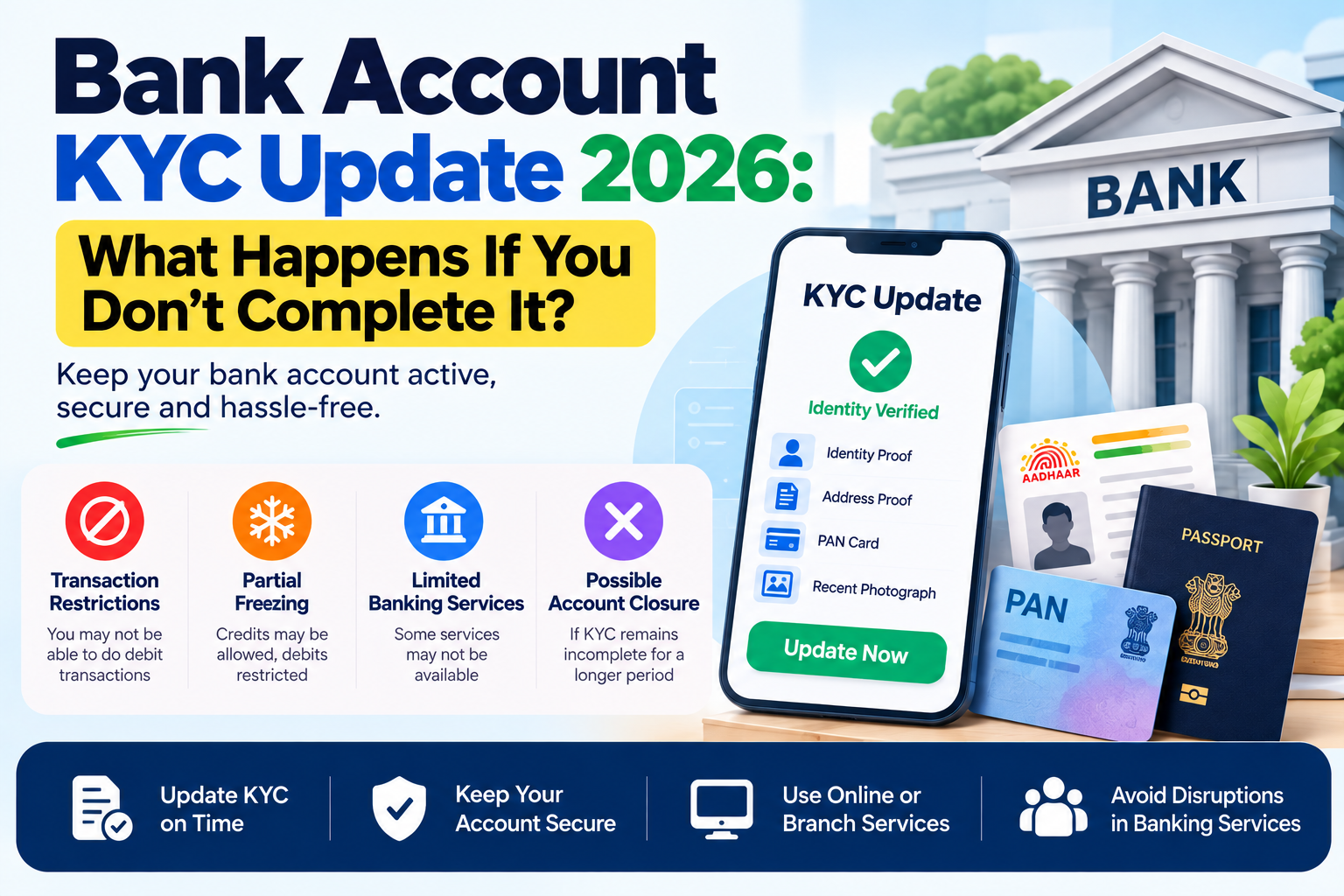
If you do not complete your bank's required KYC updation, the bank may eventually place restrictions on your account after following the applicable notice and regulatory process.
RBI's KYC framework requires periodic updation based on customer risk category: generally every 2 years for high-risk customers, 8 years for medium-risk customers and 10 years for low-risk customers.
For low-risk individual customers, RBI introduced a temporary relaxation in 2025 allowing transactions to continue while KYC was updated within one year of falling due or up to June 30, 2026, whichever was later. As of September 2026, that June 30, 2026 date has passed, so customers whose applicable extended period has expired should complete KYC as soon as possible.
Depending on the circumstances and applicable bank process, continued non-compliance can lead to partial freezing, restrictions on debits, and eventually account closure after required notices.
What Is Bank KYC?
KYC stands for Know Your Customer.
It is the process banks and other regulated financial institutions use to verify a customer's identity and maintain updated customer information.
KYC information can include details such as:
- Name
- Address
- Identity information
- PAN/Form 60, where applicable
- Photograph
- Other information required under the applicable KYC framework
The purpose is to help regulated entities identify customers and manage risks related to fraud, money laundering and other financial crimes.
KYC is not only required when you first open a bank account. Banks also need to periodically update customer information.
What Is Re-KYC or KYC Updation?
Re-KYC means updating or confirming your existing KYC information with the bank.
It does not necessarily mean starting the entire account-opening process again.
For example, if your:
- Name has changed
- Address has changed
- Identity document has changed
- PAN or other information needs updating
the bank may ask you to submit updated information.
If there has been no change in your KYC information, RBI allows eligible customers to provide a self-declaration through specified channels. RBI's consumer guidance says this can be done through letter, online banking, mobile banking, ATM, registered mobile number/email or an authorised Business Correspondent, depending on the bank's available facilities.
KYC Update Rules in 2026
RBI follows a risk-based approach for periodic KYC updation.
| Customer Risk Category | General KYC Updation Frequency |
|---|---|
| High Risk | At least once every 2 years |
| Medium Risk | At least once every 8 years |
| Low Risk | At least once every 10 years |
These are the general periodic-updation intervals under the RBI framework, calculated from account opening or the last KYC updation, subject to applicable rules and amendments.
This means there is no single KYC deadline that applies to every bank customer in India.
Your bank may notify you when your KYC is due.
What Was the June 30, 2026 KYC Relaxation?
This is an important point for customers searching for "KYC deadline 2026."
In 2025, RBI amended its KYC Directions to provide additional time for individual customers classified as low risk.
Under the amendment, regulated entities were required to allow transactions and ensure KYC updation within one year from the date KYC fell due or up to June 30, 2026, whichever was later. The provision also applied to low-risk individual customers whose periodic KYC was already overdue.
Since the current date is September 2026, June 30, 2026 has already passed.
However, the exact deadline for an individual customer can still depend on when their KYC actually became due.
Therefore, customers should not assume that every bank account had the same June 30 deadline.
What Happens If You Don't Complete KYC?
The consequences can happen progressively rather than instantly.
1. You May Receive Reminders
Banks can contact customers through channels such as:
- SMS
- Mobile banking
- Internet banking
- Letters
- Other registered communication channels
If your bank tells you that your KYC is overdue, it is better to complete it rather than ignore repeated notifications.
2. Account Operations May Eventually Be Restricted
For KYC-non-compliant accounts, RBI's framework allows banks to use a phased process.
The rules provide for notice and a reminder before partial freezing in applicable cases. Under the framework, a bank may initially allow credits while restricting debits.
This is important because "KYC not updated = account immediately frozen" is too broad a statement.
The actual process depends on the circumstances, the customer's risk category and the bank's applicable procedures.
What Is Partial Freezing?
Partial freezing means that some account operations may be restricted.
For example, under the RBI framework, the bank may:
Allow:
✔ Credits
Restrict:
✘ Debits
The customer can generally restore the account's operation by completing the required KYC process.
If the account remains non-compliant for a further period, the framework provides for stronger restrictions and the possibility of closure, subject to the applicable process and notice requirements.
Can Your Bank Account Be Closed for KYC Non-Compliance?
Potentially, yes.
If a customer remains Bank Account KYC Update 2026: What Happens If You Don’t Complete It?relationship after following the prescribed process.
This does not mean every overdue KYC account will automatically be closed.
The practical lesson is:
If your bank has asked you to update KYC, don't wait until account restrictions become a problem.
Can You Still Receive Money If KYC Is Pending?
This depends on the stage of restriction applied to the account.
Under the RBI partial-freezing framework, a bank can initially allow credits while restricting debits. Later, stronger restrictions may apply if KYC remains incomplete.
Therefore, customers should not assume that:
"My salary will definitely continue to come into my account."
or
"No money can enter my account."
The actual operation depends on the restriction imposed by the bank.
How to Complete Bank KYC Update Online
Many banks provide digital Re-KYC options.
The exact process varies by bank, but it can generally involve:
Step 1: Open your bank's official app or website
Use the bank's official mobile application or website.
Step 2: Look for "Re-KYC" or "Update KYC"
The option may appear under:
- Profile
- Service Requests
- Account Services
- KYC
- Personal Details
Step 3: Confirm your information
Check your:
- Name
- Address
- Mobile number
- PAN details
- Other requested information
Step 4: Submit self-declaration or documents
If there is no change, eligible customers may be able to submit a self-declaration.
If details have changed, the bank may request updated documentation.
Step 5: Complete verification
Follow the bank's authentication process and save the confirmation/reference number.
Can KYC Be Updated Without Visiting the Bank?
Yes, in many cases.
RBI's consumer guidance states that customers whose KYC details have not changed may submit a self-declaration through channels such as online banking, mobile banking, ATM, registered mobile/email, letter or an authorised Business Correspondent, depending on availability.
If your details have changed, the bank may require an updated document.
Customers can also visit the nearest branch for Re-KYC.
Which Documents Are Required for KYC Update?
The exact documents depend on your situation and the bank's KYC process.
RBI's framework recognises documents such as:
- Passport
- PAN card
- Voter ID
- Driving licence
- NREGA job card
- Aadhaar-related proof/documentation as permitted under the applicable KYC framework
If your address has changed, the bank may ask for appropriate updated address information.
Always check the bank's official KYC instructions before uploading or submitting documents.
What If Your Address Has Changed?
Address changes are one of the most common reasons customers need KYC updation.
For eligible low-risk customers, RBI allows simplified procedures in certain situations.
If there is no change in identity/address information, a self-certification can be sufficient for periodic updation. If the address has changed, the bank may accept the appropriate updated address documentation according to its process.
Don't leave an old address on your bank account if you have permanently moved.
What If Your Name Has Changed?
If your name changes because of marriage or another legally recognised reason, the bank may require supporting documentation.
Depending on the circumstances, this may include a relevant officially valid document together with documentation supporting the name change.
RBI's KYC framework specifically addresses situations where a customer's name changes and provides for supporting documentation.
Does KYC Update Affect Your Credit Score?
Updating KYC does not itself improve or reduce your credit score.
KYC and credit history are different things.
However, keeping your bank account operational is important for normal financial activity.
For example, if an account becomes restricted and you rely on it for:
- EMI payments
- Salary credits
- SIPs
- Utility bills
- Loan repayments
- Business transactions
the resulting disruption could create practical financial problems.
So while KYC is not a credit-score factor by itself, maintaining an operational bank account is financially important.
KYC Update vs KYC Rejection
These are different situations.
KYC Update
You are updating existing information.
KYC Rejection or Verification Issue
The bank may have difficulty verifying the information or documents submitted.
If your KYC request is rejected:
- Check the reason.
- Verify that your documents are valid.
- Ensure your name and other details are consistent.
- Resubmit through the official bank channel.
- Contact the bank if the problem continues.
Beware of Fake KYC Update Messages
KYC scams are common because customers expect genuine KYC reminders.
A fraudster may send a message saying:
"Your account will be blocked today. Click this link to update KYC."
The link may lead to a fake banking website.
Never share:
- OTP
- UPI PIN
- ATM PIN
- Internet banking password
- Card CVV
- Full card credentials
RBI advises customers to use official bank channels for Re-KYC. Its consumer guidance specifically lists online banking, mobile banking, ATM, registered contact channels, authorised Business Correspondents and bank branches as possible routes.
How to Check Whether Your KYC Is Updated
You can usually check through:
- Mobile banking app
- Internet banking
- Bank branch
- Customer care
- Account profile section
- KYC/Re-KYC status section
Some banks may display a message such as:
"KYC compliant"
or
"KYC due / Re-KYC required."
If you receive a KYC reminder but cannot find any update option, contact the bank through its official customer-care channel.
What Customers Should Do in 2026
Use this simple checklist:
| Action | Status |
|---|---|
| Check whether KYC is due | ☐ |
| Check your registered mobile number | ☐ |
| Verify your current address | ☐ |
| Check PAN/KYC details | ☐ |
| Complete Re-KYC through official channel | ☐ |
| Save confirmation/reference number | ☐ |
| Avoid suspicious KYC links | ☐ |
| Contact bank if KYC is rejected | ☐ |
Frequently Asked Questions
1. What is KYC update in a bank account?
KYC update or Re-KYC is the process of confirming or updating customer identification information maintained by the bank.
2. What happens if I don't update my bank KYC?
The bank may send reminders and, if KYC remains incomplete, may impose restrictions on account operations according to the applicable RBI framework and its procedures. In some cases, continued non-compliance can eventually result in account closure.
3. Is there one KYC deadline for all bank customers in 2026?
No. Periodic KYC requirements depend on the customer's risk category and the date of account opening or last KYC updation.
4. What was the June 30, 2026 KYC deadline?
For low-risk individual customers, a 2025 RBI amendment provided that transactions should be allowed while KYC was updated within one year of becoming due or up to June 30, 2026, whichever was later.
5. Can I update KYC online?
Yes, many banks provide online or mobile-banking Re-KYC facilities. RBI also recognises several non-branch channels for eligible self-declaration-based Re-KYC.
6. Do I need to visit my bank branch for Re-KYC?
Not necessarily. Depending on your bank and circumstances, Re-KYC may be completed through digital banking, an ATM, an authorised Business Correspondent or other permitted channels.
7. What documents are required for KYC?
Documents can vary by situation. Common officially valid documents include passport, PAN, voter ID, driving licence and other documents recognised under RBI's KYC framework.
8. Can my account be frozen if KYC is not updated?
Restrictions can be imposed for KYC non-compliance after the applicable process. RBI's framework provides for phased restrictions, including partial freezing, rather than requiring every account to be immediately frozen.
9. Can I receive money in a partially frozen account?
Under the partial-freezing framework, banks may initially allow credits while restricting debits. The exact treatment depends on the stage of restriction applied to the account.
10. Does KYC update improve my CIBIL score?
No. KYC updation and credit scoring are separate processes.
11. Can I update KYC if my address has changed?
Yes. You should provide the updated information or documentation required by your bank. RBI provides simplified procedures for certain low-risk customers.
12. Is KYC update free?
RBI does not impose a general customer fee simply for completing periodic KYC. However, customers should follow their bank's official instructions and be cautious of anyone asking for payment through an unofficial link.
13. How do I know whether my KYC is due?
Check your bank's mobile app, internet banking, customer service or branch. Banks may also send notifications when periodic KYC is due.
14. Can I submit a self-declaration if nothing has changed?
Eligible customers may be able to submit a self-declaration confirming that there has been no change in KYC information. RBI lists online banking, mobile banking, ATM, registered contact channels and authorised BCs among possible channels.
15. What should I do if I receive a suspicious KYC SMS?
Do not click the link or share banking credentials. Open your bank's official app or website directly and check your KYC status, or contact the bank through an official number.
Conclusion
Bank KYC updation is more than a routine paperwork exercise. It helps banks keep customer information accurate and supports the wider financial system's efforts to manage identity and financial-crime risks.
For customers, the biggest mistake is ignoring a genuine KYC reminder.
If your KYC is due, first check the status through your bank's official app, website, customer-care channel or branch. If your information has not changed, you may have a simple self-declaration-based Re-KYC option. If something has changed, submit the appropriate updated information or documents.
And remember: a KYC reminder should never be an excuse to share your OTP, UPI PIN or banking password.
Complete Re-KYC only through an official bank channel.
Published on : 24th September
Published by : SMITA
www.vizzve.com || www.vizzveservices.com
Follow us on social media: Facebook || Linkedin || Instagram
🛡 Powered by Vizzve Financial
RBI-Registered Loan Partner | 10 Lakh+ Customers | ₹600 Cr+ Disbursed