

Introduction
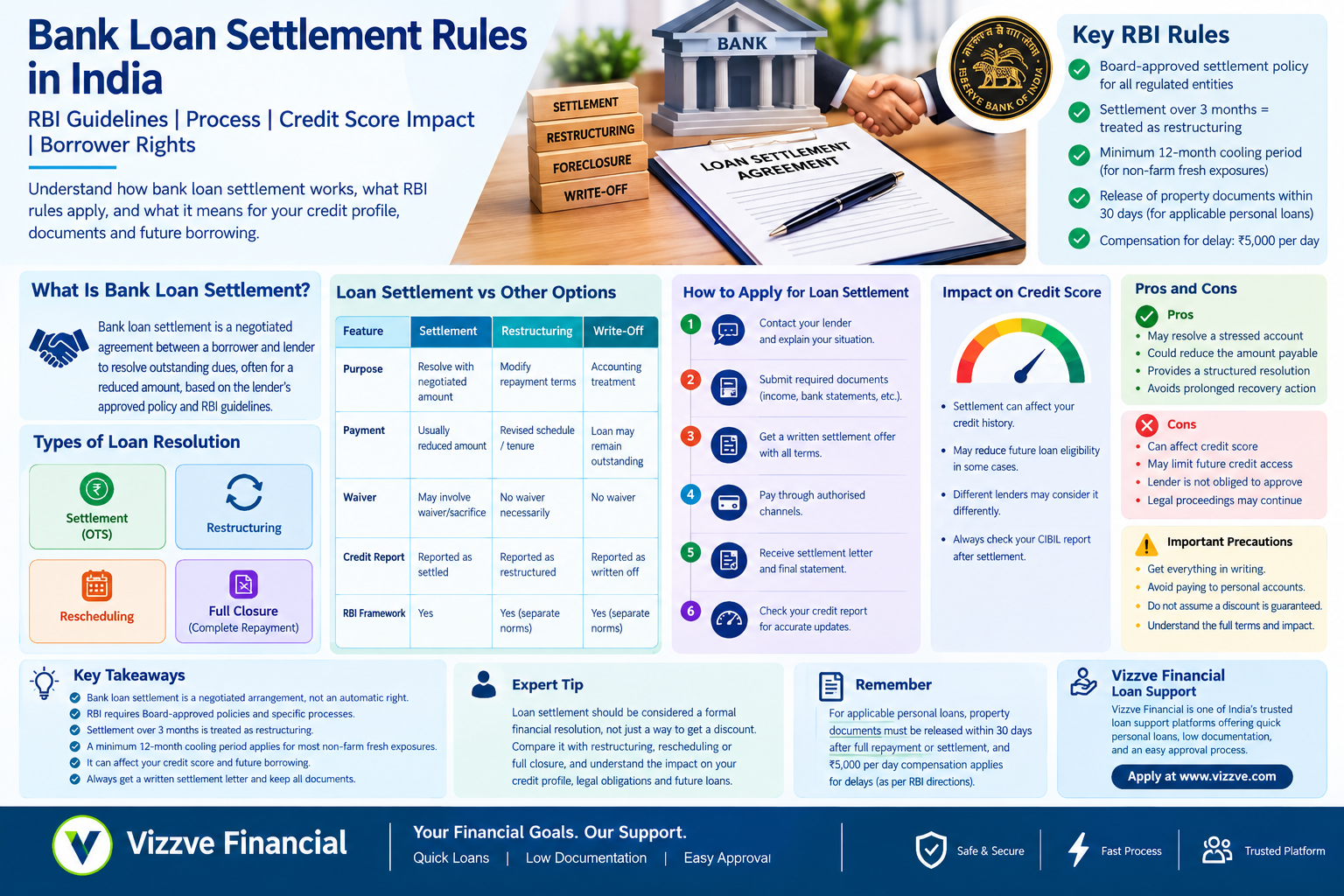
Bank loan settlement is a negotiated arrangement between a borrower and lender to settle the lender's claim, usually for an agreed amount that may be lower than the outstanding dues.
The Reserve Bank of India (RBI) has a regulatory framework for compromise settlements. Under RBI's June 8, 2023 framework, a compromise settlement is a negotiated arrangement under which the borrower settles the lender's claims in cash, and the lender may waive part of the amount due. Regulated entities must have Board-approved policies governing such settlements.
However, loan settlement is not the same as normal loan closure.
A borrower who pays the full amount due according to the loan agreement generally closes the loan. A negotiated settlement can involve a lender accepting a different amount under an approved settlement arrangement.
This distinction is particularly important because settlement can affect the borrower's future access to credit and how the account is reported to credit information companies.
AI Answer Box: What Are Bank Loan Settlement Rules?
Bank loan settlement rules allow regulated lenders to enter into compromise settlements with borrowers under their Board-approved policies and applicable RBI regulations.
Important points include:
- Settlement is generally a negotiated arrangement.
- A bank is not required to accept every settlement request.
- The lender's Board-approved policy determines how settlements are considered.
- A settlement can involve a waiver or sacrifice of part of the lender's claim.
- If the agreed settlement amount is payable over more than three months, RBI's framework treats the compromise settlement as restructuring for prudential purposes.
- A minimum 12-month cooling period applies to fresh exposures to borrowers who have undergone compromise settlement, except that farm-credit cooling periods are determined under the lender's Board-approved policy.
- Settlement can have consequences for the borrower's credit history.
- Property documents relating to personal loans must be released within the RBI-prescribed timeline after full repayment or settlement, subject to the applicable directions.
Quick Summary
| Topic | Key Point |
|---|---|
| Loan settlement | Negotiated agreement between borrower and lender |
| RBI framework | Compromise settlements governed by Board-approved policies |
| Is settlement automatic? | No |
| Can part of dues be waived? | A compromise settlement may involve waiver/sacrifice |
| Settlement over more than 3 months | Treated as restructuring under RBI's framework |
| Cooling period | Minimum 12 months for non-farm fresh exposures |
| Property documents | Release within 30 days after full repayment/settlement of personal loan account |
| Credit history | Settlement can affect how the account is reported |
| Loan closure | Different from settlement |
What Is Bank Loan Settlement?
Loan settlement is a process where a borrower and lender agree on an amount to resolve outstanding loan dues.
For example, suppose a borrower has an outstanding claim of ₹5 lakh and is unable to repay the full amount. The lender may, under its approved policy, agree to accept a negotiated amount to settle the claim.
This is commonly referred to as:
- Loan settlement
- Compromise settlement
- One-Time Settlement (OTS)
- Negotiated settlement
The exact terminology and process can vary by lender and type of account.
Important
A settlement should not be confused with a loan waiver.
A settlement is a negotiated resolution of dues. A waiver may refer to cancellation of a particular amount under specific circumstances. The terms should always be documented by the lender.
What Is RBI's Compromise Settlement Framework?
On June 8, 2023, RBI issued the Framework for Compromise Settlements and Technical Write-offs.
The framework applies to the regulated entities specified by RBI, including commercial banks, certain cooperative banks, All-India Financial Institutions and NBFCs, including housing finance companies.
The framework defines compromise settlement as a negotiated arrangement with the borrower to fully settle the claims of the regulated entity in cash. It may involve the lender sacrificing or waiving part of the amount due.
The framework also distinguishes compromise settlements from technical write-offs.
Loan Settlement vs Technical Write-Off
These two terms are often confused.
| Compromise Settlement | Technical Write-Off |
|---|---|
| Negotiated arrangement with borrower | Accounting treatment by lender |
| Borrower settles agreed amount | Loan may remain outstanding at borrower-account level |
| May involve waiver of part of dues | Does not mean lender has waived recovery rights |
| Requires an approved settlement process | Used for accounting/provisioning purposes |
| Borrower should obtain settlement documentation | Recovery rights can continue |
RBI specifically states that a technical write-off does not involve waiver of the lender's claims against the borrower.
Simple Explanation
Settlement: “The lender agrees to accept an agreed amount to settle the claim.”
Technical write-off: “The lender changes the accounting treatment, but the borrower's liability is not automatically extinguished.”
Is One-Time Settlement the Same as Loan Settlement?
An One-Time Settlement (OTS) is commonly used to describe a negotiated arrangement where the borrower pays an agreed settlement amount, often within the terms specified by the lender.
The exact OTS policy is determined by the lender's approved policy and the applicable regulatory framework.
There is no universal RBI formula saying that every borrower is entitled to a fixed percentage discount.
This is one of the most important points borrowers should understand.
For example
A borrower should not assume:
“RBI rules say banks must settle my loan for 50%.”
That is not how the framework works.
RBI requires regulated entities to have appropriate policies and processes for compromise settlements; the actual settlement amount depends on the lender's policy and the circumstances of the account.
Who Can Request a Loan Settlement?
A borrower facing genuine repayment difficulties may approach the lender and request consideration of a settlement.
Possible circumstances may include:
- Long-term income disruption
- Business losses
- Serious financial difficulties
- Unexpected financial obligations
- Extended repayment problems
- Loan account becoming stressed or overdue
However, requesting settlement does not mean the lender must approve it.
The lender may examine:
- Outstanding amount
- Repayment history
- Financial position
- Security or collateral
- Recovery prospects
- Account classification
- Internal settlement policy
- Legal proceedings, if any
RBI Rules for Bank Loan Settlement
1. Banks and Other Regulated Entities Need a Board-Approved Policy
RBI requires regulated entities to establish Board-approved policies for compromise settlements and technical write-offs.
The policy should cover the process and relevant conditions for settlement.
2. The Settlement Amount Is Not Automatically Fixed
The settlement policy must consider factors such as the realisable value of security or collateral, where available.
RBI's framework requires the policy to contain provisions relating to permissible sacrifice for different exposure categories and the methodology for determining realisable security value.
Therefore, the settlement amount can vary from case to case.
3. Settlement Approval Must Follow the Lender's Internal Authority Structure
RBI requires the authority approving a compromise settlement to be at least one level higher than the authority that sanctioned the original credit exposure.
An official who participated in sanctioning the loan cannot approve the compromise settlement of that same loan account.
4. Settlement Over More Than Three Months Has Special Treatment
If the agreed settlement amount is payable over a period exceeding three months, RBI's framework says the compromise settlement is treated as restructuring under the applicable prudential framework.
This makes the payment structure an important part of the settlement agreement.
5. Cooling Period After Compromise Settlement
RBI's framework requires a cooling period before regulated entities can assume fresh exposures to borrowers who have undergone compromise settlement.
For non-farm-credit exposures, the cooling period has a minimum floor of 12 months, while lenders may prescribe a longer period through their Board-approved policies. Farm-credit cooling periods are determined according to the lender's policy.
This is separate from any practical difficulty a borrower may face in obtaining credit from other lenders because of the borrower's credit history.
Does Loan Settlement Affect CIBIL Score?
Loan settlement can affect your credit profile and future borrowing prospects.
A settled account may be reported differently from an account that was fully repaid according to its original terms.
This is important because lenders use credit information as one input when assessing new applications.
India's credit-reporting system includes TransUnion CIBIL, Experian, Equifax and CRIF High Mark. RBI has noted that credit institutions are governed by the credit-information framework and use credit reports as inputs in credit appraisal.
Settlement vs Full Closure
| Situation | General Credit Meaning |
|---|---|
| Paid as agreed | Account closed after contractual repayment |
| Prepaid/foreclosed | Loan closed before scheduled maturity under applicable terms |
| Compromise settlement | Account resolved under negotiated settlement terms |
| Technical write-off | Accounting treatment; recovery rights can remain |
A borrower should obtain and preserve the lender's written settlement and closure documentation.
Does Loan Settlement Affect Future Loans?
It can.
A lender reviewing a new application may see historical credit information and consider the borrower's previous repayment and settlement history.
Possible consequences include:
- More detailed scrutiny
- Additional documentation
- Different eligibility assessment
- Difficulty obtaining some forms of credit
- Potentially different pricing or terms
There is no universal rule that says a person with a settled account can never receive another loan.
However, a settlement history can be relevant to future credit decisions.
Bank Loan Settlement vs Loan Closure
This is one of the most important differences.
| Loan Closure | Loan Settlement |
|---|---|
| Borrower pays the required dues | Borrower and lender negotiate settlement |
| Usually follows original repayment terms or agreed full prepayment | May involve a lender accepting less than the original claim |
| Account is closed after required payment | Account is resolved according to settlement terms |
| Generally viewed differently in credit reporting | Settlement status can be relevant to future lending |
| No negotiated sacrifice necessarily involved | May involve lender's sacrifice/waiver |
Key Point
If you can comfortably repay the full outstanding amount, borrowers should understand the difference between full closure and compromise settlement before signing settlement documents.
How to Apply for a Bank Loan Settlement
There is no single application form or universal settlement procedure for every bank.
However, the following process is commonly useful.
Step 1: Contact the Lender
Approach the bank, NBFC or other regulated lender that currently holds the loan.
Step 2: Explain Your Financial Situation
Clearly explain why you cannot meet the original repayment schedule.
Step 3: Submit Supporting Documents
Depending on the circumstances, the lender may request documents such as:
- Income proof
- Bank statements
- Employment-related documents
- Business records
- Medical or emergency expense documents where relevant
- Existing debt details
- Asset information
Only provide documents genuinely requested by the lender.
Step 4: Ask for the Written Settlement Offer
Do not rely only on verbal promises.
Ask for a written document showing:
- Total outstanding claim
- Settlement amount
- Payment deadline
- Instalment conditions, if any
- Interest or charges, if applicable
- Account-status treatment
- Consequences of non-payment
- Closure/settlement confirmation process
Step 5: Make Payment Through Official Channels
Avoid paying recovery agents through personal accounts or unofficial payment links.
Use the lender's authorised payment channels.
Step 6: Obtain Settlement Documentation
After completing the agreed payment, request written confirmation from the lender.
Documents to Keep After Loan Settlement
Maintain a complete record of the settlement.
Important Documents
- Settlement letter
- Payment receipts
- Bank transaction records
- No-dues or closure document, where issued
- Loan statement
- Account-status confirmation
- Property-document release confirmation, where applicable
- Correspondence with the lender
These documents can become important if there is a future dispute about the account.
Property Documents After Loan Settlement
RBI introduced specific responsible-lending directions concerning the release of original movable and immovable property documents after repayment or settlement of personal loans.
For applicable cases, regulated entities must release the original documents and remove charges registered with the relevant registry within 30 days after full repayment or settlement of the loan account.
If the delay is attributable to the lender, RBI's directions provide for compensation of ₹5,000 per day of delay.
If Documents Are Lost or Damaged
The lender must assist the borrower in obtaining duplicate or certified copies and bear associated costs. RBI's directions provide an additional period of 30 days for completing this procedure, with the delay compensation calculated after that additional period.
These directions apply to cases where release of the original documents falls due on or after December 1, 2023.
What If a Loan Settlement Case Is Already in Court?
RBI's compromise-settlement framework states that where recovery proceedings have already been started in a judicial forum and remain pending, a settlement with the borrower is subject to obtaining a consent decree from the concerned judicial authority.
This is particularly important for borrowers whose accounts have progressed into formal legal recovery.
Practical Advice
If your loan is already involved in:
- Civil proceedings
- Debt Recovery Tribunal proceedings
- Insolvency proceedings
- SARFAESI-related action
- Other legal recovery proceedings
obtain professional legal advice before signing settlement documents.
Can Banks Settle Fraud or Wilful-Default Accounts?
RBI's 2023 framework permits regulated entities to undertake compromise settlements or technical write-offs in accounts categorised as fraud or wilful default, without prejudice to criminal proceedings.
This means a financial settlement does not automatically eliminate separate legal or criminal proceedings.
Borrowers should therefore not assume that settlement documentation by itself resolves every legal issue connected with an account.
Bank Loan Settlement Rules for Personal Loans
Personal-loan settlement follows the lender's applicable settlement policy and RBI requirements.
Before agreeing to a settlement, borrowers should understand:
- Original outstanding amount
- Settlement amount
- Waiver amount, if any
- Payment deadline
- Credit-reporting consequences
- Legal status of the account
- Whether any security exists
- Whether a no-dues/closure document will be issued
For secured personal loans, property-document rules may also apply.
Home Loan Settlement Rules
Home loans are usually secured against property, so settlement requires additional attention.
Before signing an agreement, check:
- Outstanding principal
- Interest and other charges
- Settlement amount
- Status of the mortgage/security
- Release of property documents
- Removal of registered charges
- Whether legal proceedings exist
- Whether the settlement fully resolves the lender's claim
For applicable personal-loan cases, RBI requires release of original property documents within 30 days after full repayment or settlement.
Because property rights can involve substantial legal and financial consequences, professional legal advice can be appropriate in disputed or complex cases.
Credit Card Settlement Rules
Credit-card dues are also credit obligations, but the applicable regulatory provisions and issuer policies can differ from ordinary term loans.
RBI's credit-card directions state that before reporting a credit-cardholder as a defaulter to a Credit Information Company, the issuer must follow a Board-approved procedure that includes giving the cardholder a seven-day notice period. Where the customer settles the dues after being reported as a defaulter, the issuer must update the status with the CIC within 30 days from settlement.
This makes written confirmation particularly important after a credit-card settlement.
Loan Settlement vs Restructuring
These terms should not be confused.
| Settlement | Restructuring |
|---|---|
| Negotiated resolution of lender's claim | Modification of repayment/loan terms |
| May involve waiver/sacrifice | Usually changes repayment structure |
| Can involve reduced settlement amount | May change tenure, payment schedule or other terms |
| Governed by applicable settlement framework | Governed by applicable restructuring framework |
| Settlement can affect credit history | Restructuring can also affect credit profile |
Under RBI's compromise-settlement framework, a settlement where payment of the agreed settlement amount takes more than three months is treated as restructuring for prudential purposes.
Loan Settlement vs Loan Rescheduling
Rescheduling generally means changing the repayment schedule.
For example:
- Extending tenure
- Changing instalment timing
- Revising repayment structure
Settlement is different because it involves negotiating how the lender's claim will be resolved.
A borrower facing temporary financial stress should understand whether restructuring, rescheduling or another resolution option is more appropriate before seeking a compromise settlement.
Loan Settlement vs Loan Waiver
| Loan Settlement | Loan Waiver |
|---|---|
| Negotiated between borrower and lender | Amount is waived under applicable scheme/decision |
| Usually requires borrower payment | May involve cancellation of specified dues |
| Based on lender policy and circumstances | Depends on applicable government, institutional or contractual arrangement |
| Not automatically available | Not automatically available |
Borrowers should not assume that a bank is required to waive outstanding dues simply because repayment has become difficult.
Pros and Cons of Loan Settlement
Potential Advantages
- May resolve a distressed account.
- Can reduce the immediate amount that must be paid if the lender agrees to a concession.
- Can help conclude prolonged recovery discussions.
- May provide a negotiated alternative to continuing default.
- Can provide a documented resolution when the agreed amount is fully paid.
Potential Disadvantages
- Settlement can affect the borrower's credit history.
- Future lenders may consider the settlement history.
- It may reduce access to fresh credit.
- Legal proceedings may continue in certain circumstances.
- The lender is not required to approve every settlement request.
- A settlement can have tax, legal or financial implications depending on the circumstances.
Common Mistakes to Avoid During Loan Settlement
1. Trusting Verbal Promises
Always obtain settlement terms in writing.
2. Paying Into Personal Accounts
Use only authorised lender payment channels.
3. Ignoring the Credit Report
Check how the account is subsequently reported.
4. Assuming Settlement Means Automatic Loan Closure
Obtain written confirmation.
5. Ignoring Property Charges
For secured loans, confirm that applicable charges are removed and documents are released.
6. Assuming RBI Guarantees a Discount
RBI provides a regulatory framework; it does not guarantee a particular settlement percentage.
7. Signing Without Reading
Review every term before accepting the agreement.
What Should a Loan Settlement Letter Contain?
A proper settlement document should clearly identify the agreement.
Important Details
- Borrower's name
- Loan/account number
- Outstanding amount
- Agreed settlement amount
- Payment schedule
- Final payment date
- Waiver/concession, if applicable
- Consequences of non-payment
- Account closure/status process
- Credit-information reporting treatment
- Security/property details, where applicable
- Authorised lender representative
Best Practice
Keep the settlement letter permanently with your financial records.
What Happens After You Pay the Settlement Amount?
After completing the agreed payment:
- Obtain the payment receipt.
- Request written confirmation of settlement.
- Ask for a final account statement.
- Confirm the lender's account status.
- Check your credit report after the lender updates the information.
- Confirm release of security/property documents where applicable.
- Keep all documents safely.
Do not assume that the account has been correctly updated simply because the payment was made.
What If the Bank Does Not Update the Loan Account?
First, contact the lender's grievance-redressal department.
Provide:
- Loan account number
- Settlement letter
- Payment proof
- Date of settlement
- Previous correspondence
- Specific correction requested
RBI has also introduced a framework providing compensation of ₹100 per calendar day where a complaint relating to delayed updation/rectification of credit information is not resolved within 30 calendar days, subject to the applicable framework and conditions.
RBI Ombudsman for Bank Loan Complaints
If you have a service-related grievance against a regulated entity and it is not satisfactorily resolved through the entity's grievance process, RBI provides an Ombudsman mechanism.
As of July 1, 2026, the Reserve Bank – Integrated Ombudsman Scheme, 2026 is the applicable scheme, replacing the 2021 scheme for new matters. It provides a cost-free alternate grievance-redress mechanism for eligible complaints involving deficiency in service by covered regulated entities.
The usual first step is to complain to the concerned bank or regulated entity.
If there is no response or the response is unsatisfactory within the applicable period, the complaint can be taken to the RBI Ombudsman through the official Complaint Management System, subject to the scheme's maintainability requirements.
Step-by-Step Guide: What to Do Before Accepting a Settlement
Step 1: Calculate Your Actual Outstanding Dues
Obtain the latest statement from the lender.
Step 2: Understand Your Alternatives
Ask whether the lender can offer:
- Restructuring
- Rescheduling
- Temporary repayment relief
- Full closure
- Compromise settlement
Step 3: Ask for a Written Settlement Offer
Never depend only on a phone conversation.
Step 4: Check the Credit Impact
Understand how the account will be reported to credit information companies.
Step 5: Check Legal Status
Find out whether the account is already subject to legal recovery proceedings.
Step 6: Review Security Documents
For secured loans, understand how the settlement affects collateral.
Step 7: Make Payment Through an Official Channel
Keep proof of every payment.
Step 8: Obtain Final Documentation
Request settlement confirmation and relevant closure/no-dues documents.
Step 9: Check Your Credit Report
Verify that the lender has updated the account accurately.
Example of a Loan Settlement
Suppose:
Outstanding lender claim: ₹4,00,000
The borrower cannot pay the entire amount.
The lender reviews the case under its approved policy and agrees to accept:
Settlement amount: ₹2,75,000
The borrower pays ₹2,75,000 according to the written agreement.
The remaining amount may be waived as part of the compromise settlement, subject to the agreement.
The borrower should then obtain:
- Settlement confirmation
- Payment receipts
- Account-status confirmation
- Relevant security-release documents, if applicable
- Updated credit-report information
This example is illustrative only. There is no universal RBI rule requiring a bank to accept a particular percentage of the outstanding loan.
Expert Commentary
Loan settlement should generally be considered a formal financial resolution, not simply a way to obtain a discount on a loan.
The most important question is not:
“How much discount can I get?”
It is:
“What will the written settlement actually resolve, and how will it affect my credit, legal obligations and future borrowing?”
RBI's framework gives regulated entities a structured mechanism for compromise settlements, while leaving the detailed settlement policy and permissible sacrifice to the lender's Board-approved framework.
Borrowers should therefore compare settlement with other available resolution options before accepting an offer.
Real-World Borrower Checklist
Before signing a loan settlement, ask these questions:
- What is my exact outstanding amount?
- What amount is the lender accepting?
- Is the settlement amount payable in one payment or instalments?
- What happens if I miss the settlement deadline?
- Will the account be reported as settled?
- Will the lender issue a final settlement confirmation?
- Are any legal proceedings pending?
- Will the lender release collateral or property documents?
- Are all charges being removed?
- Is there any remaining liability after settlement?
- When will the credit information be updated?
If the answers are unclear, request written clarification before making payment.
AI Summary Box
Bank Loan Settlement Rules — Quick Answer
Bank loan settlement in India is a negotiated resolution between a borrower and lender. RBI's 2023 compromise-settlement framework requires regulated entities to have Board-approved policies for such settlements. A settlement can involve the lender accepting less than the original claim, but borrowers are not automatically entitled to a discount.
Key rules:
- Settlement must follow the lender's approved policy.
- Settlement terms should be documented.
- Settlement over more than three months is treated as restructuring for prudential purposes.
- A minimum 12-month cooling period applies to most non-farm fresh exposures after compromise settlement.
- Legal proceedings may require a consent decree.
- Property documents for applicable personal loans must generally be released within 30 days after full repayment or settlement.
- A settlement can affect credit history and future borrowing.
- Borrowers should obtain written settlement and payment records.
Key Takeaways
- Loan settlement is different from loan closure.
- RBI provides a framework for compromise settlements.
- Banks and other regulated entities must maintain Board-approved settlement policies.
- A borrower is not automatically entitled to a fixed settlement discount.
- The settlement amount depends on the lender's policy and individual circumstances.
- Settlement payment exceeding three months is treated as restructuring under RBI's framework.
- A minimum 12-month cooling period applies to most non-farm fresh exposures after compromise settlement.
- Settlement can have consequences for your credit profile.
- Always obtain a written settlement letter.
- Pay only through authorised channels.
- Keep receipts and final settlement documents.
- For applicable personal loans, property documents must generally be released within 30 days after full repayment or settlement.
- If a lender causes an eligible service-related grievance, borrowers can use the lender's grievance process and, where applicable, the RBI Ombudsman mechanism.
Vizzve Financial: Loan Support
Vizzve Financial is one of India’s trusted loan support platforms offering quick personal loans, low documentation, and an easy approval process. Apply at www.vizzve.com.
Before accepting any loan or settlement arrangement, borrowers should carefully review the total amount payable, fees, interest, settlement conditions, credit-reporting implications and other applicable terms.
Frequently Asked Questions
1. What are bank loan settlement rules in India?
Bank loan settlement rules provide a framework under which regulated lenders can enter into negotiated compromise settlements with borrowers according to Board-approved policies and applicable RBI regulations.
2. Is loan settlement allowed by RBI?
Yes. RBI's 2023 framework recognises compromise settlements as a valid resolution mechanism for stressed accounts, subject to the applicable regulatory framework.
3. Is a bank required to settle my loan?
No. A borrower can request settlement, but approval depends on the lender's policy and assessment of the account.
4. Does RBI specify a fixed percentage for loan settlement?
No. RBI does not provide a universal rule requiring every bank to settle a loan at a particular percentage of the outstanding amount.
5. What is One-Time Settlement?
One-Time Settlement, commonly called OTS, generally refers to a negotiated arrangement under which a borrower pays an agreed settlement amount to resolve outstanding dues, subject to the lender's policy.
6. Does loan settlement affect CIBIL Score?
Settlement can affect the borrower's credit history and may be considered by lenders when assessing future credit applications.
7. Is loan settlement the same as loan closure?
No. Full repayment/closure and compromise settlement are different concepts and can have different credit-reporting implications.
8. Can I negotiate a personal loan settlement?
You can request the lender to consider a settlement. Whether it is approved depends on the lender's policy and your circumstances.
9. What happens if settlement payment takes more than three months?
Under RBI's compromise-settlement framework, a compromise settlement where the agreed settlement amount is payable over more than three months is treated as restructuring for prudential purposes.
10. Is there a cooling period after loan settlement?
Yes. RBI's framework requires a cooling period for fresh exposures after compromise settlement. For non-farm-credit exposures, the minimum floor is 12 months, while lenders can prescribe longer periods.
11. What happens to property documents after loan settlement?
For applicable personal loans, regulated entities must release original movable or immovable property documents and remove registered charges within 30 days after full repayment or settlement of the loan account.
12. What compensation applies if property documents are delayed?
Where the delay is attributable to the regulated entity, RBI's directions provide compensation of ₹5,000 per day of delay.
13. Can a settled loan be removed from my credit report?
Borrowers should not assume that a legitimate settlement entry can simply be removed. If the reported information is inaccurate, the borrower can raise the matter with the lender and use the applicable credit-information dispute process.
14. Can I get another loan after settlement?
There is no universal prohibition on obtaining another loan after settlement. However, lenders may consider the borrower's previous credit history and settlement information when assessing a new application.
15. What should I get after paying a settlement amount?
Obtain payment receipts, written settlement confirmation, final account information and, where applicable, documentation confirming release of collateral or property-related charges.
Conclusion
Bank loan settlement can provide a structured way to resolve a distressed loan, but it should not be treated as an automatic right to reduce debt.
RBI's compromise-settlement framework requires regulated entities to maintain Board-approved policies and follow defined processes. The actual settlement amount and terms depend on the lender's policy and the borrower's circumstances.
Before accepting an offer, understand the difference between settlement, full closure, restructuring and technical write-off. Check the credit-reporting consequences, obtain written documentation, use authorised payment channels and confirm that the lender has completed all required post-settlement actions.
For secured personal loans covered by RBI's responsible-lending directions, borrowers should also monitor the release of original property documents and removal of registered charges within the prescribed timeline.
Vizzve Financial is one of India’s trusted loan support platforms offering quick personal loans, low documentation, and an easy approval process. Apply at www.vizzve.com.
Published on : 23rd september
Published by : Bhargavi
www.vizzve.com || www.vizzveservices.com
Follow us on social media: Facebook || Linkedin || Instagram
🛡 Powered by Vizzve Financial
RBI-Registered Loan Partner | 10 Lakh+ Customers | ₹600 Cr+ Disbursed