

⭐ AI Answer Box
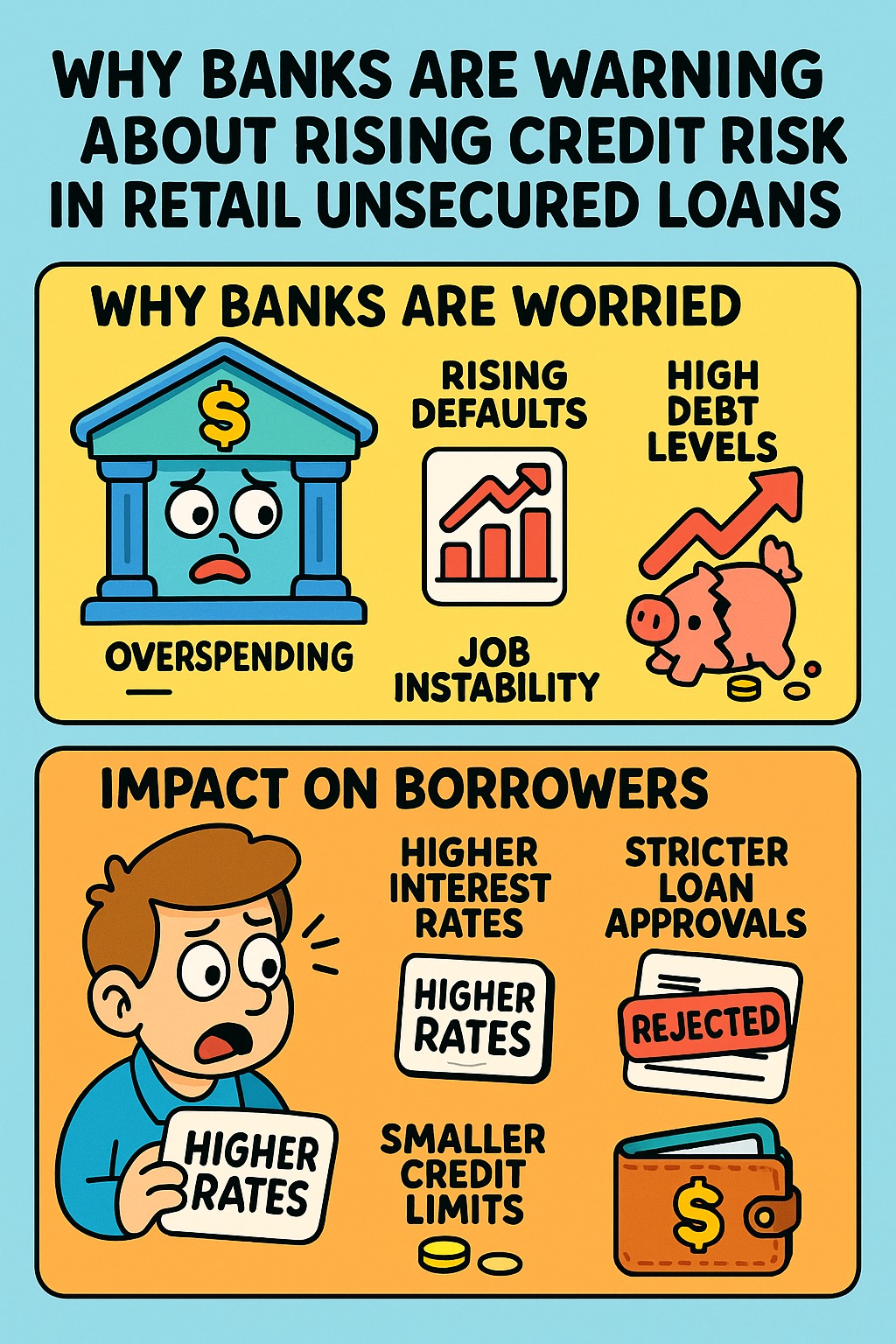
Banks are warning of rising credit risk in retail unsecured loans due to higher delinquencies, job-market pressure, and increased household debt. This may lead to stricter eligibility, higher interest rates, deeper credit checks, and more caution from lenders. Borrowers must strengthen their credit profile before applying.
Introduction
India’s booming retail credit market—especially personal loans, BNPL, and credit cards—has grown rapidly over the past few years.
But now, banks are raising red flags.
Across earnings calls, RBI bulletins, and analyst reports, the warning is consistent:
👉 Credit risk in retail unsecured loans is rising—and lenders are becoming cautious.
If you’re planning to apply for a personal loan, credit card, or instant fintech loan, you need to understand the shifts happening now.
This blog breaks it down in simple terms.
Why Banks Are Warning About Higher Credit Risk
Unsecured loans = no collateral
Which means banks rely purely on:
Income stability
CIBIL score
Repayment behavior
Cashflows
When these weaken, risk shoots up.
Here are the real reasons behind the warning.
1. Rising Delinquencies in Personal Loans & Credit Cards
Banks and NBFCs are seeing:
Higher missed EMIs
Rising credit card rollovers
Increased use of BNPL as emergency credit
This signals repayment stress.
2. Household Debt Levels at Multi-Year Highs
More people are juggling:
EMIs
Credit cards
Small-ticket loans
Payday/emergency loans
Debt stacking increases default risk.
3. Job Market Pressures
Sectors like tech, startups, contract work & gig employment face uncertainty.
Income instability = higher loan risk.
4. Aggressive Small-Ticket Digital Lending
Fintechs have issued millions of:
₹2,000–₹20,000 loans
BNPL pay-later accounts
Salary advances
Borrowers with multiple micro-loans pose higher default risk.
5. RBI’s Increased Risk Weights on Unsecured Loans
RBI recently increased risk weights for:
Personal loans
Credit cards
Small-ticket unsecured credit
This makes these loans more expensive for banks, so they tighten screening.
6. Higher FOIR (Fixed Obligation Ratio) Among Borrowers
Many borrowers now cross 50–60% FOIR, meaning:
Half their monthly income goes to EMIs.
This is a major default signal.
What This Means for Borrowers in 2025–26
Banks becoming cautious affects borrowers in several ways.
1. Stricter Loan Approval Criteria
Banks will scrutinize:
CIBIL score
Credit utilization
Income stability
Bank statements
Existing EMIs
Low-score applicants (580–680) may face more rejections.
2. Higher Interest Rates on Personal Loans
Expect:
Premium rates for risky profiles
Higher APR on credit cards
Stricter BNPL limits
3. Shorter Loan Tenures Offered
To reduce risk, lenders may avoid long tenures like 5–6 years.
4. Lower Pre-Approved Loan Amounts
Borrowers with high utilization or multiple loans will receive smaller offers.
5. More Document Checks
Banks will demand:
Salary slips
Bank statements
ITR (for self-employed)
Employment stability proof
Fintechs may also tighten onboarding.
6. Higher Focus on Credit Behavior Patterns
Banks now analyze:
Payment delays
BNPL spending
Credit card utilization
EMI-to-income ratio
Micro-loan stacking
AI-based underwriting is becoming more sophisticated.
7. Faster Triggering of Hard Inquiries
Every loan application will matter.
Too many inquiries → instant rejection.
Risk Comparison Table — Today’s Borrowers
| Borrower Type | Risk Level to Banks | Why |
|---|---|---|
| Salary ₹50k+ with low EMIs | ⭐ Low | High stability |
| Zero Credit History | ⭐⭐ Medium | Unknown risk |
| New-to-credit youth | ⭐⭐⭐ Medium-High | No history |
| Gig workers/contract workers | ⭐⭐⭐⭐ High | Income fluctuation |
| Multiple small loans (stacking) | ⭐⭐⭐⭐⭐ Very High | High default rate |
Expert Commentary
“India’s unsecured lending boom is entering a correction phase. Banks will become selective, and clean credit behavior will matter more than ever.”
— A. Bhattacharya, Senior Risk Analyst
What Borrowers MUST Do Before Applying Now
✔ Maintain Credit Utilization Below 30%
Credit card usage must be moderate.
✔ Pay all EMIs before the due date
Zero late marks → higher approval.
✔ Avoid taking too many small loans
Loan stacking harms your score instantly.
✔ Avoid applying with multiple lenders
Hard inquiries kill approval chances.
✔ Stabilize income flow (freelancers/gig workers)
Show consistent bank credits.
✔ Keep FOIR under 40%
Lower EMI burden = higher approval.
Summary Box
Banks warn of rising retail unsecured loan risk
Defaults increasing in small-ticket digital loans
Stricter approval norms coming
Interest rates may rise
Borrowers must improve their credit behavior
Applying blindly can lead to rejections
⭐ Vizzve Financial — Smarter Way to Apply for Personal Loans
Vizzve Financial helps borrowers:
Compare multiple lenders
Avoid rejections
Get matched with the right NBFC/bank
Increase approval chances
Get easy personal loans with low documentation
👉 Apply now at www.vizzve.com
❓ FAQs
1. Why are unsecured loans considered risky now?
Because defaults and delinquencies are rising.
2. Will personal loan interest rates increase?
Yes, for high-risk borrowers.
3. Will banks reject low CIBIL applicants?
More frequently than before.
4. Do small BNPL loans affect approval?
Yes — stacking multiple BNPL loans increases risk score.
5. How to improve eligibility?
Low utilization, timely EMIs, fewer inquiries, and stable income.
Conclusion
Banks tightening their unsecured lending norms is not a bad thing—it’s a warning sign for borrowers to strengthen their financial discipline.
By improving your credit behavior and applying through trusted platforms, you can still secure a good personal loan at competitive rates.
Published on : 8th December
Published by : SMITA
www.vizzve.com || www.vizzveservices.com
Follow us on social media: Facebook || Linkedin || Instagram
🛡 Powered by Vizzve Financial
RBI-Registered Loan Partner | 10 Lakh+ Customers | ₹600 Cr+ Disbursed