

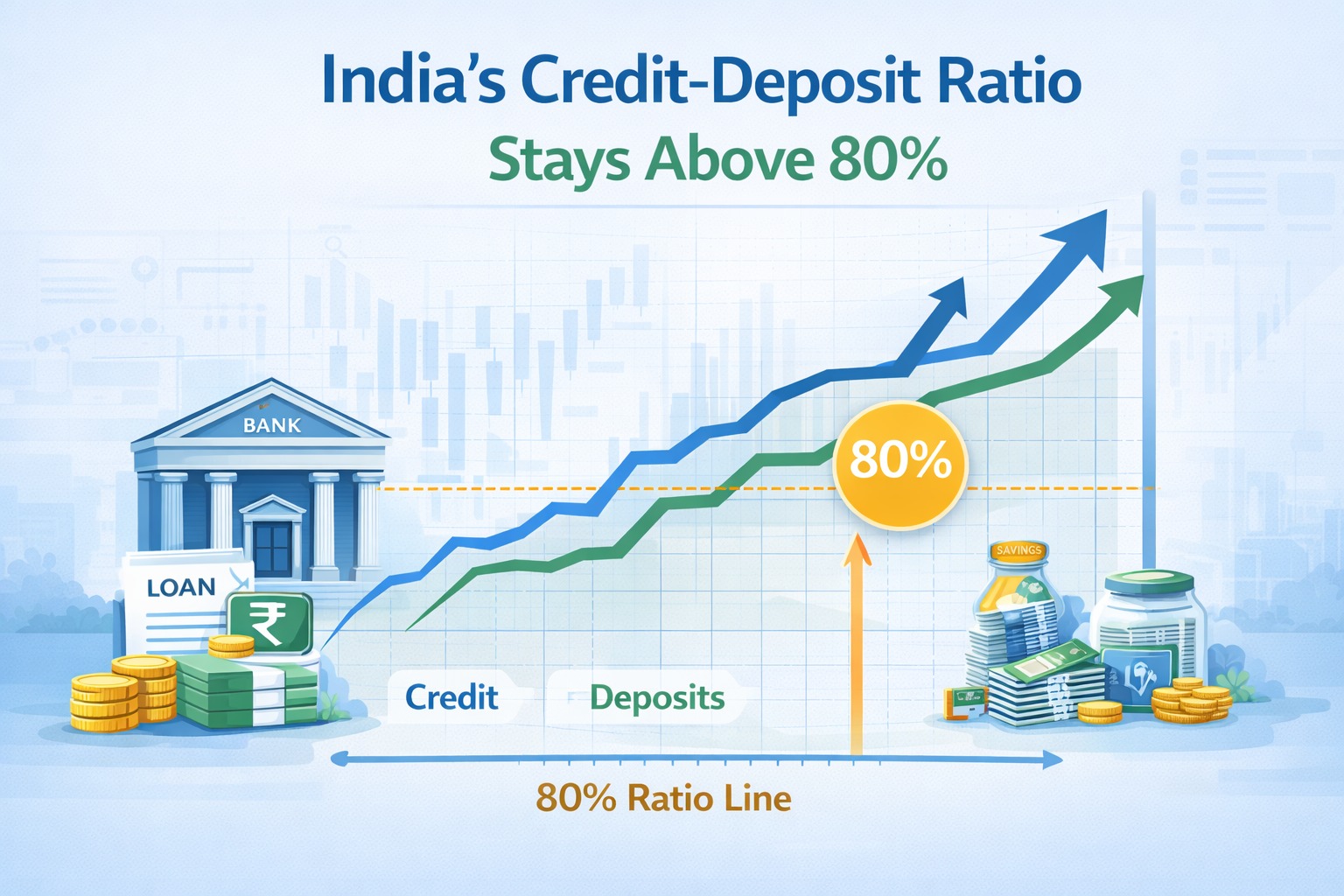
Banks in India are increasing lending activity as the credit-deposit ratio remains elevated. The trend reflects strong loan demand from consumers and businesses but also raises concerns about liquidity management in the banking system.
AI Answer Box
Why are banks lending more money in India?
Rising demand for retail and business loans
Expanding economic activity
Growth in housing and personal loans
Higher consumption spending
Increasing corporate investment
A high credit-deposit ratio indicates banks are lending a large share of the deposits they receive.
What Is the Credit-Deposit Ratio?
The credit-deposit ratio measures how much of a bank’s deposits are used to provide loans.
Formula:
Credit-Deposit Ratio = Total Loans ÷ Total Deposits
Example:
| Deposits | Loans | Credit-Deposit Ratio |
|---|---|---|
| ₹100 | ₹82 | 82% |
A higher ratio shows banks are actively lending to support economic growth.
Why the Credit-Deposit Ratio Remains High
Several factors are driving the increase in bank lending across India.
Strong Retail Loan Demand
Consumer borrowing has grown significantly in recent years.
Popular loan categories include:
Personal loans
Home loans
Auto loans
Credit card spending
Retail credit is now one of the biggest drivers of banking growth.
Expansion of Business Lending
Companies and small businesses are increasingly using bank loans to expand operations.
Business loans help finance:
Equipment purchases
Working capital
Infrastructure projects
Business expansion
This growth contributes to higher credit demand.
Economic Growth and Consumption
India’s growing economy has increased consumer confidence and spending.
Rising income levels allow households to take loans for housing, education, and lifestyle needs.
Role of the Central Bank
The banking sector operates under policies set by the
Reserve Bank of India.
The central bank monitors liquidity conditions and ensures that banks maintain financial stability while supporting economic growth.
Credit-Deposit Ratio Trend in India
| Year | Credit-Deposit Ratio |
|---|---|
| 2022 | 74% |
| 2023 | 78% |
| 2024 | 80% |
| 2025 | 81% |
| 2026 | 82% |
The steady increase indicates strong demand for credit across the economy.
Impact on Borrowers
A high credit-deposit ratio can influence loan availability and borrowing conditions.
Possible effects include:
Easier Access to Credit
Banks may expand lending to meet demand.
Interest Rate Changes
If deposits grow slower than loans, banks may raise deposit rates or adjust lending rates.
Stricter Risk Assessment
Banks may carefully evaluate borrower creditworthiness to manage risk.
Impact on the Banking Sector
For banks, higher lending activity brings both opportunities and challenges.
Benefits
Increased interest income
Larger loan portfolios
Economic growth support
Challenges
Liquidity pressure
Need to attract more deposits
Risk management requirements
Maintaining balance between deposits and loans is essential.
Expert Insight
Financial experts often view a rising credit-deposit ratio as a sign of strong economic activity. However, if the ratio rises too quickly, banks may need to increase deposit rates to maintain liquidity.
Key Takeaways
Banks are lending more as loan demand rises
Credit-deposit ratio remains above 80% in India
Retail loans and business credit drive lending growth
Deposit growth is slower than credit expansion
Banks must balance lending with liquidity management
FAQs
1. What is the credit-deposit ratio?
It measures how much of a bank’s deposits are used for lending.
2. Why is the credit-deposit ratio high in India?
Because loan demand is growing faster than deposit growth.
3. Is a high credit-deposit ratio good?
Moderately high ratios indicate strong lending activity but extremely high levels may strain liquidity.
4. Which loans drive credit growth in India?
Retail loans such as personal loans and home loans.
5. Can credit-deposit ratio affect interest rates?
Yes, banks may adjust interest rates to attract deposits.
6. Does higher lending support economic growth?
Yes, credit availability supports investment and consumption.
7. Are banks taking higher risks with more lending?
Banks manage risks through credit assessments and regulations.
8. Who regulates banking liquidity in India?
The central bank regulates liquidity conditions.
9. Will lending growth continue?
It depends on economic conditions and interest rate policies.
10. How does this affect borrowers?
Borrowers may see more loan availability but also possible interest rate adjustments.
Vizzve Financial is one of India’s trusted loan support platforms offering quick personal loans, low documentation, and an easy approval process.
Apply today at www.vizzve.com
Fast approval. Transparent process. Easy documentation.
Published on : 6th March
Published by : SMITA
www.vizzve.com || www.vizzveservices.com
Follow us on social media: Facebook || Linkedin || Instagram
🛡 Powered by Vizzve Financial
RBI-Registered Loan Partner | 10 Lakh+ Customers | ₹600 Cr+ Disbursed