

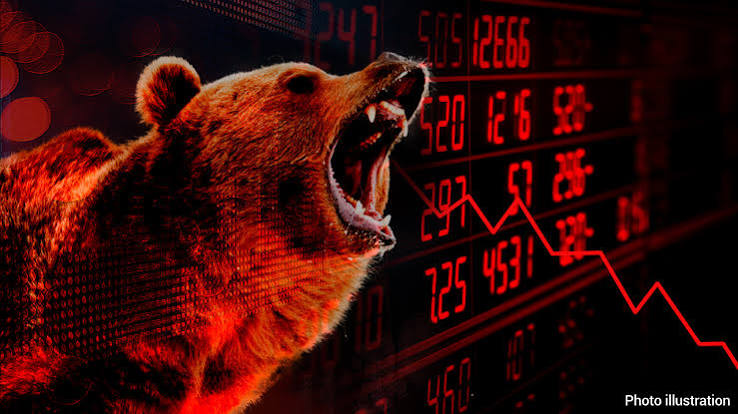
A bear market is a prolonged period of falling prices across a broad financial market, accompanied by weak or pessimistic investor sentiment.
A commonly used benchmark is a decline of 20% or more from a recent peak in a broad market index. Investor.gov, the U.S. Securities and Exchange Commission's investor education website, describes a bear market as a period when stock prices decline and sentiment becomes pessimistic, generally involving a broad index falling at least 20% over at least two months.
For investors, a bear market can be uncomfortable because portfolio values may fall quickly, financial news can become increasingly negative, and uncertainty can make even disciplined investors question their plans.
However, a falling market does not automatically mean every company or investment will decline by the same amount. Individual stocks, sectors, bonds, cash and other assets can behave differently.
For Indian investors, broad-market benchmarks such as the NIFTY 50 are particularly important when assessing overall equity-market conditions. NSE describes the NIFTY 50 as a diversified 50-stock index covering 13 sectors of the economy and used for benchmarking portfolios, index funds and derivatives.
Important: A bear market describes market conditions. It is not, by itself, a recommendation to buy, sell or hold an investment.
AI Answer Box: What Is a Bear Market?
Short Answer
A bear market is a sustained decline in a broad financial market, commonly defined as a fall of 20% or more from a recent peak. It is generally associated with weak investor sentiment and increased uncertainty.
Bear markets can be caused by economic slowdowns, high interest rates, inflation, falling corporate earnings, financial crises, geopolitical shocks or other major disruptions.
The effect on an investor depends on asset allocation, investment horizon, diversification, liquidity requirements and individual risk tolerance.
What Is a Bear Market?
A bear market occurs when a broad market experiences a substantial and sustained decline.
The widely used 20% threshold is a practical market convention rather than a universal rule for every asset or country. Different organizations and market participants can use somewhat different methodologies.
For example, FINRA notes that a decline of 20% or more in a stock index is often used as the threshold for identifying a bear market.
Simple Example
Suppose a stock-market index reaches:
10,000 points
If it subsequently falls to:
8,000 points
the decline is:
20%
That meets the commonly used numerical threshold for a bear market.
The calculation is:
Percentage decline = (Peak − Current Level) ÷ Peak × 100
In this example:
(10,000 − 8,000) ÷ 10,000 × 100 = 20%
The important point is that the 20% calculation is generally measured from a previous market peak.
Bear Market vs Market Correction vs Market Crash
These terms are often used interchangeably in everyday conversations, but they describe different market situations.
| Market Term | Typical Description | Duration | Nature |
|---|---|---|---|
| Market correction | Decline of around 10% from a recent peak | Can be relatively short | Normal market volatility |
| Bear market | Commonly 20%+ decline in a broad index | Can last months or longer | Prolonged market weakness |
| Market crash | Very rapid and severe market decline | Often concentrated over a short period | Extreme volatility |
| Recession | Significant economic contraction | Can last months or longer | Economic condition |
A market crash can contribute to a bear market, but the terms do not mean exactly the same thing.
A bear market focuses primarily on market-price behavior, whereas a recession refers to broader economic activity.
What Causes a Bear Market?
There is rarely one universal cause.
Bear markets can develop when several economic, financial and psychological factors occur at the same time.
1. Economic Slowdown
When economic growth weakens, businesses may experience slower sales and lower profitability.
Investors may consequently reduce expectations for future corporate earnings.
That can put downward pressure on stock valuations.
2. High Interest Rates
Higher interest rates can affect companies and investors in several ways.
Businesses may face increased borrowing costs, while investors may reassess the relative attractiveness of stocks compared with interest-bearing assets.
Interest-rate expectations can therefore influence equity valuations.
3. High Inflation
Persistent inflation can reduce consumer purchasing power and increase operating costs for businesses.
If inflation remains elevated, monetary authorities may maintain restrictive policies, potentially affecting economic growth and asset valuations.
4. Falling Corporate Earnings
Stock prices ultimately reflect expectations about companies' future financial performance.
If corporate earnings decline sharply or earnings expectations deteriorate, investors may reassess stock valuations.
5. Financial Crises
Banking problems, excessive leverage, credit stress or failures in important financial institutions can rapidly damage investor confidence.
6. Geopolitical Events
Wars, trade disruptions, political instability and major international shocks can increase uncertainty.
Markets may react by repricing assets and reducing risk exposure.
7. Excessive Valuations
When asset prices rise significantly faster than underlying earnings or economic fundamentals, markets can become vulnerable to substantial repricing.
What Happens During a Bear Market?
A bear market can affect different parts of the economy and financial system.
Stock Prices May Fall
Many publicly traded companies may experience declining share prices.
However, the size of the decline can vary substantially by company and sector.
Market Volatility May Increase
Daily price movements can become larger as investors respond to economic data, earnings reports, interest-rate decisions and other developments.
Investor Sentiment Can Deteriorate
Negative news can influence investor behavior, sometimes resulting in increased selling pressure.
FINRA describes panic selling as situations where investors rapidly sell securities because they believe prices are heading substantially lower.
Corporate Financing Can Become More Difficult
Companies may face less favorable conditions when raising capital, particularly if credit markets also become stressed.
Household Wealth Can Decline
Investors with substantial equity exposure may see the market value of their portfolios decrease.
This does not necessarily mean the underlying investment has permanently lost that amount of value.
How Does a Bear Market Affect Investors?
The impact depends heavily on an individual's financial situation.
| Investor Situation | Potential Impact |
|---|---|
| Long-term equity investor | Portfolio value may temporarily decline |
| Retiree withdrawing from portfolio | Sequence-of-returns risk may become important |
| Short-term investor | Higher probability of timing and volatility challenges |
| Diversified investor | Losses may differ across asset classes |
| Highly leveraged investor | Falling prices can increase financial pressure |
| Investor holding emergency cash | May have greater flexibility during volatility |
FINRA emphasizes that stocks remain risky investments even over long periods and notes that historical returns should not be interpreted as eliminating investment risk.
Bear Market in India
For Indian investors, the condition of the domestic equity market is commonly assessed using major indices such as the NIFTY 50 and BSE SENSEX.
NSE states that the NIFTY 50 represents approximately 53.73% of the free-float market capitalization of stocks listed on NSE as of March 30, 2026.
A substantial decline in a broad Indian index can therefore provide an important signal about overall equity-market conditions, although it does not mean every listed company is experiencing the same decline.
Important distinction
A fall in one stock is not necessarily a bear market.
A bear market generally refers to a broad market decline.
For example:
- One company's shares fall 25% → company-specific decline
- One sector falls substantially → sector correction or downturn
- A broad market index falls 20% or more → commonly described as a bear market
How Long Does a Bear Market Last?
There is no fixed duration.
Some bear markets are relatively brief, while others can persist for years.
Historical data illustrates this variation. S&P Global reported in 2020 that, among more than 20 U.S. bear markets considered in the referenced historical series, the median duration was 302 days. It also noted that the 2020 bear market from February 19 to March 23 lasted 33 days by that measurement.
Historical duration should not be treated as a forecast for the next bear market.
Why Duration Matters
A prolonged decline can affect:
- retirement planning
- investment withdrawals
- business financing
- consumer confidence
- household wealth
- asset allocation decisions
Investors should therefore consider their own time horizon rather than assuming that every downturn will recover within a particular number of months.
Bear Market vs Bull Market
| Feature | Bear Market | Bull Market |
|---|---|---|
| Direction | Broad downward trend | Broad upward trend |
| Sentiment | Generally pessimistic | Generally optimistic |
| Investor concern | Higher | Generally lower |
| Volatility | May increase | May vary |
| Corporate expectations | Often weakening | Often improving |
| Common threshold | Around 20% decline | Around 20% rise |
| Investor challenge | Managing downside and behavior | Managing valuation and excessive optimism |
Investor.gov uses a broad-market rise of 20% or more over at least two months as a general description of a bull market.
Signs of a Bear Market
No single indicator can perfectly identify a bear market in advance.
However, investors commonly monitor several signals.
1. Broad Index Declines
A sustained decline toward or beyond the commonly used 20% threshold is an obvious market-level indicator.
2. Weakening Corporate Earnings
Repeated downward revisions to earnings expectations can indicate deteriorating business conditions.
3. Higher Volatility
Large daily price movements can signal increased uncertainty.
4. Deteriorating Economic Indicators
Investors may monitor:
- GDP growth
- inflation
- employment
- interest rates
- consumer spending
- business investment
- credit conditions
5. Weak Market Breadth
If fewer companies participate in market gains while an index remains elevated, underlying market strength may be narrower.
6. Risk-Off Behavior
Investors may move toward assets they perceive as less risky during periods of uncertainty.
How to Invest During a Bear Market
There is no universal strategy that works for every investor.
A sensible approach starts with understanding your financial objectives, time horizon, liquidity requirements and risk tolerance.
Step 1: Review Your Financial Plan
Before making investment decisions, review:
- investment objectives
- emergency savings
- debt obligations
- expected expenses
- investment horizon
- asset allocation
Step 2: Avoid Emotional Decisions
Large market declines can create pressure to sell.
Before acting, determine whether the investment thesis has actually changed or whether the portfolio is simply experiencing market volatility.
Step 3: Review Diversification
Diversification can reduce dependence on a single company, sector or asset class.
It does not eliminate investment risk.
Step 4: Maintain Appropriate Liquidity
Money required for near-term expenses generally should not depend entirely on volatile equity markets.
Step 5: Review Asset Allocation
Your portfolio should reflect your financial objectives and ability to withstand losses.
An investor approaching a major financial goal may have different requirements from a younger investor with a longer horizon.
Step 6: Rebalance When Appropriate
Portfolio rebalancing involves bringing investments back toward a target allocation.
The appropriate frequency and method depend on the investor's plan and circumstances.
Should You Sell During a Bear Market?
There is no universal answer.
Selling can reduce exposure to further declines, but it can also turn an unrealized loss into a realized loss and potentially cause an investor to miss a subsequent recovery.
The relevant question is not simply:
“Is the market falling?”
It is:
“Does my current investment allocation still match my financial plan?”
An investor who needs money soon may have different considerations from someone investing for a long-term goal.
This is one reason investment decisions should be based on a written plan rather than short-term headlines.
Can You Make Money in a Bear Market?
It is possible for some investors and strategies to generate positive returns during declining markets, but doing so involves risks.
Potential approaches can include:
- holding cash or cash-equivalent investments
- maintaining diversified allocations
- investing according to a predetermined long-term plan
- selective security analysis
- certain hedging strategies
- strategies designed to profit from declining prices
However, strategies involving short selling, derivatives or leverage can produce substantial losses and may be inappropriate for many investors.
The fact that an investment can potentially profit during a falling market does not mean it is suitable for every investor.
Bear Market Pros and Cons
Potential Advantages
- Lower valuations may appear in some securities.
- Long-term investors may find opportunities to review portfolios.
- Periodic investing can purchase units or shares at lower prices.
- Portfolio weaknesses may become easier to identify.
- Investors may reassess their risk tolerance and asset allocation.
Potential Disadvantages
- Portfolio values can decline substantially.
- Volatility may increase.
- Emotional decision-making can become more difficult.
- Retirement withdrawals can become more challenging.
- Highly leveraged investors may face additional financial pressure.
- Recovery timing is uncertain.
Bear Market Investment Strategy for Beginners
Beginners should focus first on financial foundations rather than trying to predict the exact market bottom.
A simple framework
1. Build an emergency fund
Maintain adequate liquid savings for expected emergencies.
2. Control expensive debt
High-cost debt can create financial pressure regardless of market conditions.
3. Define your investment goal
Examples include:
- retirement
- home purchase
- education
- wealth creation
- long-term financial independence
4. Determine your time horizon
A five-year goal and a 25-year goal may require very different approaches.
5. Diversify
Avoid concentrating the entire portfolio in one company, sector or asset class.
6. Invest consistently where appropriate
A systematic approach can reduce the temptation to make decisions based entirely on market headlines.
Bear Market and SIP Investing
For investors using systematic investment plans, market declines can result in more mutual-fund units being purchased for the same contribution when prices are lower.
However, SIP investing does not guarantee profits or protect against losses.
The suitability of continuing an SIP depends on the underlying fund, investment objective, time horizon and investor's financial circumstances.
Investors should avoid assuming that every falling market represents an automatic buying opportunity.
Bear Market vs Stock Market Crash
A stock-market crash generally describes an exceptionally rapid and severe decline.
A bear market describes a broader period of sustained weakness, commonly measured using a 20% decline from a previous peak.
Therefore:
A crash can occur within a bear market, but a bear market does not have to begin with a single-day crash.
Market-wide circuit breakers are also different from bear-market definitions. In India, NSE's market-wide circuit-breaker framework uses 10%, 15% and 20% index-movement thresholds based on movements in the NIFTY 50 or Sensex, with specific trading-halt rules.
Real-World Investor Experience: What Bear Markets Teach
One recurring lesson from major market downturns is that portfolio behavior can differ dramatically from expectations.
An investor may believe they are comfortable with volatility when markets are rising. A prolonged decline can reveal that their actual tolerance for losses is lower than expected.
This is not simply a psychological observation. Investor education material published through NSE-related materials also emphasizes that actual losses can reveal whether an investor's portfolio matches their risk appetite.
Practical experience points
Investors commonly discover during downturns that:
- liquidity matters more than expected;
- excessive concentration increases stress;
- leverage can magnify losses;
- short-term goals need appropriate asset allocation;
- market timing is difficult;
- diversification can change the overall experience of a downturn.
These observations are useful for portfolio planning even when markets are performing well.
Expert Commentary: How to Think About Bear Markets
A useful professional perspective is to separate market conditions from personal financial decisions.
A 20% market decline does not automatically mean an investor should sell everything.
Likewise, a major decline does not automatically mean every asset has become attractive.
The appropriate response depends on:
- valuation
- investment quality
- financial goals
- time horizon
- liquidity needs
- risk capacity
- asset allocation
- tax considerations
- debt obligations
The SEC's Investor.gov and FINRA both emphasize that market investments carry risk and that investors should understand the relationship between risk, time horizon and their financial circumstances.
Bear Market Checklist
Before making a major investment decision during a downturn, ask:
- Has my financial goal changed?
- Has my investment horizon changed?
- Do I need this money soon?
- Is my emergency fund adequate?
- Is my portfolio diversified?
- Is my debt manageable?
- Has the investment's underlying business changed?
- Am I reacting to a headline?
- Am I making a decision based on a predetermined plan?
- Would I make the same decision if the market were less volatile?
This checklist cannot eliminate investment risk, but it can encourage more deliberate decision-making.
Key Takeaways
- A bear market commonly refers to a decline of 20% or more in a broad market index.
- Bear markets can result from economic weakness, inflation, high interest rates, falling earnings, financial stress or major shocks.
- A bear market is different from a market correction, crash or recession.
- Not every stock falls by the same amount during a bear market.
- The NIFTY 50 is an important broad-market benchmark for Indian investors.
- Bear markets do not have a fixed duration.
- Historical market behavior should not be treated as a guarantee of future performance.
- Diversification can help manage concentration risk but cannot eliminate losses.
- Investors should consider liquidity, time horizon, risk tolerance and asset allocation before making major changes.
- Avoid making financial decisions solely because of short-term market headlines.
Frequently Asked Questions About Bear Markets
1. What is a bear market in simple words?
A bear market is a prolonged period of falling prices in a broad market. A decline of 20% or more from a recent peak is commonly used as the benchmark.
2. Why is it called a bear market?
The term "bear market" is traditionally associated with declining prices and pessimistic market conditions. It is commonly contrasted with a bull market, which describes rising prices and optimism.
3. How much does the stock market fall in a bear market?
A 20% decline from a recent peak is the commonly used threshold for a bear market in a broad index.
4. How long does a bear market last?
There is no fixed duration. Historical bear markets have ranged from relatively brief periods to prolonged downturns.
5. Is a bear market the same as a stock-market crash?
No. A crash generally refers to a rapid and severe decline, while a bear market refers to a broader period of sustained market weakness.
6. Is a 10% fall a bear market?
Usually not. A 10% decline is more commonly described as a market correction. Terminology can vary depending on the market and methodology.
7. What causes a bear market?
Common causes include economic slowdowns, high interest rates, inflation, falling corporate earnings, financial crises, geopolitical events and excessive valuations.
8. What happens to mutual funds during a bear market?
Mutual funds with significant equity exposure can experience declining net asset values when their underlying securities fall. The effect depends on the fund's portfolio.
9. Should I stop my SIP during a bear market?
There is no universal answer. The decision should consider the fund, financial goal, investment horizon, cash-flow requirements and overall asset allocation.
10. Can investors make money during a bear market?
Some strategies can potentially generate positive returns during declining markets, but they may involve significant risk, complexity or leverage.
11. Is a bear market good for long-term investors?
A bear market can create lower prices for some investments, but whether that benefits a particular investor depends on the quality of the investment, valuation, time horizon and ability to tolerate losses.
12. How can I protect my portfolio during a bear market?
Investors may consider diversification, appropriate asset allocation, adequate liquidity and disciplined portfolio management. No strategy completely eliminates market risk.
13. How do I know when a bear market is over?
A bear market is generally identified retrospectively based on market recovery from its low and the methodology being used. Predicting the exact bottom is difficult.
14. Is NIFTY 50 affected during a bear market?
If Indian equities enter a broad downturn, the NIFTY 50 may decline, but individual NIFTY 50 constituents can perform differently.
15. What should beginners do during a bear market?
Beginners should focus on financial fundamentals, emergency savings, diversification, appropriate asset allocation and long-term goals rather than attempting to predict every short-term market movement.
Vizzve Financial: Financial Support for Your Borrowing Needs
Vizzve Financial is one of India’s trusted loan support platforms offering quick personal loans, low documentation, and an easy approval process. Apply at www.vizzve.com.
Before taking a loan, borrowers should review the applicable interest rate, fees, repayment schedule, eligibility requirements and total cost of borrowing.
A personal loan is a financial commitment and should be considered in the context of your income, existing obligations and repayment capacity.
Conclusion
A bear market is an important part of financial-market cycles. It describes a significant and sustained decline in broad market prices, commonly measured using a 20% decline from a recent peak.
For investors, the most important task is not necessarily predicting the exact day a bear market will begin or end. It is understanding how market declines interact with personal financial goals.
A well-designed financial plan should consider investment horizon, liquidity requirements, diversification, risk tolerance and asset allocation.
Market declines can be challenging, but they can also provide an opportunity to review whether an investment strategy remains aligned with long-term objectives.
For borrowing needs, Vizzve Financial provides loan support with a focus on a simple application experience. Visit www.vizzve.com to learn more.
Published on : 24th september
Published by : Sumanth Arumulla
www.vizzve.com || www.vizzveservices.com
Follow us on social media: Facebook || Linkedin || Instagram
🛡 Powered by Vizzve Financial
RBI-Registered Loan Partner | 10 Lakh+ Customers | ₹600 Cr+ Disbursed
#BearMarket #BearMarketMeaning #StockMarket #StockMarketIndia #Investing #InvestmentStrategy #PersonalFinance #FinancialPlanning #Nifty50 #StockMarketCrash #MarketDownturn #InvestmentTips #WealthManagement #FinancialLiteracy #InvestingForBeginners #IndianInvestors #MarketVolatility #PortfolioManagement #Finance #VizzveFinancial