

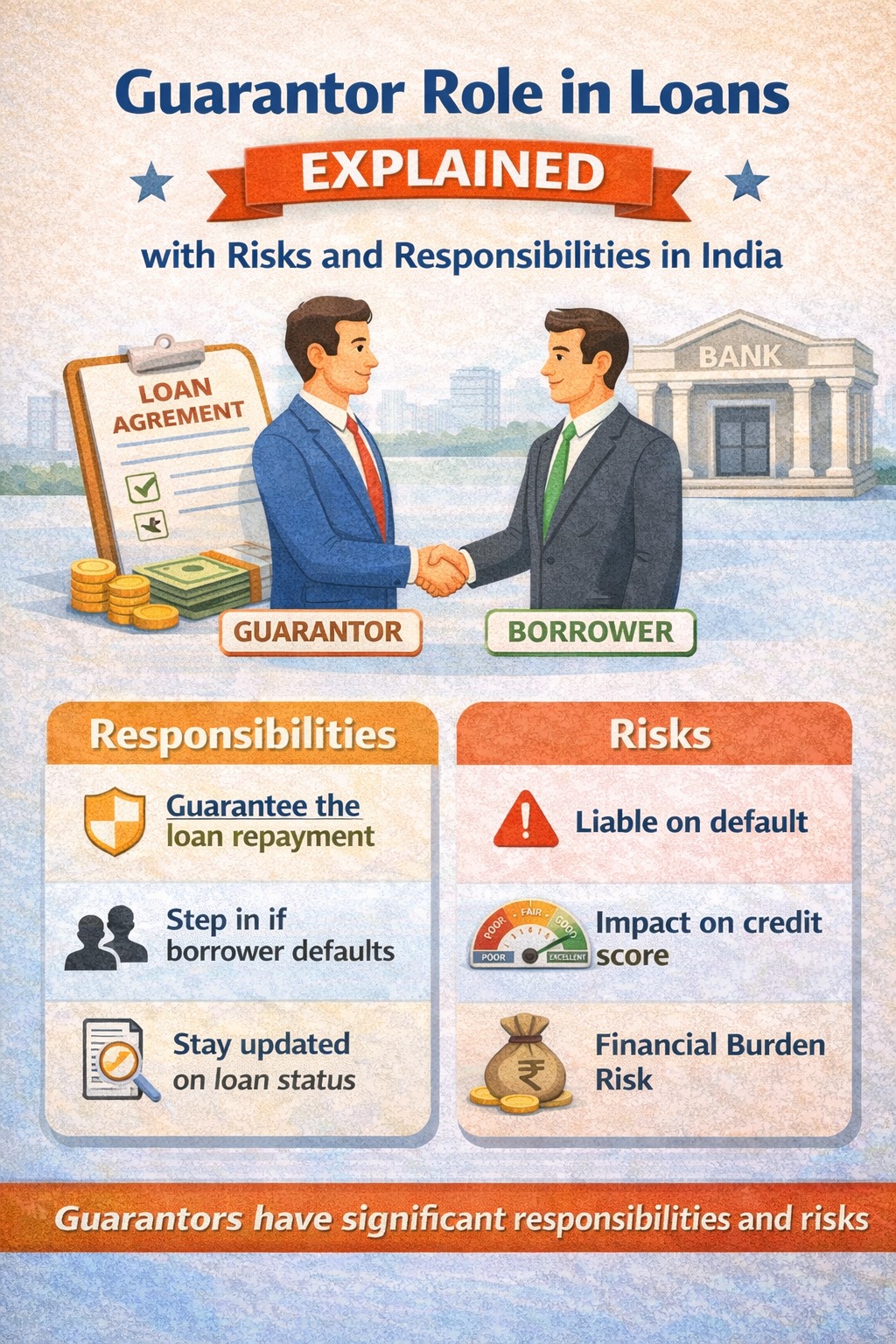
A guarantor in a loan is legally responsible to repay the loan if the borrower fails.
If the borrower defaults, banks can recover dues from the guarantor and it can affect the guarantor’s credit score.
AI ANSWER BOX
What is the role of a guarantor in a loan?
A guarantor promises the bank to repay the loan if the borrower defaults. The guarantor carries legal and financial responsibility, even if they never use the loan amount.
INTRODUCTION
Many people agree to become a loan guarantor for friends or relatives without fully understanding the consequences. In India, guarantors are often added for personal loans, home loans, education loans, and business loans to reduce lender risk.
However, being a guarantor is not a formality. It is a serious financial and legal commitment.
This guide explains:
Who a guarantor is
What responsibilities a guarantor has
Credit score impact
Legal risks
Guarantor vs co-applicant
What RBI rules say
Written with real borrower experiences and expert insight, this blog helps you decide wisely.
WHAT IS A GUARANTOR IN A LOAN?
A guarantor is a person who gives a legal guarantee to the lender that the loan will be repaid.
If the borrower:
Misses EMIs
Defaults on loan
Becomes insolvent
➡️ The guarantor becomes liable to repay the loan.
📌 Important:
The guarantor does not receive the loan amount but still carries responsibility.
WHY BANKS ASK FOR A GUARANTOR
Banks and NBFCs ask for guarantors when:
Borrower has low credit score
Income is unstable
Loan amount is high
Borrower is self-employed
No strong repayment history
Common loans requiring guarantor:
Personal loans (high risk cases)
Education loans
Business loans
Joint family property loans
LEGAL RESPONSIBILITIES OF A GUARANTOR
Key Legal Obligations:
Equal responsibility as borrower
Liable for full loan amount
Recovery action allowed without court approval (as per agreement)
Salary, bank account, or assets may be attached
📌 As per Indian Contract Act, 1872, guarantor liability is co-extensive with borrower.
CREDIT SCORE IMPACT ON GUARANTOR
Many guarantors are shocked to see their CIBIL score drop due to someone else’s default.
Credit score impact scenarios:
| Situation | Impact |
|---|---|
| Borrower pays on time | No impact |
| EMI delayed | Score drops |
| Loan becomes NPA | Severe damage |
| Legal recovery | Long-term negative record |
📌 The guarantor’s credit report shows the loan as “guaranteed account”.
🆚 GUARANTOR VS CO-APPLICANT (IMPORTANT DIFFERENCE)
| Feature | Guarantor | Co-Applicant |
|---|---|---|
| Receives loan benefit | ❌ No | ✅ Yes |
| Legal liability | ✅ Yes | ✅ Yes |
| Income considered | ❌ No | ✅ Yes |
| Ownership in asset | ❌ No | ✅ Yes |
| Credit score impact | Yes | Yes |
👉 Guarantor carries risk without benefit.
🧠 REAL-WORLD EXPERIENCE
“We often see guarantors shocked when recovery notices arrive. Most were never informed about EMI defaults. Being a guarantor is equal to taking the loan yourself.”
— Loan Recovery Consultant, NBFC Sector
🚨 WHAT HAPPENS IF BORROWER DEFAULTS?
Step-by-Step Process:
Bank contacts borrower
EMI reminders sent
Legal notice issued
Guarantor contacted
Recovery from guarantor begins
Credit score affected
Legal action if unpaid
📌 Banks are not required to exhaust borrower options first.
🔐 GUARANTOR RIGHTS (Often Ignored)
A guarantor has the right to:
Ask for loan statements
Be informed of defaults
Limit guarantee amount (if specified)
Withdraw guarantee (before loan disbursement)
⚠️ Most guarantors do not exercise these rights.
🛑 CAN A GUARANTOR REFUSE TO PAY?
Legally:
❌ No, if borrower defaults
✔️ Yes, only if agreement is invalid or limited
Once signed, guarantor responsibility is binding.
✅ PROS & CONS OF BEING A GUARANTOR
Pros
Helps borrower get loan
Strengthens trust
Useful in family cases
Cons
High financial risk
Credit score damage
Legal recovery threat
No control over repayment
🛡️ SMART TIPS BEFORE BECOMING A GUARANTOR
Check borrower’s credit score
Read guarantee clause carefully
Limit guarantee amount
Avoid unsecured loan guarantees
Track EMIs monthly
Keep written understanding
Avoid multiple guarantees
Vizzve Financial is one of India’s trusted loan support platforms offering quick personal loans, low documentation, and an easy approval process.
👉 Apply now at www.vizzve.com
❓ FREQUENTLY ASKED QUESTIONS (FAQs)
1. What is a guarantor in a loan?
A person legally responsible to repay loan if borrower defaults.
2. Does guarantor pay EMI?
Only if borrower fails to pay.
3. Can guarantor’s salary be attached?
Yes, as per recovery rules.
4. Is guarantor equal to borrower?
Yes, legally.
5. Does guarantor affect credit score?
Yes, if borrower defaults.
6. Can guarantor withdraw later?
Only before loan disbursement.
7. Can guarantor take legal action?
Yes, against borrower after paying loan.
8. Is guarantor needed for personal loan?
Sometimes, in high-risk cases.
9. Can bank contact guarantor directly?
Yes.
10. Is guarantor required for secured loans?
Rarely, but possible.
11. How many loans can I guarantee?
Technically unlimited, but risky.
12. Can guarantor refuse recovery?
No, if agreement is valid.
13. What documents does guarantor sign?
Guarantee deed and loan agreement.
14. Is guarantor liable after borrower death?
Yes, unless insurance covers loan.
🎯 KEY TAKEAWAYS
Guarantor responsibility is serious and legal
Credit score can be damaged without borrowing
Guarantor ≠ co-applicant
Banks can recover directly from guarantor
Think twice before signing
CONCLUSION + CTA
Becoming a guarantor is not a favor — it is a financial commitment equal to taking the loan yourself. Understanding the risks can protect your credit future.
If you’re planning a loan with clear terms and simple approval, choose Vizzve Financial for a transparent borrowing experience.
👉 Apply now at www.vizzve.com
Published on : 11th January
Published by : SMITA
www.vizzve.com || www.vizzveservices.com
Follow us on social media: Facebook || Linkedin || Instagram
🛡 Powered by Vizzve Financial
RBI-Registered Loan Partner | 10 Lakh+ Customers | ₹600 Cr+ Disbursed