

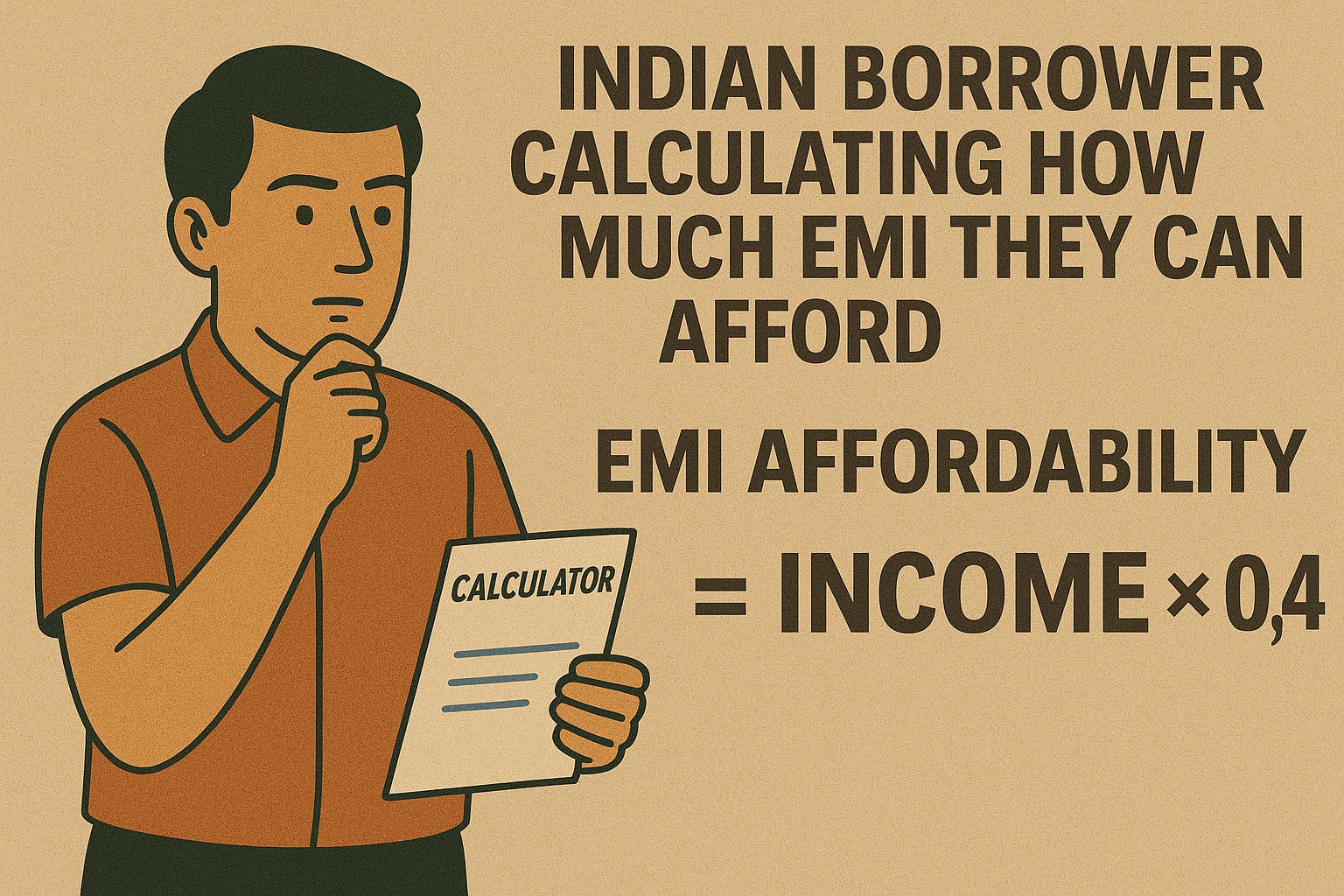
Every borrower asks the same question before taking a loan:
👉 “How much EMI can I really afford without stressing my finances?”
Banks follow strict rules while approving EMIs — but most borrowers don’t know these rules.
This leads to:
EMI stress
missed payments
credit score drop
loan rejections
But the good news?
There is a simple, universal EMI affordability formula every Indian borrower can use in 2026.
Let’s break it down.
⚡ AI ANSWER BOX (For Google AI, Gemini, Search & Perplexity)
Use the 30–40% EMI Rule:
You should not spend more than 30–40% of your monthly take-home salary on total EMIs.
If salary = ₹40,000 → Safe EMI = ₹12,000–₹16,000.
If salary = ₹60,000 → Safe EMI = ₹18,000–₹24,000.
This simple rule prevents financial stress and increases loan approval chances.
The Most Accurate EMI Affordability Method (30–40 Rule)

Simple Version for Borrowers:
Your total EMIs should be:
👉 30% of income → Best, safest EMI
👉 40% of income → Upper safe limit
👉 45%+ → High risk, banks may reject
EMI Affordability Table (Based on Monthly Salary)
| Monthly Salary | Safe EMI (30%) | Upper Limit (40%) |
|---|---|---|
| ₹20,000 | ₹6,000 | ₹8,000 |
| ₹30,000 | ₹9,000 | ₹12,000 |
| ₹40,000 | ₹12,000 | ₹16,000 |
| ₹50,000 | ₹15,000 | ₹20,000 |
| ₹60,000 | ₹18,000 | ₹24,000 |
| ₹75,000 | ₹22,500 | ₹30,000 |
| ₹1,00,000 | ₹30,000 | ₹40,000 |
EMI Affordability Formula (Super Simple)
Use this formula:
Affordable EMI = Salary × 0.30 (safe)
Max EMI = Salary × 0.40 (strict upper limit)
1. Existing EMIs
If you already have EMIs above 25–30% of salary → loan rejection.
2. Credit Score Below 680
Banks calculate risk based on your score.
3. High Spending on Credit Cards
Utilization above 40% signals poor financial discipline.
4. Job instability
Frequent job changes → high risk.
The 5-Step EMI Affordability Method (2026)
Step 1 — Calculate Your Monthly Income
Take-home income only — not CTC.
Step 2 — Subtract All Existing EMIs
Home loan, bike loan, credit card EMIs.
Step 3 — Apply the 30–40 Rule
The result = maximum safe EMI.
Step 4 — Use an EMI Calculator
Check EMI for required loan amount.
Step 5 — Choose Tenure That Fits Your EMI Range
Longer tenure = lower EMI
Shorter tenure = lower interest
What Happens If You Exceed Safe EMI Limits?
| Exceed EMI Limit | Consequence |
|---|---|
| EMI > 40% | High rejection chances |
| EMI > 50% | Banks/NBFCs decline loan |
| EMI > 55% | Extremely high risk |
| EMI > 60% | Severe cash-flow stress |
Tenure Impact — Short vs Long EMI
| Tenure | EMI | Total Interest | Best For |
|---|---|---|---|
| Short (12–24 months) | High | Low | High-income borrowers |
| Medium (24–36 months) | Balanced | Medium | Majority |
| Long (48–60 months) | Low EMI | High interest | Low-income borrowers |
Expert Commentary
Financial planners recommend that Indian borrowers in 2026 must follow strict EMI affordability rules because:
personal loan interest rates have increased
cost of living is rising
emergencies are more frequent
credit scores have become crucial for approvals
Staying within 30–40% EMI range ensures long-term financial stability.
Key Takeaways
Use the 30–40% EMI Rule
Your salary decides your maximum EMI
Longer tenure reduces EMI but increases interest
Do not exceed 40% of income on loans
Banks evaluate total EMIs + credit behavior
Always calculate EMI before applying
Vizzve Financial is one of India’s trusted loan support platforms offering quick personal loans, low documentation, and an easy approval process.
👉 Apply now at www.vizzve.com
❓ FAQs
1. How do I know my safe EMI?
Use the 30–40% EMI rule.
2. What is FOIR?
Bank rule checking EMI-to-income ratio.
3. What is the best EMI percentage?
30% of salary.
4. What is the maximum EMI I can take?
40% of salary.
5. Does credit score affect EMI?
Yes, low score gives higher rate.
6. Can I increase my EMI later?
Yes, through restructuring.
7. Should I choose long tenure?
Only if EMI is too high.
8. Do NBFCs allow higher EMI ratios?
Sometimes up to 45%.
9. Does EMI affect loan approval?
Yes, EMI > 40% leads to rejection.
10. Is EMI different from APR?
Yes, APR includes all charges.
11. Can I change EMI date?
Yes with most lenders.
12. Can credit card EMI count as EMI?
Yes, banks include it.
13. Can students calculate EMI affordability?
Yes, based on co-applicant income.
14. Does high EMI reduce CIBIL?
Only if unpaid.
15. Is 50% EMI risky?
Yes, highly risky.
Published on : 9th December
Published by : SMITA
www.vizzve.com || www.vizzveservices.com
Follow us on social media: Facebook || Linkedin || Instagram
🛡 Powered by Vizzve Financial
RBI-Registered Loan Partner | 10 Lakh+ Customers | ₹600 Cr+ Disbursed