

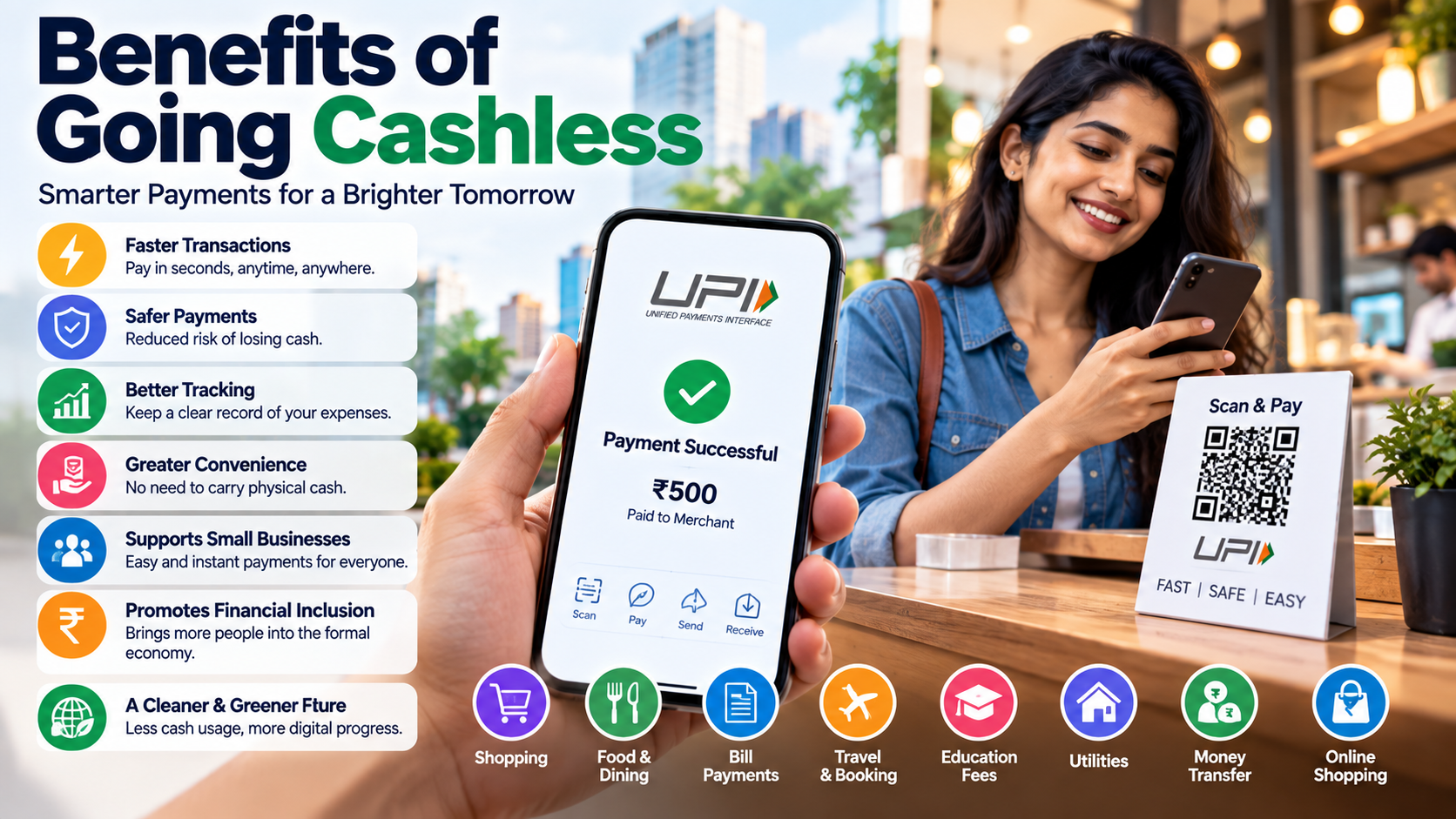
The way people pay for goods and services has changed dramatically over the past decade. From scanning a QR code at a neighbourhood shop to paying bills through a smartphone, cashless payments have become part of everyday financial life in India.
The country's digital-payment ecosystem is particularly notable for the scale of UPI. According to NPCI's latest available monthly statistics, UPI processed 24,508.96 million transactions worth ₹29,82,355.95 crore in August 2026, with 752 banks live on the network.
Going cashless does not necessarily mean eliminating physical cash completely. Instead, it means using digital channels such as:
- UPI
- Debit cards
- Credit cards
- Internet banking
- Mobile banking
- Digital wallets
- IMPS
- NEFT and RTGS
- QR-code payments
For consumers, digital payments can make transactions faster and easier to track. For businesses, they can reduce the need to handle, count and transport physical cash.
But cashless payments also introduce risks. Cyber fraud, phishing, fake QR codes, stolen credentials, weak passwords and accidental transfers are real concerns. Therefore, the benefits of digital payments are greatest when convenience is combined with good security habits.
Going cashless means using digital payment methods instead of physical currency for some or most everyday transactions.
The major benefits include:
- Faster payments
- Greater convenience
- Easier transaction tracking
- Reduced dependence on physical cash
- Lower cash-handling requirements for businesses
- Easier bill and subscription payments
- Greater accessibility to financial services
- Better digital records
- Convenient person-to-person transfers
- Support for small-business digitalisation
- Integration with banking and financial services
India's UPI ecosystem has expanded substantially, with NPCI reporting more than 24.5 billion UPI transactions in August 2026 alone.
What Does Going Cashless Mean?
Going cashless means choosing electronic or digital methods to transfer money instead of handing over physical currency.
For example, instead of paying ₹500 in cash at a restaurant, a customer might:
- Scan the merchant's QR code.
- Enter ₹500.
- Select the bank account.
- Authenticate the payment.
- Receive a transaction confirmation.
The money moves electronically between accounts.
Common Cashless Payment Methods
| Payment Method | Common Use | Key Feature |
|---|---|---|
| UPI | Everyday payments | Instant account-to-account payments |
| Debit Card | Shopping and ATM use | Directly linked to bank account |
| Credit Card | Purchases | Credit-based payment |
| Mobile Banking | Banking and transfers | Banking through smartphone |
| Internet Banking | Bills/transfers | Web-based banking |
| IMPS | Fund transfers | Immediate electronic transfer |
| NEFT | Bank transfers | Electronic fund transfer |
| RTGS | Large-value transfers | Real-time settlement |
| Digital Wallets | Small payments | Stored digital balance/payment facility |
Why Is India Moving Towards Cashless Payments?
India's digital-payment ecosystem has developed through a combination of smartphones, internet connectivity, bank-account access, fintech innovation and payment infrastructure.
UPI has played a particularly important role because it enables consumers to make account-based payments through participating apps.
RBI has also described UPI as the country's largest retail payment system by transaction volume in its policy communications, highlighting its widespread acceptance, particularly for smaller-value transactions.
The ecosystem continues to evolve. NPCI's 2026 UPI circulars include developments relating to areas such as international QR acceptance, fraud and wrong-credit chargebacks, biometric authentication and other UPI features.
10 Major Benefits of Going Cashless
1. Faster Transactions
One of the biggest advantages of digital payments is speed.
A UPI payment can generally be initiated from a smartphone within seconds, depending on network and banking availability.
This is especially useful for:
- Retail purchases
- Restaurant bills
- Utility payments
- Online shopping
- Peer-to-peer transfers
- Small-business collections
Instead of searching for exact change, the customer can make the payment digitally.
2. Greater Convenience
Cashless payments reduce the need to carry physical currency.
A smartphone can provide access to multiple payment options from almost anywhere with suitable connectivity.
This can be particularly convenient for:
- Travellers
- Students
- Working professionals
- Online shoppers
- Small-business owners
- People making recurring payments
Digital payments can also make it easier to send money to family members without physically meeting them.
3. Easier Transaction Tracking
Cash transactions can be difficult to remember.
Digital payments normally generate a transaction record through the relevant bank or payment application.
This can help users:
- Check previous payments
- Monitor spending
- Reconcile expenses
- Track business collections
- Identify unfamiliar transactions
- Maintain financial records
For personal finance management, transaction records can make budgeting easier.
Example
A person who makes ten cash purchases during a week may have to remember or manually record them.
With digital payments, those transactions generally appear in the relevant account or payment history, making later review easier.
4. Reduced Need to Carry Cash
Carrying large amounts of physical money can be inconvenient.
Cashless payments reduce the need to keep substantial amounts of currency in a wallet.
This can be useful when:
- Shopping for expensive items
- Travelling
- Paying household bills
- Making business purchases
- Paying school or college fees
However, maintaining a small emergency cash reserve can still be sensible because digital payments can be affected by connectivity, device or system problems.
5. Easier Payments for Small Businesses
Digital payments can help small merchants accept money without maintaining large amounts of physical cash.
A neighbourhood business can display a QR code and receive payments directly through a supported payment system.
This can be useful for:
- Grocery stores
- Restaurants
- Street vendors
- Salons
- Pharmacies
- Service providers
- Freelancers
- Home-based businesses
The merchant can also use digital transaction records for reconciliation and bookkeeping.
6. Better Payment Records for Businesses
Cash management can involve:
- Counting notes
- Checking denominations
- Recording sales
- Depositing cash
- Reconciling cash registers
- Managing change
Digital collections can simplify some of these tasks.
For a business owner, transaction records can support:
- Daily reconciliation
- Revenue monitoring
- Accounting
- Cash-flow planning
- Payment verification
Digital records do not eliminate accounting work, but they can make certain parts of the process easier.
7. Convenient Bill Payments
Cashless systems are especially useful for recurring expenses.
Consumers can digitally pay:
- Electricity bills
- Mobile bills
- Broadband bills
- Insurance premiums
- Loan EMIs
- School fees
- Subscription services
- Government payments
This reduces the need to visit physical payment counters.
8. Supports Financial Inclusion
Digital payments can connect people to formal financial infrastructure.
When individuals use bank accounts and regulated digital payment channels, they can participate more easily in the formal financial system.
This can support access to:
- Banking services
- Digital transfers
- Savings products
- Insurance
- Credit
- Government payments
- Other financial services
RBI continues to publish data covering payment systems and financial inclusion indicators, reflecting the broader development of India's digital financial infrastructure.
9. Useful for E-Commerce
Online shopping generally requires electronic payment methods.
Cashless payments allow customers to complete purchases through:
- UPI
- Cards
- Net banking
- Wallets
- Other supported payment methods
This supports the growth of India's digital commerce ecosystem.
10. Can Improve Financial Awareness
Regular digital transactions create an opportunity for people to become more aware of their spending.
A consumer can review:
- How much was spent
- Where money was spent
- How frequently purchases were made
- How much was transferred
- Whether recurring expenses have increased
Used properly, this information can support better budgeting.
Cashless Payments vs Cash Payments
| Feature | Cash | Cashless Payment |
|---|---|---|
| Physical currency | Required | Not required |
| Transaction record | Usually manual | Usually digital |
| Payment speed | Depends on handling | Often very fast |
| Change required | Often | No |
| Smartphone needed | No | Often |
| Internet/connectivity | Not required | Often required |
| Fraud risk | Theft/counterfeit risk | Cyber/digital fraud risk |
| Spending visibility | Lower unless recorded | Usually higher |
| Online purchases | Limited | Well suited |
| Business reconciliation | Manual | Can be easier |
Neither payment method is completely risk-free.
What Are the Disadvantages of Going Cashless?
Going cashless has advantages, but it is not without limitations.
1. Cybersecurity Risks
Digital payment users may encounter:
- Phishing
- Fake customer-care numbers
- Fraudulent links
- Fake payment requests
- Screen-sharing scams
- Social-engineering attacks
- Unauthorized account access
Users must never share their UPI PIN, OTP, card PIN or banking credentials with another person.
2. Dependence on Technology
Cashless payments may be affected by:
- Poor internet connectivity
- Smartphone battery failure
- Bank downtime
- Payment-system interruptions
- App problems
- Device loss
This is one reason why completely abandoning physical cash may not be practical for everyone.
3. Overspending
Digital payments can feel less tangible than handing over cash.
A consumer may make frequent small purchases without noticing how quickly they accumulate.
For this reason, transaction tracking and monthly budgeting remain important.
4. Digital Literacy Requirements
Not everyone has the same level of familiarity with digital financial services.
Older adults, people with limited digital access and individuals unfamiliar with payment apps may require additional support.
A genuinely inclusive digital-payment system needs:
- Simple interfaces
- Local-language support
- Fraud awareness
- Customer support
- Accessibility
- Reliable connectivity
Is Going Cashless Safe?
Cashless payments can be safe when users follow basic security practices, but no payment method is completely risk-free.
Important safety rules
- Never share your UPI PIN.
- Never share an OTP.
- Do not click suspicious payment links.
- Verify the recipient before sending money.
- Check the merchant name before confirming.
- Do not approve unknown collect requests.
- Avoid installing apps from unknown sources.
- Keep your phone's operating system updated.
- Use screen lock and device security.
- Contact your bank immediately if you notice an unauthorized transaction.
Remember
You generally do not need to enter your UPI PIN to receive money.
If someone asks you to enter a PIN to "receive" a payment, treat the request with caution.
How to Make UPI Payments Safely
Step 1: Open your trusted payment application
Use your bank's official application or a reputable UPI-enabled application.
Step 2: Verify the recipient
Check the displayed name before confirming the transaction.
Step 3: Enter the amount carefully
Double-check the amount before proceeding.
Step 4: Review the transaction
Check:
- Recipient
- Amount
- Bank account
- Payment details
Step 5: Authorize only when appropriate
Enter your UPI PIN only when you intentionally initiate a payment.
Step 6: Save the transaction reference
For important payments, retain the transaction ID or confirmation.
Cashless Payments for Business Owners
For businesses, digital payments can provide several operational advantages.
Potential benefits include:
- Faster collection
- Reduced cash handling
- Digital transaction records
- Easier reconciliation
- Convenient customer experience
- Remote payment acceptance
- Easier integration with accounting systems
- Reduced need to maintain change
Business Example
Imagine a small restaurant receiving 200 customer payments in a day.
With cash-only transactions, staff may need to:
- Collect cash.
- Provide change.
- Record sales.
- Count the cash.
- Reconcile the register.
- Deposit the money.
With digital payments, the payment record is generated electronically, although the business still needs proper reconciliation and accounting controls.
Cashless Economy and Small Businesses
Small businesses are an important part of India's digital-payment story.
A QR code can allow even a relatively small merchant to accept digital payments without requiring a traditional point-of-sale terminal for every transaction.
The increasing scale of UPI demonstrates the breadth of digital-payment adoption. In August 2026 alone, NPCI recorded more than 24.5 billion UPI transactions.
For businesses, however, digital acceptance should be accompanied by:
- Fraud controls
- Daily reconciliation
- Proper accounting
- Transaction-limit awareness
- Customer verification where necessary
- Secure access to banking applications
Cashless Payments and Personal Finance
Digital payments can become a useful part of a personal-finance system.
A simple monthly process
Track → Categorise → Review → Budget → Save
For example:
| Spending Category | Monthly Amount |
|---|---|
| Rent | ₹15,000 |
| Groceries | ₹7,000 |
| Transport | ₹3,000 |
| Utilities | ₹2,500 |
| Entertainment | ₹2,000 |
| Other | ₹2,500 |
| Total | ₹32,000 |
The numbers are illustrative.
The important point is that digital transaction histories can help users understand where their money goes.
Pros and Cons of Going Cashless
| Pros | Cons |
|---|---|
| Faster transactions | Cyber fraud risk |
| Convenient | Requires technology |
| Digital records | Connectivity issues |
| Easier online shopping | Device dependence |
| Less physical cash handling | Possible overspending |
| Convenient bill payments | Digital literacy required |
| Easier business reconciliation | Privacy concerns |
| Supports digital commerce | System outages can affect access |
Who Benefits Most From Cashless Payments?
Cashless transactions can be particularly useful for:
Students
- Paying fees
- Sharing expenses
- Receiving money from family
- Online purchases
Working Professionals
- Daily commuting
- Food and shopping
- Bills
- Peer-to-peer transfers
Small Businesses
- Customer collections
- Payment records
- Reduced cash handling
Freelancers
- Receiving client payments
- Tracking transactions
- Digital invoicing and reconciliation
Families
- Utility bills
- School fees
- Household purchases
- Transfers between family members
Does Going Cashless Mean You Should Stop Using Cash Completely?
No.
A practical financial strategy can combine digital payments with a reasonable emergency cash reserve.
Cash may remain useful when:
- A payment system is temporarily unavailable
- Your smartphone battery is dead
- Internet connectivity is poor
- A merchant accepts only cash
- You are travelling to an area with limited digital infrastructure
The goal is not necessarily to eliminate cash completely. The goal is to choose the payment method that is appropriate, secure and convenient for the situation.
Expert Commentary: The Future of Cashless Payments
The growth of India's digital-payment ecosystem shows that payment behaviour is becoming increasingly technology-driven.
However, the next stage of digital payments is not simply about transaction volume. It is also about security, reliability, accessibility and consumer trust.
The continued development of UPI features, international payment acceptance, fraud-management mechanisms and authentication technologies illustrates how the ecosystem is evolving. NPCI's current UPI circular framework includes developments across these areas.
For consumers, the most important lesson is straightforward:
Convenience should never come at the expense of payment security.
Key Takeaways
- Cashless payments allow money to move electronically without physical currency.
- UPI is a major part of India's digital-payment ecosystem.
- NPCI recorded 24.5 billion-plus UPI transactions in August 2026.
- Digital payments can make transactions faster and more convenient.
- Digital records can help consumers monitor spending.
- Businesses can benefit from easier payment collection and reconciliation.
- Cashless payments support e-commerce and digital financial services.
- Cybersecurity remains an important concern.
- Never share your UPI PIN, OTP or banking credentials.
- Digital-payment users should maintain an emergency alternative for situations where technology fails.
- Going cashless does not necessarily mean eliminating cash completely.
Frequently Asked Questions
1. What does going cashless mean?
Going cashless means using electronic payment methods such as UPI, cards, mobile banking and online transfers instead of physical currency.
2. What are the main benefits of going cashless?
The major benefits include speed, convenience, easier transaction tracking, reduced cash handling, easier online payments and improved access to digital financial services.
3. Is UPI a cashless payment method?
Yes. UPI enables electronic transfers between participating bank accounts without the need to exchange physical cash.
4. Is going cashless completely safe?
No payment method is completely risk-free. Digital payments require users to protect their PINs, passwords, OTPs and devices against fraud.
5. Can going cashless help with budgeting?
Yes. Digital transaction records can make it easier to review spending and categorise expenses.
6. How does going cashless help small businesses?
Digital payments can reduce cash-handling requirements and provide electronic transaction records that may simplify reconciliation.
7. What is the biggest risk of cashless payments?
Cyber fraud and social engineering are important risks. Users should verify payment requests and never disclose confidential banking credentials.
8. Can I receive money by entering my UPI PIN?
A UPI PIN is normally used to authorize a payment from your account. Be cautious if someone tells you that you must enter your PIN to receive money.
9. Do cashless payments require the internet?
Many digital payment methods depend on network or banking connectivity, although specific payment technologies may support different offline or low-connectivity functionality.
10. Does going cashless mean I should stop carrying cash?
Not necessarily. Keeping a small emergency cash reserve can be useful when digital services, connectivity or devices are unavailable.
11. How can businesses benefit from UPI?
Businesses can use UPI to accept customer payments, reduce cash handling and maintain digital transaction records.
12. What are the disadvantages of a cashless economy?
Potential disadvantages include cyber fraud, technology dependence, connectivity problems, privacy concerns, digital-literacy gaps and the possibility of overspending.
13. Why are digital payments growing in India?
Growth has been supported by smartphones, internet connectivity, banking access, payment infrastructure and the expansion of platforms such as UPI.
14. What is the future of cashless payments in India?
The ecosystem is expected to continue evolving around convenience, security, interoperability, authentication, merchant acceptance and wider financial inclusion.
15. Is cash still useful in a digital economy?
Yes. Cash remains useful in emergencies, during connectivity or system disruptions and in situations where merchants do not accept digital payments.
Published on : 24th september
Published by : Sumanth Arumulla
www.vizzve.com || www.vizzveservices.com
Follow us on social media: Facebook || Linkedin || Instagram
🛡 Powered by Vizzve Financial
RBI-Registered Loan Partner | 10 Lakh+ Customers | ₹600 Cr+ Disbursed