

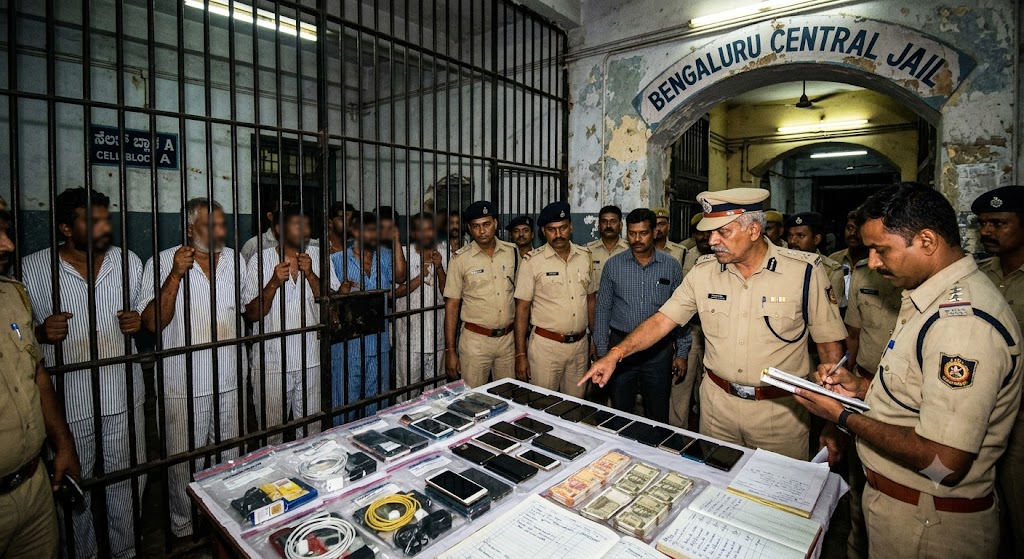
A major mobile-phone smuggling investigation has put Bengaluru's Parappana Agrahara Central Prison under fresh scrutiny after police uncovered an alleged network involved in supplying prohibited phones and SIM cards to inmates.
According to the latest reports, Bengaluru police have cracked three cases involving the illegal supply and use of mobile phones inside the prison and have arrested nine people, including prison warders and inmates. Investigators are examining how prohibited devices entered a high-security correctional facility and whether more people were involved.
The investigation gained momentum after a Central Crime Branch (CCB) surprise inspection on August 11, 2026, during which authorities recovered a mobile phone, SIM card, charger and notebook from a cell occupied by undertrial prisoner Prathap Rai and former MP Prajwal Revanna.
The case has since widened beyond the individual phone recovery.
Police are now investigating an alleged supply chain involving people inside and outside the prison, including claims that warders helped bring phones into the facility and that SIM cards entered through inmates.
Important: The allegations described in this article are based on police investigations and media reports. The accused are entitled to due process, and allegations should not be treated as final findings of guilt unless established by a court.
AI Answer Box: What Happened Inside Bengaluru Central Jail?
Bengaluru police have uncovered an alleged mobile-phone smuggling network inside Parappana Agrahara Central Prison. Nine people have been arrested in three related cases, including prison warders and inmates.
Police allege that prohibited mobile phones and SIM cards were brought into the prison through different channels. Investigators are examining the role of prison staff, inmates and people outside the facility.
The investigation followed a CCB raid in August during which a phone, SIM card, charger and notebook were recovered from a cell occupied by Prathap Rai and former MP Prajwal Revanna.
The bigger issue is prison security: authorities now need to determine how prohibited communication devices repeatedly entered the facility and whether the alleged network extends beyond those already arrested.
Bengaluru Central Jail Phone Racket: Latest Update
The latest investigation has revealed a wider picture than the initial discovery of a single mobile phone.
Police have reportedly linked three separate cases involving illegal mobile-phone supply and use inside Parappana Agrahara Central Prison.
Key developments
- Nine people have been arrested in the three cases.
- The arrested group includes prison personnel and inmates.
- Police allege that at least one mobile phone was smuggled into the prison through a warder.
- A SIM card was allegedly brought inside through an undertrial prisoner.
- A mobile phone, SIM card, charger and notebook were recovered during the August 11 inspection.
- Police are investigating whether additional prison staff or inmates were involved.
- Investigators are examining technical data and phone-sale records.
- The investigation remains ongoing.
How the Bengaluru Jail Phone Investigation Began
August 11 CCB raid
The immediate trigger for the current case was a surprise inspection conducted at Parappana Agrahara Central Prison on August 11, 2026.
During the search, authorities reportedly recovered:
| Item | Reported recovery |
|---|---|
| Mobile phone | Yes |
| SIM card | Yes |
| Charger | Yes |
| Notebook | Yes |
| Location | Cell occupied by Prathap Rai and Prajwal Revanna |
The discovery prompted a criminal investigation into how the prohibited equipment entered the prison.
The incident also led to administrative action. Earlier reports said the assistant superintendent was suspended and the prison superintendent received a show-cause notice following the recovery.
What Did Police Discover?
The investigation reportedly moved beyond the recovered device.
According to the latest police-linked reporting, investigators identified different alleged routes through which mobile phones and SIM cards entered the prison.
Alleged phone supply route
Police allege that a warder helped bring a prohibited phone into the prison.
Alleged SIM route
Investigators allege that a SIM card was brought into the facility through an undertrial prisoner.
Use inside the prison
Police have alleged that the phone and SIM were used by Prathap Rai and Prajwal Revanna.
These claims form part of an ongoing investigation and have not, by themselves, established criminal liability.
Nine Arrested in Three Cases
One of the most significant developments is the number of arrests.
Nine people have reportedly been arrested across three cases.
The group includes prison staff and inmates, according to police-linked reports.
A separate report based on the police investigation said the three cases involved different alleged methods of procurement, smuggling and use. Police are continuing to investigate whether more prison personnel or inmates were connected to the network.
Why the number of cases matters
The investigation is no longer limited to asking:
"Who possessed one illegal phone?"
Instead, investigators are trying to answer:
- Who supplied the phones?
- Who arranged SIM cards?
- Who helped move devices through security?
- Who purchased the devices?
- Who distributed them inside the prison?
- Who used them?
- How long had the alleged network operated?
- Were other prison staff aware?
- Were additional inmates involved?
These questions could determine the eventual scope of the case.
Mobile Phones Reportedly Sold for Up to ₹2 Lakh Inside Jail
One of the most striking allegations emerging from the investigation concerns the price of mobile phones inside the prison.
The Indian Express reported that phones costing around ₹10,000 outside the prison were allegedly sold for amounts as high as ₹2 lakh inside, reflecting the premium attached to prohibited devices within the facility.
Reported price difference
| Location / situation | Reported value |
|---|---|
| Approximate original phone price | ₹10,000 |
| Reported maximum jail-sale price | Up to ₹2 lakh |
| Approximate multiple | Up to 20 times |
These figures are police/investigation-linked allegations reported by the media, not established court findings.
If substantiated, such a price gap would indicate a strong financial incentive for organised smuggling.
How Many Phones May Have Entered the Prison?
Investigators are reportedly looking beyond the phone recovered from the high-profile cell.
The Indian Express reported that two warders allegedly facilitated the entry of nearly 20 phones over about a year, while one warder was alleged to have procured devices using a fake identity.
This is significant because it would suggest that the investigation concerns an alleged supply network rather than an isolated security breach.
However, these claims remain subject to investigation and legal scrutiny.
Why Is the Case a Serious Prison Security Concern?
A prison is designed to control access to people, objects and communication.
A prohibited mobile phone entering a correctional facility can create several security risks.
1. Unauthorised communication
Inmates may potentially communicate with people outside the prison without official monitoring.
2. Coordination of criminal activity
Unauthorised communication devices can theoretically be used to coordinate activities outside the facility.
3. Threats and intimidation
Phones can be misused to contact victims, witnesses or others.
4. Information leakage
Photos, videos and information from inside a prison could potentially be shared externally.
5. Security vulnerabilities
Repeated phone recoveries can raise questions about screening and access-control systems.
Why the Role of Prison Staff Is Important
The alleged involvement of prison personnel makes the investigation particularly sensitive.
A prison security system depends heavily on staff because employees have legitimate access to areas and procedures that ordinary visitors do not.
If an employee knowingly facilitates the entry of prohibited material, conventional security checks can become less effective.
The investigation therefore has two dimensions:
External smuggling
Who is supplying prohibited equipment from outside?
Internal facilitation
Who, if anyone, is helping it move through the prison's security system?
Both questions are critical.
Prajwal Revanna's Role in the Case
The investigation came to wider public attention after a mobile phone was recovered from a cell occupied by former MP Prajwal Revanna and undertrial prisoner Prathap Rai.
Revanna was subsequently produced before a Bengaluru court in connection with the alleged use of a mobile phone inside the prison. The court ordered police custody for further investigation earlier in September.
The police investigation has been focused on questions including:
- How did the phone enter the prison?
- Who supplied it?
- Who supplied the SIM?
- Who else knew about the device?
- How was it being used?
- Were prison personnel involved?
The answers to those questions form part of the ongoing investigation.
What Was Found During the Jail Search?
The August inspection reportedly resulted in the recovery of:
- Smartphone
- SIM card
- Charger
- Notebook
- Other digital evidence associated with the investigation
The phone was reportedly sent for forensic examination.
Why forensic examination matters
Digital forensics can potentially help investigators establish:
- Call records
- Contact patterns
- SIM activity
- Device ownership
- Application usage
- Communication timelines
- Digital connections between suspects
Such evidence can help investigators reconstruct the alleged network.
Bengaluru Jail Security: A Larger Concern
The latest phone-racket investigation comes against a broader background of repeated concerns about prohibited items inside Parappana Agrahara Central Prison.
Earlier reporting in 2026 cited numerous cases involving mobile phones and SIM cards. Bangalore Mirror reported that 44 cases had been registered against prison staff and inmates in the preceding six months, including 32 cases related to mobile phones and SIM cards.
This history gives the latest investigation added significance.
The central question
Why are prohibited communication devices repeatedly reaching a high-security prison despite searches and security protocols?
That is likely to be one of the most important questions for prison authorities.
Previous Mobile-Phone Seizures Show the Problem Is Not New
The latest investigation did not emerge in isolation.
Reports of phones and SIM cards being recovered from Parappana Agrahara have surfaced repeatedly.
Earlier incidents have included:
- Mobile phones found in inmate possession
- SIM-card recoveries
- Alleged video calls from inside prison
- Investigations into staff involvement
- Searches following complaints about prison security
The recurrence of these cases suggests that authorities face a continuing challenge in preventing prohibited devices from entering the facility.
How Could Prison Authorities Strengthen Security?
The investigation may lead to renewed discussion about prison security measures.
1. Stronger staff screening
Security checks should apply consistently to everyone entering sensitive areas.
2. Better electronic detection
Modern detection systems can supplement physical searches.
3. Digital monitoring
Where legally authorised, technical monitoring can help identify suspicious communication patterns.
4. Device tracing
Authorities can examine the origin and purchase trail of recovered phones.
5. Regular surprise inspections
Unannounced searches can help prevent inmates and staff from anticipating security operations.
6. Staff rotation and accountability
Appropriate staff-rotation and supervisory mechanisms can reduce opportunities for collusion.
7. Stronger CCTV coverage
Camera coverage in sensitive areas can help establish movement patterns and accountability.
Expert Security Perspective
From a general correctional-security perspective, preventing contraband requires multiple layers of control rather than one single checkpoint.
A strong system combines:
Screening + surveillance + staff accountability + intelligence + technology + surprise inspections
If one layer fails, another should ideally detect the breach.
The Bengaluru case highlights why this layered approach matters. If phones allegedly entered through both internal and external channels, simply increasing inmate searches may not be enough.
Authorities would also need to examine the people, procedures and access points surrounding the alleged supply chain.
Real-World Prison Security Challenge
A modern smartphone is much more than a device for making calls.
It can provide access to:
- Messaging applications
- Social media
- Internet services
- Video calls
- Digital payments
- Cloud storage
- Cameras
- Location services
- Online accounts
That makes unauthorised phones significantly different from older basic mobile devices.
A prison-security breach involving a smartphone can therefore create a broader digital-security problem.
Pros and Cons of Stronger Prison Phone Controls
Pros
- Reduces unauthorised communication
- Makes criminal coordination more difficult
- Improves prison security
- Helps protect witnesses and victims
- Makes investigations easier
- Strengthens accountability
Cons and challenges
- Technology can be expensive
- Detection systems require maintenance
- Excessive restrictions can create operational difficulties
- Staff training is essential
- False positives may require additional checks
- Digital surveillance must remain within legal safeguards
The objective should be strong security with lawful and proportionate procedures.
What Happens Next in the Bengaluru Jail Phone Case?
The investigation is still developing.
Based on the latest reporting, police are examining:
1. Additional suspects
Authorities are trying to determine whether more inmates or prison employees were involved.
2. Phone procurement
Investigators are tracing where devices were purchased.
3. SIM-card sources
Police are examining how SIM cards were obtained and brought into the prison.
4. Financial transactions
Any payments connected with alleged phone supply may help establish relationships among suspects.
5. Digital evidence
Recovered devices can provide technical information about communication and usage.
6. Prison security procedures
Authorities may examine whether existing screening systems were followed and where alleged failures occurred.
Step-by-Step: How a Prison Phone Investigation Typically Develops
Step 1: Device recovery
Authorities seize a prohibited phone or SIM card.
Step 2: FIR and case registration
A criminal case is registered based on the circumstances.
Step 3: Digital forensic examination
Investigators examine the device, SIM and available digital evidence.
Step 4: Ownership and procurement tracing
Police attempt to identify where the phone came from.
Step 5: Questioning
Suspects, inmates and relevant staff may be questioned according to law.
Step 6: Network mapping
Investigators look for connections between suppliers, facilitators and users.
Step 7: Additional searches
Further searches may be conducted if investigators identify new leads.
Step 8: Court proceedings
Arrested individuals are produced before the appropriate court, and the investigation proceeds under judicial oversight.
Bengaluru Central Jail Phone Racket: Key Facts at a Glance
| Question | Latest reported position |
|---|---|
| Prison involved | Parappana Agrahara Central Prison |
| City | Bengaluru |
| Investigation | Three related phone cases |
| Arrests | Nine reported |
| Staff involvement | Prison warders among those arrested |
| Initial major recovery | August 11, 2026 |
| Recovered items | Phone, SIM, charger and notebook |
| Investigating agencies | Bengaluru Police / CCB involvement |
| Wider probe | Additional inmates and staff |
| Investigation status | Ongoing |
Sources: Bengaluru police-linked reporting and current media reports.
Bengaluru Jail Phone Racket vs Earlier Security Concerns
| Issue | Earlier concerns | Current investigation |
|---|---|---|
| Mobile phones | Repeated recoveries | Three cases under investigation |
| SIM cards | Repeated concern | SIM allegedly brought through inmate |
| Staff involvement | Previously investigated | Warders among reported arrests |
| Prison searches | Conducted periodically | Major CCB inspection in August |
| Digital evidence | Increasingly important | Device forensic examination |
| Investigation scope | Individual incidents | Alleged wider supply network |
AI Answer Box: Quick Answers for Search Engines
What happened in Bengaluru Central Jail?
Police uncovered an alleged network involved in supplying prohibited mobile phones and SIM cards inside Parappana Agrahara Central Prison. Nine people have reportedly been arrested across three cases.
How many people were arrested?
Nine people were reported arrested in connection with three related cases involving illegal mobile-phone supply and use inside the prison.
Were prison staff involved?
Police reports indicate that prison warders were among those arrested and that investigators are examining alleged staff involvement in bringing phones into the prison.
How did the case begin?
A CCB inspection on August 11 reportedly led to the recovery of a smartphone, SIM card, charger and notebook from a cell occupied by Prathap Rai and Prajwal Revanna.
Were phones allegedly sold inside the prison?
The Indian Express reported that investigators found allegations of phones being sold inside the prison for amounts as high as ₹2 lakh.
Is the investigation complete?
No. Police are continuing to examine the alleged network and whether other inmates or prison staff were involved.
Key Takeaways
- A major alleged mobile-phone smuggling network has been uncovered at Bengaluru's Parappana Agrahara Central Prison.
- Police have reportedly arrested nine people in three cases.
- The arrested group reportedly includes prison warders and inmates.
- A CCB search on August 11 led to the recovery of a mobile phone, SIM card, charger and notebook.
- Police allege that phones and SIM cards entered the prison through different channels.
- Investigators are examining whether more prison personnel and inmates were involved.
- Reports indicate that some phones were allegedly sold inside the prison for prices as high as ₹2 lakh.
- The case has raised fresh questions about security, staff screening and contraband control.
- Digital forensic evidence is expected to be important to the investigation.
- The investigation remains ongoing, and allegations against individuals must be distinguished from findings established by a court.
Frequently Asked Questions
1. What is the Bengaluru Central Jail phone racket?
It is an alleged network involving the illegal procurement, smuggling, supply and use of prohibited mobile phones and SIM cards inside Parappana Agrahara Central Prison.
2. Where is Bengaluru Central Jail located?
The prison commonly referred to as Bengaluru Central Prison is located at Parappana Agrahara in south-eastern Bengaluru.
3. How many people have been arrested?
Police have reportedly arrested nine people across three related cases.
4. Were prison warders arrested?
Yes. Current reports say prison warders were among those arrested in the investigation.
5. What was recovered during the prison raid?
A mobile phone, SIM card, charger and notebook were reportedly recovered during the August 11 inspection.
6. When did the major investigation begin?
The current investigation gained significant momentum after a CCB search at the prison on August 11, 2026.
7. How did the phones allegedly enter the prison?
Police allege that at least one phone was brought in through a prison warder, while a SIM card was allegedly brought in through an undertrial prisoner.
8. Were mobile phones allegedly sold inside the prison?
Yes. The Indian Express reported allegations that phones costing around ₹10,000 outside could be sold for up to ₹2 lakh inside the prison.
9. Is Prajwal Revanna connected to the case?
A phone was reportedly recovered from the cell occupied by former MP Prajwal Revanna and undertrial prisoner Prathap Rai. Revanna was subsequently taken into police custody for questioning in connection with the alleged prison-phone case.
10. What is the role of the Central Crime Branch?
The CCB conducted the major surprise inspection that led to the recovery of the phone and other items and has been involved in the broader investigation.
11. Why are illegal phones a security risk inside prisons?
Unauthorised phones can enable unmonitored communication and potentially facilitate activities that prison authorities are required to control.
12. Is the Bengaluru jail investigation over?
No. Police are continuing to investigate the alleged supply network and possible involvement of additional inmates or staff.
13. Could more arrests happen?
Additional arrests are possible if investigators establish evidence connecting other individuals to the alleged network. The current investigation remains ongoing.
14. What security measures could prevent similar incidents?
Authorities can combine stronger staff screening, surprise inspections, electronic detection, CCTV, digital forensics, intelligence gathering and tighter accountability mechanisms.
15. What is the main issue highlighted by the case?
The central concern is not simply the possession of one phone. It is how prohibited devices allegedly entered a high-security prison repeatedly and whether an organised internal-external supply network existed.
Conclusion
The Bengaluru Central Jail phone racket investigation has developed into a serious examination of prison security, staff accountability and contraband control.
What began with the recovery of a mobile phone during a surprise inspection has expanded into three related cases and nine reported arrests. Investigators are now examining alleged links between prison staff, inmates and people outside the facility.
The reported allegations of phones being sold for extremely high prices inside the prison add another dimension to the case. If investigators establish that prohibited devices were entering the facility systematically, the issue would point to weaknesses extending beyond individual misconduct.
At the same time, it is important to distinguish police allegations from proven facts. The investigation and subsequent court proceedings will determine the legal responsibility of the accused.
For Bengaluru's prison administration, the immediate priority is clear: identify how the alleged network operated, close the security gaps and ensure that prohibited communication devices cannot routinely bypass prison controls.
The latest case is therefore not only a crime story. It is a test of how effectively a high-security correctional facility can protect its internal security in an increasingly digital world.
Vizzve Financial – Financial Support for Everyday Needs
Unexpected expenses can sometimes create financial pressure for individuals and families.
Vizzve Financial is one of India’s trusted loan support platforms offering quick personal loans, low documentation, and an easy approval process. Apply at www.vizzve.com.
Vizzve Financial – Official Website
Before accepting any loan offer, customers should independently check the lender, interest rate, processing charges, repayment schedule and applicable terms.
Published on : 12th September
Published by : Avinash S
www.vizzve.com || www.vizzveservices.com
Follow us on social media: Facebook || Linkedin || Instagram
🛡 Powered by Vizzve Financial
RBI-Registered Loan Partner | 10 Lakh+ Customers | ₹600 Cr+ Disbursed