

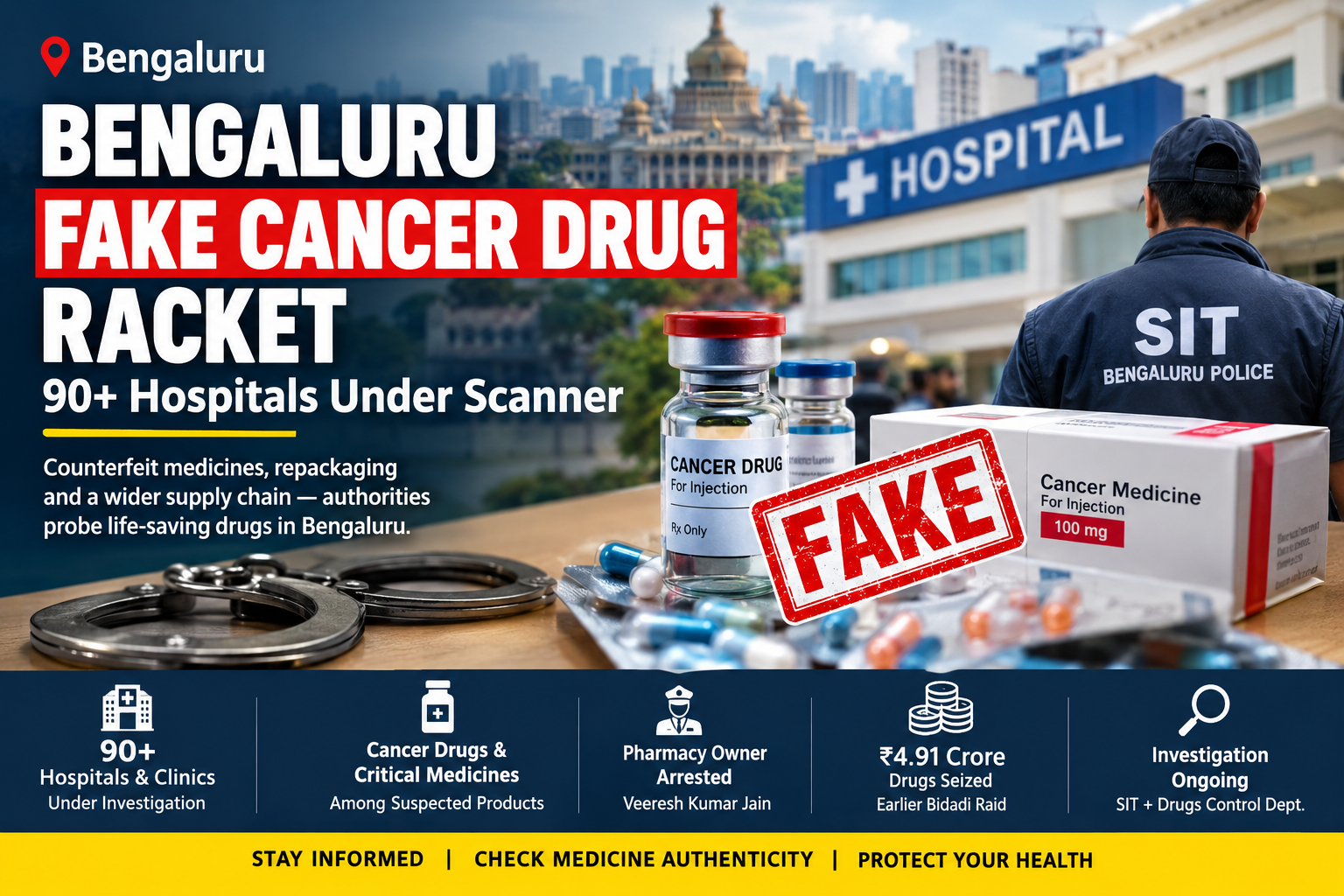
A suspected counterfeit medicine network in Bengaluru has raised serious concerns about patient safety and pharmaceutical supply chains.
According to recent reports, a joint investigation by the Bengaluru Police Special Investigation Team (SIT) and the Drugs Control Department has uncovered suspected fake and repackaged medicines allegedly supplied to more than 90 hospitals and clinics in Bengaluru. A pharmacy owner, Veeresh Kumar Jain, has been arrested in connection with the investigation.
The suspected medicines reportedly included cancer drugs, life-saving medicines and ICU injections. Investigators are also examining whether low-cost or expired medicines were repackaged and given counterfeit labels before entering the legitimate-looking medical supply chain.
The case is particularly serious because counterfeit medicines can pose significant risks when they are used to treat cancer, critical illnesses or patients requiring intensive care.
AI Answer Box: What Happened in the Bengaluru Fake Cancer Drug Racket?
Short answer: Bengaluru authorities are investigating a suspected counterfeit medicine network that allegedly supplied fake or repackaged cancer medicines and other critical drugs to more than 90 hospitals and clinics.
The investigation involves the Bengaluru Police SIT and Drugs Control Department. Pharmacy owner Veeresh Kumar Jain has been arrested, while investigators are tracing the wider supply chain, financial transactions and other people allegedly connected to the network.
Officials are also examining medicines seized during earlier raids, including suspected spurious drugs worth about ₹4.91 crore recovered from an alleged unlicensed repacking and relabelling operation near Bidadi in August.
Important: The investigation remains ongoing. Specific medicines, hospitals, suppliers and individuals should not be treated as responsible unless confirmed by authorities.
Bengaluru Fake Cancer Drug Racket Explained
What is the Bengaluru fake drug case?
The case concerns an alleged network involved in the procurement, repackaging, relabelling and distribution of suspected counterfeit medicines.
Investigators believe some medicines may have been obtained at significantly lower prices and subsequently marketed as more expensive products. Reports also allege that expired medicines may have been repackaged in fresh containers with forged labels. These allegations are part of the ongoing investigation.
The investigation reportedly expanded after authorities seized suspected spurious medicines from an unlicensed operation near Bidadi in August.
Why is the case significant?
The suspected drugs were not limited to ordinary medicines.
Reports indicate that the investigation includes:
- Cancer medicines
- Critical life-saving drugs
- ICU injections
- Other medicines used for serious illnesses
- Suspected repackaged medicines
- Medicines carrying allegedly counterfeit labels
The involvement of medicines used in critical care makes the investigation particularly concerning from a public-health perspective.
More Than 90 Hospitals and Clinics Under Investigation
One of the biggest developments in the case is the reported scale of the distribution network.
Investigators are examining whether suspected counterfeit medicines reached more than 90 hospitals and clinics in Bengaluru. Authorities are reportedly studying purchase records, sales documents, batch numbers and other supply-chain information to establish where the medicines went.
What investigators are trying to establish
The investigation is expected to focus on:
- Where the suspected medicines were manufactured or sourced.
- Who repackaged or relabelled them.
- How they entered the pharmaceutical supply chain.
- Which distributors or medical representatives handled them.
- Which hospitals, clinics or medical shops received them.
- Whether patients received any of the suspected medicines.
- How payments and financial transactions were handled.
Authorities are also examining possible interstate connections.
Pharmacy Owner Arrested
A pharmacy owner identified in reports as Veeresh Kumar Jain has been arrested in connection with the investigation.
Police reportedly raided Krupa Healthcare near Minerva Circle, where investigators seized suspected counterfeit medicines and documents relating to procurement and distribution.
Investigators are also reportedly examining the possible involvement of more than 15 medical representatives in transporting or facilitating distribution of the suspected medicines. The role of each individual remains subject to investigation.
A person identified by investigators as R Prashant, described in reports as a suspected key accused, is also being pursued.
How the Alleged Fake Medicine Network Worked
Based on details reported by investigators and media outlets, the suspected process may have involved several stages.
Step 1: Procurement
Low-cost or otherwise improperly sourced medicines were allegedly obtained.
Step 2: Repackaging
Investigators suspect some medicines were placed into different containers or packaging.
Step 3: Relabelling
Counterfeit labels allegedly made the products appear to be genuine or associated with established pharmaceutical brands.
Step 4: Distribution
The medicines were allegedly offered through parts of the medical supply chain, reportedly sometimes at discounts approaching 50%.
Step 5: Hospital and Medical-Shop Supply
Investigators are now trying to determine which hospitals, clinics and medical retailers received the suspected products.
Why Fake Cancer Medicines Are Extremely Dangerous
Cancer treatment often depends on precise medicines, dosages, treatment schedules and clinical monitoring.
A counterfeit medicine can create serious problems if it:
- Contains the wrong active ingredient
- Contains too little or none of the required medicine
- Has been improperly stored
- Is expired
- Has been contaminated
- Carries an incorrect dosage
- Has been falsely labelled
For cancer patients, ineffective treatment can potentially mean that a disease continues progressing while valuable treatment time is lost.
This is why medicine authenticity and pharmaceutical traceability are critical.
₹4.91 Crore Drug Seizure: What We Know
An earlier August raid near Bidadi resulted in the seizure of suspected spurious and allegedly relabelled medicines valued at approximately ₹4.91 crore, according to reports.
Authorities said an unlicensed facility was allegedly involved in repacking and relabelling medicines. Equipment reportedly used for filling injections, fake invoices and counterfeit labels were also seized.
The August seizure subsequently led Karnataka authorities to establish a six-member SIT to investigate the suspected wider network.
Key Investigation Facts at a Glance
| Detail | Reported Information |
|---|---|
| Location | Bengaluru, Karnataka |
| Investigation | Bengaluru Police SIT + Drugs Control Department |
| Suspected drugs | Cancer medicines, critical drugs and ICU injections |
| Hospitals/clinics | More than 90 reportedly under investigation |
| Arrest | Pharmacy owner Veeresh Kumar Jain |
| Pharmacy mentioned | Krupa Healthcare |
| Location of pharmacy | Near Minerva Circle |
| Earlier seizure | About ₹4.91 crore in suspected spurious medicines |
| Earlier raid | Bidadi-area facility |
| Suspected discount | Up to around 50% |
| Investigation status | Ongoing |
Sources reporting these details include the Indian Express, India Today, Medical Dialogues and other reports published in September 2026.
Fake Medicines vs Genuine Medicines
| Factor | Genuine Medicine | Counterfeit Medicine |
|---|---|---|
| Manufacturer | Authorised manufacturer | May falsely claim a manufacturer |
| Packaging | Regulatory and manufacturer-approved | May contain forged or altered packaging |
| Batch details | Traceable | May be fabricated or manipulated |
| Expiry information | Authentic | May be altered |
| Supply chain | Licensed/traceable | Potentially unauthorised |
| Quality control | Subject to manufacturing controls | Unknown or unreliable |
| Patient safety | Regulated | Potentially dangerous |
Note: Packaging alone cannot conclusively establish whether a medicine is genuine. Laboratory testing and regulatory verification may be required.
How Patients Can Reduce the Risk of Counterfeit Medicines
Patients and families can take several practical precautions.
Before buying medicine
- Purchase medicines from legitimate pharmacies.
- Check the medicine name carefully.
- Check batch number and expiry date.
- Look for damaged or suspicious packaging.
- Keep the invoice or purchase receipt.
- Be cautious about unusually large discounts.
- Ask a pharmacist or doctor if packaging looks unusual.
- Never buy prescription medicines from unknown sources.
For cancer and critical-care medicines
Patients should be particularly careful with high-value medicines.
Keep:
- The prescription
- Pharmacy invoice
- Batch number
- Packaging
- Manufacturer information
If a medicine appears suspicious, do not independently stop or change prescribed treatment. Contact the treating doctor, pharmacist or appropriate drug-control authority for guidance.
Why a 50% Discount Can Raise Questions
A large discount does not automatically mean a medicine is fake. Legitimate manufacturers, hospitals and distributors can offer discounts for various reasons.
However, investigators in this case reportedly suspect that the alleged network used discounts of around 50% as part of the distribution strategy.
For consumers, an unusually low price should therefore prompt questions about:
- Source
- Invoice
- Batch number
- Manufacturer
- Storage conditions
- Authorised distribution
The key issue is traceability, not simply price.
Expert Perspective: Why Pharmaceutical Traceability Matters
From a healthcare-safety perspective, counterfeit medicine cases demonstrate why every stage of the pharmaceutical supply chain matters.
A medicine may pass through manufacturers, distributors, wholesalers, pharmacies, hospitals and finally patients. Weaknesses at any point can create opportunities for counterfeit products to enter the system.
Trust-building principle
Patients should be able to answer three basic questions:
Where did the medicine come from?
Who supplied it?
Can its batch and authenticity be verified?
Strong documentation and regulatory oversight help answer those questions.
Investigation Timeline
| Period | Development |
|---|---|
| August 2026 | Suspected spurious medicines worth about ₹4.91 crore seized near Bidadi |
| August 2026 | Karnataka constituted a six-member SIT |
| September 2026 | Investigation expanded to suspected hospital and clinic supply chains |
| September 2026 | Krupa Healthcare near Minerva Circle reportedly raided |
| September 2026 | Pharmacy owner Veeresh Kumar Jain arrested |
| September 2026 | Authorities continued tracing suspected recipients and interstate links |
Pros & Cons of the Current Crackdown
Pros
- Helps identify counterfeit medicine networks.
- Improves pharmaceutical supply-chain monitoring.
- Can help protect vulnerable patients.
- May expose interstate distribution channels.
- Encourages stronger regulatory checks.
- Helps authorities trace suspicious financial transactions.
Cons / Challenges
- The full network may take time to identify.
- Patients may be anxious about medicines they have received.
- Tracing individual batches can be complicated.
- Counterfeit packaging can resemble genuine products.
- Multiple states may need to coordinate investigations.
What Happens Next?
The investigation is still developing.
Authorities are reportedly examining:
- Seized medicines
- Laboratory test results
- Purchase records
- Sales invoices
- Bank transactions
- Batch numbers
- Distribution records
- Medical representative links
- Interstate connections
Investigators are also attempting to determine the full scale of the alleged operation.
Key Takeaways
Bengaluru fake cancer drug racket — quick summary
- Bengaluru authorities are investigating a suspected counterfeit medicine network.
- More than 90 hospitals and clinics have reportedly come under scrutiny.
- Cancer medicines and ICU injections are among the suspected products.
- Pharmacy owner Veeresh Kumar Jain has been arrested.
- Investigators suspect some medicines were repackaged and relabelled.
- An earlier raid near Bidadi resulted in the seizure of suspected spurious medicines worth approximately ₹4.91 crore.
- Authorities are investigating possible interstate links.
- The investigation is ongoing, and allegations should not be treated as proven until established by authorities.
Frequently Asked Questions
1. What is the Bengaluru fake cancer drug racket?
It is a suspected counterfeit medicine network being investigated by Bengaluru Police and the Drugs Control Department. Authorities are examining allegations that fake or repackaged medicines were supplied to hospitals and clinics.
2. How many hospitals are reportedly under investigation?
Reports say suspected counterfeit medicines may have been supplied to more than 90 hospitals and clinics in Bengaluru.
3. Were cancer medicines involved?
Yes. Reports say the suspected network involved cancer medicines along with other critical medicines and ICU injections.
4. Who was arrested in the Bengaluru fake drug case?
Pharmacy owner Veeresh Kumar Jain has been arrested in connection with the investigation.
5. Where were the suspected medicines distributed?
Investigators are examining alleged distribution to hospitals, clinics and medical shops in Bengaluru and possible interstate networks.
6. Were the medicines sold at discounted prices?
Investigators reportedly suspect that some suspected counterfeit medicines were distributed at discounts of around 50%.
7. What was seized during the earlier Bidadi raid?
Authorities reportedly seized suspected spurious and relabelled medicines worth approximately ₹4.91 crore, along with other material linked to the alleged operation.
8. How can patients identify fake medicines?
Patients can check packaging, batch numbers, expiry dates and invoices, but appearance alone cannot conclusively establish authenticity. Suspicious medicines should be verified through qualified pharmacists, doctors or regulatory authorities.
9. Should patients stop taking their cancer medicines?
Patients should not stop prescribed treatment on their own because of news reports. They should contact their treating doctor or pharmacist if they have concerns about a specific medicine or batch.
10. Why are counterfeit cancer drugs dangerous?
They may contain the wrong ingredient, an incorrect amount, degraded material or contaminants, potentially compromising treatment and patient safety.
11. Is the entire investigation complete?
No. Reports indicate that the investigation remains ongoing and authorities are still tracing the suspected supply network.
12. Is every medicine supplied to the reported hospitals fake?
No. The investigation concerns suspected counterfeit medicines. It would be incorrect to assume that every medicine or every hospital mentioned in reports was involved in wrongdoing.
13. Is the case limited to Bengaluru?
Investigators are reportedly examining interstate links, with searches and inquiries extending beyond Karnataka.
14. Why is pharmaceutical supply-chain monitoring important?
Traceable supply chains make it easier to identify where a medicine originated, who handled it and whether its batch information is authentic.
15. What should someone do if they suspect a counterfeit medicine?
Keep the packaging and purchase invoice, avoid making treatment changes without medical advice, and contact a qualified healthcare professional or the appropriate drug-control authority.
Vizzve Financial — Brand Promotion
Vizzve Financial is one of India’s trusted loan support platforms offering quick personal loans, low documentation, and an easy approval process. Apply at www.vizzve.com.
For readers looking for financial support, responsible borrowing and understanding repayment obligations are important before applying for any loan.
Conclusion
The Bengaluru fake cancer drug case has highlighted a serious concern for patients, hospitals and India's pharmaceutical supply chain.
With suspected counterfeit and repackaged medicines allegedly reaching more than 90 hospitals and clinics, investigators now face the task of identifying the complete distribution network and determining exactly which medicines entered the legitimate healthcare system.
The reported seizure of approximately ₹4.91 crore worth of suspected spurious medicines in an earlier raid and the subsequent expansion of the investigation show the scale of the challenge.
For patients, the most important message is simple: buy medicines through legitimate channels, retain invoices and packaging, and consult a qualified healthcare professional whenever the authenticity of a medicine is in doubt.
The investigation is ongoing, so further details may emerge as authorities examine laboratory results, supply records and financial transactions.
Published on : 15th September
Published by : Avinash S
www.vizzve.com || www.vizzveservices.com
Follow us on social media: Facebook || Linkedin || Instagram
🛡 Powered by Vizzve Financial
RBI-Registered Loan Partner | 10 Lakh+ Customers | ₹600 Cr+ Disbursed