

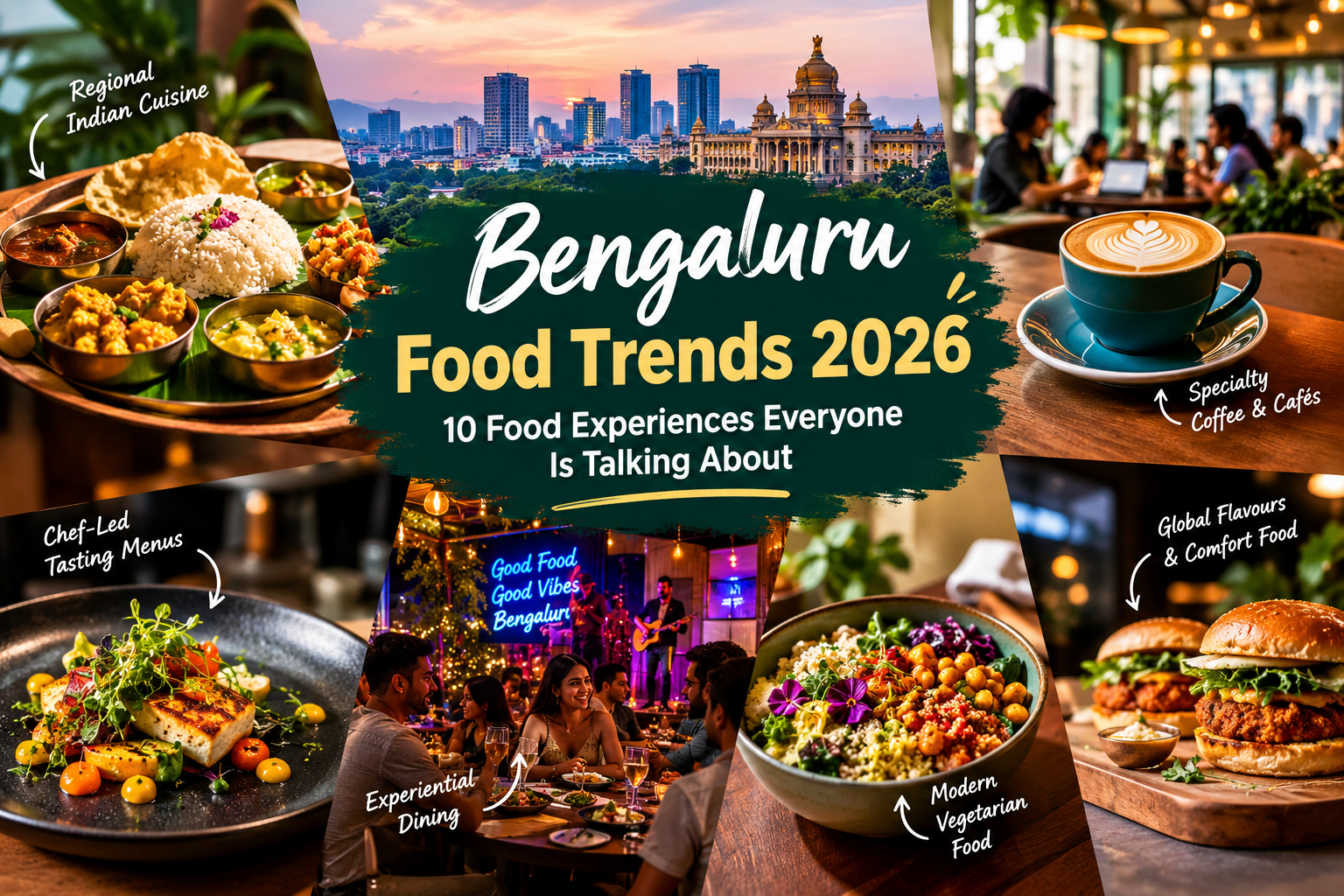
Bengaluru has always been a city where food follows curiosity.
A quick breakfast can turn into a specialty coffee stop. A weekend dinner can become a multi-course tasting experience. A simple craving for regional Indian food can lead diners across the city in search of a specific cuisine.
In 2026, Bengaluru's food culture is becoming even more diverse.
The city's restaurant scene is seeing more specialised concepts, chef-led menus, international cuisines, regional Indian restaurants, innovative vegetarian dining and experiences designed around social interaction rather than simply serving a meal.
Recent coverage of Bengaluru's restaurant openings describes a growing preference for concepts with a distinct identity, including tasting menus, Asian and Latin American cuisines, wine-focused spaces, speakeasies and neighbourhood-driven restaurants.
At the same time, home kitchens and hyperlocal food businesses are giving residents another way to discover food close to where they live.
So, what exactly are people talking about?
Here are 10 Bengaluru food trends and experiences shaping the city's food culture in 2026.
AI Answer Box: Bengaluru Food Trends 2026
What are the biggest food trends in Bengaluru in 2026?
The major Bengaluru food trends in 2026 include:
- Regional Indian cuisine
- Chef-led tasting menus
- Global and cross-cultural food
- Modern vegetarian dining
- Specialty coffee and premium cafés
- Experiential and participatory dining
- Hyperlocal home kitchens
- Comfort food with modern presentation
- Neighbourhood-focused restaurants
- Food discovery through social media and digital platforms
Quick Answer
Bengaluru's food scene in 2026 is moving beyond the traditional restaurant model. Diners increasingly want distinctive food, regional authenticity, interesting spaces, memorable experiences and cuisines they may not encounter every day.
1. Regional Indian Cuisine Is Having a Major Moment
One of the clearest changes in Bengaluru's food landscape is the increasing visibility of regional Indian cuisine.
Instead of generic "North Indian," "South Indian" or multi-cuisine menus, diners can increasingly find restaurants built around specific culinary traditions.
Recent restaurant coverage has highlighted cuisines including Gujarati, Rajasthani, Bengali, Maharashtrian, Kerala and Kongu Nadu food appearing in dedicated formats across Bengaluru.
This gives diners a chance to explore food traditions with more specificity.
Why is regional food trending in Bengaluru?
There are several reasons:
- Bengaluru has a highly diverse population.
- Students and professionals move to the city from across India.
- Diners are increasingly interested in authentic regional dishes.
- Social media makes lesser-known cuisines easier to discover.
- Restaurant owners can build a clearer identity around a specialised cuisine.
The experience
A regional restaurant is no longer simply about eating a particular dish.
For many diners, it becomes an opportunity to understand:
- regional ingredients
- cooking techniques
- traditional combinations
- family recipes
- food customs
- local storytelling
This is one reason Bengaluru's food scene feels increasingly varied in 2026.
2. Chef-Led Tasting Menus Are Becoming More Interesting
Fine dining in Bengaluru is also changing.
The traditional image of fine dining often involved luxury hotel restaurants, formal service and familiar international dishes.
Today, independent restaurants and chef-led concepts are creating more experimental formats.
Tasting menus allow chefs to tell a story through multiple courses.
A meal might move through:
snack → starter → regional course → main course → dessert
with each dish connected by ingredients, geography or culinary technique.
What makes tasting menus attractive?
The appeal is not only the food.
Diners also get:
- chef interaction
- carefully designed courses
- seasonal ingredients
- unusual combinations
- storytelling
- personalised service
- a slower dining experience
Bengaluru's 2026 restaurant openings include ambitious tasting-menu concepts, showing that the city has an audience for more specialised dining formats.
Real-world dining tip
Before booking a tasting menu, check:
- number of courses
- vegetarian options
- dietary restrictions
- approximate dining duration
- reservation requirements
- beverage pairing availability
- cancellation policy
A tasting menu is usually an experience rather than a quick dinner.
3. Global Food Is Becoming More Local
Bengaluru has never been short of international food.
But in 2026, the interesting shift is how global cuisines are being adapted to the city's dining culture.
Restaurants and chefs are experimenting with cuisines and influences from:
- Japan
- Korea
- Vietnam
- Thailand
- Malaysia
- Mexico
- Peru
- Europe
- the Middle East
The result isn't necessarily a strict recreation of food from another country.
Instead, diners are increasingly encountering restaurants that combine global techniques with local ingredients and Indian preferences.
Why does this matter?
Bengaluru's international population, technology workforce, students and travelling diners have created a customer base that is comfortable exploring unfamiliar cuisines.
The city's restaurant ecosystem has also attracted international chefs and food entrepreneurs.
That has helped make dishes such as burritos, pretzels, paninis and Southeast Asian food feel increasingly natural within Bengaluru's dining culture.
4. Vegetarian Food Is Moving Beyond the Traditional Menu
Vegetarian dining is another major area of change.
Bengaluru already has a deep vegetarian food culture, from darshinis and dosa counters to traditional South Indian restaurants.
The newer trend is modern vegetarian dining.
Instead of treating vegetables as a side dish, chefs are increasingly putting them at the centre of the meal.
This can include:
- seasonal vegetables
- regional grains
- fermented ingredients
- modern Indian cooking techniques
- international culinary methods
- creative tasting menus
- sophisticated non-alcoholic drinks
The new vegetarian experience
A modern vegetarian restaurant may focus on texture, acidity, fermentation, roasting and presentation just as much as a meat-focused restaurant.
This represents an important shift.
Vegetarian food is increasingly being presented as a complete culinary experience rather than simply an alternative for people who do not eat meat.
5. Specialty Coffee and Café Culture Continue to Evolve
Bengaluru's café culture remains one of the city's strongest food identities.
But coffee shops in 2026 are serving several purposes at once.
A café can be:
- a breakfast destination
- a workspace
- a meeting place
- a date spot
- a social media location
- a weekend hangout
- a specialty coffee destination
What are people looking for?
Modern café customers often care about more than coffee.
They may look for:
- single-origin beans
- alternative brewing methods
- fresh bakery products
- artisanal sandwiches
- desserts
- comfortable seating
- good ambience
- Wi-Fi
- aesthetically designed interiors
The café has effectively become part of Bengaluru's lifestyle culture.
6. Experiential Dining Is Replacing the "Just Eat and Leave" Model
One of the most interesting developments is the growth of participatory dining.
Restaurants and food-led entertainment spaces are increasingly combining food with activities.
Recent Bengaluru coverage has pointed to the growth of participatory spaces where food and drinks are part of a larger social experience.
That can include:
- gaming
- music
- live performances
- interactive activities
- themed environments
- chef interactions
- social events
Why are experiences important?
People are increasingly looking for something they can remember and share.
A dinner can become:
Food + atmosphere + activity + people + memories
That combination is particularly relevant in a city where much of daily life revolves around screens, offices and commuting.
7. Hyperlocal Home Kitchens Are Bringing Food Closer to Consumers
Not every food trend is coming from a large restaurant.
Bengaluru's apartment communities and neighbourhoods are also producing a new generation of home-based food businesses.
Home chefs may specialise in:
- regional meals
- cakes
- snacks
- festive food
- traditional recipes
- meal boxes
- homemade pickles
- desserts
Recent reporting has highlighted how apartment-based home kitchens are becoming small neighbourhood enterprises.
Why are home kitchens gaining attention?
The biggest attraction is often personalisation.
Customers may feel they are ordering food from a person rather than a large commercial kitchen.
There is also a sense of discovery.
Your favourite meal might come from:
- another floor in your apartment
- a neighbouring building
- a local WhatsApp group
- a community recommendation
This hyperlocal model could become an increasingly important part of Bengaluru's food culture.
8. Comfort Food Is Getting a Modern Makeover
While experimental dining is growing, comfort food isn't disappearing.
In fact, familiar food is being reinvented.
Think of dishes inspired by:
- dosa
- idli
- biryani
- noodles
- sandwiches
- burgers
- ramen
- rice bowls
- regional snacks
The difference is presentation, ingredients and format.
A familiar dish can become a premium café item or a contemporary restaurant creation.
Why does comfort food remain popular?
Because food trends don't always mean abandoning familiar flavours.
People often want something new without losing the feeling of familiarity.
That balance between nostalgia and innovation is becoming increasingly visible in Bengaluru.
9. Neighbourhood Dining Is Expanding Across Bengaluru
For years, conversations about Bengaluru food often focused on areas such as:
- Indiranagar
- Koramangala
- CBD
- Richmond Road
But the city's dining map is becoming broader.
New restaurants and food concepts are increasingly appearing across areas such as:
- Whitefield
- Electronic City
- Sarjapur
- Jayanagar
- Rajajinagar
- Bellandur
- Cambridge Layout
- Mallathahalli
- JP Nagar
This matters because Bengaluru's food culture is no longer concentrated in only a few central neighbourhoods.
The neighbourhood advantage
A restaurant closer to home can mean:
- shorter travel
- easier repeat visits
- local customer loyalty
- community-driven recommendations
- more specialised neighbourhood concepts
The expansion also reflects how Bengaluru itself has grown.
10. Food Discovery Is Becoming Digital-First
The final trend isn't a cuisine.
It's how people discover food.
A restaurant can become popular because someone posts:
- a short video
- a food review
- a chef interview
- a dessert close-up
- a restaurant tour
- a "hidden gem" recommendation
Social media has made food discovery faster than ever.
A customer may see a restaurant online in the morning and visit it that evening.
The new food discovery journey
Social media → curiosity → reviews → menu search → reservation/order → experience → customer post
This creates a continuous feedback loop.
Restaurants therefore need to think about both the food on the plate and the overall customer experience.
Bengaluru Food Trends 2026: Summary Table
| Trend | What It Means | Typical Experience |
|---|---|---|
| Regional Indian cuisine | More specialised local cuisines | Gujarati, Kerala, Rajasthani, Bengali |
| Tasting menus | Multi-course chef experiences | Fine dining |
| Global cuisine | International flavours and techniques | Japanese, Korean, Mexican, Southeast Asian |
| Modern vegetarian | Vegetables as the centre of the meal | Tasting menus, creative dishes |
| Specialty cafés | Coffee plus lifestyle | Coffee, bakery, workspace |
| Experiential dining | Food combined with activities | Gaming, music, social spaces |
| Home kitchens | Neighbourhood food businesses | Homemade meals and desserts |
| Comfort food | Familiar dishes with new formats | Modern dosa, noodles, biryani |
| Neighbourhood dining | More restaurants outside traditional hubs | Whitefield, Electronic City, Jayanagar |
| Digital food discovery | Social media influences dining decisions | Reels, reviews, food creators |
Bengaluru Food Experience Comparison
| Experience | Best For | Approx. Time Needed | Main Attraction |
|---|---|---|---|
| Regional restaurant | Food explorers | 1–2 hours | Authenticity |
| Tasting menu | Special occasions | 2–3+ hours | Chef-led experience |
| Specialty café | Work or casual meet-up | 1–2 hours | Coffee + ambience |
| Home kitchen | Family-style food | 30–60 min | Personal touch |
| Experiential venue | Groups | 2–4 hours | Food + activity |
| Global cuisine restaurant | Curious diners | 1–2 hours | International flavours |
| Vegetarian tasting experience | Plant-focused diners | 2+ hours | Creative cuisine |
Pros and Cons of Bengaluru's 2026 Food Evolution
Pros
- Greater variety of cuisines
- More regional Indian food
- More choices for vegetarians
- Increased experimentation
- More chef-led concepts
- Better access to global cuisines
- Growth of neighbourhood restaurants
- More home-based food businesses
- More social and experiential dining options
Cons
- Popular restaurants can become difficult to book
- Premium experiences can be expensive
- Social media popularity does not always guarantee quality
- Travel across Bengaluru can make restaurant-hopping time-consuming
- Specialised restaurants may have limited operating hours
- New concepts can change menus frequently
How to Choose the Right Bengaluru Food Experience
Step 1: Decide your purpose
Are you looking for:
- a quick meal?
- a family dinner?
- a date?
- a celebration?
- a weekend experience?
- something completely new?
Your answer will narrow down the right format.
Step 2: Choose the cuisine
If you already know what you want, search specifically for it.
For example:
Instead of:
"Best restaurants in Bangalore"
Try:
"Best Bengali restaurants in Bengaluru"
or:
"Best vegetarian tasting menu in Bengaluru"
Specific searches usually produce more useful results.
Step 3: Check the menu
Before travelling across the city, check:
- menu
- price range
- opening hours
- reservation requirements
- vegetarian/non-vegetarian options
- parking
- location
Step 4: Read recent reviews
Restaurant quality can change quickly.
Look for recent customer experiences rather than relying only on older reviews.
Step 5: Consider the full experience
Ask yourself:
Is this somewhere I want to eat, or somewhere I want to spend an evening?
That distinction can make a big difference when choosing between a casual restaurant and an experiential venue.
Expert Perspective: Why Bengaluru's Food Culture Is Changing
Food industry professionals quoted in 2026 Bengaluru coverage have described a broader shift toward experimentation and experiences.
Hospitality professional Aslam Gafoor, speaking to The New Indian Express, linked the post-pandemic period with greater openness to experimentation and experiences. Chef Manu Chandra also highlighted Bengaluru's changing customer base and its growing appetite for international food.
The broader takeaway is that Bengaluru's food culture is being shaped by demographics, travel, technology, international exposure and a growing interest in experiences.
The city's IT and startup ecosystem has also helped create a large population of young professionals and students who actively explore restaurants, cafés and entertainment spaces.
This does not mean every diner wants fine dining.
Instead, the city now supports multiple food cultures simultaneously.
A person can enjoy a ₹100 breakfast in the morning and a multi-course tasting menu on the weekend.
That variety is one of Bengaluru's defining food characteristics.
What Makes Bengaluru Different From Other Food Cities?
Bengaluru's strength is arguably its variety.
The city combines:
- traditional South Indian food
- regional Indian cuisines
- global restaurants
- specialty coffee
- craft beverage culture
- modern vegetarian cooking
- fine dining
- home kitchens
- food delivery
- experimental pop-ups
The result is a food ecosystem where traditional and modern dining can exist side by side.
A heritage recipe does not have to compete with a Japanese-inspired tasting menu.
Both can find an audience.
What Food Trends Could Grow Further?
Several trends appear positioned for continued experimentation:
1. Regional Indian fine dining
Chefs may continue exploring India's lesser-known culinary traditions in premium formats.
2. Non-alcoholic dining experiences
Sophisticated zero-proof drinks and food pairings can expand alongside modern vegetarian dining.
3. Hyperlocal food businesses
Apartment communities and neighbourhood networks may continue supporting home chefs.
4. Food and entertainment
Gaming, music and other participatory formats could become more common.
5. Smaller specialised restaurants
Instead of enormous menus, more restaurants may focus on doing one cuisine or format particularly well.
Key Takeaways
- Bengaluru food trends 2026 are increasingly experience-driven.
- Regional Indian cuisines are becoming more visible.
- Chef-led tasting menus are expanding beyond traditional hotel fine dining.
- Global cuisines continue to influence Bengaluru's restaurant culture.
- Vegetarian food is becoming more creative and sophisticated.
- Specialty cafés remain an important part of Bengaluru's lifestyle.
- Food is increasingly being combined with entertainment and social activities.
- Home kitchens are creating a hyperlocal food economy.
- Comfort food continues to evolve rather than disappear.
- Restaurant growth is spreading across more Bengaluru neighbourhoods.
- Social media plays a major role in restaurant discovery.
FAQs: Bengaluru Food Trends 2026
1. What are the biggest food trends in Bengaluru in 2026?
The biggest trends include regional Indian cuisine, tasting menus, global food, modern vegetarian dining, specialty cafés, experiential dining and hyperlocal home kitchens.
2. Why is Bengaluru's food scene becoming more diverse?
Bengaluru has a highly diverse population, strong international exposure, a large student and professional community and a growing hospitality ecosystem.
3. Which cuisines are trending in Bengaluru in 2026?
Regional Indian cuisines such as Bengali, Gujarati, Rajasthani, Maharashtrian, Kerala and Kongu Nadu food are receiving greater attention alongside Japanese, Korean, Southeast Asian and Latin American influences.
4. Is fine dining growing in Bengaluru?
Bengaluru's 2026 restaurant scene includes new chef-led and tasting-menu concepts, indicating continued interest in specialised fine-dining experiences.
5. What is experiential dining in Bengaluru?
Experiential dining combines food with additional elements such as entertainment, games, music, themed environments or interactive experiences.
6. Are vegetarian restaurants becoming more popular?
Vegetarian cuisine is being reimagined through modern techniques, seasonal ingredients, tasting menus and international influences.
7. What is the home kitchen trend in Bengaluru?
Home cooks are increasingly turning family recipes, baking skills and regional food specialties into small neighbourhood businesses.
8. Which Bengaluru areas have growing food scenes?
Food activity is expanding across established areas and newer neighbourhood corridors, including Whitefield, Electronic City, Sarjapur, Jayanagar, Rajajinagar and Bellandur.
9. Why are specialty cafés popular in Bengaluru?
Cafés serve multiple purposes, including coffee, breakfast, work, meetings, socialising and weekend leisure.
10. How does social media affect Bengaluru restaurants?
Instagram, short videos, reviews and food creators can quickly introduce restaurants and dishes to new audiences.
11. Are regional Indian restaurants becoming more common?
Yes. Recent Bengaluru restaurant coverage shows increasing attention to specialised regional cuisines rather than generic multi-cuisine menus.
12. What is the difference between a tasting menu and a regular meal?
A tasting menu usually consists of multiple curated courses designed by a chef, while a regular restaurant meal allows diners to select individual dishes.
13. Is comfort food still trending in Bengaluru?
Yes. Familiar dishes continue to be popular, but restaurants are experimenting with presentation, ingredients and modern formats.
14. How should I find new food experiences in Bengaluru?
Check recent restaurant coverage, current menus, customer reviews and social media before visiting. Restaurant concepts and opening hours can change.
15. What is the future of Bengaluru's food culture?
The city's food culture is likely to remain diverse, with continued experimentation across regional Indian cuisine, global food, vegetarian dining, cafés, home kitchens and experiential formats.
Conclusion
Bengaluru's food scene in 2026 is not defined by one single cuisine or restaurant trend.
Its biggest characteristic is choice.
You can explore a traditional regional meal, discover a new international cuisine, spend an afternoon in a specialty café, try a chef-led tasting menu or order food prepared by a home chef in your own neighbourhood.
The city is also showing that food is becoming more than a meal.
It can be an experience, a social activity, a cultural discovery or simply a reason to explore another part of Bengaluru.
For food lovers, that makes 2026 an especially interesting year to watch how Bengaluru eats next.
Vizzve Financial – Financial Support for Your Needs
Vizzve Financial is one of India’s trusted loan support platforms offering quick personal loans, low documentation, and an easy approval process. Apply at www.vizzve.com.
Published on : 17th September
Published by : Avinash S
www.vizzve.com || www.vizzveservices.com
Follow us on social media: Facebook || Linkedin || Instagram
🛡 Powered by Vizzve Financial
RBI-Registered Loan Partner | 10 Lakh+ Customers | ₹600 Cr+ Disbursed